Mazda Cosmo Sport (1967)
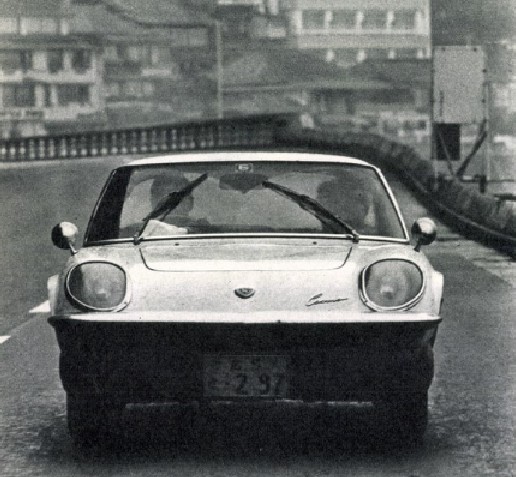
Publication: Auto Sport
Format: Road Impressions
Date: September 1967
Author: Robert Dunham, Noriko Uchida, Auto Sport Editorial Staff (uncredited)
Robert Dunham, an American driver living in Japan, test-drove the revolutionary rotary engine Mazda Cosmo Sport. Female race announcer and car enthusiast Noriko Uchida joined him as copilot. Both of them said they were “completely enthralled” by the car, so let’s take a look at their impressions.
A Car That Excites You
I’ve been in the car business for twenty years, and in racing for ten years, and as a result, I’ve found that very few cars now truly excite me.
No matter how nimble and fast a Formula car is, it doesn’t excite me; nor does an Indy car, which only gives me a sense of beastly power and intimidation.
The Group 7 two-seater racers are just machines built to do a job, except for the Chaparral, which fascinates me with its unique engineering and futuristic design. The Nissan R380 and Daihatsu P-5 don’t particularly interest me. I have a lot of respect for the Porsche 906 (Carrera 6), but there’s probably nothing among this year’s prototypes that can beat Pete Brock’s Samurai.
When I turn my attention to production sports cars, neither the Jaguar E-Type, TR4, Fairlady, nor the Toyota 2000GT excite me. These are commercial sports cars aimed at the general public, and are not truly cars for enthusiasts. The Volvo P1800 is interesting in terms of design, but unfortunately, I am not satisfied with the power. I somehow like the Mustang fastback. But if I had $6,000 (2,160,000 yen) to spend, I would buy a Porsche 912. Why? Because it offers the joy of controlling a unique, sophisticated machine.
If I had half that amount of money, though, I would choose the new Mazda Cosmo Sport without hesitation. Read the road impressions below to find out why.
Adjusting the steering wheel
Since I do a lot of racing, you might imagine that my road impressions will focus on top speed, acceleration, and high-speed cornering. However, this impression is different from my usual. I would like to deliver a report on a road trip in the Mazda Cosmo Sport, a new, exciting, and totally unique sports car that anyone can drive.
The conditions for enjoying a comfortable driving experience, not to mention minimal traffic congestion, are the following three points. First, good weather. Second, an exciting car. Of course, it has to have good performance in terms of acceleration, speed, handling, braking, and so on, but it also has to be a car that doesn’t tire the driver out. Third, a charming young lady–she’ll surely make your driving more enjoyable in addition to the comfortable weather and mood.
Our drive began on July 13th. The Cosmo that Toyo Kogyo’s Tokyo branch had prepared for us was in satisfactory condition. And thanks to the charming Noriko Uchida, a freelance race announcer who I was introduced to through the Auto Sport editorial department, two of the three conditions were met. Although we were not blessed with the first condition of good weather, we went ahead with the test anyway. As a result, we learned that as long as a sports car’s performance is good, the weather is not an issue.
The first thing that impressed me about the Cosmo was its outstanding acceleration and the smoothness of changing up and down through the gears. Apart from a Porsche, this was the easiest and smoothest shifting gearbox I have ever experienced in any car. The short shift throws made quick gearchanges easy. The clutch is very firm, but not stiff or tiresome. Driving in Tokyo requires constant stops, starts, and gearchanges, but in the Cosmo, I was able to push through the morning rush hour with ease.
I met Noriko Uchida just 20 minutes before our departure, and was delighted to learn that she also knows a thing or two about cars. She would be the perfect navigator for the test.
At the entrance to the Third Keihin Expressway, we stopped to check the tire pressure, gasoline, and oil, and during that time I also checked the instruments and other things to familiarize myself with the shift points, handling, braking, and so on. Although my legs are much longer than most people’s, I quickly found that by adjusting the seat and steering wheel, I could find a comfortable driving position.
It was a humid day, and it was so stuffy inside the Cosmo that we opened the windows and all the air vents to let outside air flow through the cockpit. I think there is still room for improvement in the air circulation. The transmission gets very hot while driving, but I wonder if this could be solved by improving the cabin ventilation.
What surprised me at the first gas stop was that the Cosmo performed perfectly well on low-octane regular gasoline. During that time, Ms. Uchida and I discussed our driving plans and how to record time and other information on the trip. I looked over the dashboard and found that its layout was excellent, and I was especially pleased with how well-positioned the tachometer, the most important gauge of all, was and how easy it was to read. Other gauges, such as the water temperature gauge, oil temperature gauge, and ammeter were also easy to read. However, when it comes to the temperature and pressure gauges, it seems better to display actual numbers rather than just warning lights. In a sports car, indicator lights should only be used to indicate the handbrake, high beams, and turn signals. An oil pressure warning light is just a little too obtuse, carrying a certain “amateur” connotation.
Eyes Flock to the New Engine
When we first filled up with gas in Ebisu, a huge crowd immediately gathered around the Cosmo, including the gas station staff and customers. I think there were two reasons for this: the attractive looks of both the new Mazda Cosmo, and Uchida-san. I can’t say which was prettier. But truly, every time our car stopped, people surrounded it, their eyes shining with curiosity, and they would usually ask us to open the hood and show them the Cosmo’s engine.
I don’t know if it was due to Toyo Kogyo’s effective advertising or the merits of the car itself. But what can be clearly said is that everyone knew that this was a rotary engine car. A completely new engine! It was different from any engine that had come before! It produced power that was incomparable to other engines in the same class! And it was made in Japan! Who wouldn’t be interested in that?
As the average Japanese person becomes more car-savvy, they start to demand better cars, more powerful cars, and more stylish, sporty cars. At the same time, there is also a growing demand for economy cars and minicars. The two are not mutually exclusive; the sudden success of the Honda N360 is a clear example of this.
There is no doubt that a revolutionary machine like the Cosmo will greatly contribute to improving Toyo Kogyo’s image as a leader in technological development. Rotary engines can be installed in any model. Pete Brock, a designer who is a good friend of mine, has said, “The most stylish Japanese car in terms of design is the Mazda Luce.” A Luce with a rotary engine is also quite conceivable.
It is a well-known fact that the Cosmo’s rotary engine was produced with technical cooperation from the West German NSU and Wankel companies. However, it is also an indisputable fact that Toyo Kogyo itself developed it, making repeated improvements. I have never driven an NSU Spyder, so I cannot compare the Cosmo with that original rotary engine car. However, I was fortunate enough to have the opportunity to test drive a Cosmo when it was still a prototype nearly two years ago, and from that experience, there have been so many improvements that it is impossible to list them all. Before releasing it for general sale, Toyo Kogyo tried to make every effort to improve it with the aim of creating a “complete engine,” and it delivered.
Acceleration in the Rain
The Cosmo’s styling is modern and attractive, and makes the car look more lightweight than it is. The actual weight of 950kg is a little too heavy, to be honest. As for the color, I think that the icy blue-white of the prototype I drove matches this car better than cream-white. In the near future, monthly production will reach 100 units. Why is such mass production necessary? Because mass production will help reduce costs. To sell to the general public, the price will need to be close to 1 million yen.
I was surprised to learn that the Fairlady is sold in smaller numbers domestically than it is exported. The Toyota 2000GT probably won’t sell very well in Japan either. Honda’s S series is popular with young people, but its size is too small to be called a sports car.
What about the Mazda? I think it has enough power to fill the gap between those sports cars, both domestically and overseas. Despite the strong potential demand, there are no high-performance sports cars in the $3,000-$3,500 range in the United States. In the $2,500 class, there are the TR4, MGB, and Fairlady, and above $4,000, there are the Porsche, Volvo, and Jaguar XK. If the Cosmo could be sold at a price between $3,000-$3,300, it would surely take the American market by storm. The Cosmo has the handling and performance to satisfy the demands of American buyers.
Now, let’s get back to the test drive of the Cosmo with Ms. Uchida. Our test drive route took us from Tokyo to Chigasaki, Odawara, Yugawara, and Daiki, then finally back to Tokyo. The total distance covered was 235km over a period of 4 hours and 48 minutes, and I think you can see how varied the driving conditions were.
It was raining when I arrived to pick up the Cosmo, so acceleration tests on the wet, crowded highways had to be done very carefully. Under these conditions, the Cosmo reached 60, 80, 100, and 140km/h in 5.6, 6.9, 13.8, and 30.5 seconds, respectively. Acceleration up to any higher speeds was impossible because of the rain. In the end, a 0-400m test was impossible because the road was wet and traffic was heavy, but I think 16 seconds would be possible if the road conditions were good.
In fact the Cosmo’s acceleration performance in each gear was excellent. The maximum engine speed was 7000rpm, and the torque range was also satisfactory. In all gears, the rotary engine’s full power was available as long as it exceeded 2500 to 3000rpm, but it was particularly outstanding in second and third gears. Also, at high speeds, the engine demonstrated the same overtaking acceleration performance whether it was in third or fourth gear, making it particularly easy to overtake slower vehicles. There was a tendency for the rear end to sink under hard acceleration.
Excellent High-Speed Cornering
The mechanism of the rotary engine is very simple. Therefore, its reliability should be better than a normal piston engine, and it should be cheaper to maintain and adjust. One significant thing is that there is almost no engine noise, and the feeling it gives while driving is comfortable, sporty, and powerful. There is no tappet noise or valve noise, so I didn’t have to shout to converse with Ms. Uchida in the passenger seat.
By the time we reached the exit off the Third Keihin Expressway, we decided that our next destination would be Chigasaki. Here are our impressions (mine and Ms. Uchida’s) from the drive between Yokohama and Chigasaki. First, the driving position is suitable for people of all sizes, so no matter how long you drive, you never feel tired. This a big difference compared to the Jaguar, TR4, and Stingray.
Second, the position of the shift lever is also very good. As mentioned above, gearchanges were extremely smooth, but there was occasionally a gear crunching noise when trying to quickly downshift from top to third gear.
Third, I did several braking tests while driving at high speed, and there was no sign of fade. The discs did make a squealing noise, but this turned out to be because the pads were sticking to the front discs (the car was still new and not yet broken in) and were not releasing completely.
Fourth, and this is a very simple thing, but the Cosmo turned out to be extremely easy to drive in the rain. A switch on the dash lets you raise and lower the radio antenna remotely.
After completing a series of tests, including acceleration and braking, we turned on the radio, enjoyed listening to some jazz, and talked about cars and racing. Ms. Uchida also races in a Honda S800. We eventually arrived at the Pacific Hotel in Chigasaki. Here, we took a break and cooled off with cold drinks before heading to our next destination, Odawara, where Uchida took the wheel.
As expected, the criteria for a sports car from Uchida were focused on design, comfort, ease of driving, and convenience.
The first thing that surprised her was that the steering wheel was adjustable. She was able to adjust the driving position to suit her. Since she drives an S800, she was able to point out the differences between the Honda and the Cosmo. She explained that the Honda is good for short, sporty drives, but when it comes to cockpit comfort and atmosphere, it can’t compare to the Cosmo. She also praised the large cockpit space, the good visibility, and the excellent handling characteristics.
From a feminine perspective, she also added that the seats in the S800 are made of non-breathable vinyl, so in the summer, they make the driver sweaty and stick to the driver’s skin, making them feel very hot. In contrast, the Cosmo’s seats are made of firm cloth and are very refreshing. So, her evaluation of the Cosmo is that it is a comfortable, convenient, and easy-to-drive car, even for a woman of smaller stature. The adjustable map lamp on the passenger side of the console box was also convenient for navigating.
After Odawara, I took the wheel again. The rain had stopped, so from here, I took the opportunity to test the high-speed handling at various speeds. To conclude, I’d like to add my own impressions of the Cosmo. Handling with the standard suspension is excellent. The conditions were wet and slippery, but the car could put full power to the ground in each gear, so I could safely power slide through any corner by balancing the throttle and steering. It does tend towards oversteer a little, but that’s not a bad thing.
Driving stability is very good. It holds the road well in corners and is easy to control, there is no pitching or excessive rolling. There is a slight but controllable tendency for wheelspin on wet surfaces.
When the rain started to fall heavily again, I slowed down to normal speeds. At this point, I had one request. I would like Toyo Kogyo to study the swept area of the wipers more, because there were blind spots toward the fenders that obscured my view of the rearview mirrors.
We took a break in Atami for lunch, took a few photos, and then headed back home. After trying some more high-speed cornering in Yugawara, we took the expressway back to Tokyo.
I look forward to driving the Cosmo again. I’d like to do a perfect road test in the bright sunshine next time.