Mazda Cosmo Sport (1966)
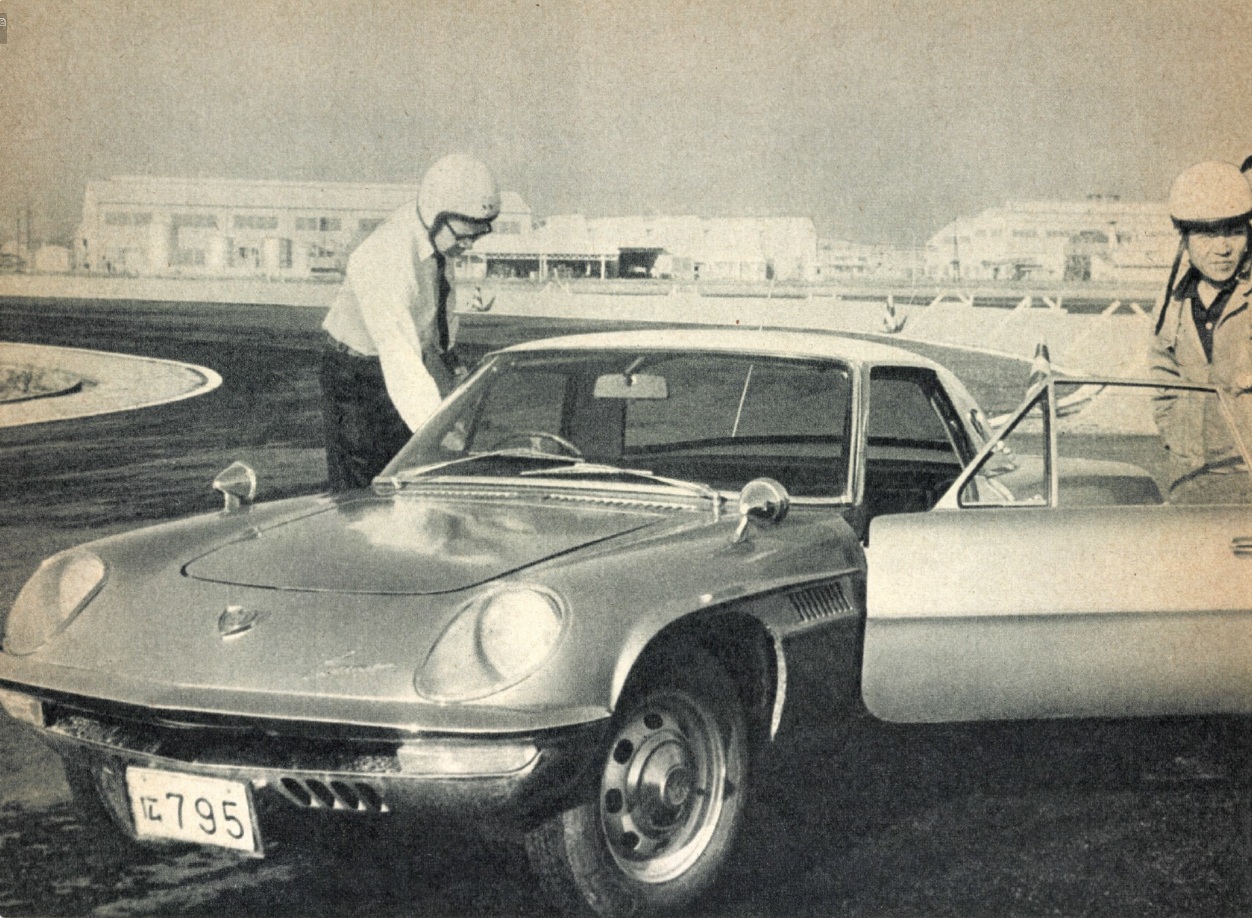
Publication: Auto Sport
Format: Test Drive Report
Date: Spring 1966
Author: Robert Dunham
Robert Dunham’s Test Run: Mazda Cosmo
“I Drove the Much-Anticipated Rotary-Engined Mazda Cosmo”
—The first published road test of the Mazda Cosmo.
Recently, through an introduction by the Asahi Evening News, I was invited by Tsuneji Matsuda, president of Toyo Kogyo, to visit the company’s factory and test course in Hiroshima. There, to my great surprise, I was given the opportunity to drive Japan’s first rotary-engined car: the Mazda Cosmo. It was an experience that proved both immensely enjoyable and genuinely memorable.
On the morning I visited Toyo Kogyo’s Ujina plant, the air was cold and dry, but fortunately the sky was perfectly clear and the weather could not have been better.
Mr. Sasaki of the Research Planning Department, together with several of Toyo Kogyo’s engineers, was waiting at the test course. First, one of the company’s test drivers completed several laps so that I could become familiar with both the characteristics of the car and the course itself. After that, I took the wheel and completed about seven laps of my own. The Mazda Cosmo I drove was the 1000cc two-rotor sports model.
The Rewards of Dedicated Development
Toyo Kogyo entered into an agreement with West Germany’s NSU Motorenwerke and NSU Wankel GmbH in July 1961 to jointly develop the rotary-piston engine. At the time, the rotary engine remained little more than an experimental concept, and the agreement attracted relatively little attention from Japan’s other automobile manufacturers.
Toyo Kogyo, however, pursued the project with remarkable dedication and efficiency, steadily developing and improving a variety of rotary-engine prototypes. The results first became public at the 1963 Tokyo Motor Show, where the company displayed two rotary engines: a 400cc unit producing 35ps and an 800cc unit producing 75ps. It was, of course, the first time engines of this type had ever been exhibited there. Even so, most other manufacturers still dismissed the project as little more than “an expensive experiment.”
At the 1964 Tokyo Motor Show, however, Toyo Kogyo took a big step forward by unveiling two rotary-engine cars under the Cosmo name: one with a single 400cc rotor and another with four 400cc rotors–the latter, naturally, totaling 1600cc.
Thereafter, Toyo Kogyo developed a single-rotor engine similar to that produced by NSU, while at the same time succeeding in designing multi-rotor engines. The latest version of the Cosmo sports car was then unveiled at the 1965 Tokyo Motor Show.
Responsive and Remarkably Quiet Engine
Let me begin by describing my impressions of the Mazda Cosmo (two-rotor, 1000cc) after driving it on the Ujina factory test course.
Two characteristics become immediately apparent, even to someone with little experience of high-speed driving.
-
Press the accelerator fully and the engine speed climbs to its limit almost instantaneously, yet even under these conditions the engine remains remarkably quiet. The same is true under engine braking.
-
Compared with a conventional piston-engined car, acceleration response is exceptionally sharp, regardless of the gear selected.
Driving the Cosmo, I found it hard to believe that this was a 1000cc automobile. Its official output is said to be 110ps, and it certainly delivers every bit of that. Needless to say, its performance is in an entirely different class from that of the conventional 45-50ps, pushrod-type 1000cc cars we are familiar with.
The factory’s test-course straight measures just under 1000m, yet even without using the engine to its limit or over-revving it, the Cosmo readily reached 150km/h. Throughout the four forward gears, I was rarely aware of any lack of power.
I did notice, however, that the engine lost a small amount of power in second gear while driving on the high-speed banking. This appeared to be nothing more than a momentary interruption in the fuel supply to the engine. Raising the carburetor float level slightly should resolve the problem easily.
One Further Improvement: Reducing Weight
The smoothness of the transmission is remarkable. All four forward gears can be selected with exceptional ease, and even engaging reverse presents no difficulty.
Road holding and handling are every bit as capable, refined, and secure as those of any expensive European sports car. The steering remained commendably neutral, showing no trace of excessive oversteer or understeer.
Even at high speeds, the car could be guided through bends with complete confidence. Disc brakes are fitted at the front, and under heavy braking they proved especially effective. The feel was reassuringly firm. Some small sports cars have a tendency for the steering to become light in corners, but I detected no such weakness in the Cosmo.
If I were to ask for one further improvement, it would be a reduction in curb weight from the present 950kg to something nearer 850kg. With that alone, I believe the car’s already impressive performance could be improved further still. Moreover, such a reduction ought to be achievable without fundamentally altering the car’s overall design.
Mass Production Is Only a Matter of Time
This two-door, two-seat hardtop coupe is an attractive design, and should appeal strongly to those with an interest in sporting automobiles. The interior layout is equally well conceived. It is both tasteful and practical, and even for taller foreign drivers such as myself, comfort is by no means lacking.
The tachometer and other instruments that require constant attention from the driver are all arranged on the dashboard for maximum legibility. The steering wheel, pedals, and gear lever are likewise positioned so that they can be operated efficiently by the average driver.
Toyo Kogyo intends soon to place the Mazda Cosmo (two-rotor, 1000cc) in the hands of its dealers and component suppliers for evaluation under normal driving conditions, gathering further data from everyday use. Judging from this, it seems clear that the Mazda Cosmo will enter mass production in the near future.
It is said that Toyo Kogyo plans to study the results of these trials before introducing the car to the market, with 1967 as its target. In the meantime, there can be little doubt that countless enthusiasts are eagerly awaiting the Mazda Cosmo’s sales debut.
Perhaps it will even make an appearance at the Japanese Grand Prix this May.