Mazda Cosmo Sport (1966)
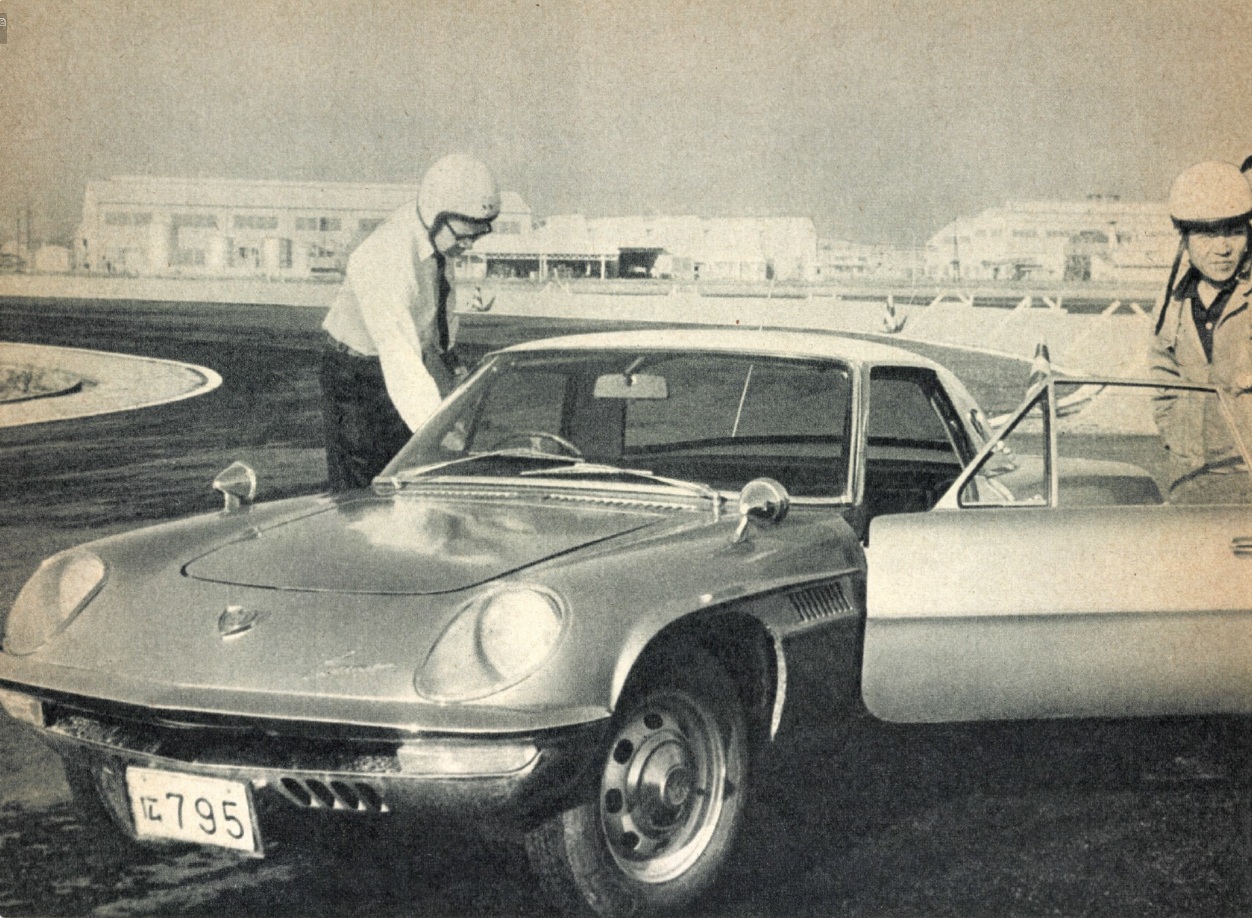
Publication: Auto Sport
Format: Road Impression (original article includes Toyota 2000GT impression, posted separately)
Date: Spring 1966
Author: Robert Dunham
Robert Dunham’s Test Run: Mazda Cosmo Sport
“I drove the much-anticipated rotary engine car, the Mazda Cosmo.” I’m still surprised to be able to say these words. This is a test-drive report of the Mazda Cosmo, published for the first time.
Recently, I was invited by Toyo Kogyo’s president, Tsuneji Matsuda, to visit the company’s factory and test track in Hiroshima, as reported in the Asahi Evening News. There, believe it or not, I had the opportunity to test drive the Mazda Cosmo, Japan’s first rotary engine car. It was a truly enjoyable and valuable experience for me.
The morning I visited Toyo Kogyo’s Ujina factory, the air was dry and chilly, but fortunately the skies were clear and the weather perfect.
Mr. Sasaki from the Research and Planning Division and several other engineers from Toyo Kogyo appeared at the test course. First, the company’s test driver drove around the course several times to familiarize me with the characteristics of the car and the course. After this, I took the wheel myself and drove the Cosmo, a 1000cc 2-rotor sports car, around the course for about seven laps.
Passionate Research Pays Off
Toyo Kogyo signed an agreement with NSU and Wankel of West Germany to jointly develop rotary piston engines in July 1961. At that time, the rotary piston engine was still in the experimental stage, so the agreement did not generate much interest among other domestic car manufacturers.
Toyo Kogyo worked diligently and efficiently to develop and perfect various prototypes of the rotary engine. They exhibited two rotary engines at the 1963 Tokyo Auto Show, a 35ps 400cc and a 75ps 800cc. Of course, this was the first time that engines of this type had been exhibited. However, other manufacturers still considered it merely an expensive experiment.
But at the Tokyo Auto Show the following year, in 1964, Toyo Kogyo took a big step forward by unveiling two rotary engine cars called the Cosmo: one intended to use a single-rotor 400cc engine and one to use an engine with four 400cc rotors, the latter of which would naturally be 1600cc.
Toyo Kogyo subsequently came up with a functioning single rotor engine similar to that produced by NSU, and also succeeded in designing a two-rotor engine, and thus unveiled the current version of the Cosmo sports car at the 1965 Tokyo Auto Show.
Sharp and Quiet Engine
Let me share my impressions after test driving a Mazda Cosmo (2 rotor, 1000cc) on the test course at the Ujina Factory.
First of all, even if you have no experience of high-speed or highway driving, there are two things that you will notice right away.
First, when you step on the accelerator, the rpm climbs to its limit in an instant, but even in that state the engine is extremely quiet, even during engine braking.
Second, compared to ordinary piston engine vehicles, acceleration in reaction to the throttle is extremely sensitive regardless of which gear you are in.
Driving the Cosmo, it’s hard to believe that this is a 1000cc car. Its official output is 110ps, and it certainly has at least that much. It goes without saying that it performs much better than the many 45-50 horsepower pushrod 1000cc cars out there.
The factory test track has a straight section just under 1000m long, but I was able to easily reach 150km/h without having to fully utilize the engine or over-rev it. With four forward gears, I rarely felt a lack of horsepower. However, I did notice a slight drop in engine power in second gear during high-speed turns, but this was likely simply due to fuel starvation in the engine. This could easily be remedied by raising the float level on the carburetor somewhat.
Further Improvements Needed in Vehicle Weight
The gearbox was incredibly smooth, and gear changes through the four forward speeds were extremely easy, as was finding reverse gear.
Road holding and handling are as efficient, smooth and solid as any expensive European sports car, with neutral steering characteristics that are free of excessive oversteer or understeer.
Even at high speeds, I was able to carve through turns easily. The brakes were discs on the front wheels, and they provided good braking power, especially when decelerating suddenly. There was a definite feeling of firmness and solidity to the car. In some small sports cars, there tends to be an unsettling feeling of lightness in the steering when going around corners, which is a drawback, but I didn’t feel that with the Cosmo.
If I were to be greedy, I think we could further improve the current performance by reducing the unladen weight from 950kg to about 850kg, which should be possible without changing the overall design of the car.
Mass Production Is Only a Matter of Time
The design of this two-door, two-seat hardtop coupe is stylish. Anyone interested in a sports car will surely be pleased. The interior layout is also tasteful. It is efficient and not at all uncomfortable for tall foreigners like me.
The dashboard is excellent, with the tachometer and other gauges that the driver must constantly check positioned for maximum visibility, not to mention the positioning of the steering wheel, pedals and gear shift, which are all within easy reach of the average driver.
Toyo Kogyo plans to hand over the Mazda Cosmo (2 rotor, 1000cc) to dealers and parts manufacturers in the near future to collect and monitor data in normal driving conditions. From this, it is clear that the Mazda Cosmo will be mass-produced in the near future. Toyo Kogyo is said to be waiting for the results of these experiments before releasing it on the market in 1967, but in any case, many fans are already waiting for the Mazda Cosmo’s sales debut. Perhaps it will appear at the Japanese Grand Prix in May.