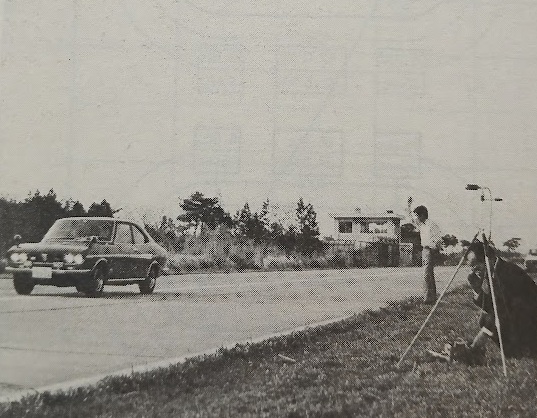
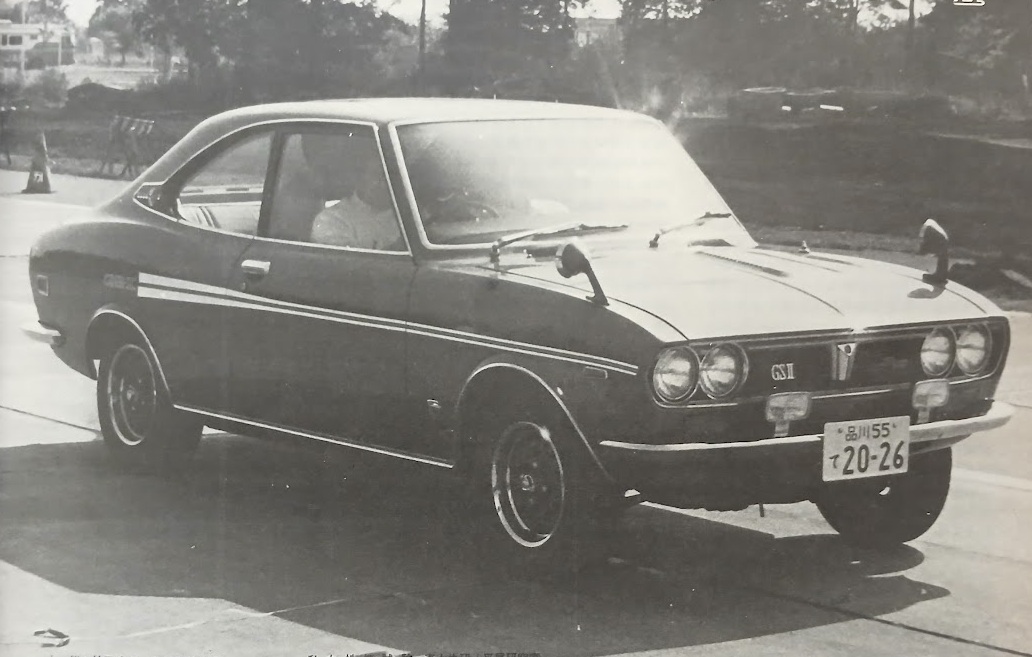
Mazda Capella Rotary Coupe GS II (1972)
Publication: Motor Fan
Format: Road Test
Date: August 1972
Authors (Roundtable): Moriyuki Watanabe, Osamu Hirao, Masaru Mitsuyama, Eizo Ikeda, Kenji Higuchi, Atsushi Watari, Hiroshi Okazaki, Jun Narue, Kyoichi Yamaguchi, Muneo Kishimoto, Taiji Oda, Kunitaka Furutani, Hiroshi Hoshijima, Fumihiko Arakawa, Taizo Tateishi, Takeshi Toba, Sei Shindo, Kenzaburo Ishikawa, Toshihide Hirata, Minoru Onda, Motor Fan Editorial Staff (uncredited)
The Rotary Comes of Age
Magazine: First, could you give us an overview of the Capella GS II?
Watanabe: The original Capella was introduced in May of 1970. As it happened, that year marked our company’s 50th anniversary, and we decided to use the occasion to completely rethink our development system. We wanted to create something that could eventually grow into a truly great car by world standards.
With that goal in mind, we assembled a special project team. In that sense, the Capella was a car developed through the combined efforts of the entire company.
We devoted a great deal of thought to creating a well-balanced car. As a result, we may have ended up with a car that leaned somewhat toward the soft-riding side. I believe this had its own merits, but subsequent market research showed that roughly half of rotary-engine buyers wanted something with a harder, more sporting character.
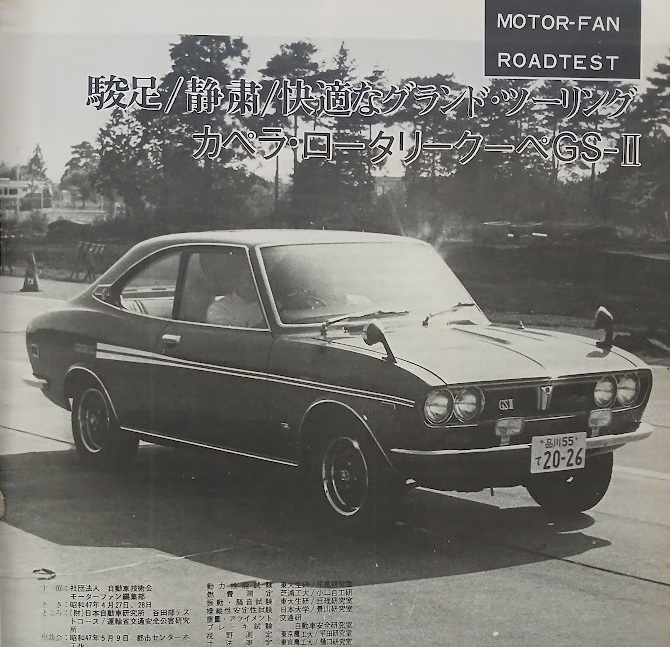
We felt the Capella range ought to include a model that would answer that demand. That led to the GS II, a car intended to serve both as the flagship of the series and also the more performance-oriented model.
The primary objective was to increase engine output. At the same time, our surveys showed that between 60-70% of respondents felt that a hard-driving car ought to have a 5-speed transmission. Personally, I had long wanted to see a rotary engine paired with a 5-speed gearbox brought to market, so we decided to introduce one.
Because the car was intended for more enthusiastic driving, we also focused heavily on improving handling. Ride height was lowered by 40mm, spring rates were increased by approximately 20% at the front and 30% at the rear, and damping force was raised by roughly 30% as well.
However, those changes produced excessive understeer, so we reduced the diameter of the front stabilizer bar from 23mm to 21mm. Naturally, we also fitted wider tires–165SR13 radials–and widened the wheels from 4J to 4.5J.
Since this was also intended to be the top-of-the-line model, we worked to give it as refined and luxurious an atmosphere as possible. The color scheme centers on somewhat more vivid shades, including a signature purple, and the interior is color-coordinated as well. We have also made the fashionable body stripes currently in vogue available as an option.
Overall, I believe we’ve succeeded in creating a car that remains enjoyable even when driven hard.
Magazine: The rotary engine itself seems to have matured considerably by now. How do you see that?
Watanabe: Fundamentally, the engine has not changed, but a great deal of know-how has accumulated over time, and we’ve made substantial improvements as a result.
Take oil consumption, for example, which is one of the most frequently-discussed subjects with rotary engines. We’ve gained a much clearer understanding of oil-seal design and of the various limits involved in lubrication control, and oil consumption has improved considerably compared with the early days.
Low-speed performance has also benefited from improvements in sealing technology.
Another example is the internal gear. No driving force is actually transmitted through it, but because there are pitch errors in the gear teeth, resonance can occur at very high engine speeds. Under normal driving conditions this presents no problem whatsoever, but when the engine is run at 8000-9000rpm, resonance can sometimes develop.
Accordingly, we’ve carried out a number of detailed refinements involving the gear itself, its mounting method, and related areas.
Hirao: How much oil does it consume relative to fuel consumption?
Watanabe: I would say somewhere around one part oil to every 200-250 parts gasoline.
Hirao: In that case, it isn’t really much different from a reciprocating engine. There was a note in the owner’s manual specifically telling drivers to keep a close eye on the oil level during long-distance trips, so I had assumed oil consumption must be quite high.
Watanabe: The difference is that with a reciprocating engine, even if oil pressure drops, you can usually keep going for a while. And even if it does seize, it’s generally only the bearings that suffer damage. In a rotary engine, however, the entire side housings can be damaged. In that sense, neglecting the oil has much more serious consequences than it does with a reciprocating engine.
Magazine: It seems the exhaust system has also been revised.
Watanabe: Our primary concern with the exhaust system was reducing restriction. The same is true of reciprocating engines, but in the case of a rotary engine, performance is affected enormously by exhaust-system design.
On the GS II, we achieved an increase of roughly 5ps simply by enlarging the diameter of the exhaust outlet slightly.
If the diameter is increased too much, however, resonant shell noise becomes a problem. We’ve also made some minor changes to ignition advance, but it appears that reducing exhaust restriction has had the greater effect.
Magazine: How high can the rotary engine safely be revved?
Mitsuyama: Under no-load conditions, contact-breaker surge begins to occur at around 9000rpm.
Magazine: So the point where the engine stops pulling is really just a limitation of the ignition system. In that case, if you wanted to rev it beyond that…
Watanabe: With a transistorized ignition system, the engine would certainly rev higher. However, the internal gear begins to resonate, and that’s where mechanical failures start to occur.
I think that if you were to run the engine beyond 10000rpm, service life would be reduced quite dramatically.
That said, in practical terms, I don’t think anyone is ever going to operate the engine at 9000rpm in normal use.
Is a 5-Speed Necessary for a Rotary?
Magazine: One question is whether a rotary engine really needs a 5-speed transmission.
Watanabe: I had a feeling someone was going to bring that up. (laughs)
Hirao: Why not go all the way and make it a 6-speed? If more gears are always better… (laughs)
Magazine: You mentioned that the 5-speed gearbox was introduced in response to market demand…
Watanabe: That’s right. And I think that, as one of the requirements for a hard-driving car, a 5-speed transmission has become something of a matter of public opinion, if you will.
Ikeda: Up to now, I’ve always regarded the Capella’s 4-speed as one of the best transmissions in this class. Its gearing had a distinctly European character, with a very wide operating range. It managed to combine good acceleration with excellent high-speed flexibility.
Given that, I can’t help wondering whether introducing a 5-speed is simply yielding to the fashions of the day…
Watanabe: That’s not exactly the case.
Rather, with cars, there are often situations where adding something beyond pure function increases the product’s value.
Higuchi: So it’s not really a question of whether a 5-speed is better or worse. It’s that a 5-speed is necessary.
Watanabe: Necessary as a product, yes. Not necessarily as an engineering solution.
Watari: If everyone else has a 5-speed and you don’t, it’s harder to sell the car. So the answer becomes: “Yes, we offer a 5-speed too.”
Okazaki: The 5-speed itself is fine, but is the overall gearing–including the final drive ratio–really ideal as it is?
Watanabe: Given the engine, the body, and the use of 165SR-13 tires, I believe a 3.90 final drive would actually be the most appropriate ratio.
The reason we deliberately chose 4.111 instead is that, having gone to the trouble of fitting a 5-speed transmission, we felt there ought to be at least some tangible benefit to having that fifth gear.
Narue: I’d be interested to hear just how much benefit there really is. (laughs)
Watanabe: With a 3.90 final drive, if you’re driving around town in top gear and your speed drops to around 30km/h, acceleration from that point is a little lacking.
A 4.111 ratio improves that situation. But if the transmission has only four speeds, it becomes difficult to have it both ways. With a 5-speed, you can.
Okazaki: Do you really think the sort of person who drives this kind of hard-edged car is going to be that “lazy”?
Watanabe: I think people use a car according to the situation. They want something that can be driven casually when desired, but can also be used to its full potential. The idea was to make it versatile enough to handle a wide range of situations.
Okazaki: If only the first- and second-gear ratios were a little taller…
Higuchi: You don’t really need first gear anyway.
Watanabe: That would be a problem. We’d like people to use first gear. The energy absorbed by the clutch when starting in first is completely different from starting in second.
Ikeda: Some people enjoy getting a brief chirp of wheelspin when they pull away quickly. But I think there are more people nowadays who feel that sort of noise isn’t necessarily a good thing…
Watanabe: It’s true that the engine produces more power than the tires can fully put to use, so one could argue that first gear is too low. I work with both rotary and reciprocating engines, so I’m very aware of this. If you don’t think carefully about gear ratios, a rotary can give you a lot of trouble.
In fact, the first car we fitted with a rotary engine used the same first-gear ratio as the reciprocating-engined version. The problem we encountered–and this is one of the rotary’s weak points–was that it wasn’t very happy at extremely low road speeds with only a small throttle opening. It was much too easy to stall the engine.
We wanted to avoid that, and the rotary also places more severe demands on the clutch than a reciprocating engine. Those considerations played a role in our choice.
That said, we’ve recently been working on ways to make a rotary compatible with gear ratios similar to those used in reciprocating-engined cars. If that proves successful, we’d like to move in that direction in the future.
Yamaguchi: The brochure shows a GS II towing a trailer. Looking at that, I thought, “Now that’s the real value of a 4.111 final drive.” (laughs)
Hirao: The engine is so quiet that without a tachometer you can hardly tell how fast it’s turning. Even if first gear is a little on the low side, it doesn’t seem to matter much–as long as nothing breaks.
Kishimoto: In surveys of actual buyers, we’ve found that 69% chose the GS II specifically because it had a 5-speed transmission.
Magazine: The final-drive ratio can be changed as an option, can’t it?
Watanabe: Yes, it can be changed as desired.
Full Decoration?
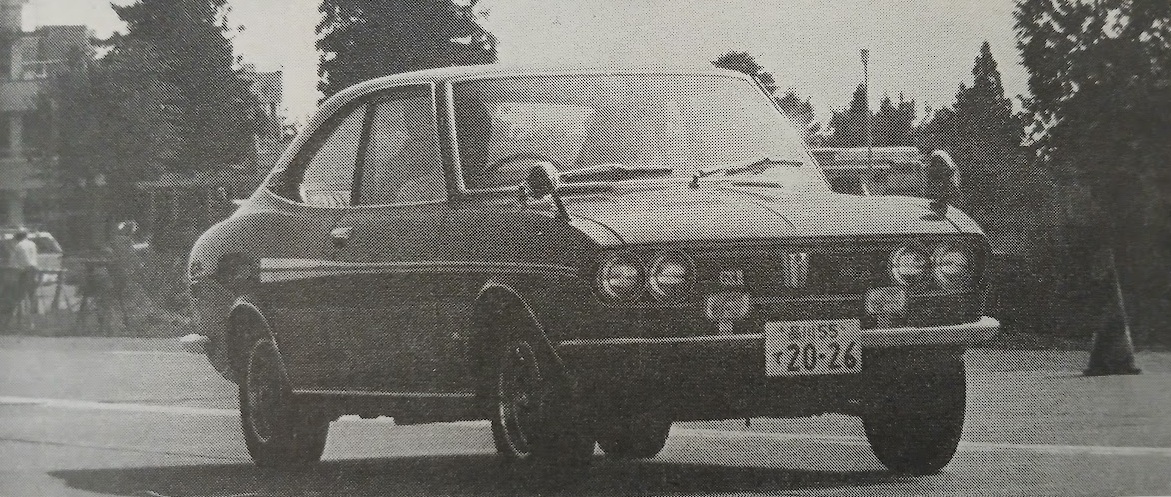
Magazine: One distinctive aspect of the styling is that it’s a hardtop with a center pillar…
Watanabe: Put another way, you might it call a pillared hardtop. When we were developing it, the American MVSS regulations were beginning to focus on rollover protection. We felt that without a center pillar we could run into difficulties exporting to the United States. At the time, we simply weren’t confident that a true hardtop could meet the crash requirements then being discussed.
Later, thinking in America began to change, and technically it’s no longer necessary to have a pillar, but…
Oda: From a design standpoint, we would have preferred a full hardtop with better visibility and a cleaner appearance. Since we had to retain the pillar, we made it as thin as possible and finished it in matte black so it would appear less conspicuous.
Watanabe: With pillarless hardtops, there are also issues like wind noise at high speed, and in those days very few were completely watertight during a car wash.
Since this was being launched as part of the company’s 50th anniversary program, we felt strongly that we didn’t want to force the issue and end up putting out a car that wasn’t quite right.
Magazine: If you think of it as a two-door, though, it works well enough…
Watanabe: Even so, we do hear people saying it would have been better as a true hardtop.
Watari: With this configuration, it’s true that you don’t get any whistle from the wind. But these days everybody expects all the side glass to disappear completely, and when you lower all the windows, that black frame does look a little awkward.
Magazine: Another distinctive feature, perhaps, is the fondness for hexagons. (laughs)
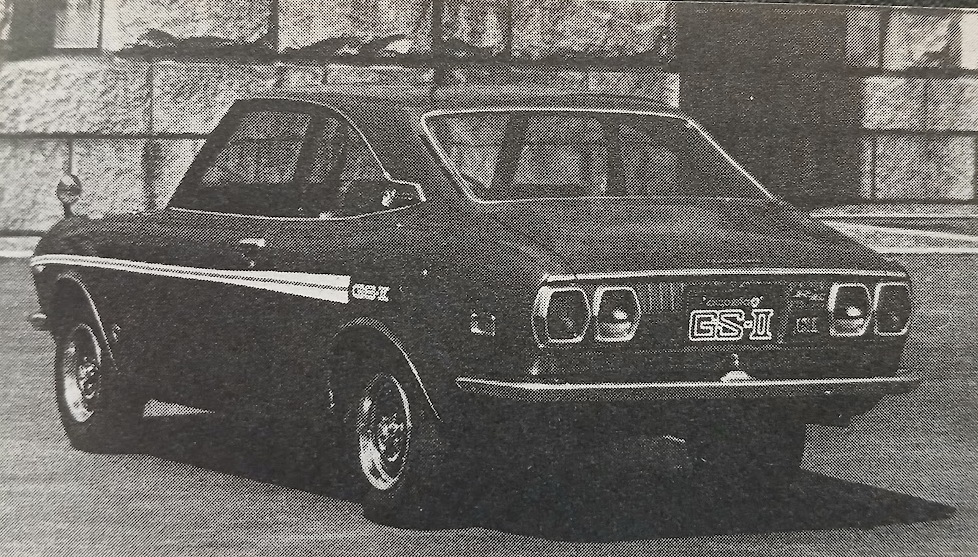
Oda: Round taillamps had become one of the identifying features of Mazda’s rotary models, and we wanted to carry that theme forward. But if we kept repeating the same round design forever, people would eventually get tired of it.
We were also hearing complaints that the taillamps were too small. We wanted to increase their size, but with the existing body shape there was no room to make them any larger. So we experimented with a variety of sketches in search of a slightly different image, and eventually concluded that a hexagonal shape was probably the most appropriate solution.
Hoshijima: What I dislike about the GS II’s styling is all the badges. There are “RE” and “GS II” emblems stuck all over the car.
Oda: That’s actually something we’ve reflected on ourselves. In the end, though, the GS II was conceived very much around creating a strongly sporting image.
Hirao: It feels like a case of “full decoration.” If someone wants all those extras, just make them available and let them add them if they want.
Oda: I agree. Ideally, these are the kinds of things that should be available only for those customers who really want them.
Watanabe: It’s a difficult issue. In that respect, the Luce was a very clean, uncluttered car. But at the time it was criticized quite strongly for not having enough.
The designers put up considerable resistance to adding all these things to the GS II. Perhaps we’ve swung the pendulum a little too far in the other direction this time.
Magazine: Speaking of colors, you’ve chosen a rather unusual shade of purple.
Watanabe: This purple is the symbol of the GS II–its image color.
It’s said that this sort of color may become fashionable in the future, and part of our thinking was to get ahead of the trend a little by adopting it as the car’s signature color.
Hoshijima: I think it’s a very attractive color. It’s just that if I were buying one myself, I might not quite have the courage. (laughs) Perhaps our own sensibilities are in a transitional period.
Kishimoto: Even so, about 63% of GS II buyers are choosing this color.
Porsche-Type Synchromesh Not as Durable as Expected
Magazine: Next, let’s have the performance results.
Furutani: The standing-start acceleration times were 0-50m in 4.4 seconds, 0-100m in 6.8 seconds, 0-200m in 10.4 seconds, and 0-400m in 16.3 seconds. Top speed averaged 186.01km/h over the 5.5km test lap, with 192.87km/h recorded through the 400m timing section.
We were just discussing the low first gear ratio, but first stretches to nearly 50km/h, and second reaches a little over 80km/h. For a car of this type, the ratios are actually fairly conventional.
One thing I noticed, however, was that after fully extending first gear and attempting the shift into second, the engine speed didn’t drop very quickly. As a result, second sometimes felt a little reluctant to engage.
Hirao: The synchromesh complains.
Watanabe: Since you’re disengaging the clutch, that shouldn’t really have anything to do with the synchro during the shift itself.
Hoshijima: If you want to make the engine speed fall more quickly, and improve the response of the secondary throttle…
Watanabe: Since the secondary is controlled by boost pressure, one approach would be to switch to a mechanical system and force it closed more aggressively. But then the carburetor’s characteristics become disconnected from boost pressure, and the overall matching suffers.
With the boost-controlled setup, both engine speed and torque are taken into account.
Furutani: Compared with a reciprocating engine, how much lower are the friction losses?
Mitsuyama: In terms of internal engine drag, if we compare it with a typical 2-liter reciprocating engine, there’s almost no difference at low engine speeds. Below about 2000rpm they’re essentially the same.
At higher engine speeds the rotary does have somewhat lower losses, though even then it’s only on the order of about 5%.
Hirao: If the synchro is complaining, maybe the answer is to use a Porsche-type synchromesh.
Watanabe: We actually thought the same thing ourselves–that a Porsche-type synchro might be better suited to a rotary engine–and we experimented with it quite extensively.
What we discovered, however, was that the Porsche type isn’t nearly as good as its reputation suggests. We bought a variety of cars and tested them. Under our own test procedures, not a single Porsche-type synchro would last 10,000km. If that is representative, the system we’re using now is actually the better choice.
That said, it’s a very difficult problem.
The Porsche synchro is fundamentally designed with shift feel as the priority. If you design a synchro to withstand high-rpm downshifts, the shift quality inevitably becomes a bit notchy and less pleasant. We’re currently considering a more durable design that will tolerate high-rpm downshifting without damaging the synchro. The feel may suffer slightly, though.
The weakness of the Porsche synchro is that when you downshift at high engine speeds, the molybdenum-coated friction surface invariably suffers damage. We’ve tested this on a number of different cars, and we’ve even had Porsche design units specifically for use with the rotary engine, but the result was the same.
Ikeda: Under normal customer use, what would your test cycle correspond to?
Watanabe: Perhaps around 30,000km.
That said, it isn’t a test involving especially abusive driving.
In fact, I complained to them about it recently, and they told me that they’re planning extensive design changes and will send us revised components. I think they’ve become aware of the issue themselves.
Ikeda: Since we’re talking about the transmission, there’s another point. The shift lever doesn’t have a very distinct self-centering action.
Most 5-speed gearboxes use a light spring to bias the lever toward the third- and fourth-gear plane, partly to prevent shift errors…
Hirao: That’s true. When you pull it back from fifth, it does make you a little nervous.
You start wondering whether it might slip into second. Or when dropping from fifth to third, whether you might accidentally end up in first.
Watanabe: Under those conditions, I don’t think it would actually go into gear.
The road speed is too high, so the shift would become extremely heavy and simply wouldn’t engage.
People mention this point fairly often, but I think it’s largely a matter of familiarity.
Personally, I find a spring-biased lever harder to use. When starting from rest, for example, I’ve occasionally made the mistake of following the spring pressure and putting it into third gear instead of first. Experiences like that have made me wonder whether perhaps it’s better not to have a centering spring at all.
Fuel Economy Curve Remains Flat at High Speed
Magazine: Mr. Oguchi isn’t here today because of other commitments, but could we at least hear the company’s fuel economy figures for reference?
Arakawa: At constant speeds, fuel consumption is 12.0km/l at 40km/h, 12.5km/l at 50km/h, 12.4km/l at 60km/h, 12.0km/l at 70km/h, 11.0km/l at 80km/h, 10.5km/l at 90km/h, 9.5km/l at 100km/h, 8.5km/l at 110km/h, and about 8.0km/l at 120km/h.
For the model driving-cycle tests, driving with a 40km/h target speed produced 6.37km/l at an average speed of 22.2km/h, while driving with a 60km/h target speed returned 5.42km/l at an average speed of 25.25km/h. These tests were conducted using a pattern modeled after the Oguchi Laboratory procedure.
Magazine: The constant-speed figures don’t seem to fall off very much at higher speeds.
Watanabe: Compared with a reciprocating engine, the curve is much flatter.
Magazine: Given the power output, is that about what you’d expect?
Hirao: In terms of fuel consumption relative to power, yes.
As Quiet as a Full-Size Car
Magazine: Let’s hear the results of the vibration and noise measurements.
Tateishi: The suspension’s natural sprung-mass frequency is 1.5Hz at both front and rear. Unsprung-mass frequencies are 13.5Hz at the front and 15.5Hz at the rear, so the rear suspension is slightly stiffer.
Interior noise measured 56 phons at 40km/h, 60 phons at 60km/h, 65 phons at 80km/h, 69 phons at 100km/h, and 72 phons at 120km/h.
Exterior noise was 70 phons at a steady 50km/h in second gear, and 79 phons during acceleration from 50km/h.
Watari: There’s a well-established belief that the rotary engine is quiet, and this is absolutely true. On the A-scale, it comes in 3-4dB under our evaluation zone, making it exceptionally quiet. Of course, no matter how smooth the engine is as a source of vibration, you’ll still get noise if there are weak points in the body or suspension, but Mazda seems to have done a good job of preventing that. Overall, it’s about as quiet as a full-size American car.
There are some Japanese cars over two liters that are quiet as well, of course. If I were to ask for more, though, I’d say road noise is a bit pronounced. Perhaps the unsprung weight is on the heavy side.
Hirao: At around 120km/h the front end was shaking a bit. Would that be the tires?
Watanabe: It’s wheel balance.
Arakawa: If the balance is off, you get resonance in the unsprung components.
Watanabe: In a way, that’s one of the rotary engine’s headaches. With a reciprocating engine, even much worse unsprung-mass resonance often goes completely unnoticed.
Watari: When a car gets this quiet, you start hearing everything.
Watanabe: Exactly. That’s why we’re very strict about tire specifications, and about wheel balancing as well. Even so, eliminating it completely is quite difficult.
Watari: The thing is, on the Tomei Expressway, around 120km/h is exactly the speed people use most often.
Ikeda: Japanese cars seem particularly prone to that combination–out-of-balance tires and dampers that can’t adequately control them.
Watanabe: It’s less a damper problem than a matter of the body’s bending vibration frequency. If you raise the body’s natural frequency, a resonance that appears at 120km/h might not show up until 140 or 150km/h instead. As a rule, monocoque bodies of this size in Japanese cars tend to have a bending-frequency resonance somewhere between about 120-140km/h.
Hirao: If, for example, the engine mounts were made a little softer, couldn’t that resonance be isolated?
Watanabe: One approach is to use the engine itself as a dynamic damper. The problem is that if you do that, other vibrations never completely go away. You end up spreading them over a wider range instead.
Watari: It would help if the car itself were larger.
Still, tires seem to be the weakest point of Japanese cars in general. Everyone says foreign tires are better…
Watanabe: I feel a bit sorry for the tire manufacturers when they get all the blame. The wheels are actually the bigger problem. Wheel runout can exceed 1mm.
Hoshijima: Compared with European cars, I did find these tires a little disappointing.
Ikeda: Maybe it needs tires on the level of a Porsche.
Yamaguchi: For speeds where you really shouldn’t be driving anyway. (laughs) An SR tire is only guaranteed up to 180km/h, isn’t it?
Watanabe: That’s the official rating, yes, but I think their actual capability is probably around 210km/h.
Moderate Understeer
Magazine: Let’s hear the results of the handling and stability tests.
Toba: The practical minimum turning radius is 4.85m on the outside and 2.53m on the inside. That’s exceptionally small for this class, about on par with a 1400cc car. I think the main reason is the fairly large steering angles–42° on the inside wheel and 32° on the outside.
The overall steering ratio is 17.3. That’s a relatively low numerical value for this class.
Steering effort at a standstill increases in proportion to steering angle up to about 200° in either direction, reaching roughly 14-15kg. Beyond that point it remains nearly constant all the way to full lock. Compared with other cars, steering effort is somewhat higher up to around 300°, but lighter thereafter.
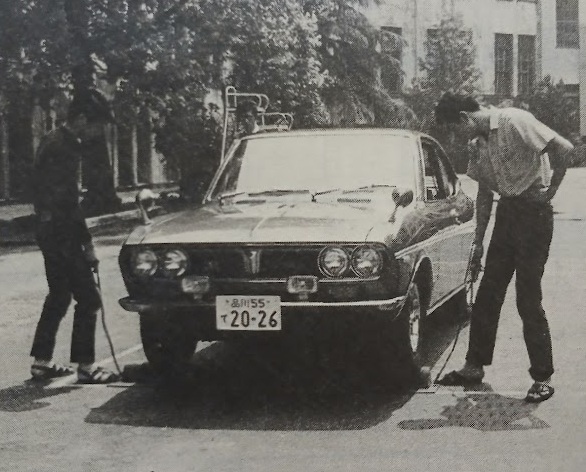
The roll angle is 4.3°, or 4.4° by photographic measurement. Considering the lower center of gravity and stiffer spring rates, that seems a little on the high side. However, tire pressures were only 1.5kg/cm², so that may have had some influence.
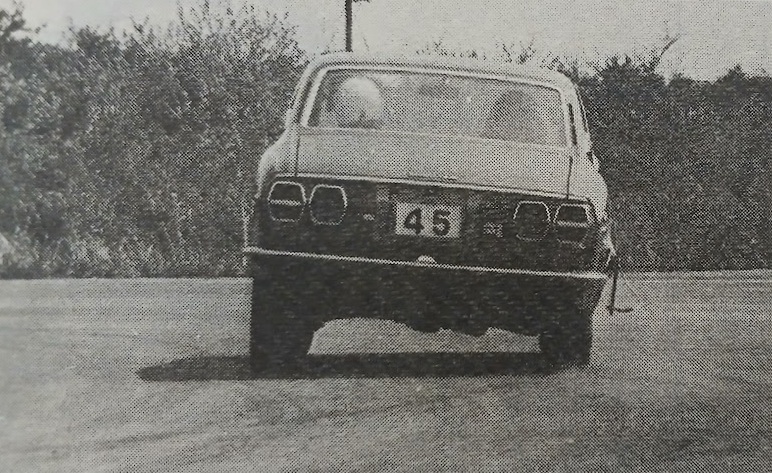
Understeer/oversteer characteristics are about average for this class up to roughly 0.4g of lateral acceleration, with a moderate degree of understeer. Beyond that point, however, understeer increases sharply. The skid pad at Yatabe has a relatively low coefficient of friction, and among the cars we’ve tested so far, many have shown a similarly abrupt rise beginning around 0.45g.
Steering holding effort measures 2.5kg at 0.2g of lateral acceleration and nearly 4kg at 0.5g, increasing gradually between those points.
Steering effort was also measured during slalom testing: it is 2kg at 0.1g lateral acceleration and about 3.6kg at 0.3g. The figure remains about the same even near 0.5g.
As for free-release directional stability with hands off the wheel, the car settles well at lower speeds. At around 100km/h, however, convergence becomes somewhat weaker, requiring roughly three seconds for oscillations to settle down.
Watanabe: Regarding the roll angle, our own figures show about 3.5° with four occupants aboard.
The result seems rather high, so that concerns me a little.
Toba: What measurement method did you use?
Arakawa: We measured it on a tilt platform.
Toba: In that case, the difference may simply come down to the measurement method. Another thing is that we conducted the tests at the specified tire pressure of 1.5kg/cm², but isn’t that a bit low? It seemed to me that tire deformation was contributing quite a lot to the roll angle.
Watanabe: That may very well be the case.
Toba: And the understeer/oversteer characteristics seem to show the same effect. They begin rising quite abruptly from around 0.4g, which may also be related to tire pressure.
Watanabe: Tire pressure may also be affecting the hands-off stability results. Our own data show the car settling within about 1.5-2.0 seconds at 120km/h.
Magazine: Do owners actually keep the tires at 1.5kg/cm²?
Shindo: I imagine most people run them a little higher than that.
Watanabe: Personally, I’m bothered by the tendency of radial tires to pick up and throw small stones, so I usually keep mine on the low side.
Shindo: The tire manufacturers have been telling us to use 2.0kg/cm².
Okazaki: Even at low speeds, steering feel is best at around 2.0kg/cm².
Even the high-speed recommendation of 1.7kg/cm² leaves the tire feeling a bit soft in the sidewall. The ride is already quite good, so I don’t think there’s any need to go as low as 1.5kg/cm².
As for your earlier comment about reducing understeer…
Watanabe: By increasing the spring rates and damping force, we ended up with more understeer than we wanted. The stabilizer bar was used to compensate for that. Still, I think we’ve arrived at a fairly good balance. The breakaway point comes at about 0.7g in left-hand turns and around 0.65g in right-hand turns.
Okazaki: My impression is that it’s somewhat understeer-biased, but in a very manageable way.
Watanabe: To be perfectly frank, it’s about the same as a certain company’s 2-liter GT. I happen to think that car’s handling is exceptionally good.
Okazaki: Couldn’t the steering feel be made a little more “dry,” or crisp? Perhaps by stiffening the steering joints somewhat…?
Watanabe: That’s a difficult question, because it depends on where you choose to set the standard. Personal preference plays a role as well. In fact, the steering rigidity is very similar to that car’s.
Hirao: I drove it on a day when the wind was unusually strong, and I thought it handled crosswinds quite well.
Watanabe: I think it’s among the better Japanese cars in that respect. The suspension setup helps, and lowering the center of gravity has certainly contributed.
Furutani: When a crosswind hits, the whole car tends to drift sideways. It doesn’t swing from the nose or the tail; instead, the force seems to act on the car as a whole, somewhere between the two. That’s why it never feels particularly unsettling.
Watanabe: Wheelbase has a tremendous influence on that. Ultimately, it’s a matter of the relationship between the center of pressure created by the wind and the car’s center of gravity. We learned that with the Cosmo, which was rather sensitive to crosswinds. When we lengthened the wheelbase by 100mm, the problem disappeared almost immediately. As a result, the GS II ended up with a very well-matched balance in that regard.
Brakes That Refuse to Fade
Magazine: Let’s hear the data from the Traffic Engineering Research Institute.
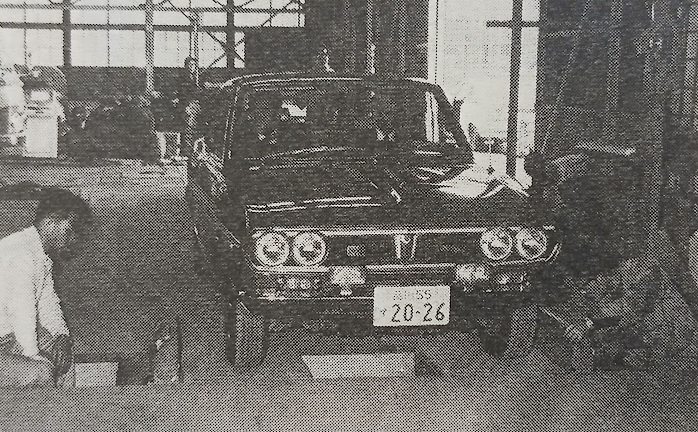
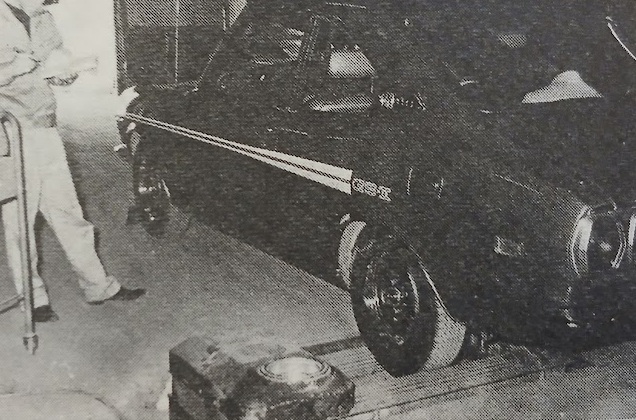
Ishikawa: Vehicle weight came to 1,005kg, with a front-to-rear distribution of 53:47. The figure remains almost unchanged with one or two occupants in the front seats. With five passengers aboard, it shifts to 48:52.
Alignment settings are conservative, with small amounts of both toe-in and camber at the front, while the rear wheels are essentially neutral. Under load, camber changes very little, but toe tends to move slightly toward toe-out.
On the brake dynamometer, achieving 0.6g of deceleration required a pedal effort of 17kg. In the road test, however, the figures were 14kg at 50km/h, 12kg at 100km/h, and about 11kg at 130km/h. In other words, braking effectiveness actually improves as speed increases.
In the fade test, pedal effort was approximately 11kg on the first stop and showed virtually no change even by the tenth stop. These brakes are extremely resistant to fade.
Magazine: Strong braking and no fade… it sounds like the ideal brake system.
Ishikawa: That’s right. They don’t fade, and they don’t squeal, either. They’re excellent brakes.
Watanabe: We use a French Bendix-type system. The pads are Ferodo type.
Magazine: About the lack of squeal…
Watanabe: The trouble with brakes is that you never know when they’re going to produce squeal. I don’t think there’s any pad in existence that can guarantee absolute silence under all conditions. The rigidity of the disc itself also matters, as does the rigidity of the caliper mounting. With brakes, you often don’t know whether they’ll squeal until you’ve actually built the system.
Watari: The disc and caliper often end up with very similar vibration frequencies. When they line up just right, that’s when you get noise.
Watanabe: If you try to eliminate squeal through the pad material alone, you’re in for a difficult job.
Adding a servo tends to make it easier to create a brake system that doesn’t squeal. That’s because you can get away with using a somewhat lower coefficient of friction.
Spare Tire Placement Raises Concerns
Magazine: Next, let’s hear the results of the visibility tests.
Hirata: Overall driving visibility is quite good for this class. The average is around 2.5 steradians, while this car measured 2.69 steradians. The large windshield is a major factor, measuring 0.73 steradians, which is near the upper end of the range. However, the windshield wiper sweep area is only average, so I think it could stand to cover a bit more of the windshield. In particular, there seems to be a fairly large unwiped area toward the right-front corner.
Magazine: And now the dimensional measurements.
Onda: In terms of overall dimensions, the body is slightly larger than both the Carina and the Galant GTO. Perhaps because the ride height has been lowered, ground clearance is quite limited around the muffler area. The measured figure is 155mm, which I think is getting rather marginal.
The doors themselves are fairly large, but our measurements show that the opening angle is surprisingly small when they are fully opened.
The thing that stood out most, however, was the spare tire sitting right in the middle of the trunk. Given the location of the fuel tank, I imagine there were all sorts of packaging difficulties involved…
Watanabe: There really wasn’t anywhere else to put it. On the reciprocating-engine model, the spare tire is mounted underneath the floor together with the fuel tank. At the time, rear-end collision concerns weren’t nearly as prominent as they are today, and in Europe there was strong emphasis on maximizing trunk floor space, which is why we adopted that arrangement.
With the rotary model, however, we increased fuel capacity to 65 liters, and the exhaust system also required a larger muffler. As a result, the spare tire was inevitably pushed up into the trunk. Honestly, if anyone has a clever solution for this, we would very much like to hear it.
Watari: Leave out the spare tire altogether and just include two or three cans of tire sealant. (laughs)
Magazine: Couldn’t it be mounted upright?
Watanabe: Europeans generally dislike that arrangement very much.
These days, more manufacturers are returning to the practice of mounting the fuel tank behind the rear seatback, but that, too, is not especially popular in Europe. The common request there seems to be: make the fuel tank smaller if you must, but keep it under the floor.
On the other hand, that approach doesn’t satisfy American requirements. It’s difficult to come up with a solution that pleases everyone.
Onda: Since the car was conceived as a luxurious model, it comes equipped with just about every convenience feature one could ask for.
One noteworthy detail is the door lock location, which has been placed in an easy-to-reach position toward the front. Another is the combination lever, which consolidates about six controls–including the turn signals and wipers–into a single unit.
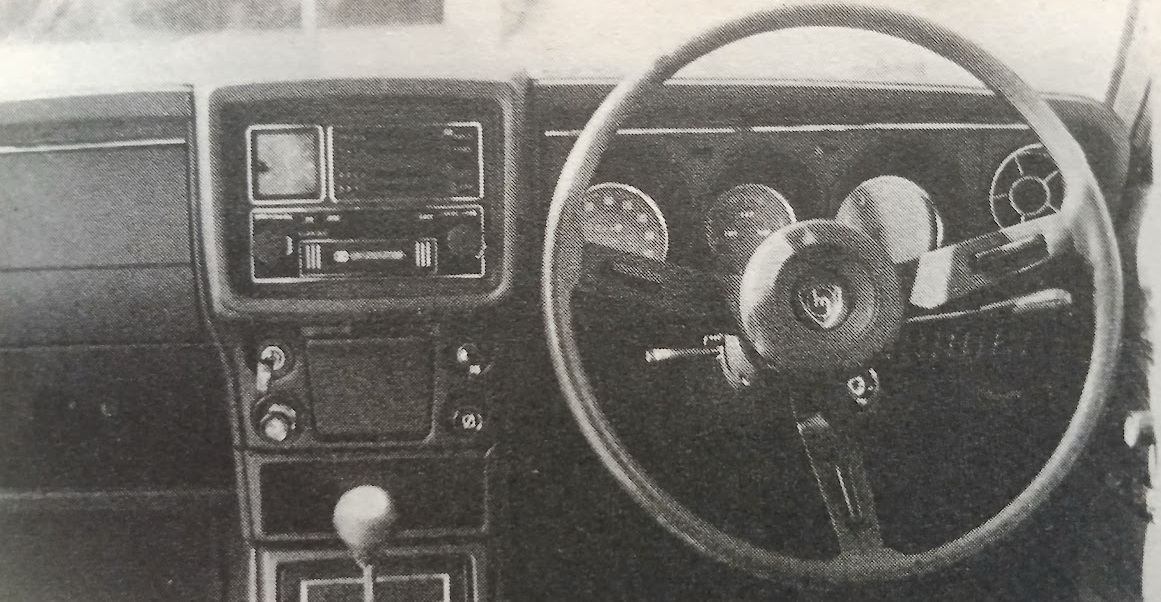
As for the instrument panel, there has traditionally been a rule that the most important gauge should be placed directly in front of the driver. If not, then the speedometer and tachometer would typically be arranged ahead symmetrically. In this car, however, the ammeter occupies the central position, with the speedometer and tachometer on either side. That struck me as rather unusual.
Watanabe: You’re absolutely right about that. Our own principle had always been to place the most important gauge in the center, the second most important on the right, and the third on the left. That’s why, on previous rotary models, it was considered standard practice to put the tachometer in the center.
On this car, however, we couldn’t place the speedometer on the right because of the routing of the speedometer cable. Since the speedometer had to be positioned on the left, we moved the tachometer to the right in order to maintain visual balance. So yes, it is an unconventional arrangement.
Rear Defogger and Fan Operate Together
Ikeda: This is a minor point, but I didn’t realize that switching on the heater fan automatically activates the rear window heating element. I actually found myself looking for a separate rear defogger switch. I’d prefer it if the two functions could be operated independently.
Watanabe: I think that whenever conditions require the rear window to be defogged, the front window will always need attention first. Whether you’re using warm air or cool air, the fan ought to be running in those circumstances. So I believe the proper arrangement is for the rear defogger to come on automatically whenever the fan is switched on.
Ikeda: Even when driving above 50km/h, do you still use the fan for windshield defrosting?
Watanabe: I don’t think the windshield can be defrosted satisfactorily by ram air alone. If you rely only on outside air without the fan, the airflow distribution is very poor and the glass never clears completely.
Hoshijima: The front window clears very quickly when the fan is on, but there are times when the rear window takes quite a while for the fogging to disappear…
Watanabe: But in that sort of situation, if you switch the fan off, the front window will start fogging up again almost immediately.
That’s why I think separating the front and rear systems would only make things unnecessarily complicated.
Hirao: In other words, your view is that if it doesn’t bother the driver, there’s no problem. (laughs)
Ikeda: Although then you have to live with the fan noise…
Watanabe: No, in this car, if you run the fan on low speed, it’s quiet enough that you’ll hardly notice it.
Furutani: I drove it quite a bit in rainy weather, and I thought the ventilation system worked exceptionally well. With the defroster on and the vents open, cool air comes out at face level, the windshield stays perfectly clear, and warm air flows to your feet. It’s a very effective arrangement.
Ikeda: The ventilation system is certainly good. The only issue is that if you’re not in the habit of running the fan, you may not realize that the rear defogger won’t operate…
Hoshijima: I can imagine situations where you’d want to switch on only the rear defogger.
Hirao: That’s really a matter of habit. When I’m driving at 100km/h, I always run the fan. It’s part of keeping the cabin properly conditioned.
Yamaguchi: I was driving a Savanna for about two months, and before long I found myself doing the same thing. You gradually get used to it without realizing it.
I’ve finally been trained. (laughs)
Magazine: Before we finish, could you tell us about production plans?
Watanabe: Including both export and domestic sales, we’re planning for between 8,000-10,000 rotary-powered Capellas per month. Of those, domestic sales should account for around 4,000-4,500 units. Within that figure, we’re expecting roughly 1,500 to be GS IIs.
Fortunately, Capella exports are growing very rapidly at the moment. We’re establishing a network on the East Coast of the United States this autumn, so I think exports will probably reach about twice their present level.
Magazine: For export markets, we imagine automatic transmissions are more important…
Watanabe: That’s right. The Capella automatic is scheduled to go on sale this autumn.
Magazine: With that, we’ll bring the discussion to a close.
Postscript: Story Photos