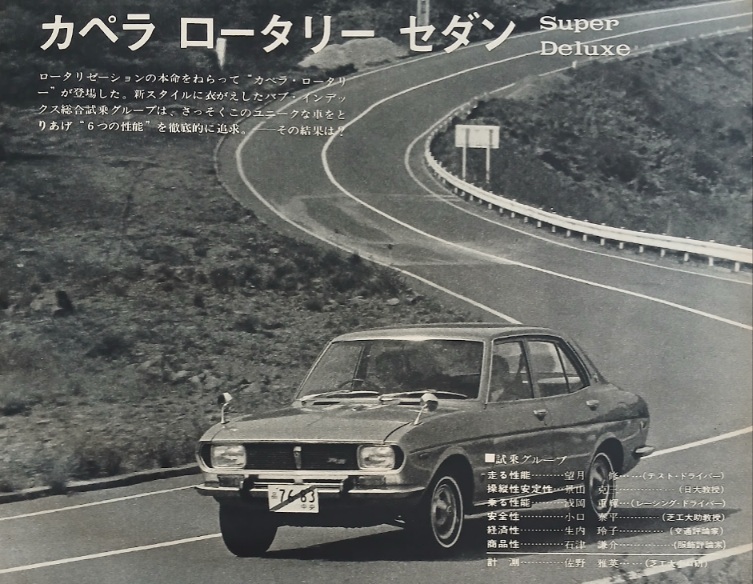
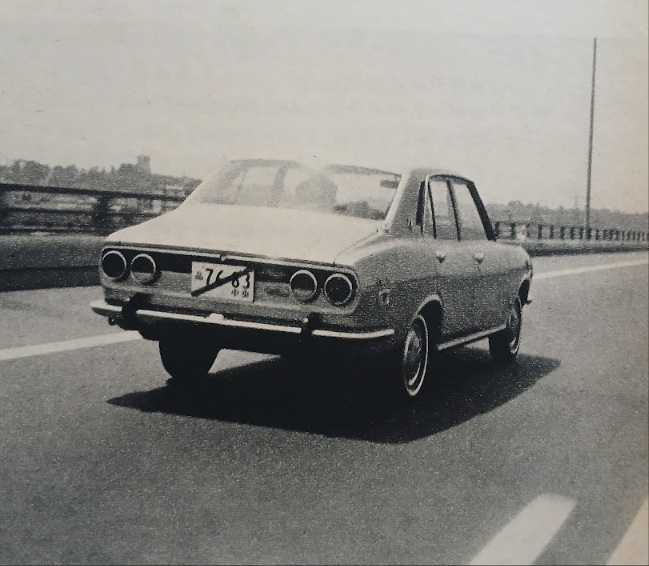
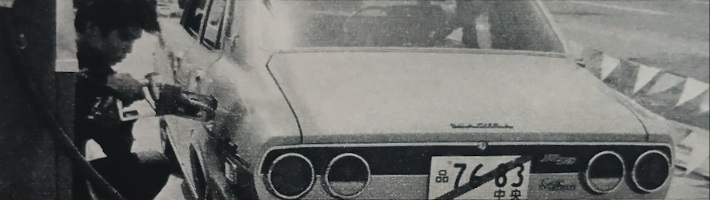
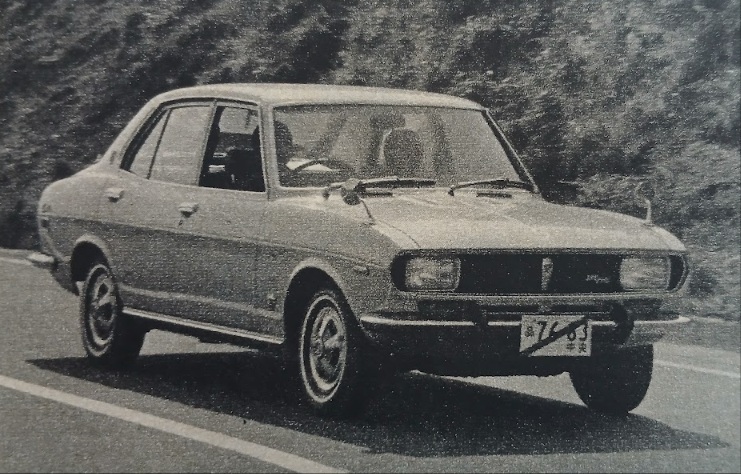
Mazda Capella Rotary Super Deluxe (1970)
Publication: Motor Fan
Format: “Bubble Index” Road Test
Date: July 1970
Author: Osamu Mochizuki, Katsuzo Kageyama, Shigeki Asaoka, Yasuhei Oguchi, Reiko Ikuuchi, Kenzuke Ishizu, Motor Fan Editorial Staff (uncredited)
The Capella Rotary has arrived, aiming to become the mainstay of Mazda’s rotary-engine lineup. With a new format, the “Bubble Index” road-test group immediately took up this unusual car, putting its “six aspects of performance” through a comprehensive examination. What were the results?
First Test in the New “Bubble Index” Format: The Capella
“We intend to develop the Capella series into Toyo Kogyo’s main model range, and to bring a breath of fresh air to the small passenger-car market with a car that will lead the way into the highway age.” These were the words of a Toyo Kogyo executive at the Capella’s launch presentation, held at the Imperial Hotel in Tokyo on May 13.
The Capella series consists of two lines: one powered by a newly developed 573cc × 2-rotor rotary engine producing 120ps, and the other by a water-cooled, 1586cc OHC 4-cylinder engine developing 100ps. Both are offered in sedan and coupe versions, but the Motor Fan editorial staff first selected the Capella Rotary Sedan (Super Deluxe) for a comprehensive road test using the “Bubble Index” method. The Rotary Coupe, with a character distinct from the sedan in both design and performance, is scheduled to undergo another Bubble Index road test in next month’s issue.
Our Bubble Index road test series has now been running for six months. Beginning with this issue, we have revised the editorial format to provide a more complete evaluation.
The main change is the assignment of six specialists, each with clearly defined responsibility for one of the six main areas used to evaluate a test car: (1) Performance, (2) Handling & Stability, (3) Interior & Comfort, (4) Safety, (5) Economy, and (6) Product Appeal. Naturally, in keeping with the principle of the Bubble Session—a discussion in which specialists from the various fields gather around a hexagonal table—each contributor will present his or her own assessment of the assigned subject while also introducing readers to the opinions of the other five.
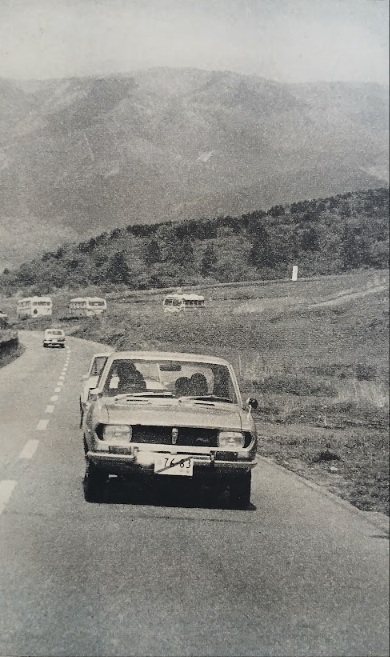
We chose almost the same driving route as in previous tests. Keeping the conditions as consistent as possible makes comparisons with other cars easier. Specifically, the route runs from the Tokyo Interchange of the Tomei Expressway to the Gotemba Interchange, over the Otome Pass, along the Hakone Turnpike, back over the Otome Pass, and then from the Gotemba Interchange to the Tokyo Interchange.
On the outbound journey along the Tomei Expressway, we tested overtaking performance and acceleration when merging from entrance ramps. On the Hakone Turnpike, we evaluated practical hill-climbing ability, while on the return journey from the Turnpike toward the Otome Pass, we took a route along the shores of Lake Ashi to test the car over rough roads. In this way, we subjected the Capella to a variety of driving conditions. Where necessary, we also took measurements to obtain numerical data.
So, what were the results of the test? The most notable findings were as follows.
First, all the specialists agreed that the Capella’s engine performance was outstanding. Its 573cc × 2-rotor rotary engine delivers performance comparable to that of a GT car powered by a 2000cc 6-cylinder reciprocating engine. Moreover, the combination of the Capella’s light weight and excellent engine response produced acceleration and hill-climbing performance that substantially surpassed those cars, as confirmed by our measurements. Even the lack of low-speed torque that had once been a concern with rotary engines has been improved to the point where it is no longer a problem.
Second, there was the matter of steering feel. The Capella uses a recirculating-ball steering system with a variable gear ratio, but the specialists pointed out that, partly because of the suspension characteristics, the steering “feels somewhat heavy” and “could be a little more responsive.”
Third, opinions on ride comfort were overwhelmingly favorable. Comments included “There is very little body roll, and the ride is exceptionally good” and “There was nothing unpleasant about the vibration or noise.”
Fourth, one comment concerning the Capella’s appeal as a product was particularly striking: “Until now, cars equipped with rotary engines have had a strong reputation for being expensive for what they offer. But I think the Capella has done away with that impression.”
Prices for the Capella Rotary are 698,000 yen for the Standard sedan, 748,000 yen for the Deluxe, and 787,000 yen for the Super Deluxe. The Coupe costs 728,000 yen in Standard form, 778,000 yen for the Deluxe, and 845,000 yen for the top-of-the-range Grand Sports. These prices apply in Tokyo, Osaka and Nagoya.
It should also be mentioned that the Capella Rotary Super Deluxe used for this comprehensive road test was not a car specially prepared by the manufacturer for testing. It was selected at random from among the cars displayed at the launch presentation.
What size of reciprocating engine should a rotary engine be compared with? This is a question that arises whenever rotary engines are discussed. On this point, the JAF Domestic Competition Vehicle Regulations, which serve as the rules governing Japanese motorsport, contain a relevant provision. In effect, the system calls for doubling the total displacement of a rotary engine to obtain its equivalent reciprocating-engine displacement.
Applying this method to the Capella Rotary, its total displacement is 573cc × 2, which, when doubled, gives 2292cc—equivalent to a reciprocating engine of approximately 2.3 liters. It should be emphasized, however, that this is strictly a convention adopted for motorsport purposes.
The relevant provision from the 1970 JAF Domestic Competition Vehicle Regulations reads as follows:
“Rotary-Piston Engines: Cars equipped with rotary-piston engines covered by the NSU-Wankel patent shall be recognized on the basis of a conversion formula for piston displacement. The equivalent displacement shall be twice the difference between the maximum and minimum volumes of the working chamber.”
Performance: An Exceptionally Quick Sedan (Osamu Mochizuki)
As far as performance is concerned, there is absolutely nothing to fault. I doubt there is another four-door sedan quite as quick as this one. In terms of performance, it can fairly be compared with a high-class GT car in the 2-liter category.
The source of this performance is, of course, Mazda’s distinctive rotary engine with side intake ports, a 2-rotor unit of 573cc × 2.
In displacement, this falls exactly between the company’s Familia-series 491cc × 2 and Luce-series 655cc × 2 rotary engines. The Capella’s position in the market appears to correspondingly place it in the 1600cc class.
The new engine develops a maximum output of 120ps/6500rpm and maximum torque of 16kgm/3500rpm. With a vehicle weight of 965kg, the weight-to-power ratio is an excellent 8kg/ps.
The first impression on getting behind the wheel is of quietness and smoothness. Rotary engines have long been noted for their quiet running, but the exhaust note has now become more subdued as well. This quietness serves to make the car’s tremendous performance all the more striking. The Capella captivated us with its almost whirlwind-like pace.
As the overtaking acceleration and speed-attainment figures clearly show, the Capella recorded results that can only be called extraordinary for a four-door sedan in the 1600cc class. Moreover, my impression is that almost any driver could achieve these figures. Such is the flexibility of the engine and the absence of any quirks in its power delivery.
Maximum torque of 16kgm is developed at the relatively low speed of 3500rpm, and the engine maintains more than 12kgm over an astonishingly broad range from 1000-7000rpm. In third gear, it can comfortably cover speeds from 20km/h at 1300rpm all the way to 140km/h.
Looking at the maximum speeds in each gear, we find 57km/h in first, 90km/h in second, 140km/h in third and 185km/h in top. It is noticeable, however, that there is a considerable gap between the first- and second-gear pair and the third- and fourth-gear pair. Since the engine is capable of covering such a wide speed range in each gear, I feel that second could be brought a little closer to third. This would probably be more convenient in practical driving, particularly when climbing and descending mountain passes or driving at low speeds in town.
As for the rotary engine’s relatively weak engine braking, it presents no particular problem except in top gear. Even with a reciprocating engine, the wheel brakes provide most of the braking force when driving in top, so in practice there is virtually no disadvantage attributable to the rotary engine in this respect.
The Capella has servo-assisted disc brakes, and their stopping capacity is quite sufficient. However, perhaps because of the characteristics of the servo, the initial pedal response feels somewhat uncertain. There is a sense that the braking force does not quite correspond to the pressure applied to the pedal.
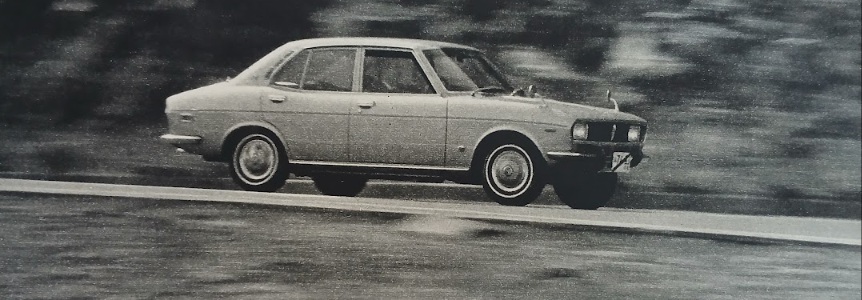
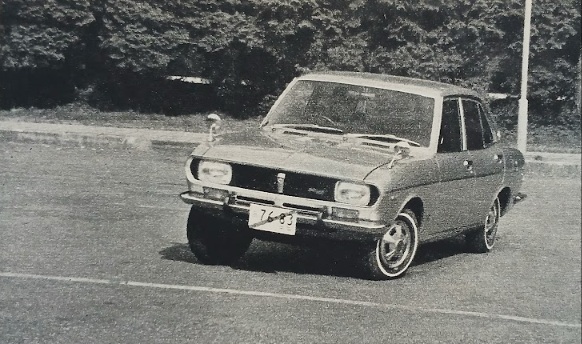
On the winding roads of Otome Pass and the Hakone Turnpike, we all thoroughly enjoyed the car’s remarkably agile handling. Its roadholding is outstanding. It takes a great deal to make the tires break away. Even in high-speed cornering, provided the cornering speed and drift angle are kept constant, the car maintains a remarkably stable attitude with very little body roll. Since the suspension has relatively soft spring and damper rates, one would normally expect considerable roll, but the relationship between the center of gravity and the suspension’s roll center has been particularly well worked out.
What did surprise me, however, was the sluggish steering response when a sudden turn of the wheel was required, or when making an abrupt lane change. Combined with a lack of rigidity in the steering system, this gives the impression of having to work the steering wheel back and forth, and there is a tendency for some yawing motion to remain when the car is brought back into line.
The handling characteristics show a moderate degree of understeer, so these tendencies are probably the result of several factors in the front suspension geometry acting together. The somewhat low roll stiffness at the rear may also contribute. Nevertheless, none of this detracts in the slightest from the Capella’s overall excellence.
Its remarkable speed, quietness, outstanding roadholding and comfortable accommodation are all qualities fully worthy of a sports touring car.
Handling & Stability: A High Standard of Roadholding (Katsuzo Kageyama)
The engine makes full use of the rotary’s characteristics, delivering exceptionally smooth and powerful performance. As a result, the car can be controlled freely and easily through the use of engine power. As far as engine performance is concerned, there is nothing to complain about.
Driving Controls: The clutch pedal is somewhat heavy, but I actually find this degree of effort easier to work with. Clutch engagement is good, and the pedal layout is generally satisfactory. If I had to find fault, I would say that the difference in height between the brake and accelerator pedals is rather too large.
The gearshift lever has a slightly long throw, and first gear in particular seems to be positioned too far forward and to the left.
Steering: The steering is quite heavy while turning the wheel with the car stopped or at a crawl. I also felt that the steering system was somewhat lacking in rigidity compared with other cars. It is impossible to identify the cause without looking at the alignment and other details. I suspect it has something to do with the front-wheel alignment and tire width—the test car was fitted with 6.15-13 tires—or, more precisely, the relationship between tire width and wheel offset. (Note: A smaller wheel offset increases steering effort.) In ordinary driving, however, there is no problem, and the steering effort is about right.
The steering response also felt somewhat sluggish. Weight distribution and other relevant factors should not be all that different from other cars, so it is possible that the tires themselves are to blame. I cannot say so with certainty, of course, but in theory this sort of behavior can occur when the tires’ cornering power is insufficient for the load carried by the front wheels.
Directional Stability: The car’s straight-line stability when the steering wheel is released is fairly good. It takes little time for any deviation to settle down, and the car seems to regain a steady course quite positively.
Cornering Performance: The car has a fairly pronounced tendency toward understeer, appropriate to its character as a sedan. However, because the engine is so powerful in relation to the vehicle’s weight, the reverse point—the point at which understeer changes to oversteer—seems to arrive relatively early. This tendency would be particularly pronounced on a wet road, though the same is true of any car.
There is very little body roll, so there is no problem in that respect. On the other hand, it can be difficult to sense exactly when the reverse point is approaching. In ordinary driving, one would rarely corner hard enough to reach this point, so it is hardly worth making an issue of, but…
Roadholding is also exceptionally good on rough roads, and the ride is comfortable. The car’s ability to negotiate poor surfaces is so impressive that, as an aside, I even found myself thinking it might be interesting to try it in a rally.
Tire Squeal: I had the impression that the tires began to squeal rather early during cornering. This naturally means that the tires are slipping sideways, but I wonder whether their cornering power is somewhat limited. Since this is a sedan, the tires may have been chosen with less demanding cornering in mind. Fitting tires of a different character might also alter the steering feel I mentioned earlier.
Braking: The brake servo seemed a little too powerful. The brakes themselves are certainly effective, and I do not think there is any problem with stopping distances or overall braking performance. However, while this is perhaps asking too much, I would have liked better pedal feel, both at the beginning of braking and as the car comes to a stop.
In any event, there is no doubt that this is a high-performance sedan equally at home on the highway and on rough roads.
Interior & Comfort: Some Complaints About the Interior Layout (Shigeki Asaoka)
The accelerator response is astonishingly good. As I pressed the pedal down, I could feel a smooth, sustained shove against my back. This kind of smooth acceleration is unique to the rotary, and impossible to experience with a reciprocating engine. What pleased me even more, however, was how genuinely quiet the engine was. When I drove the Rotary Coupe and Cosmo previously, I actually found them noisier than cars with reciprocating engines. But with the new Capella, Mazda, which until now has promoted the rotary as a sporting engine, has finally taken the plunge and put it to use in an ordinary passenger car. In that sense, the Capella might well be called Mazda’s “ace in the hole.”
Everyone knows that quietness, comfort, safety and economy are essential to a passenger car. But amid the current sporting-car boom, a car this quiet is something of a rarity.
The black leather separate seats are equipped with head restraints and adjustable to suit the driver’s height. There is nothing particular to criticize here. They have a generous range of fore-and-aft adjustment and reclining backrests, and there is little point in comparing them with those of other cars. Nor did I hear many complaints about the rear seat during the Bubble Session. However, fitting a car of this class with a built-in center armrest and a metal emblem on the seatback is rather like wearing patent-leather high heels with a pair of slacks.
The steering wheel has three matte-black spokes and a plastic rim with a simulated woodgrain finish.
The dashboard, perhaps in keeping with the latest fashion, is made entirely of black, textured molded plastic. To the sides of the central combination gauge are a tachometer reading to 8000rpm on the right and a speedometer reading to 200km/h, with trip odometer, on the left. There is nothing particularly interesting about this arrangement, either. In the center of the dashboard, a shiny, silver-trimmed rectangular surround houses the heater and ventilation control levers, a square clock, and a radio with car stereo, among other items.
The turn-signal stalk to the right of the steering column also incorporates the headlight flasher and high/low beam switch, together with a two-speed windshield wiper switch and washer control.
During the test, we entered a tunnel on the Tomei Expressway. I could not find the light switch on the dashboard, so I tried turning this stalk. To my surprise, the windshield wipers suddenly sprang into action. I hurriedly turned it back, but by then we were already well inside the tunnel. I decided to use the headlight flasher instead and pressed the stalk, only to be greeted by a sudden gush of washer fluid. Before I had recovered from this second surprise, we were out of the tunnel. I later discovered that I was not the only one who experienced this.
I immediately set about looking for the light switch and, sure enough, found a small lever near the base of the turn-signal stalk on the right side of the steering column. In this position, it is impossible to see while sitting normally facing forward, and operating it requires feeling around with one’s hand. Perhaps it is partly a matter of familiarity, but many of us agreed that the location was poor. Night follows day without fail, and even in daylight there are times, such as in tunnels, when the headlights are needed. To put the light switch in a position where one would normally expect to find something like the hazard warning switch (four-way flasher) hardly seems like the work of people who know how to design a car.
In terms of performance and overall design, I do not think the Capella compares unfavorably with European or American cars.
But when a car this small is burdened with limousine-like overdecoration and this kind of switch layout, I cannot help feeling that the problem goes beyond anything I might complain about to the manufacturer. It suggests a fundamental lack of understanding of motorization itself.
Safety: Safety Through a Reserve of Power (Yasuhei Oguchi)
The first thing that struck me when I took the wheel of the test car was the tremendous reserve of power provided by the rotary engine, together with a degree of quietness and freedom from vibration that can hardly be judged by the standards we have applied to conventional reciprocating engines.
The higher a car’s performance, the more important it becomes to provide a corresponding level of safety. In this respect, the Capella far exceeds expectations.
Safety can be divided into two categories: the ability to avoid an accident in the first place, or what is generally called preventive safety, and the ability to minimize injury and damage should an accident occur, or post-accident safety. In a road test, preventive safety can be assessed primarily through driving impressions, whereas post-accident safety must be judged mostly by what is visible.
From the standpoint of preventive safety, the Capella’s excellent acceleration is a major advantage. Its strong response from low speeds allows the driver considerable leeway in choosing a safe lane, making it particularly easy to drive in city traffic. On the expressway, meanwhile, it can merge from an entrance ramp into near-120km/h traffic with power to spare in third gear. Even in top gear, the engine’s strong, flat torque characteristics provide plenty of acceleration at high speeds.
Overtaking on the expressway is effortless. The time spent alongside the vehicle being passed is short, and the driver can return to the main lane without any uneasiness. These qualities are essential to safe long-distance driving, and they also contribute more to reducing fatigue than one might expect.
As for speed control, I had expected engine braking to be somewhat inadequate, but it proved effective enough. The servo-assisted disc brakes provide stable braking with light pedal effort, and even under deceleration of around 0.6g, there is no noticeable change in the car’s attitude. They inspire a good deal of confidence.
From the standpoint of preventive safety, the Capella’s handling and stability at high speeds are slightly less developed than its engine and braking performance would lead one to expect, although they are still of a high standard for a sedan. Indeed, precisely because its engine performance is so exceptional for this class, one wishes for somewhat greater assurance in the overall balance.
This is particularly noticeable when avoiding an obstacle at high speed. After the initial evasive maneuver, the car’s recovery in response to the countersteering input shows a slight phase lag relative to the steering angle. (Note: “Phase lag” refers to a delay in the vehicle’s response to a change in steering angle.)
In practice, situations in which this characteristic becomes important are rare, and one might argue that finding oneself in such a situation while driving is itself the problem. Nevertheless, as long as a human being is at the wheel, the more capable a car is in such conditions, the better.
Economy: High Performance at a “Bargain Price” (Reiko Ikuuchi)
Let’s begin with the price. The Capella series ranges from 560,000 yen for the least expensive 1600cc reciprocating-engine model (delivered in Tokyo, Nagoya or Osaka) to 845,000 yen for the top-of-the-line Rotary Coupe GS. The Rotary Super Deluxe tested here costs 787,000 yen.
To gauge initial reactions to the price, I randomly asked about ten self-described automotive critics at the launch presentation. Half replied, “That’s about what I’d expect,” while the other half said, “It’s cheaper than I thought.” Those who found it surprisingly inexpensive seem to have expected a far higher price, judging by the previously announced Luce Rotary, which costs 1,750,000 or 1,450,000 yen, depending on the model.
Let us compare the price of the test car with those of other models. The difficulty here is deciding which cars belong in the same class as the Capella. The Capella Rotary is something of a little devil, with unusually high horsepower for its size. I therefore tried two comparisons: one based on vehicle dimensions, which are among the factors determining a car’s class, and another based on engine output and maximum speed.
Comparison with cars of similar size:
| Capella Rotary Dx |
Car B 1600Dx 4-tier floor |
Car C 1600Dx 4-tier floor |
Car F 1600Dx 4-tier floor |
|
|---|---|---|---|---|
| Total length (mm) | 4150 | 4120 | 4170 | 4240 |
| Overall width (mm) | 1420 | 1410 | 1400 | 1600 |
| Price (yen) | 748,000 | 679,000 | 647,000 | 683,000 |
(Note: Since the other models in this comparison do not have Super Deluxe versions, I have used the price of the Capella Rotary Deluxe instead.)
Judged on this basis, the Capella Rotary is somewhat more expensive than other cars of similar size. However, the 1600cc reciprocating-engine Deluxe costs 658,000 yen, making it comparable in price to, or even cheaper than, the other cars.
<Comparison with cars of similar power output and top speed>
| Capella Rotary Super Dx |
Car C 1900 GSL |
Car C 2000 HT · SL |
Car C 2000 special |
Car F 2000 Z type |
Car I 1600 coupe |
|
|---|---|---|---|---|---|---|
| Output (ps) | 120 | 115 | 125 | 130 | 130 | 120 |
| Maximum speed (km/h) |
185 | 175 | 165 | 170 | 185 | 190 |
| Price (yen) | 787,000 | 786,000 | 1,202,000 | 1,145,000 | 930,000 | 1,720,000 |
By this comparison, the Capella Rotary Super Deluxe can in fact be considered inexpensive.
Next comes fuel economy. The results are shown in the test data, but the difference between the measured figures and the manufacturer’s stated km/l figures is relatively small. In particular, the modest loss in fuel economy during the hill-climbing test and over the dirt-road section seems to support Mazda’s claim that the rotary engine performs well at low speeds.
As for maintenance costs, there was not enough information to reach a conclusion. I contacted several dealers selling the Capella to see how the charges for a 10,000km inspection and engine adjustment compared with those for other cars, but they said they had not yet received official instructions on pricing.
I was, however, told that the charges for engine adjustment would be the same for rotary and reciprocating engines. I had hoped to hear that, because of its simpler construction, the rotary would cost less to adjust, so this was a little disappointing.
There is also the question of future trade-in value. When I asked the Japan Automobile Appraisal Association about the trade-in value of rotary-engine cars, the reply was: “We make no distinction between rotary-engine and reciprocating-engine cars. What matters is the vehicle’s remaining value. There may, however, be some difference in any additional amount above the appraised value, owing to the difficulty of reselling a traded-in car. That is a separate matter from the Appraisal Association’s work.”
I did not investigate actual trade-in prices, but if rotary-engine cars continue to gain in popularity, such concerns should eventually disappear.
In conclusion, the Capella Rotary Sedan is somewhat expensive for its size, but inexpensive in terms of the performance it offers. Indeed, I almost suspect that Mazda has understated its performance figures out of respect for its much more expensive big brother, the Luce Rotary.
Product Appeal: Indistinct Identity Is a Disadvantage (Kensuke Ishizu)
Having thoroughly enjoyed the qualities of the rotary engine in the Cosmo, I had eagerly awaited the arrival of another rotary-equipped car. But when the Capella Rotary Sedan Super Deluxe appeared before me, I must confess that I was disappointed. (Editor’s note: Mr. Ishizu was formerly a Cosmo owner.)
I cannot quite make sense of it. What distinguishes this car from an ordinary reciprocating-engine passenger car? I simply don’t understand. Mazda already has the Familia and Luce, both conventional passenger cars offered with reciprocating and rotary engines. There should have been plenty of room for a car designed exclusively around the rotary engine. Yet the Capella has been developed along the same lines as the Familia and Luce. What are we to make of that?
I work in the world of fashion, where trends change rapidly. I pride myself on studying consumer behavior more closely than most, and if I may venture a judgment based on that experience, I would put it this way. There are two ways of selling a product to the public in large numbers. One is to appeal to the broadest common denominator; the other is to offer something distinctive, with a character of its own. The Capella has almost certainly taken the former course.
The overriding demand to sell in large numbers must have ruled out creating a product that put individuality first. Perhaps Mazda felt that the second approach would risk appealing to too narrow a market, with too little scope for expansion.
But I believe that even a distinctive product with a narrow appeal can find its way into mass production and consumption through diversification. The production process itself can remain standardized. By varying the colors, grille designs, wheel covers and any number of other options, a manufacturer can offer buyers a tremendous variety of choices.
Take the paint, for example. Why not establish arrangements with specialist paint shops so that owners can have their cars repainted easily and inexpensively? Cars are no longer what they once were; they are already becoming consumer goods. I hear that the overwhelming majority of owners now replace their cars within two years. If that is the case, why not make it possible for them to change the color of their car every month, if they wish?
I am an amateur when it comes to cars, so perhaps some of my suggestions are foolish or off the mark.
But the car we have tested is a rotary. It offers performance equivalent to that of a reciprocating-engine car of more than 2000cc, and its qualities are so outstanding that I hardly need to say more. Toyo Kogyo itself has enthusiastically declared that “the 1970s will be the age of the rotary.” But there is nothing about the body that immediately identifies this as a rotary-engine car, and nothing about its appearance that makes a lasting impression.
I am not suggesting that Mazda should resort to eccentricity for its own sake. It is entirely possible to create individuality by taking a fundamentally sound design and adding a sense of modernity and “something extra.” That, to my mind, is the very essence of individuality.
Once behind the wheel, the rotary engine’s qualities become abundantly clear. The car is quiet, with excellent acceleration from rest and equally impressive overtaking performance. It stands well above other cars in its class.
What a waste. I cannot help regretting that Mazda’s great gamble on the rotary engine should reach the market in such a half-hearted form.
How to read the Bubble Index
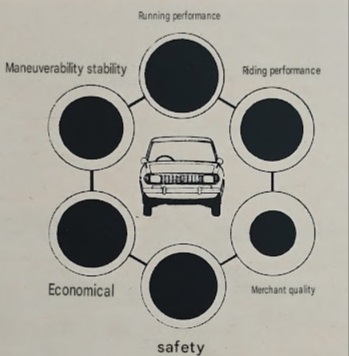
The aim of this comprehensive test drive is to judge the overall character of a car based on an evaluation of six main pillars: driving performance, handling and stability, riding performance, safety, economy, and marketability. The evaluation method used is a Bubble Session, a systems engineering method in which six specialists from different fields gather around a hexagonal table to exchange opinions. Each evaluation is shown in the black areas of the six circles, and the more evenly sized the black circles are, the better balanced the car is in each category; the less evenly sized, the more unique the car is.
Postscript: Story Photos