Mazda Capella Rotary Coupe GS (1970)
Publication: Motor Fan
Format: “Bubble Index” Road Test
Date: August 1970
Author: Osamu Mochizuki, Katsuzo Kageyama, Shigeki Asaoka, Yasuhei Oguchi, Reiko Ikuuchi, Kenzuke Ishizu, Masahide Sano
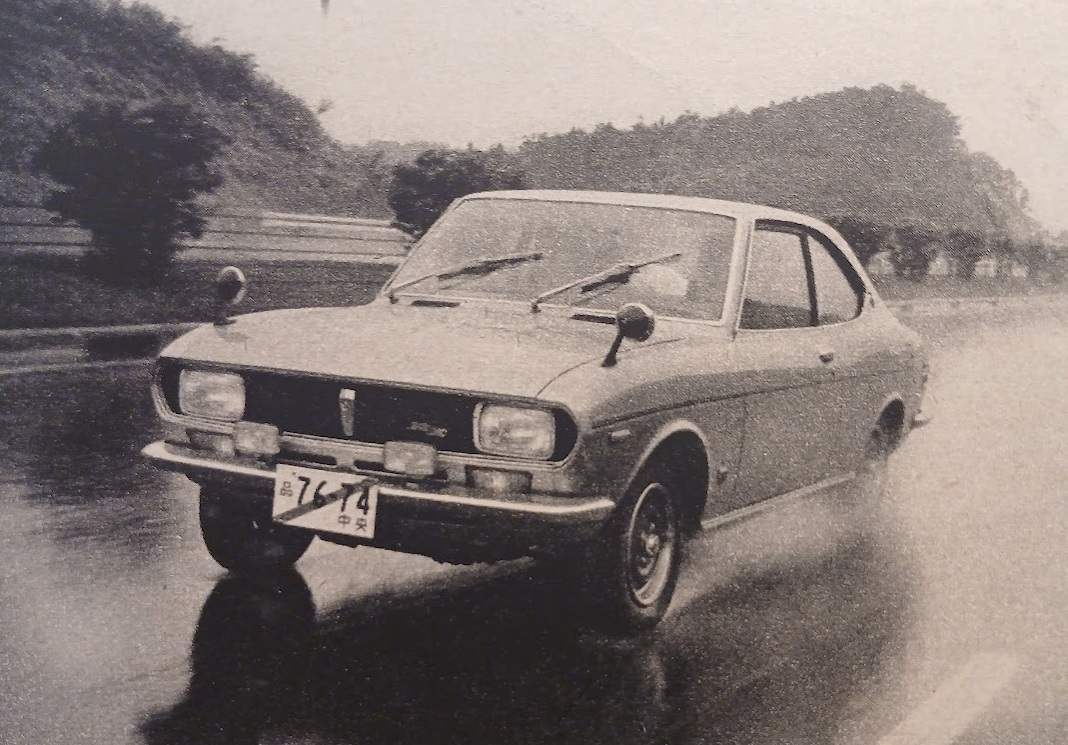
“The power performance is outstanding…” “The styling is cohesive, but a little too ordinary…” Six specialists test-drove the Capella GS in the pouring rain and analyzed this cutting-edge coupe from a variety of angles.
The Coupe’s Performance Surpasses That of the Sedan
Following on from the Capella Rotary Sedan (featured in the July issue), the Bubble Index comprehensive test drive group examined the Capella Rotary Coupe and the reciprocating 1600 Super Deluxe sedan this time, evaluating six categories: driving performance, handling and stability, ride and interior, safety, economy, and marketability.
The test drive route was the same as last time. We took the Tomei Expressway from Tokyo IC to Gotemba IC, then exited onto the Otome Touge, drove on the Hakone Turnpike, then returned to Tokyo the way we came, via Otome Touge and the Tomei Expressway from Gotemba IC to Tokyo IC. However, the weather conditions this time were, unfortunately, terrible. On the day we left Tokyo, it had been raining continuously since the morning, and in Hakone, flash floods were gushing out from cracks on the side of the road. So, while we did manage to drive up to the Hakone Turnpike, we had to cancel the hill climbing performance test due to the danger involved. We measured fuel consumption and acceleration performance, but because of the heavy rain, the figures were generally lower than they would have been on a clear day.
However, the downpour also allowed the test drivers to confirm some impressions that would not have been possible on sunny days. For example, the Capella’s wipers left a 10cm-wide patch on the right side of the windshield uncleared, and the rear defogger would have been more effective if it were set a little lower in the rear window.
Also, the “dullness” in the steering response that our test drivers pointed out in the test of the Rotary Sedan was significantly improved in the Coupe. This is likely due to the fact that the Coupe GS comes standard with radial tires.
The Capella Rotary Coupe GS that we test drove this time is equipped with the same two-rotor 573cc x 2 120ps engine as the Capella Rotary Sedan that we tested previously. However, because it is a coupe, the body silhouette is much more refined, the vehicle height is 25mm lower, and the weight is about 5kg lighter, so the catalog top speed is 190km/h, 5km/h faster than the sedan.
The reciprocating engine Capella 1600 sedan (Super Deluxe model) which served as this test’s accompanying car has not received much attention, being overshadowed by the Rotary Coupe, but its water-cooled, four-cylinder, OHC, 1586cc engine produces 100ps, and it boasts considerable performance in its own right. Our test drivers gave it positive reviews, with comments like, “it’s extremely quiet,” and “Perhaps because of the long, 78 x 83mm stroke, it has good flexibility from low to high engine speeds.”
Measurements were conducted mainly on the Rotary Coupe.
Power Performance: High-Speed Cruising in the Rain (Osamu Mochizuki)
This entire test drive took place in pouring rain, so we didn’t have a chance to fully appreciate the Coupe GS’s capabilities. However, it was quite adaptable to driving in these conditions, and we still had some positive experiences.
First of all, on the highway, it has excellent straight-line stability, and is quite resistant to crosswinds. In this sense, it can be said to meet the first requirement for a high-speed vehicle. The roadholding is at a high level, which contributes to the excellent straight-line stability and allows it to maintain a steady, consistent high-speed cruising pace even in rainy conditions.
The 155SR-13 radial tires fitted to the test car are standard equipment on the Coupe GS, and they make cornering on wet roads feel less slippery. However, the addition of radial tires makes the steering heavier, and especially at low speeds, the effort feels like it exceeds that of a 2-liter class car.
In the standing-start acceleration tests, the data was naturally worse than it would have been in clear weather. Starting off in first gear was accompanied by considerable wheelspin. There was also a moment of strong wheelspin when shifting into second. However, after that, acceleration continued smoothly despite the heavy rain. Here again, the tires’ strong grip was clearly evident.
Looking at the timed acceleration runs from our previous test of the Capella Rotary Sedan, that car covered 0-140km/h in 16.8 seconds on a clear day. In that test, we upshifted through the gears at the rev limit of 7000rpm, as wet-weather traction was not a concern. This time, the Coupe GS took 22.5 seconds when upshifting at a more cautious 6500rpm. When we upshifted at 7000rpm, the time was 17.7 seconds. In other words, it was 25% slower than the previous test with 6500rpm upshifts, and 5% slower with 7000rpm upshifts. We wondered why a difference of just 500rpm could cause such a big difference in time.
To answer this, we considered the fact that, with each upshift, the engine speed in the next higher gear is about 4000rpm. Looking at the rotary’s output curve, its power is unusually low at 3000rpm but rises to a peak in the 5000rpm range. In other words, while the typical characteristics of a high-speed reciprocating engine would show a power curve that is either flat or dips slightly around this 3000-5000rpm range, the Capella Rotary exhibits the exact opposite. At 4000rpm, the Capella Rotary is producing about 85ps. The output curve of a typical 120ps reciprocating engine would likely be around 75ps. At 4250rpm, the rotary and reciprocating engines’ curves are around 90ps and 80ps, respectively.
With the 5ps increase from 80-85ps representing a proportionately smaller increase than 75-80ps of the reciprocating engine, the difference in rpm has a smaller impact on the Capella Rotary’s acceleration data. So what is the cause of the large difference between upshifting at 6500 and 7000rpm? The conclusion is simple: “There is no drop-off in power even at 7000rpm.” The published performance curve shows a slight drop from the 120ps peak output to 118ps at 7000rpm, but the feeling from our test drive suggests that the power is still increasing slightly at this engine speed. The accuracy of the tachometer needle must also be considered as a variable, but generally the needle is only slightly behind the actual rotation speed, so it is not a significant factor. In any case, since this engine does not exhibit valve float at high speeds, you must be very careful about over-revving.
Due to the heavy rain, there were sections where we drove at a fairly slow pace. In this driving, we found that engine speeds as low as 1500rpm in third and fourth gear were both within the practical range. It’s a tenacious engine. However, we were a little concerned about the sudden driveline shock when we got on and off the accelerator at these speeds. This may be due to the strong torque, but perhaps the drivetrain needs more effective damping, or the propeller shaft wind-up is too great. The ride would be more comfortable if this shock were reduced a bit.
We also test-drove the reciprocating 1600 at the same time, which was quite quiet and had excellent response. It certainly lives up to its 100ps horsepower rating. Despite its long stroke of 78 x 83mm, its acceleration was smooth, and naturally it was tenacious at low speeds. We were able to speed up and down the mountain pass in a truly comfortable manner. For an average driver, it is a car that is extremely easy to handle.
Maneuverability and Stability: Steering Response is Improved Compared to the Sedan (Katsuzo Kageyama)
Since it rained heavily all day, our driving style was so cautious that it could have been said to be “endorsed by the Metropolitan Police Department.” As a result, this was not a test of the limits of maneuverability and stability, but rather a test of maneuverability and stability during careful real-world driving.
On the other hand, the rain also brought about some unexpected discoveries. First of all, visibility in the Rotary Coupe is poor because the already-skimpy fender mirrors are obscured by areas left unwiped by the wipers, making it particularly difficult to see the left fender mirror. Coupe-style rear windows often pose problems in rainy weather, and this car was no exception. The rear window is electrically heated to prevent fogging, but there are no heating wires near the bottom of the window, so while it is effective when driving, backing up in a tight parking lot is very difficult. We hope this can be improved.
The steering is quite heavy when turning the wheel while stopped or at very low speeds. This may be difficult for female drivers. Of course, once you get going, there’s no problem.
In the Capella Rotary Sedan we drove previously, the car’s sluggish steering response left a strong impression on us, but this Coupe’s steering is much more sensitive. We pointed out that the cause of the sluggish steering was likely a lack of cornering power from the tires, and because the Coupe uses radial tires, we didn’t feel any lack of cornering power this time. It seems that tire characteristics play a major role after all.
Needless to say, the Rotary Coupe GS is an extremely powerful car, so we had to modulate the throttle carefully while climbing and descending Hakone in the pouring rain. Perhaps because of this, the car was able to run steadily without any slipping, but it also has good roadholding and grip.
However, after changing gears, the shock that occurs in the driveline as the throttle is opened seems to be a little excessive.
Even though we drove through deep puddles, splashing around like a motorboat, the brakes remained perfectly fine. However, while the brakes are effective, their servo assistance is too powerful, and the pedal requires too little pressure. I personally had to concentrate to avoid pressing too hard.
When I switched from the Rotary Coupe to the 1600cc reciprocating sedan, my overriding impression was of the heavy feeling when accelerating. I also felt impatient with the way the engine revved up. However, after driving it for a while, not only did I no longer notice this, but it was actually quite enjoyable. And that’s because 100ps from a 1600cc engine is really quite impressive.
The 1600cc engine offers fairly high performance for a reciprocating engine. It’s quiet, tenacious, and easy to use. In fact, the reciprocating Capella is a very good car. Unfortunately, it has a flashy big brother called the Rotary Coupe, and while it’s too bad, it doesn’t make a particularly strong impression. However, Toyo Kogyo may be hoping to make more money from this modest-but-surprising younger brother than from the flashy big brother.
Ride and Interior: Good Seats and Convenient Storage (Shigeki Asaoka)
Cars these days are amazing. Following on from last month, I test drove the Capella Rotary Coupe and the reciprocating 1600 sedan, this time through a typhoon-like downpour that continued throughout the day. Even in the torrential rain, though, not a single drop got inside the car, and despite the chaos of collapsing cliff sides and soaked roads outside, I was able to drive calmly from the Tomei Expressway to Hakone and back.
Although the weather conditions were not good, I had already tested the Rotary Sedan in last month’s Bubble Session (published in the July issue) and was generally familiar with it, so evaluating the interior wasn’t a problem. The coupe and sedan are almost identical in terms of their interiors, but there are some slight differences. One is the design of the console: the sedan’s is shaped like a boat hull, extending forward almost flat with the shift lever at its center. The coupe’s is a type that rises up to integrate with the dash panel, as is commonly seen in other GT cars. The dash also includes a car stereo with radio as standard equipment.
In the previous test, I expressed some dissatisfaction with the sedan’s interior, but after driving the Capella Rotary twice now, I noticed other general issues I hadn’t noticed before, despite the detail differences between the sedan and the coupe. For example, both the coupe and the sedan have a storage shelf attached under the instrument panel, but the material used is quite flimsy. It’s secured in place with screws, but it looks unreliable.
However, the front seats in the coupe have a device that I really like. In coupe type cars, it is difficult to get in and out of the rear seats, but in the Capella coupe, when you step on a pedal behind the front seats when getting out of the rear seats, the front seatback folds forward and the seat slides forward at the same time. Not only that, but when it is returned, it is reset to its original slide position. Toyo Kogyo calls this a seat with a memory function, and it is extremely convenient. If I may be greedy, it would be even nicer if the backrest angle was also reset, which would completely solve one of the weaknesses of coupe-type cars.
The 1600cc sedan that accompanied us is equipped with a 100ps SOHC four-cylinder engine. This engine is also extremely quiet, and it is clear that Toyo Kogyo has focused on the theme of “silence.” I imagine that the engineers in the testing department in particular hard a hard time. Vibrations and noise are generated from many different sources, and I understand how difficult it is to isolate and eliminate them one by one.
It is impressive that the Capella manages to be quieter than its rivals in terms of both intake and exhaust noise, in both the rotary and reciprocating engine models. However, compared to the excellence of the powerplant, there are still some shortcomings in the interior and design.
Safety: Situational Awareness is the First Step Towards Preventive Safety (Yasuhei Oguchi)
Heavy rain disrupted traffic in many areas. Accidents continued to occur on the Tomei Expressway from the morning, causing the outbound lane to be closed beyond Gotemba. While these were the worst weather conditions for a test drive, they were very suitable for evaluating safety.
Good acceleration, one of the preventive safety features for avoiding accidents, is dependent on the amount of driving force available in each gear from low to high speeds. In this regard, since the Rotary Coupe is equipped with the same engine as the Rotary Sedan, it offers ample driving force for overtaking and acceleration, as befits a high-performance engine, and also improves the ability to avoid accidents in an emergency.
Straight-line stability at high speeds on windy days can be a problem on highways, but in this regard, the weight of the steering, which can be burdensome for beginners at low speeds, is actually excellent at high speeds.
However, if I were to be greedy, it seems that the emergency avoidance capability when driving near the limits of stability could be improved a little. It is true that the yaw and the delayed steering response when changing course that we noted in the sedan are almost imperceptible in the Coupe GS, perhaps due to the difference in tires. However, because the power performance is so great, it feels like the emergency avoidance capability could use further improvement from the perspective of balance.
Although the body roll during sharp turns is not significantly different from other GT cars in this class, it feels like there is less. This gives an even stronger impression of excellent stability when cornering, and is an element that gives you peace of mind.
The only significant inconvenience I found while driving in the rain was a blind spot in the windshield wipers’ otherwise-large wiping surface, which left an unwiped area about 10cm wide on the right side. What’s more, if you push the seat back to hold the steering wheel in a straight-arm driving position, half of the fender mirror is hidden. This didn’t bother me much when I was driving on the highway, but it was quite a concern when I was going over Otome Pass. After all, the first step in preventive safety is for the driver to be aware of their surroundings, and from this perspective, this is a basic problem. The solution seems like a simple matter of moving the wiper fulcrum outwards.
The heated rear window glass is effective in enabling the driver to be aware of their surroundings. However, the heated area is positioned a little too high, making it difficult to see nearby objects when parking or pulling into a garage. If possible, it would be better to move the heating wires a few centimeters lower.
Regarding safety if an accident actually occurs, it can be said that the level of safety is high, with the adoption of an energy-absorbing steering column and laminated glass, and the reduction of protrusions wherever possible.
Economy: Is the Price Difference With the Sedan Just a “Mood Tax?" (Reiko Ikuuchi)
The previously tested Rotary Sedan was priced at 787,000 yen. The Rotary Coupe Grand Sport (GS) tested this time is priced at 845,000 yen. The difference is 58,000 yen. According to the catalog data, the coupe’s top speed is 190km/h, 5km/h faster than the sedan, and the 0-400m time is a blistering 15.7 seconds. It also comes standard with radial tires, plus other, less important sporty features. As noted elsewhere, fuel economy during this test drive was worse in certain sections, but this was likely due to the test drive being conducted in the rain.
So, the question is how to think about the 58,000 yen difference between the coupe and sedan. It seems better to think of this as a “feeling price” rather than a practical benefit.
When people choose such high-performance cars, it seems that they rarely buy them for practical reasons alone, and that a hobby or enthusiast element must also be taken into account. If that’s the case, then for those who choose this car, the 58,000 yen difference is not all that high as a “price for the mood.” For that reason, I gave this coupe a slightly higher score for value than I gave the sedan last time.
The hardtop version of Toyota’s Corona Mark II 1900GSL is priced at 849,500 yen compared to 744,000 yen for the sedan, a difference of over 100,000 yen, but the hardtop is apparently selling overwhelmingly better. Perhaps the price difference is simply being absorbed by people who think of it as “hobby expense.”
Meanwhile, the price difference between the rotary and reciprocating engine Capellas is 845,000 yen for the Rotary Coupe GS, versus 738,000 yen for the reciprocating 1600 Coupe Super Deluxe. The difference is 107,000 yen (of course, there are differences not only in the engines but also in the equipment levels). Two years ago, the difference between the Familia 1200 Coupe and the Familia Rotary Coupe was 150,000 yen. It is good to see the price difference with reciprocating-engine models narrowing, as it highlights one advantage of rotary engines: their relatively simple and inexpensive mechanism (Note that the Familia Rotary has also since been reduced in price.)
If I were to be even greedier, I would like to see the manufacturer stop saddling rotary engines with deluxe accessories and instead have their prices come even closer to those of reciprocating engine models.
In terms of fuel economy, comparing the Rotary Coupe and reciprocating 1600 sedan we also test drove, the rotary averaged 7.5km/l, while the reciprocating sedan got 10.9km/l. We calculated the fuel cost per kilometer assuming that the regular gasoline used by the rotary cost 50 yen per liter, and that the high-octane used in the reciprocating engine cost 60 yen. The result was 5 yen 50 sen per kilometer for the reciprocating engine, and 6 yen 66 sen for the rotary. As expected, the rotary is more expensive to keep fueled, but the high performance more than makes up for that, so the extra cost is probably acceptable.
As you can see in the results, I have come up with my own Bubble Index score to evaluate the economic efficiency, taking into account performance for the price, price for the vehicle class (size, etc.), fuel efficiency, maintenance cost, durability, and resale value. However, in choosing a score, it’s a bit troublesome that data is difficult to obtain for the latter three items.
Marketability: Well-Balanced But Lacking Impact (Kensuke Ishizu)
Compared to sedans, making a good first impression is even more important for coupes. When I first laid eyes on the Capella Rotary Coupe, my initial reaction was, “hmm, pretty good.” It was well-balanced. The feel of a rotary car, its silhouette, the interior design, and the color palette–while not exactly perfect, it looked quite good overall. It was available in a range of bright body colors, and there was something about it that appealed to me, even if only just a little.
I said that it was well-balanced, but this doesn’t mean it is unique. To repeat what I said about the Capella Rotary Sedan, it’s unfortunate that despite having the rotary engine as its defining feature, it hasn’t yet been able to fully utilize its image appeal.
Why doesn’t Toyo Kogyo, with its rotary engine as a weapon, make the most of the “rotary image” in a coupe, a car with more character than a sedan? It’s like throwing away your weapon and taking on the two yokozuna with your bare hands. I just can’t understand it.
In the field of fashion, snakeskin (print) is all the rage in Italy right now. Until now, snakeskin has only been used for belts, handbags, shoes, and such.
Now, even though it is just a print, it is being featured in clothing. Some people analyze this trend as a manifestation of a yearning for nature in a mechanical age.
This analysis is almost certainly correct, but I don’t think that’s all there is to it. In other words, I think the visual element plays a huge role. The snakeskin’s juxtaposition of regular and irregular patterns, rather than being forcefully blended together, are arranged side-by-side in a natural coexistence. The appeal of imbalance is a recent buzzword, and this is exactly what I mean. I believe that fashion is also an expression of thought.
Up until now, car manufacturing has focused on creating cars that are high-performance “hardware,” but I believe we have already entered an era where the emphasis is on “software.” In other words, the injection of “humanity.” If we simply pursue mechanical advances without incorporating human emotional elements, the future of the automobile will be very bleak.
The Capella Rotary Coupe is well-balanced, but lacks impact. Why? Perhaps it’s because the designers were stuck in the preconceived notion that cars equal speed, which equals streamlined form. From now on, logic alone won’t cut it. Setting aside the Italian snakeskin craze, the rotary engine is, in a sense, a revolution in engines. So why couldn’t the body style have been given more individuality?
The reasons for buying the reciprocating 1600 sedan are economical in nature, so a simple appeal to rationality might be fine. However, as a rotary car, especially a coupe, which requires maximum “freshness,” it surely should have incorporated a more striking design.
How to read the Bubble Index
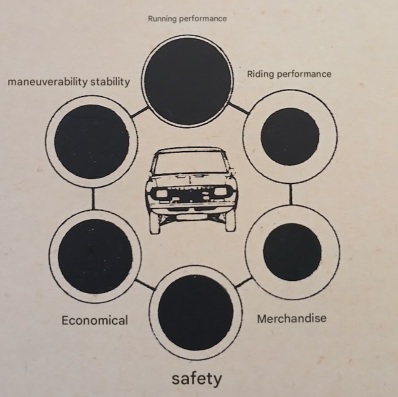
The aim of this comprehensive test drive is to judge the overall character of a car based on an evaluation of six main pillars: driving performance, handling and stability, riding performance, safety, economy, and marketability. The evaluation method used is a Bubble Session, a systems engineering method in which six specialists from different fields gather around a hexagonal table to exchange opinions. Each evaluation is shown in the black areas of the six circles, and the more evenly sized the black circles are, the better balanced the car is in each category; the less evenly sized, the more unique the car is.
Postscript: Story Photos


