Mazda Capella Rotary Coupe GS (1970)
Publication: Car Graphic
Format: Road Test
Date: October 1970
Author: “C/G Test Group” (uncredited)
Summary: Exceptionally smooth and powerful rotary engine. Normal conversation possible during sustained 160km/h cruising. Strong mid-range torque makes it easy to drive even in city traffic. Both handling and ride are of a high standard. Pronounced nose dive under hard braking; rear wheels prone to early lock-up. Effective ventilation.
Road testing the Capella Rotary Coupe GS
Car Graphic recognized the potential of the rotary engine from an early stage. When the Familia Rotary Coupe went on sale in July 1968, we purchased one immediately and, over the following two years, conducted a long-term test covering approximately 47,000km, publishing periodic reports in these pages.
During that time, the only major engine-related trouble occurred at around 35,000km, when the oil seals on the No. 2 rotor (equivalent to the oil scraper rings in a reciprocating engine) wore excessively, resulting in abnormally high oil consumption—approximately 250km per liter. Replacing the two seals proved to be the only repair required. Oil consumption subsequently returned to roughly 1,000km per liter, and the car still had ample useful life remaining. Just as we were debating what to do with it before its compulsory inspection came due, however, the Capella was introduced, giving us the opportunity to evaluate Mazda’s latest stage of “Rotaryization.”
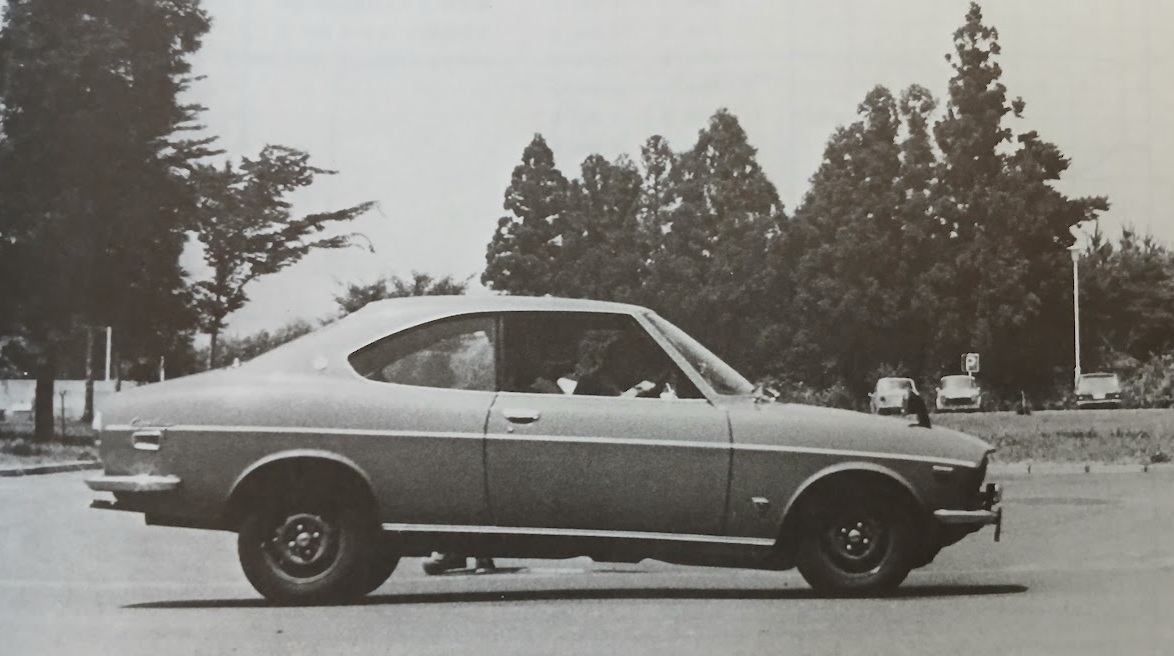
Our C/G Capella is the Coupe GS, the highest-performance—and, at 845,000 yen, the most expensive—model in the range. Our preference had been for the dark green body color, but none of the first batch delivered to dealers was finished in that shade. (C/G’s taste in colors, like the manufacturers’ predictions of market demand, seldom seems to coincide with that of the general public.) Instead, the Capella delivered to the C/G office on the evening of July 22 wore a trendy orange.
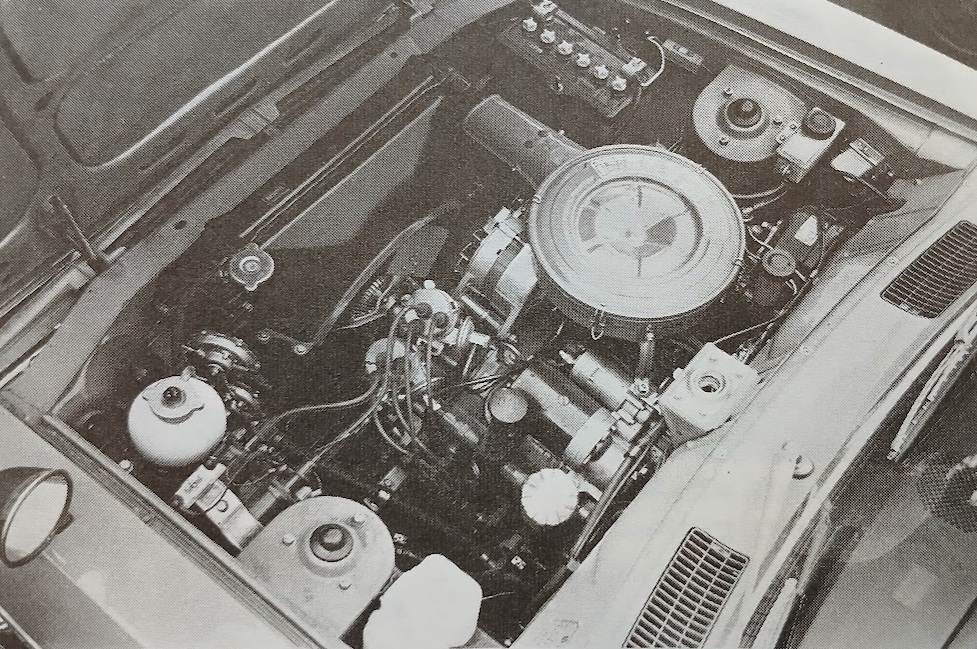
Without question, the feature of greatest interest in this car is its rotary engine, so we will begin with a brief outline. The two-rotor rotary engine, designated the 12A by Mazda, is slightly larger than the Familia’s 10A unit, with a chamber displacement of 573cc. This increase was achieved simply by widening the rotor housing by 10mm. The radius of the trochoid therefore remains unchanged, allowing the same machining equipment used for the Familia (and the Cosmo) to be retained. For comparison, the main specifications of the Capella Rotary and the earlier models are shown below.
| Displacement | Compression | Output | Torque | Weight | |
|---|---|---|---|---|---|
| Cosmo | 491 x 2 | 9.4 | 128/7000 | 14.2/5500 | 960kg |
| Familia | 491 x 2 | 9.4 | 100/7000 | 13.5/3500 | 825kg |
| Capella | 573 x 2 | 9.4 | 120/6500 | 16.0/3500 | 960kg |
| Luce | 665 x 2 | 9.1 | 126/6000 | 17.5/3500 | 1185kg |
Only three days separated the arrival of the car and our scheduled tests at Yatabe. During that time it was necessary to complete the initial running-in period (the handbook recommends just 1,000km—a welcome contrast to a reciprocating engine) and have the first service carried out. Members of the staff took turns driving the car day and night to complete the running-in, and by the time it reached Yatabe the odometer had only just passed 1,700km.
There was naturally some concern about subjecting what was, for all practical purposes, a brand-new car to the rigors of maximum-speed testing—particularly as we intended to keep it in long-term service as our everyday transport. In the event, however, the Capella recorded outstanding performance figures, coming remarkably close to the manufacturer’s published claims.
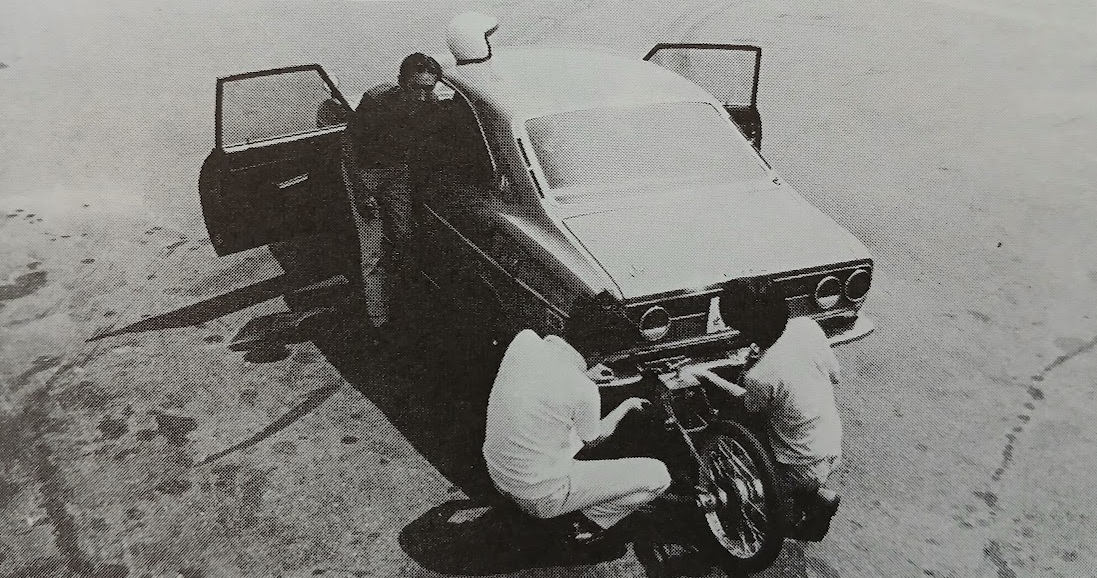
Let us begin with the figures. C/G’s maximum-speed test is a demanding one. The car is driven flat out continuously around the Yatabe course, with average speeds measured over both the 1km straight and the 5.5km high-speed circuit. (The maximum speeds published by manufacturers are generally either figures achieved only momentarily over a distance of a few meters, or values calculated on paper.)
The Capella recorded a consistent average of 187.5km/h over the 1km section and 186.6km/h around the 5.5km circuit. This makes it the fastest Japanese production passenger car C/G has tested to date, while even among GT cars, only the earlier Fairlady 2000—which pursued outright performance at the expense of almost everything else—has proved faster. Consider the following figures, all obtained from Car Graphic’s own tests.
| 0-400m | 0-100km/h | 0-160km/h | Max Speed | |
|---|---|---|---|---|
| Capella Rotary | 16.8 | 10.6 | 30.1 | 187.5 |
| Familia Rotary | 17.2 | 10.9 | 33.4 | 184.0 |
| Skyline 2000GT | 17.6 | 11.2 | 38.4 | 172.4 |
| Skyline 2000GT-R | 16.4 | 9.2 | - | 179.6 |
| Fairlady 2000 | 15.8 | 8.7 | 23.4 | 190.0 |
| Fairlady Z432 | 16.6 | 10.0 | 29.6 | 175.6 |
| Corona Mark II GSS | 16.6 | 10.0 | 29.6 | 184.7 |
| Galant AII GS | 17.2 | 11.7 | 35.3 | 173.1 |
| Honda 1300 Coupe 9 | 17.5 | 11.3 | 35.5 | 171.4 |
Reviewing this table, the results recorded by the GT-R and Z432 are unusually poor and clearly fall short of their true capabilities. (In the GT-R’s case, clutch slip during testing was partly to blame.) This perhaps illustrates just how difficult it is to keep a semi-racing engine—with twin overhead camshafts, three carburetors, and four valves per cylinder—in perfect adjustment.
By contrast, the completely stock Capella and Familia Coupe (both Car Graphic long-term test cars) were driven straight to Yatabe without any special preparation and simply recorded speeds very close to their catalog claims—190km/h and 180km/h respectively. Surely this says something about the rotary engine’s advantage over the reciprocating engine, with its inherently simpler construction.
Even by international standards, there are few practical cars in the 2-liter class capable of matching such performance. The Alfa Romeo 1750 GTV and BMW 2002 come fairly close, but it is only when one gets to the Porsche 911 that the Capella is clearly outpaced. (The 911 is essentially a two-seater, and needless to say, costs several times as much.)
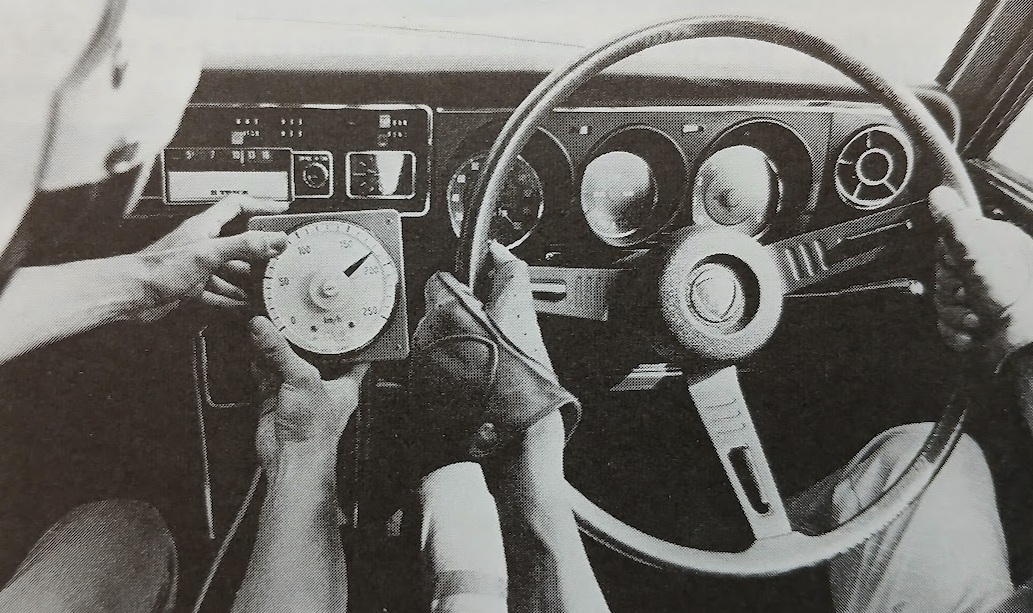
The tachometer’s yellow zone extends from 6500-7000rpm, with the red zone beginning at 7000rpm and continuing to 8000rpm. Overall gearing is, if anything, slightly on the low side for the engine’s output and the car’s weight. For example, at Yatabe, the maximum speed of 187.5km/h (the speedometer, optimistic as ever, had run completely off the scale and was indicating something in the region of 215km/h) corresponded to approximately 6750rpm, right in the middle of the yellow zone.
A few weeks after the Yatabe tests, when the odometer had reached 4,300km, we took the Capella to FISCO circuit. Once again the speedometer needle swept off the end of the scale on the right-hand circuit’s main straight, and it became necessary to lift off the throttle halfway through the banking.
We have remarked more than once on the rotary engine’s delightfully free-revving character, yet even after stepping out of the finest reciprocating-engined cars—for example, a Porsche or Honda’s 1300—the Capella still leaves a fresh impression. The fuel cut-off fitted to the Familia Rotary (which operates at 7000 ± 200rpm) has been omitted from the Capella, leaving the prevention of over-revving entirely to the driver’s self-control. In practice, a rotary engine—with no valve gear to suffer damage and excellent intake and exhaust efficiency—will spin to nearly 8000rpm in second gear without the slightest sign of distress.
The Capella Rotary enjoys two decisive advantages over a reciprocating engine.
The first is its exceptional flexibility, something quite unusual for a power unit of this performance level. Throttle response is crisp throughout an extraordinarily wide speed range. Most impressive of all is its eagerness at high engine speeds. Power does not fall away even beyond 6000rpm, and even in fourth gear, pressing the accelerator still produces a clear response.
At the other end of the scale, its low-speed performance in everyday driving is just as impressive. Top gear can comfortably be taken as low as 1000rpm (approximately 28km/h), and even in city traffic with a 50km/h speed limit, one can use third and top gear almost half and half. Thanks chiefly to its generous power reserves and outstanding flexibility, the need to shift down is far less frequent than in a reciprocating engine of comparable performance. Even an inexperienced driver would find the Capella remarkably easy to drive.
Nothing illustrates the engine’s excellent characteristics more clearly than the in-gear acceleration figures. In third gear, for example, the time required to accelerate through each successive 40km/h increment—from 20km/h all the way to 120km/h—varies by less than a second, ranging from 6.8 to 7.7 seconds. The same consistency is evident in top gear: 40–80km/h takes 10.6 seconds, while 100–140km/h requires 11.7 seconds.
Of all the cars Car Graphic has tested, only two have surpassed the Capella’s third- and fourth-gear overtaking performance: the Corona Mark II GSS, which has a clear advantage due to its considerably greater output and torque (140ps, 17.0kgm, 7.50kg per horsepower), and the Fairlady Z432 (160ps, 18.0kgm, 6.50kg per horsepower). Both, moreover, are equipped with 5-speed gearboxes, so their third and fourth gears have slightly lower overall gearing than the same gears in the Capella. The improvement in torque over the Familia Rotary is likewise unmistakable.
The rotary engine’s second great virtue is its smoothness and quietness compared with a reciprocating engine. At 150km/h (approximately 5000rpm), engine vibration is almost completely absent. At that speed, the loudest sound comes not from the engine but from the wind passing over the body, and even then it remains possible to carry on a normal conversation with one’s passenger.
Earlier rotary engines, including that of the Familia, were accompanied by a characteristic deep-throated roar under hard acceleration. In the Capella, however, Mazda has adopted a three-port exhaust arrangement with progressively opening ports, successfully subduing the exhaust’s original sound. As a result, exhaust noise is exceptionally quiet, both inside and outside the car.
It is on expressways such as the Tomei and Meishin that the Capella truly comes into its own. If the law permitted, 160km/h would present no difficulty as a sustained cruising speed. Admittedly, there are many foreign cars capable of cruising even faster. Yet even where such speeds are possible, the human nervous system can seldom endure the intense noise or vibration—more often both—for any great length of time. The Capella is different. It can sustain such speeds without appreciable strain on either the car or its occupants.
The 4-speed gearbox has well-chosen ratios. Third gear, in particular, pulls effortlessly to 140km/h, making it tremendously effective for high-speed overtaking. As noted earlier, the engine’s exceptionally flexible power characteristics give each gear an unusually wide operating range, and for that reason a 5-speed gearbox is hardly necessary. For export markets, however, where opportunities for prolonged high-speed running are more common, a slightly taller final-drive ratio would probably be advantageous.
Where the rotary engine does fall short of a good reciprocating engine is in its relatively modest torque at very low engine speeds. To compensate, first gear has been given a slightly lower overall ratio than that of the 1.6-liter reciprocating-engine Capella, making standing starts easier. The other shortcoming appears during trailing throttle—that is, when the engine is under braking. As the speed falls to around 1500-1800rpm, the engine’s running becomes slightly uneven. Under power, however, it remains perfectly smooth.
Right from new, the gearshift is light and positive, although throws are somewhat longer than in the Familia Rotary. On our test car, the synchronizers for second and third gear were also rather weak, producing gear clash even during unhurried shifts.
The brakes are remarkably powerful for the light pedal effort required and are equal to the Capella’s high performance. In our repeated 0-100-0 fade test, pedal effort increased only from an initial 12kg to 15.5kg on the tenth stop, demonstrating excellent resistance to fade. During the Yatabe tests, the brake pads appeared to have not yet been fully bedded in, as they exhibited slight vibration under heavy braking from high speeds. However, this disappeared with continued use.
One discovery made during our time at FISCO was just how quickly the Capella could shed speed. Before the hairpins, braking was so effective that there was little need to supplement it with third-gear engine braking—of which the rotary provides little anyway. Instead, it was entirely possible to remain in top gear under braking and shift directly into second.
Heavy braking from lower speeds, however, requires some caution. Nose dive is pronounced, and the rear wheels have a tendency to lock prematurely. In hard stops from 50km/h, increasing pedal effort actually tended to lengthen the stopping distance. (Peak deceleration is an instantaneous maximum and does not necessarily correspond to the shortest stopping distance.) At a pedal effort of 25kg, all four wheels locked and slid, inevitably increasing stopping distance. A pressure-control valve (PCV) in the rear brake circuit would seem to be desirable.
Fuel economy must, of course, be considered in relation to the car’s performance. Even under steady-speed conditions, however, the Capella consumes slightly more fuel than the Fairlady Z432. Over the course of our 4,300km test, commuting through the morning and evening rush hours returned 5.8-6.2km/l, while 100km/h expressway cruising yielded only 9.0-9.8km/l. The overall average worked out to 7.07km/l.
These figures can hardly be called economical, but in exchange for such outstanding performance, they are perhaps a price one must be prepared to pay. The fuel tank is generously sized, holding 65 liters. One consolation is that, despite its 9.4:1 compression ratio, the engine is specified to run on regular-grade fuel. Even when gasoline eventually becomes fully unleaded, Mazda expects little reduction in output. Toyo Kogyo also reports that a thermal reactor using a comparatively inexpensive catalyst has already enabled one of its cars to satisfy US Federal emissions standards, suggesting that the Capella should have little difficulty meeting Japan’s increasingly stringent exhaust-emissions regulations as well.
During the 4,300km test, we added 3.5 liters of oil. Oil consumption worked out to 1,230km/l, which is normal for a rotary engine.
The Capella’s suspension, with its live rear axle located by coil springs, four trailing links, and a Panhard rod, represents a considerable advance over the Familia Rotary’s leaf-spring arrangement, both in handling and ride. Radial tires are standard equipment on the Capella GS, and our test car was fitted with 155SR-13 Bridgestone Radial 11 tires.
The steering, requiring 3¾ turns from lock to lock, remains distinctly family-car-like in its lack of response, even on radial tires. Only after raising tire pressures from the recommended 1.7/1.7kg/cm² (for high-speed driving) to 2.3/2.5kg/cm² did it reach a level we would consider satisfactory.
In the brief road impression published in our July issue, we wrote: “The cornering limit is quite high for a live-axle car, but breakaway comes suddenly and with little warning, while the slow steering makes corrections difficult.” At that time the tires were inflated to the standard pressures. After further testing at Yatabe and FISCO with higher pressures, however, we have revised that opinion somewhat. The car remains decidedly biased toward understeer, yet its handling is in fact quite good.
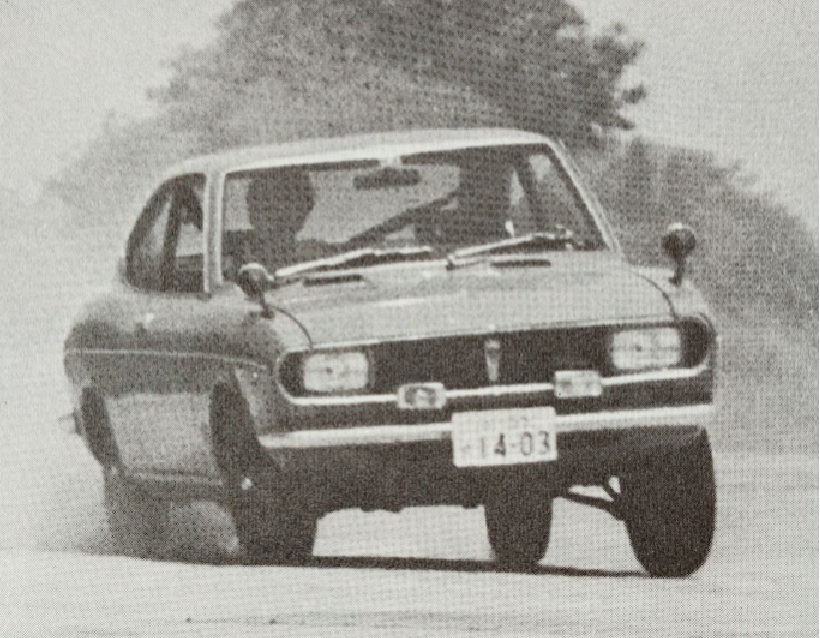
The proof lies in the fact that one member of our staff lapped FISCO’s 6km course in 2m 50s. Even so, the combination of 155-section tires on 4J rims is unquestionably inadequate for a car of this performance. After only a few laps at high speed, the shoulders of the tires showed severe wear. The softly sprung suspension, tuned primarily for ride comfort, allows considerable body roll, and with so much power available, there is frequent wheelspin in tight corners. Consequently, rear-tire wear proved noticeably greater than at the front.
The manufacturer is well aware of this shortcoming and tells us that 4½J rims will soon become standard equipment. In our view, however, 5½J or 6J rims fitted with 165HR-14 tires would be ideal, and we are considering making the conversion ourselves. Increasing wheel diameter by one inch would also raise the overall gearing, with corresponding benefits for fuel economy, and we think 14-inch wheels would look better in proportion to the body. Of course, tire wear should also be greatly reduced.
High-speed directional stability is exceptionally good, and the Capella is considerably less affected by crosswinds than the Familia. Ride quality is excellent over every kind of road surface. Most notably, rear-seat comfort has been greatly improved over that of the Familia. Over isolated bumps such as manhole covers at speed, the sharp upward kicks—which were quite pronounced in the Familia—have been reduced dramatically. Road noise and vibration are also well suppressed, and even on rough surfaces the harsher characteristics of the radial tires are seldom noticeable.
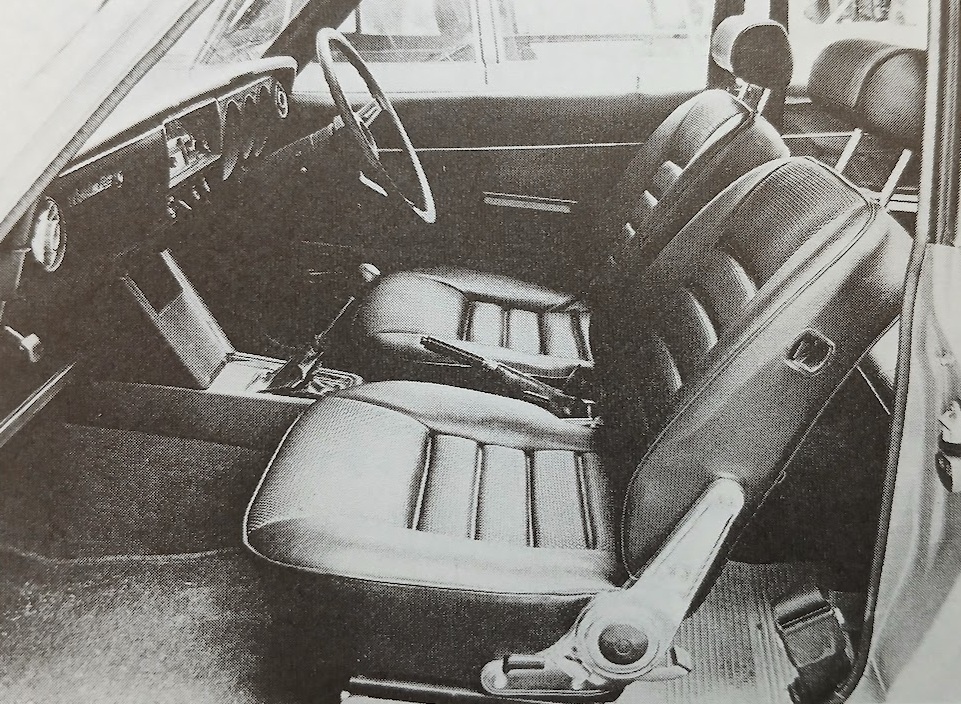
Despite its compact external dimensions, the interior provides ample room for four adults to travel comfortably over long distances. The rear seat, in particular, is considerably more spacious than that of the Familia. Even with a tall driver at the wheel, a passenger behind still enjoys adequate knee- and headroom. The center rear cushion is comfortably soft, although its relatively high position limits headroom somewhat for taller occupants.
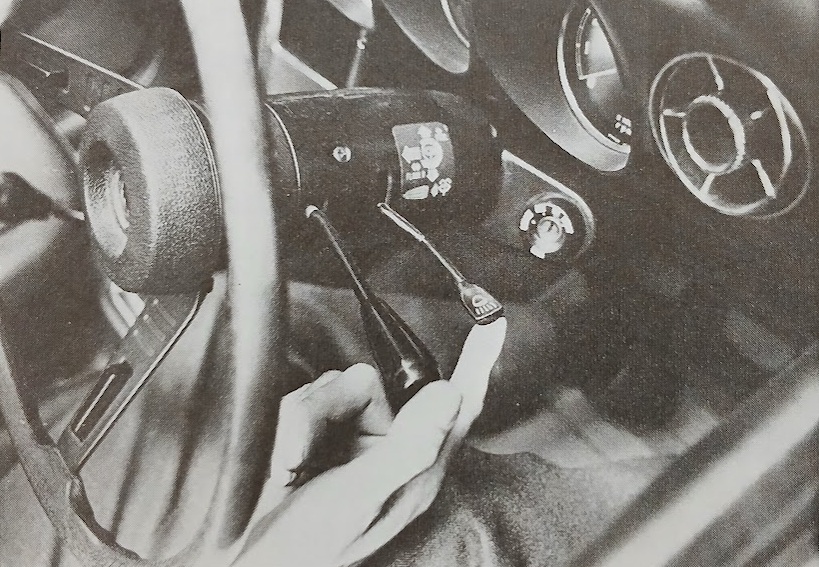
The driver’s seat offers generous fore-and-aft travel. Adjusted all the way back, even a driver 178cm tall will find it impossible to fully depress the clutch. The controls are well arranged, and the instruments are easy to read. The only exception is the headlamp switch, which is tucked behind the wiper and turn-signal stalks, making it awkward to reach. We promptly lengthened the lever by some 60mm, after which it became far easier to operate.
The GS even comes standard with an 8-track stereo—although, surprisingly, the radio itself is not equipped with push-button tuning.
Ventilation is excellent. The absence of vent windows is no handicap whatsoever.
Fresh air flows naturally through the cabin once the car is moving, while a three-speed blower provides ample forced ventilation when required. This makes the Capella one of the few cars in which it is genuinely possible to cruise at high speed on a hot day with the windows fully closed.
Regrettably, interior materials and finish are a step backward from those of the Familia Rotary. The check-patterned cloth upholstery of the earlier car has given way to non-breathable vinyl, while inexpensive one-piece molded plastic appears throughout the cabin. Within the first week of use, the right-hand door window developed a tendency to come out of its guide. (If opened while travelling at high speed, wind pressure would bow the glass enough that it could no longer be closed.) The inside door handle also became loose. When we investigated, we found that it was secured to its shaft by only a single screw.
Certainly, there remain several areas in which the Capella could be improved. Yet owners are likely to overlook a few minor shortcomings in return for its outstanding performance. Overall, taking its performance, accommodation, ease of use, and price into consideration, one is tempted to call the Capella this year’s “Car of the Year.”
Postscript: Story Photos