Mazda Capella Rotary Coupe GS II (1972)
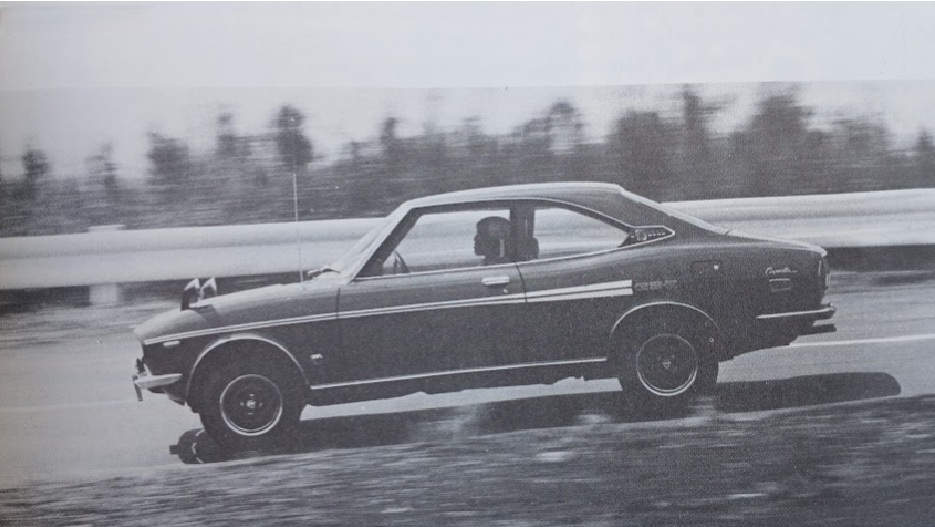
Publication: Car Graphic
Format: Road Impressions
Date: June 1972
Author: “C/G Test Group” (uncredited)
Road testing the Mazda Capella Rotary Coupe GS II
Last March, the Mazda Capella underwent a minor change. An expanded “G Series” lineup, which added the availability of an automatic transmission, had already been introduced the previous October, and the existing models have now been updated to bring them into line with it. At the same time, the model variations were reorganized along the same lines as the Savanna and Grand Familia ranges. It was in this round of revisions that the Capella Rotary Coupe GS II–the top-grade model of the series (Tokyo delivery price: 920,000 yen), and the subject of this 800km test–made its appearance.
Car Graphic purchased one of the earliest Capella Rotary Coupes immediately after the model’s introduction in May 1970, and until quite recently we used it extensively for long-distance, high-speed travel, covering some 50,000km. Looking back now, as documented in our monthly test reports, what stands out is the contrast between the car’s extraordinary performance and the repeated efforts we made to improve handling that remained extremely unrefined in character. We widened the wheel rims, changed tires, strengthened the dampers, and even fitted a smaller-diameter steering wheel in an effort to improve matters, even if only slightly.
These measures each produced a certain degree of effect, and in the end our C/G Capella’s handling could at least be tolerated for sporting driving. Even so, its fundamental characteristics–persistent understeer and slow steering response–could not be substantially altered, not even with the fitment of Michelin XAS tires, and there was ultimately no alternative but to wait for more extensive design changes. Our conclusion, and our hope, was that if these handling deficiencies could be improved, the Capella would become a far more attractive long-distance tourer.
Judged by its on-paper specifications, at least, the new GS II appeared to be precisely that ideal Capella. The suspension has been stiffened and the overall height reduced by 40mm. A 5-speed gearbox–essentially the existing transmission with an overdrive fifth gear added–is now standard equipment. And to compensate for the slight increase in weight, up 5kg over the standard GS to 980kg, the engine has also received a modest increase in output.
Beginning with handling, it is fair to say that the Capella has made substantial progress in this regard. Compared with the standard GS, the new suspension features dramatically increased spring rates: from 1.63kg/mm to 2.0kg/mm at the front, an increase of approximately 23%, and from 2.22kg/mm to 3.0kg/mm at the rear, nearly 35%. Correspondingly, damping force has also been raised significantly, with both compression and rebound settings increased by roughly 50% at all four corners compared with the other models in the range. As already noted, overall height has been reduced by 40mm, and the front wheel alignment has likewise been revised slightly.
The effect of these changes is most clearly reflected in the reduction of understeer. Compared with the early Capella, whose nose would wash progressively wider in corners, demanding ever larger steering corrections as the car drifted outward, the understeer reduction we had already noticed in last year’s G Series models–with their slightly firmer dampers and somewhat wider tires–has become considerably more pronounced in the GS II. Indeed, it has now been reduced to what might reasonably be considered a fairly standard level for this type of car.
As a result, the car maintains stable understeer throughout cornering regardless of speed. The ultimate limit itself, however, is not especially high. At times the rear will break away somewhat abruptly, and because the steering still retains that unpleasant sensation of twisting soft rubber at initial turn-in–combined with the large-diameter, thin-rimmed steering wheel, which requires a firm grip and becomes tiring over long distances–quick corrections demand rather busy hands.
Given the potential of this car’s rear suspension, the test car seemed to surrender grip rather too early, and part of the blame lay with the tires. The 165SR-13 Bridgestone Super Speed Radial 20s fitted at the time remained commendably compliant even when inflated to 2.0kg/cm²–well above the manufacturer’s recommended pressure–but outright adhesion was low. Under heavy loading, particularly at the outside front wheel in downhill corners, the sidewalls also tended to roll over.
In Car Graphic’s experience, the Yokohama GT Special XX in the same size seems to offer superior handling, though even with the standard GS suspension and tire pressures left at 1.5kg/cm², the ride is considerably firmer.
The stiffened suspension itself, however, proved far less detrimental to ride comfort than we had feared. In fact, it remained markedly more compliant than the C/G Capella fitted with rally-spec front dampers and Michelin XAS radials, transmitting little more than slight impacts over pavement joints and similar irregularities. The car’s characteristic body roll remained pronounced, though not especially objectionable, but at high speed the chassis still tended to pick up a certain amount of yaw as it settled after a bump.
The new fully synchronized 5-speed gearbox, prepared exclusively for the GS II, is essentially the existing Capella 4-speed transmission (3.683 / 2.263 / 1.397 / 1.000) with an indirect overdrive top gear (0.862) added. At the same time, the final-drive ratio has been lowered to 4.11. As a result, the overall ratios become 15.141 / 9.303 / 5.743 / 4.111 / 3.544, compared with 14.364 / 8.826 / 5.448 / 3.900 for the other models using the 3.90 final drive (both fitted with identical tires).
This revised gearing could be expected both to improve fuel economy at high-speed cruising and to enhance overall performance, particularly acceleration. However, the results of our acceleration and top-speed tests at Yatabe can hardly be said to have met expectations.
Despite modifications to the engine, including enlargement of the secondary jets in the single four-barrel carburetor, a more aggressive setting for the automatic ignition advance, and a slight increase in the diameter of portions of the exhaust system–yielding an output of 125ps/7000rpm (red zone from 7000rpm, yellow from 6500rpm) and 16.3kgm/4000rpm, up from the previous 120ps/6500rpm and 16.0kgm/3500rpm–the results were modest. Top speed in a flying start reached only 181.8km/h, while the 0-400m acceleration time was 16.7 seconds.
By comparison, the previously tested C/G Capella–at just 2000km, effectively still in new condition–recorded 187.5km/h and 16.8 seconds with apparent ease.
What becomes clear here is that, contrary to the figures on paper, the engine lacks outright power. In the low and mid-range this is not especially noticeable, but beyond 5000rpm in the upper range there is a clear lack of punch. As a result, while the risk of over-revving during hard acceleration has been reduced, the explosive surge up to the limit is also absent.
In fifth gear, maximum speed corresponds to approximately 6700rpm, but if the car is driven straight into a headwind the tachometer needle drops suddenly by as much as 500-600rpm, which makes the situation all the more evident.
This is most likely the result of tuning carried out in connection with emissions regulations. In all other respects, however, its character remains that of a rotary engine–its exceptional smoothness and mechanical silence hardly need repeating.
The new 5-speed gearbox is a useful addition. Thanks to the engine’s abundant torque, it can be used as more than a simple overdrive; if desired, it will pull cleanly from as low as 45km/h (around 1500rpm) without any sense of strain. In normal highway driving, it is therefore entirely possible to complete all overtaking maneuvers without a single downshift, and in complete safety.
The fifth gear itself, however, generates a distinctly metallic mechanical noise, which–combined with the inherent quietness of the power unit–stands out clearly against the already noticeable wind noise.
At 100km/h, engine speed is 3700rpm in fourth and 3200rpm in fifth; at 160km/h, the corresponding figures are 5700rpm and 4900rpm. However, because this engine shows little change in character across such a narrow spread of revs, the practical advantage of fifth gear is limited almost entirely to fuel economy.
Engaging fifth requires moving the lever forward and to the right against a spring-loaded gate beyond the standard H-pattern, but the sideways travel is excessive. One must first pull the lever decisively to the right from neutral and then push it forward, making the action somewhat exaggerated and awkward.
The Capella’s manual gearbox has long suffered from weaknesses in synchromesh capacity and shift feel, and these have been carried over into the GS II. In fact, on the test car–which had just been fitted with new synchronizer rings–the action remained rather stiff, and even so the synchros were still relatively weak, becoming easily overwhelmed during rapid shifts.
As for fuel consumption, the results were poor: 4.84km/l during the Yatabe test session including maximum acceleration runs, 5.19km/l in urban driving, and 6.71km/l on a one-day tour of the Tomei Expressway and Hakone, for an overall average of 5.58km/l. However, this is largely the result of running the car hard while making almost no use of fifth gear and paying no attention to economy. Used as intended–as a high-speed cruiser–it is unlikely that consumption would be worse than this. Regular gasoline is specified.
As for the body, interior, and exterior, there is little to add beyond the fact that, as befits a high-priced domestic sports car, it is extremely well appointed. Even so, it retains the earlier Capella’s virtues: quarter windows that can be rolled down with regulators despite the two-door coupe layout, and a powerful ventilation system.
Whether the metallic paint–whose shades include a striking purple–or the optional adhesive side stripes, or the oddly glossy vinyl upholstery, are pleasing or not is ultimately a matter of taste.
Fully equipped in this way, the Capella Rotary Coupe GS II is clearly qualified to sit at the upper limit of this class of domestic cars. Although the once almost violent level of punch has somewhat softened, it remains unquestionably formidable at high speeds on the highway, and the fact that its performance and its qualities as a practical touring car–ride comfort and spaciousness–are successfully balanced is worthy of high praise.
Furthermore, C/G would like to express the hope here that this chassis will eventually be offered in combination with the JATCO-built “RE-Matic” automatic transmission.