Isuzu Florian TS (1969)
Publication: Motor Fan
Format: Test Drive Report
Date: June 1969
Author: Tatsuyoshi Ehara
A Touch of Sporting Character
“Which are you, a wolf or a sheep?” Isuzu, which has presented itself as an enthusiastic advocate of offering different models for different kinds of drivers, has now added a new model called the Touring Sports (TS) to the Florian, a car that originally belonged firmly in the sheep camp.
Isuzu had made the Bellett its winning card, emphasizing its sporting character and positioning it as a car for the wolves, while the Florian was intended for the sheep, cultivating an image of a dignified family car. But it seems that among the sheep in the “Isuzu pasture” there were also a few wolfish individuals, though this is hardly a scene from “Little Red Riding Hood.”
When it comes to the person behind the wheel, however, a driver may be a sheep one day and a wolf the next, depending on his mood at the time. Even the most sedate driver occasionally feels like driving hard. Conversely, a driver who habitually holds the tachometer needle just short of the red zone will, when on a date with his sweetheart, often drive so gently that one wonders whether the spark plugs might foul. Seen in this light, there should be no objection to adding a touch of sporting character to the Florian, the representative of the sheep camp.
Luckily, I had an opportunity to test this car, so I will relate my impressions just as I experienced them.
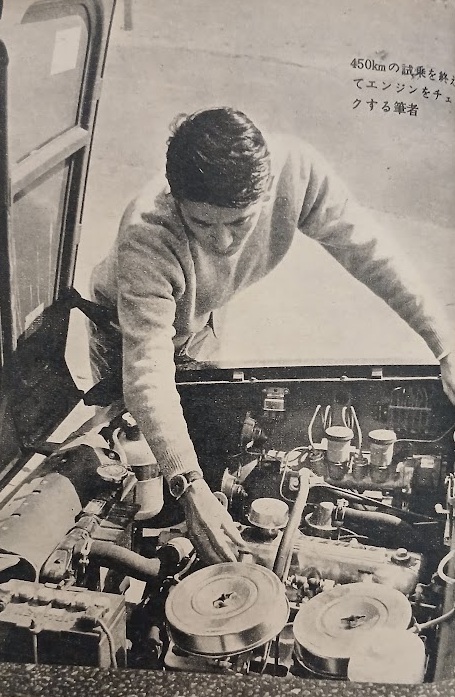
The engine is the 1584cc G161 unit, the same as that of the Bellett 1600GT. Fed by twin SU-type carburetors with good intake efficiency, it develops 90ps/5400rpm and torque of 13.0kgm/4200rpm. With the use of a high-geared 3.727 final drive, the TS reaches a maximum speed of 160km/h, the highest in the Florian range. The taller final gearing, however, means that its standing-start 0-400m time comes out at a merely respectable 18.1 seconds.
The braking system has also been strengthened, with Bendix F-type disc brakes at the front to improve stopping power.
The change to front discs has eliminated the rather abrupt, grabby action at low speeds that is characteristic of the ordinary Florian. Until one gets used to the disc brakes, their response can feel a little less reassuring, but the actual braking performance is superior, so I do not think this presents any problem once the driver has adjusted to it. Moreover, the brake hydraulic system is divided into two independent circuits for the front and rear wheels, reducing the danger should a brake line or other component fail. This is a welcome feature, and one that reflects a conscientious approach to safety.
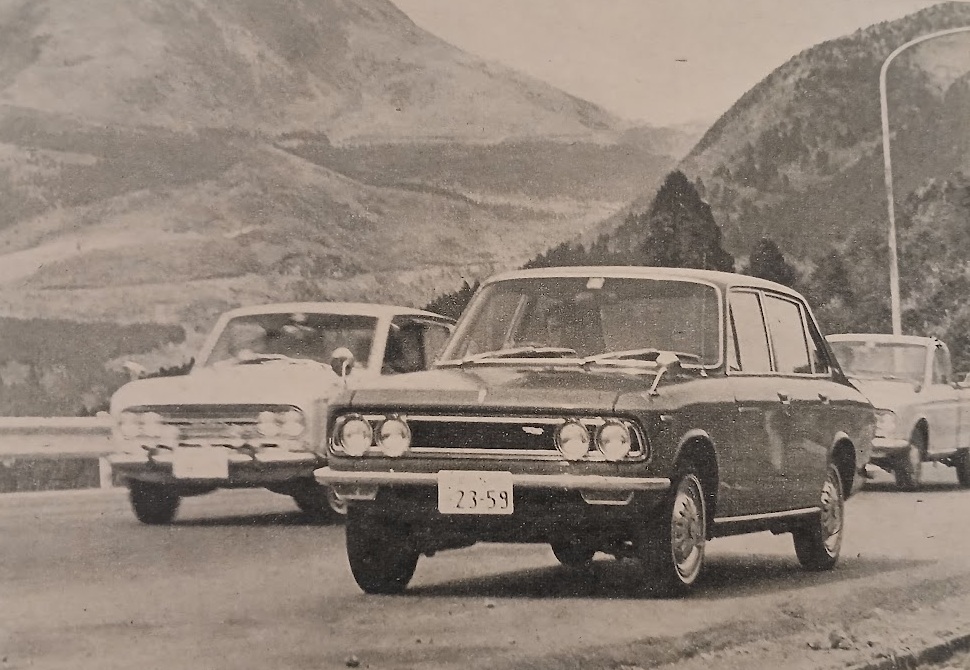
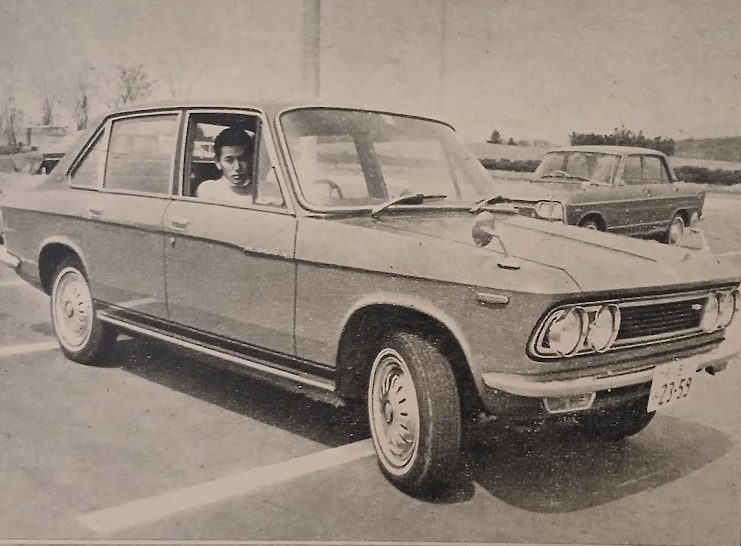
Drawing on experience gained with the 117 Coupe, Isuzu has adopted de Carbon-type (gas-filled) shock absorbers at the front, strengthened the stabilizer bar, and fitted uprated rear shock absorbers. Consideration has thus been given to improving stability at high speeds without sacrificing ride comfort. The tires are low-profile 6.15-14 4PR tubeless types, with an unusual design featuring two narrow white stripes around the sidewalls.
Other changes include a sports-type dual exhaust pipe and, as a novel feature, an electrically heated rear-window defogger to maintain rearward visibility.
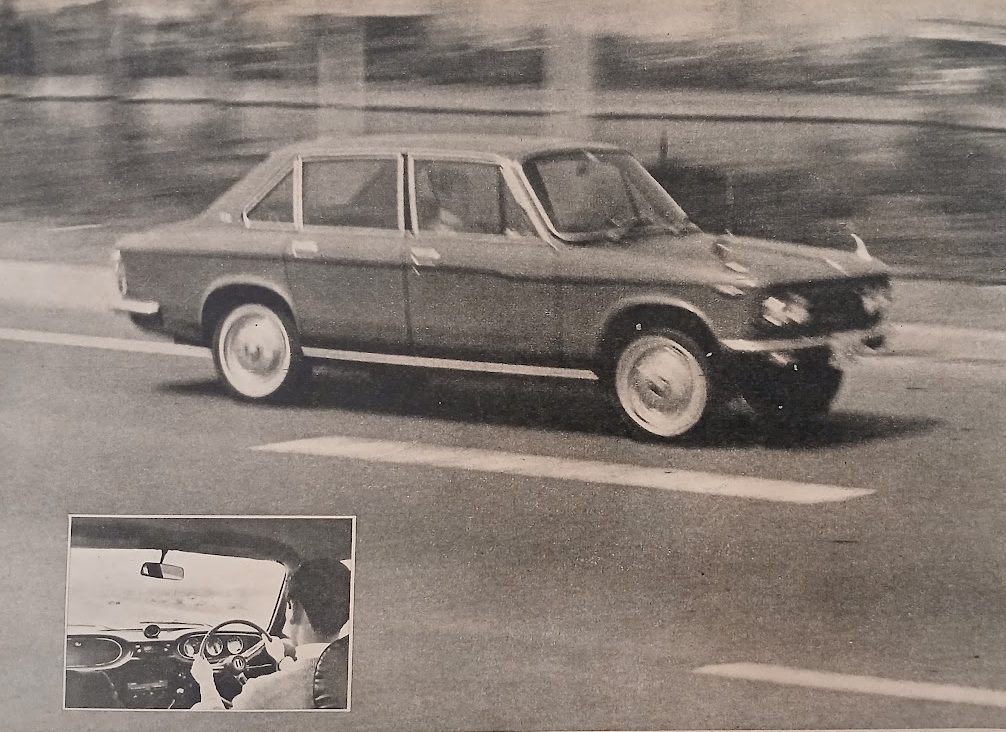
In keeping with the sporting character, the instrument panel has three round dials arranged side by side. There is no sign of the oval-shaped instruments of the standard Florian, which had not been particularly well received by some. The dial on the left incorporates three gauges for oil pressure, water temperature and fuel, while a tachometer reading to 7000rpm sits in the center position, with the yellow zone beginning at 5500rpm and the red zone at 6000rpm.
On the right is a speedometer reading to 180km/h with a trip meter, completing a neatly arranged set of instruments. The decision to place the tachometer in the center is particularly welcome. Considering the tachometer’s intended purpose, the arrangement often seen in Japanese GT-type cars, with the speedometer in the center and the tachometer off to the side, seems to defeat half the purpose of fitting a tachometer in the first place.
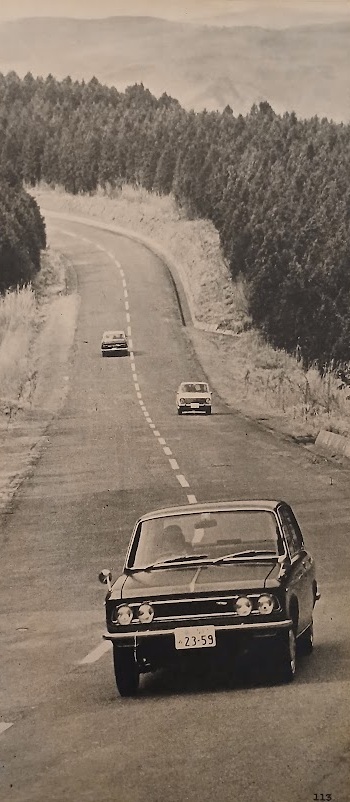
But how does the car perform on the road? For this test drive, I chose a route through the Izu Peninsula, including the Tomei Expressway, the Hakone Shindo, the Izu Skyline and the unpaved roads of the Amagi mountains, to experience the car in a variety of conditions.
A Spacious Interior
Starting off, a satisfactory driving position can be achieved by adjusting the seat fore and aft and setting the backrest angle. Perhaps in an effort to provide better thigh support, however, I felt a little pressure at the sides of the hip bones. The steering wheel is well positioned, but apparently because space has been provided for a footrest to the left of the clutch, the pedals seem to be shifted slightly to the right when one is facing forward in the seat, holding the wheel. Ideally, I would like the accelerator pedal to be 2cm higher and about 1.5cm wider to the left, so that heel-and-toe could be performed comfortably even in regular shoes. The seat belt fits snugly and comfortably, thanks to the spring action of its retractor.
Turning the ignition key and starting the engine, one can certainly feel the effect of the SU-type carburetors. The engine has what might simply be called a good “feel” to it. But the clutch, being the standard Florian mechanism, is surprisingly light if one is expecting the feel of a sports-type car or GT. This is one of the more agreeable aspects of the Florian’s “sheep-like” character, and the same can be said of the light steering.
I tried some high-speed running on the Tomei Expressway as far as Oi-Matsuda, but as the test car was still new, having covered only about 3,000km, its wheels were somewhat out of balance, and since I was also driving on a public road, I was unable to establish its maximum speed. Judging from the way the car ran at 140km/h, however, I feel that it could reach its claimed top speed without difficulty.
Acceleration when joining the main lane from a service area was quite sufficient, and gave no cause for concern. The wind was fairly strong, however, and the car was noticeably susceptible to crosswinds. Even in still air, cruising at around 120km/h gave an inescapable sensation of lightness, as though the car were floating slightly.
What a driver wants above all else is the feeling that the car is firmly planted on the road. Yet from around 100km/h, the Florian begins to show a tendency to lift, and it becomes difficult to stay in one’s lane without constant steering corrections. There is no denying this. I should point out, however, that this characteristic is shared by most Japanese cars, and is perhaps unavoidable given the state of Japan’s roads up to now.
The Florian’s dimensions occupy a rather curious middle ground. Its spacious interior tends to make one expect the performance of a 2-liter-class car, but that would be asking too much. It is better to think of it as a car with 1600cc-class performance and an especially roomy interior. Viewed in this light, the generous accommodation makes even prolonged high-speed driving surprisingly free from fatigue.
One other feature deserves special mention: the headlamp flasher incorporated into the turn-signal switch. It is extremely effective, and apart from the few points mentioned above, I was entirely satisfied with the car’s performance on the expressway.
Next came the climbs and descents on the paved roads of the Hakone Shindo. I felt no lack of power, but personally I would have preferred a somewhat stronger tendency toward understeer.
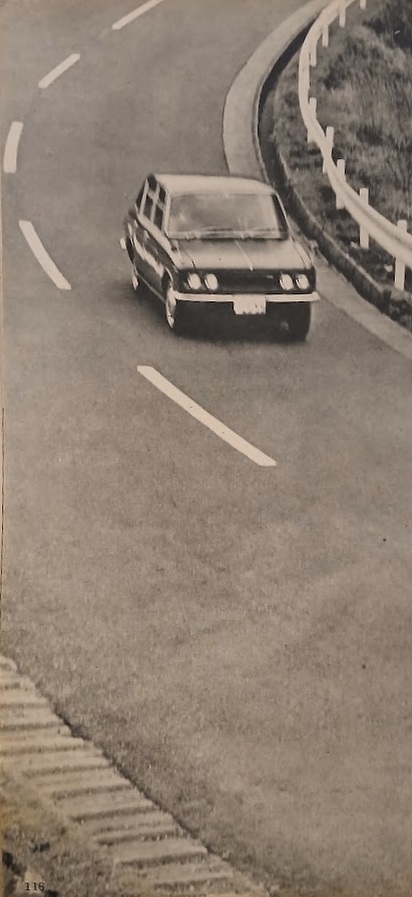
The size of the body, which had been an advantage when driving in a straight line on roads such as the Tomei Expressway, became something of a disadvantage when negotiating the succession of corners on the Hakone Shindo. The car took on a rather ponderous feel, with its body roll and other movements contributing to a lack of sharpness.
This tendency persisted on the Izu Skyline, with its succession of bends on relatively level ground. Near Jukkoku Pass, where the pavement was rough, the addition of pitching motions demanded even more careful attention to the steering. Of course, the car itself maintains good grip through corners and can withstand quite hard cornering, but this seems to demand even greater concentration from the driver.
The disc brakes greatly improve braking stability at high speeds, and I was able to use them hard with complete confidence. But why should the disc pads already be making high-pitched squealing sounds after only 3,000km? Perhaps one must simply accept this as a characteristic of Japanese cars in general, but I would like to see the component suppliers give more attention to the materials they use.
One sometimes sees strawberries displayed at fruit shops, with fine, evenly sized berries arranged on top and rather poor ones hidden underneath. I cannot help thinking of such deceptively displayed strawberries when using Japanese disc brakes. They feel excellent immediately after the pads have been replaced, yet after another 2,000km the feel is completely different. This is not unique to the Florian, but common to Japanese cars in general. Should manufacturers not be more demanding of their suppliers in technical matters, rather than concentrating so much on cost?
If a driver finds such high-pitched squealing unpleasant, he should complain about it repeatedly. That will make the manufacturer take notice, improve quality, and ultimately lead to the development of cars and components fully capable of holding their own on the world market. Users should never simply resign themselves to such shortcomings.
I have wandered rather far into the details, but I hope this criticism will be understood in the spirit in which it is intended. It is precisely because the Florian TS I drove this time is fundamentally so free of faults that I am making such demands.
Stable Cornering Characteristics
Among those most interested in the introduction of the Florian TS, there must be quite a few rally enthusiasts. Ever since the Florian appeared as a factory entry in last year’s 10th Japan Alpine Rally, I imagine many rally drivers have been considering trying the car, attracted by its spacious interior and the prospect of reduced fatigue. The new TS should be a particularly tempting proposition for Japanese rally drivers.
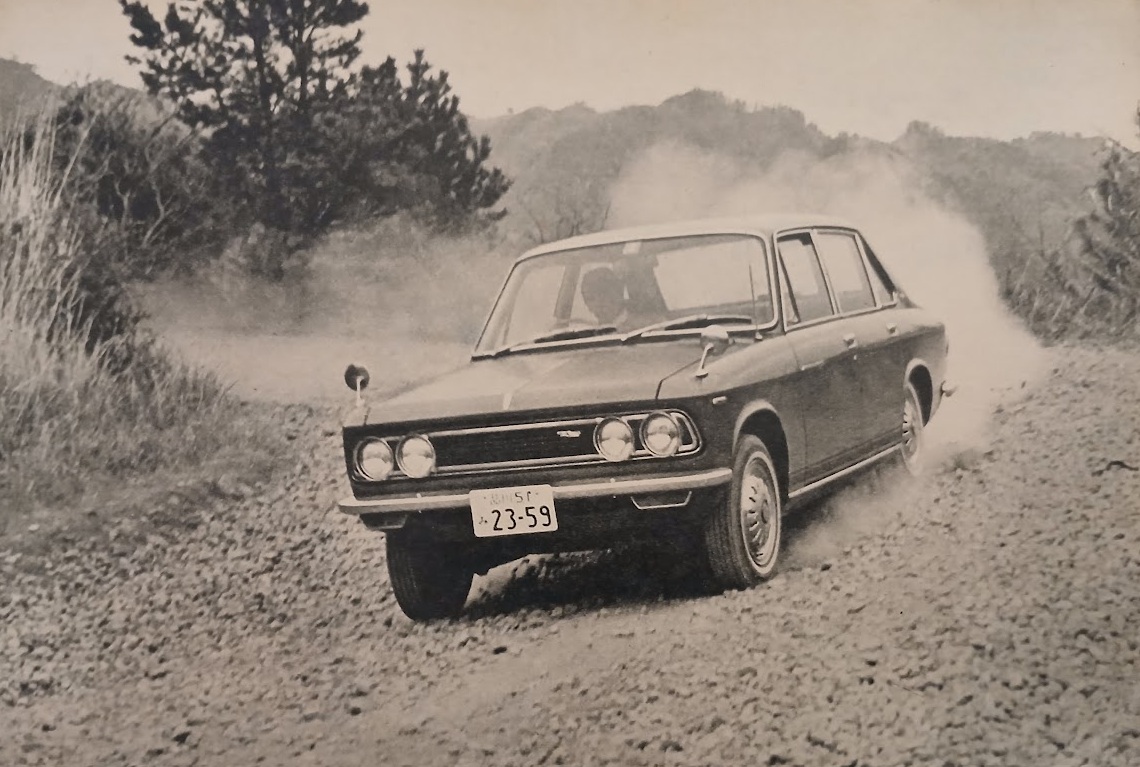
With this in mind, I took the car onto the unpaved roads of the Amagi mountains to assess its potential as a rally car. As it was daytime and I had a passenger with me, I was unable to put the car through as severe a test as I would have liked. Nevertheless, I offer my impressions in the hope that they may be of some use.
Generally, when a car is driven over an unpaved road, if the shocks transmitted from below and the driving force do not work together properly, either the front or rear will tend to stray from the intended line. In the Florian’s case, however, judging from the effect of the gas-filled shock absorbers and the feel of the front suspension, one can tackle an unpaved course with confidence.
Naturally, the body roll and the way cornering forces are transmitted, owing to the car’s size, do not give it the sharp response of a smaller car. On the other hand, this same characteristic contributes to the car’s stability. When deliberately sliding the rear to point the car quickly into a tight corner, a driver who is used to the sharp GT-type cars of the 1- to 1.5-liter class will find the response almost frustratingly slow.
On the other hand, I think this also makes the car less likely to spin suddenly as a result of a small mistake, and from the standpoint of safety, the Florian TS may actually have an advantage. Still, the vague, floating sensation I noticed on paved roads remains present on unpaved surfaces. Although the car corners securely and holds its intended line on the straights, there is still something about its behavior that prevents the driver from fully relaxing. Perhaps the cause lies in the steering ratio or the steering wheel itself.
Once this point is taken into account, however, the effect of the gas-filled front shock absorbers is excellent, and the rear-end behavior seems to be among the most stable of any Isuzu car. I believe the Florian TS could be used quite satisfactorily in a rally without any modifications.
Having given the car passing marks in every area, I would now like to mention a few points that I hope will be addressed in the next minor model change.
A Horn That Is Easier to Operate
Regarding the exterior, I understand that a matte-black finish for the hood will be available as an option, but I find it difficult to understand the purpose of this. Presumably, the intention is to reduce reflected light and lessen driver fatigue. But if that is the case, I cannot help asking what will be done about the chrome plating on the fender-mirror supports and windshield-wiper arms.
Next, I have two requests concerning the steering wheel. The first is to make it easier to operate the horn ring built into the GT-type wood-grain wheel. With a thumb resting on a steering-wheel spoke, it seems impossible to press the horn ring fully with the pad of the thumb without changing one’s grip. With sports-type wood-grain steering wheels, one’s hand must often be taken off the wheel altogether to sound the horn. In this respect, the Florian TS is reasonably well designed, since the driver can operate the horn without letting go of the wheel, but in practice it is necessary to press the ring with the tip of the thumb to sound the horn properly.
My other request may simply be a matter of personal preference, but I think the steering-wheel rim could be made a little thicker. Perhaps this is because of the slight floating sensation mentioned earlier. When a car feels this way on the road, a thin steering-wheel rim can give the driver a psychological sense of insecurity.
Questions About Instrument Design
The driver’s seat offers a wide range of adjustments for finding a suitable driving position, which is welcome, but after covering nearly 500km, I began to wonder whether it might be mounted a little too low. There is a tendency for the driver to slouch and gradually sink down into the seat.
Next, there is the design of the instruments. The color red is generally associated with danger, and I believe its use should be limited to warning the driver of undesirable conditions, such as a drop in oil pressure, a parking brake left on, or any of the various other things that could go wrong with the car. I do not think it desirable to have other touches of red around the instrument panel constantly catching one’s attention.
Looking back over these points, it is clear that the changes I would like to see are all very minor details, which suggests that the Florian TS is fundamentally a well-developed product.
Because Japan’s domestic engine-displacement classification draws a dividing line at 2 liters, Japanese manufacturers must satisfy every requirement within a limited engine capacity. Specific output now seems to have reached levels comparable to those of sports cars, but unlike American manufacturers, who can simply increase displacement to gain more acceleration, Japanese makers have little choice but to improve performance by reducing weight.
As a result, Japanese cars inevitably tend to lack a certain solid, substantial feel. In this sense, the Florian can be considered a success. For a car in the 1600cc class, it offers a spacious, accommodating interior and has succeeded in establishing the image of a refined, comfortable owner-driven car. Moreover, the introduction of the TS, with its emphasis on acceleration, goes a long way toward overcoming the somewhat sluggish character that the Florian’s relatively large body might otherwise impose.
The Image of a Youthful Sheep
The idea of concealing GT-class performance beneath the exterior of an ordinary family car has often been pursued by manufacturers under the familiar expression “a wolf in sheep’s clothing.” Yet in many cases, the disguise has not been entirely convincing, with the wolf’s tail occasionally poking through. In the case of the Florian TS, however, there seems to be nothing that betrays the presence of a wolf, and this makes a favorable impression.
In fact, the Florian TS is no wolf in sheep’s clothing. Rather, it might be described as an especially young and energetic sheep within the flock. If buyers approach the Florian TS in this spirit, thinking of it as a youthful sheep rather than expecting the character of a wolf, I do not think they will be disappointed at all.
Postscript: Story Photos