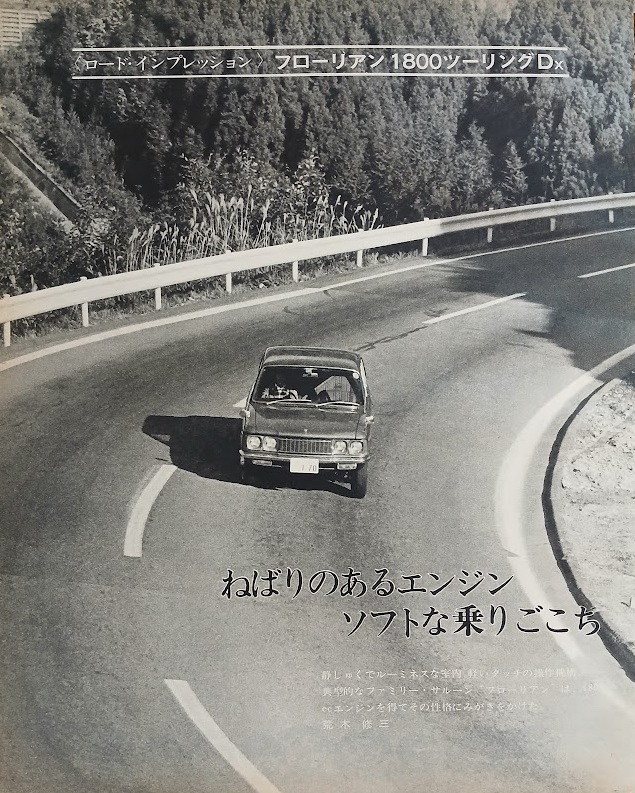
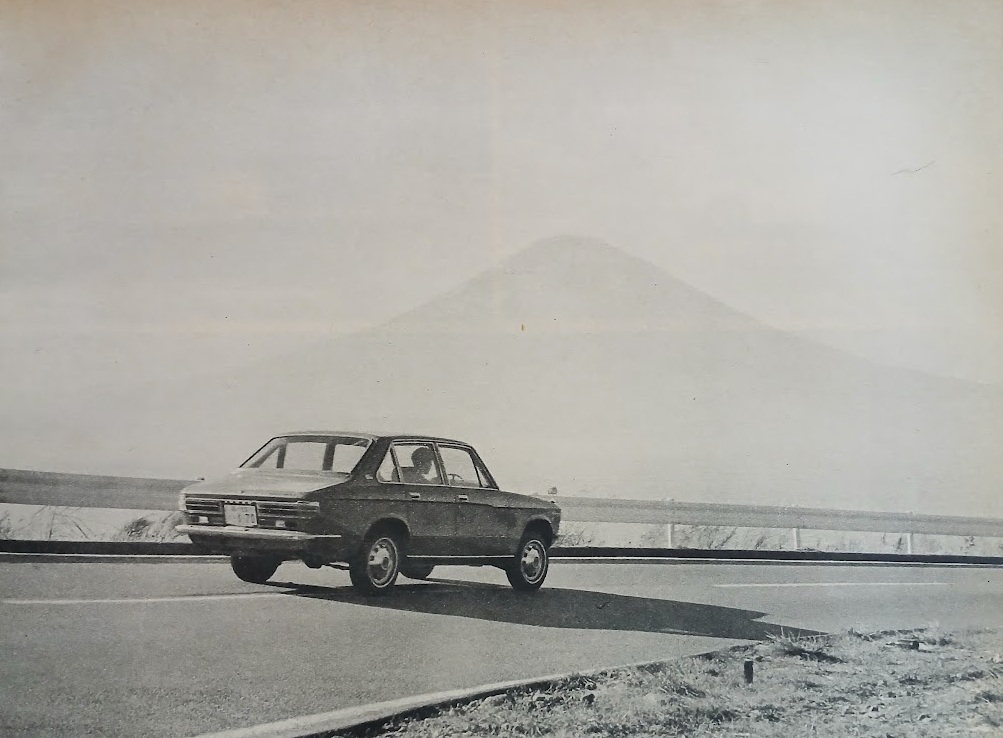
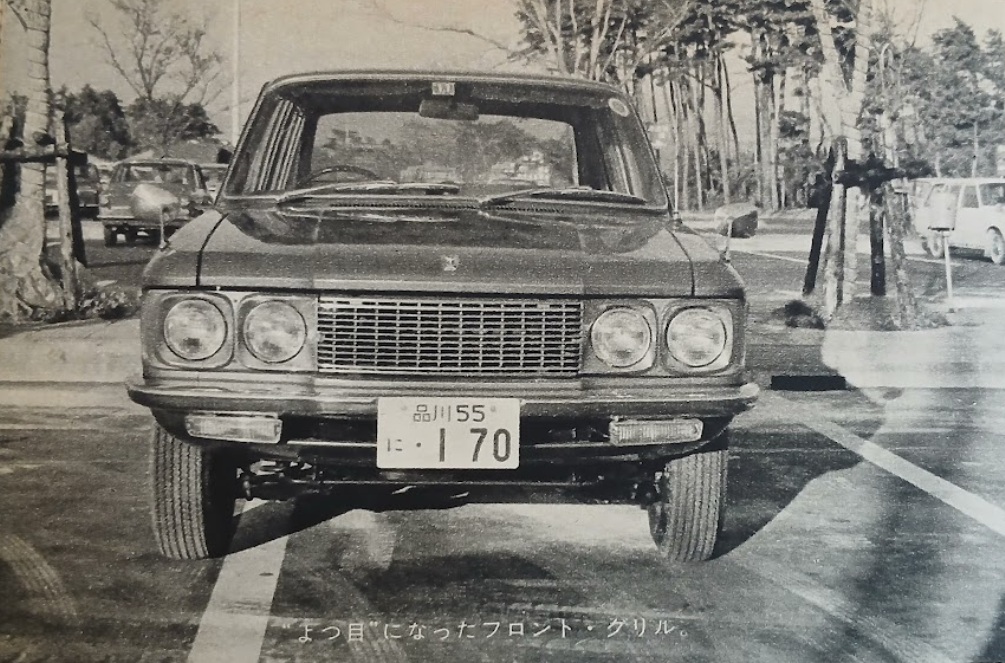
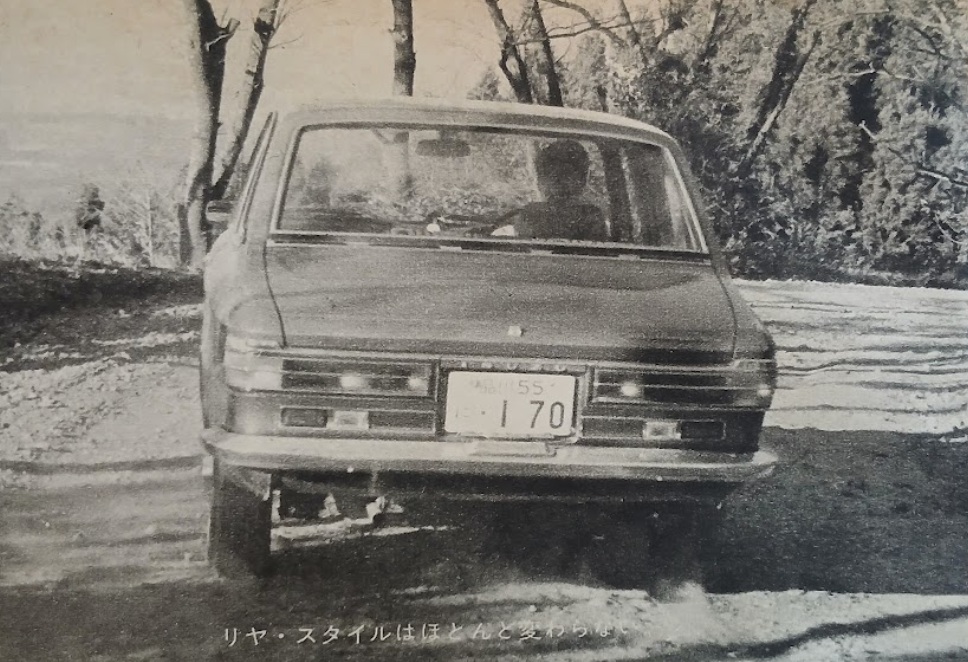
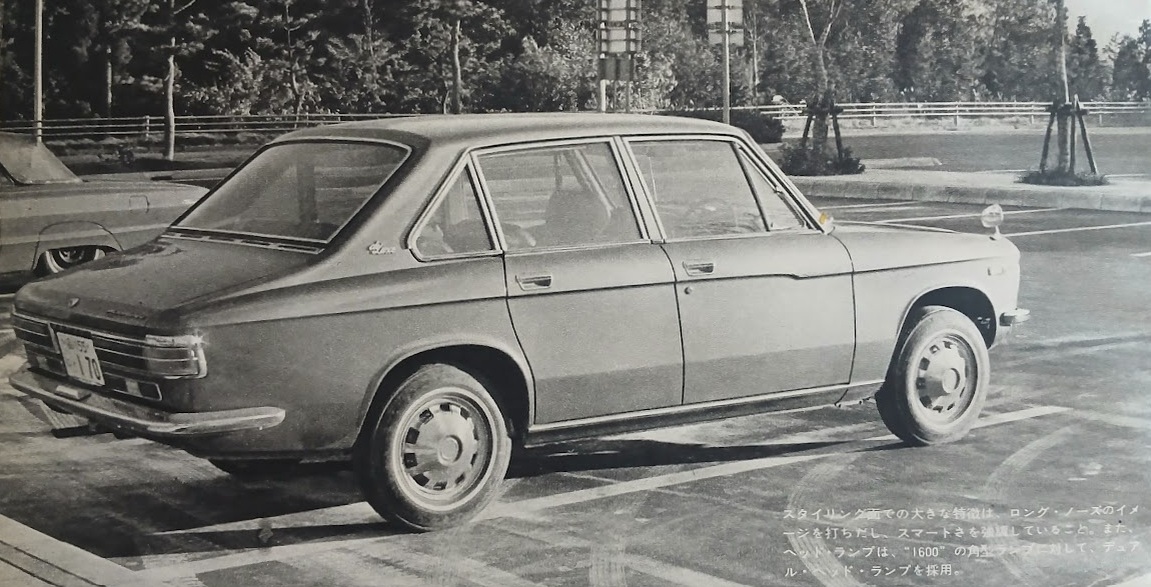
Isuzu Florian 1800 Touring Deluxe (1971)
Publication: Motor Fan
Format: Test Drive Report
Date: January 1971
Author: Shuzo Araki
A Flexible Engine, a Supple Ride
A quiet, spacious interior. Light, effortless controls. Already a pure family sedan, the Florian, has gained a new 1800cc engine that further strengthens its character.
The Advantages of Greater Displacement
Increasing engine displacement while leaving the body unchanged is a well-established approach. Indeed, it is no exaggeration to say that nearly every Japanese car has followed this path. In the so-called “popular car” class, the familiar progression has been to begin at 800cc, then grow to 1000cc, 1200cc, and 1300cc. Meanwhile, some engines originally introduced at 1300cc have ultimately been enlarged to displacements as high as 1800cc.
Naturally, there are limits to how far a single engine block can be shared. Some manufacturers, however–notably Ford of Germany–have pursued production efficiency to the point of alternately increasing bore and stroke until the final engine bears little resemblance to the original (if it is indeed possible to say which version was the original). The result, in some cases, is an extremely oversquare engine.
Japanese manufacturers have not taken the idea quite that far. Instead, engines are generally designed with a certain degree of future enlargement in mind. Once that limit is reached, an entirely new engine is developed. Since designing a new engine is an expensive undertaking, every effort is naturally made to give each design the broadest possible range of applications.
The main advantage of increasing displacement is that output and torque are easily improved. Above all, the increase in torque makes a substantial contribution to ease of driving. In simple terms, it provides the driver with the added reserve that comes from an extra few hundred cc. Because higher output is achieved through greater displacement rather than higher engine speeds, quietness and durability also benefit. It is advantageous, too, in addressing today’s concern for cleaner exhaust emissions.
For the manufacturer, it is an inexpensive way of increasing a car’s appeal. And if the price difference amounts to only a few tens of thousands of yen, buyers naturally tend to opt for the higher-grade model. By taking advantage of this purchasing psychology, manufacturers can encourage customers to move upmarket, increasing profit margins in the process. The gap left behind can then be filled with another new model, creating additional demand at a lower price point.
This pattern of development has been followed throughout the world, but in Japan the cycle has moved especially quickly, no doubt reflecting the country’s rapid motorization. At the same time, domestic cars have traditionally tended to have larger engines relative to their body size than European cars. Increasing displacement still further, while simultaneously extracting more power at higher engine speeds, has certainly produced outstanding performance. Even so, one cannot help wondering whether the rest of the car has always been able to keep up.
Smooth Progress Through City Traffic
Now, onto the subject at hand. Unlike the general trend among Japanese cars, the Florian has always had a body somewhat larger than its engine might suggest. Even with displacement increased to 1.8 liters, it never feels out of balance.
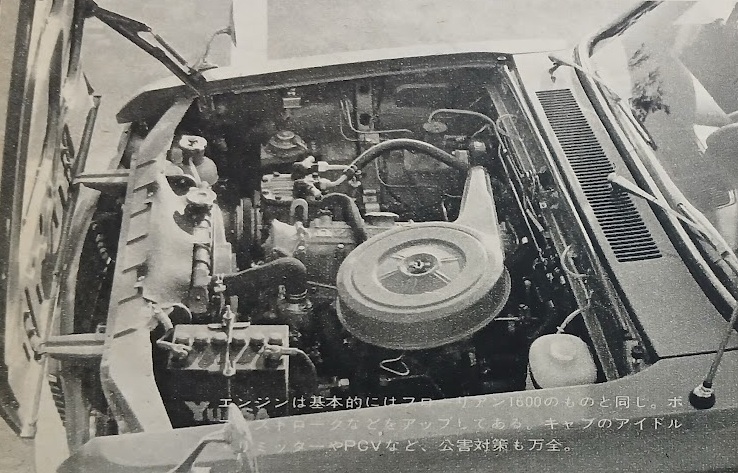
The increase in displacement has been achieved by enlarging the bore from 82mm to 84mm and extending the stroke from 75mm to 84mm, resulting in a square 1817cc engine. Because of the longer stroke, all the major components–including the cylinders, connecting rods, crankcase, and the camshaft timing chain–have been redesigned. Other changes accompanying the increased displacement include larger intake and exhaust valves and intake ports. Naturally, the pistons have also been revised.
The carburetor is also new, using a two-barrel design that combines features of the Rochester and Stromberg types. This setup is fitted only to the Deluxe tested here. Elsewhere in the Isuzu range, twin SU carburetors are used on the Florian TS, Bellett 1800GT, and Isuzu 117 Coupe. Measures to reduce exhaust emissions include an idle limiter for the carburetor and a PCV (Positive Crankcase Ventilation) system.
Taken together, these represent fairly extensive changes, and in terms of manufacturing cost, they can hardly be described as especially efficient.
Fundamentally, however, the engine remains the same design as before, retaining its emphasis on strong performance at low and medium engine speeds.
The increase to 1.8 liters further strengthens that character. In single-carburetor form, maximum output rises to 100ps/5400rpm, while peak torque increases to 14.6kgm/3000rpm–gains of 10ps and approximately 1.9kgm over the 1600, both achieved at the same engine speeds. Even more revealing is the torque curve, which remains very flat, delivering more than 14kgm from 2000-5000rpm.
This does not mean that the engine is unwilling to rev. Above about 4000rpm, however, the engine note becomes louder. Because that sound takes the form of a low-frequency boom, it can become something of a psychological burden for the driver.
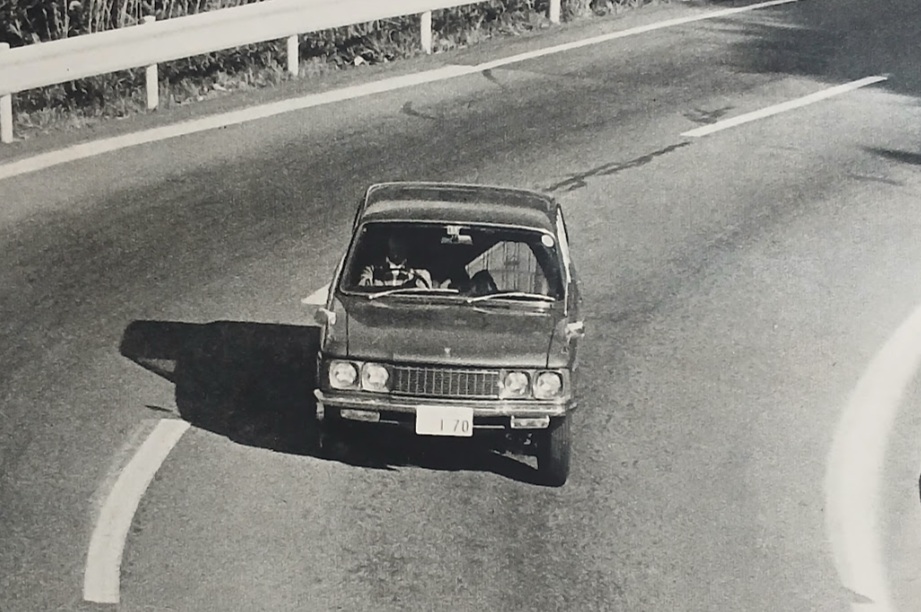
For example, cruising on the Tomei Expressway at 100-110km/h is exceptionally quiet and comfortable. Press the accelerator farther, however, and the booming resonance begins to make itself heard. Admittedly, the test car was virtually brand new, having covered only 50km, so I did not increase speed beyond 120km/h. In that sense, the slightly rough feel at higher engine speeds–and the impression that the engine is running out of breath, largely caused by the change in engine note–may simply have been the result of an engine that had not yet loosened up.
In city traffic, the combination of a flexible engine and well-chosen gear ratios makes for smooth, effortless driving. It is very much the sort of car that can be left in top gear and simply driven.
The gearbox retains the same short, positive shift action as before. The only reservation–and I suspect this may have been a matter of the transmission loosening up–was that first gear felt a little reluctant to engage. Apart from that, shifts were positive, with light effort. The synchromesh is highly effective, giving the gearbox a satisfying feel. The slight tilt of the gear lever toward the driver is another thoughtful touch.
At higher engine speeds, the gear lever had previously suffered from pronounced vibration, but this has now been almost entirely eliminated. Resting one’s left hand on the lever no longer produces the sensation of receiving an “electric massage.”
Naturally, this has also reduced the amount of noise transmitted through the gear lever. One point did stand out, however. With the rest of the car now quieter, the gear whine in first and second gear has become more noticeable, particularly under engine braking. This criticism is hardly unique to Isuzu; it is something that could be said of Japanese cars in general. Greater precision in gear manufacturing would go a long way toward reducing this noise.
As opportunities to drive on expressways like the Tomei continue to increase, it is certain that an overdrive top gear will become increasingly desirable. The advantages are obvious: lower noise levels and improved fuel economy. Needless to say, however, such an overdrive gear is only worthwhile if executed with sufficient precision.
In that respect, I found myself wishing for an overdrive gear in the Florian. The existing 4-speed gearbox is rather widely spaced, although the overall matching is satisfactory apart from a rather low first gear ratio of 3.507. Given the engine’s character, frequent shifting is unnecessary in any case. The final-drive ratio is a fairly tall 3.727, but perhaps because the Florian combines a relatively light 960kg body with an engine with generous low-speed torque, it never feels sluggish.
Overall, its performance is typical for the class, and the emphasis placed on ease of use is, while perhaps not very exciting, worthy of particular praise.
That said, compared with earlier Isuzu engines, this one is already noticeably more willing to rev…
A Few Other Impressions…
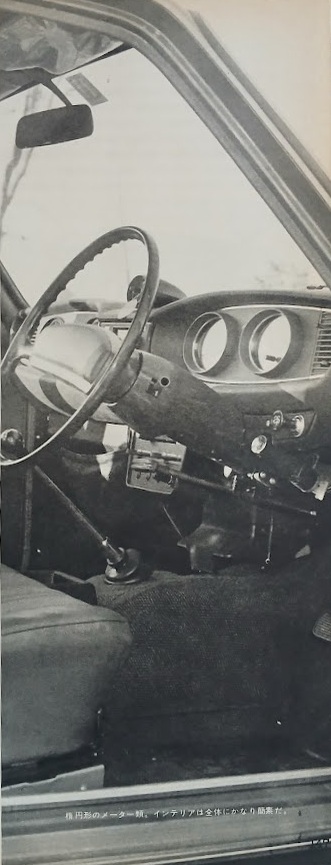
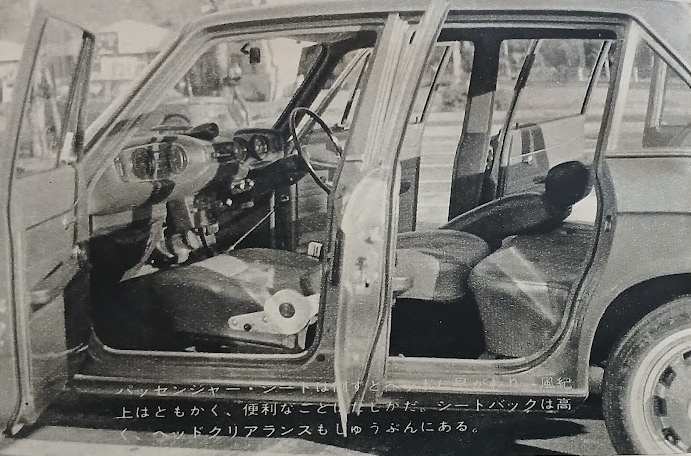
The interior retains the same oval-themed design, so the overall impression is much the same as before. The main difference is the seat upholstery, which now uses a woven vinyl material. It feels pleasant to the touch and seems particularly well ventilated. Both the seat shape and cushioning are well judged, and it fits the body well. Although the seating position is somewhat high, the seatback is tall enough and headroom is generous, making it easy to settle into a relaxed driving position. There is also plenty of seat travel.
Fold the passenger seat down flat and it becomes a bed. Remove the headrest, and the driver’s seat quickly does the same. Manufacturers no longer highlight this in their advertising because it was seen as somewhat indecent, but in all seriousness, it is a genuinely useful feature, and certainly one of the Florian’s selling points.
The cabin is bright and spacious. There is generous foot room, and the provision of a footrest to the left of the clutch is welcome. The test car was fitted with the factory-option air conditioner, which occupies the glove box position. Even so, the cabin retains a “simple” atmosphere. Compared with today’s increasingly over-decorated interiors, it lacks what one might call a “gorgeous” mood. A little more “trimming” around the instrument panel and center console would create quite a different impression.
The servo-assisted drum brake system, twin-leading in the front and leading-trailing in the rear, is rather uncommon, but braking remains well balanced from side to side, the pedal has good rigidity, and the overall feel is not bad. Although the rear brakes are not fitted with a hydraulic proportioning valve, they resisted locking even under fairly heavy braking.
The pedal is perhaps a little too light, however. This may simply be a matter of familiarity, but I found it somewhat difficult to modulate, and I could not help but feel that this type of system might also be more susceptible to fade. Since I had no opportunity to confirm this during the test, however, I cannot say so with certainty.
Under hard braking, nose dive is fairly pronounced.
The suspension has been revised with stiffer front springs and De Carbon shock absorbers, yet ride quality remains supple. The pedals and controls all operate with a light touch, and the steering is also light. There is virtually no friction in the steering, making low-speed maneuvering effortless, and the car is easy to handle in city traffic.
Once speeds increase, however, the steering begins to feel a little too light. I had the impression that steering-system rigidity was somewhat lacking.
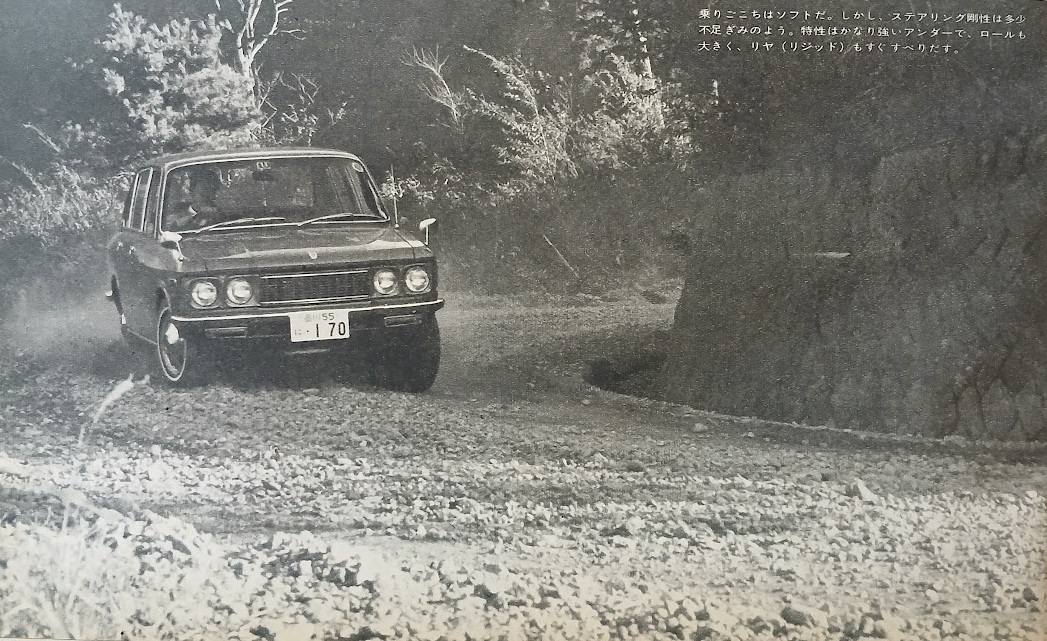
This is entirely in keeping with the Florian’s character, but turn-in is by no means sharp, and the handling exhibits fairly pronounced understeer. Body roll is considerable, and because the tires do not generate especially high cornering forces, the rear will begin to slide quite easily. Even so, it remains easy to control. The Florian also proves surprisingly capable on gravel roads and other rough surfaces. Despite the conventional live-axle rear suspension, rear-wheel adhesion is good.
The test took place in unusually strong crosswinds, and while driving on the Tomei Expressway the Florian was noticeably affected. Because steering effort is so light, the steering wheel tends to feel almost as if it is floating when struck by a crosswind. That is not to say the car ever became difficult to control, of course.
On the return journey, the wind eased somewhat, allowing the Florian to demonstrate stable and reassuring road manners.
Fuel consumption over the 227km test route was 8.4km/l, measured by the full-tank method. Considering that the car was virtually brand new and that roughly 90% of the distance was covered at around 100km/h, this seems a reasonable result.
In Japan, the 1.8-liter class is largely occupied by “personal cars.” The Florian 1800, by contrast, is very much a pure family car, its character more closely resembling that of a European family sedan. In that sense it is rather unassuming, but perhaps it is, in fact, a car a step ahead of its time.
Few cars are as immediately approachable as the Florian. Even someone driving it for the first time will find it natural and straightforward to handle. Its qualities are exactly those one would expect of a family car.
If I were to ask for anything more, it would be a little additional “refinement” in some of the details. Then again, perhaps that very “plainness” is part of what gives the Florian its sense of trustworthiness as a family car.
Postscript: Story Photos