Isuzu Florian TS (1969)
Publication: Car Graphic
Format: Road Impression
Date: September 1969
Author: Kenji Kikuchi
Road-testing the Isuzu Florian TS
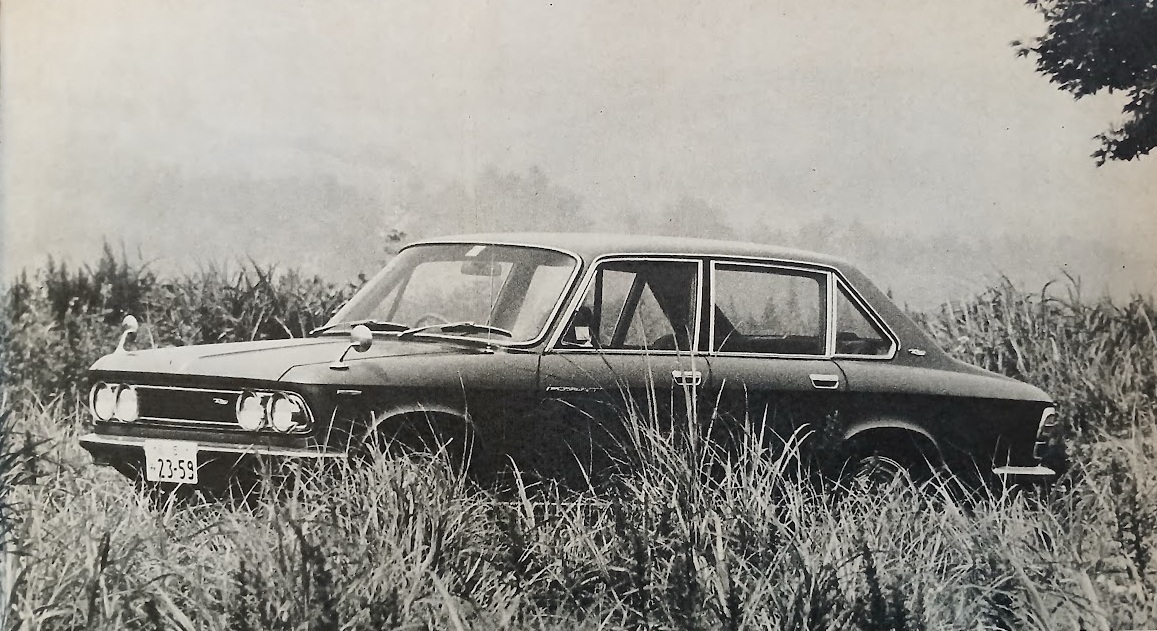
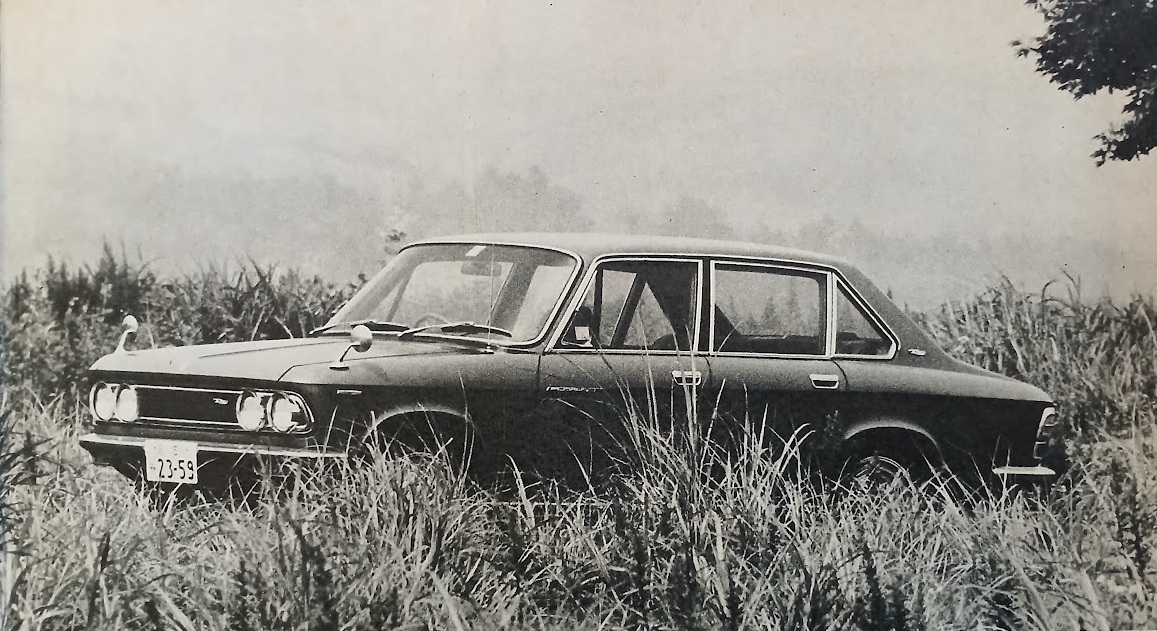
There are no outstanding features or attention-grabbing qualities to speak of, but the Florian TS (Touring Sports, PA20SD) is a sporting sedan built with thoughtful attention to detail and a conscientious approach. It was introduced this past March, when the Florian series underwent a minor change, as a model positioned between the existing Deluxe and Super Deluxe. Its character is much the same as that of the Bellett 1600 Sports, but it is a new model aimed at a market one class higher.
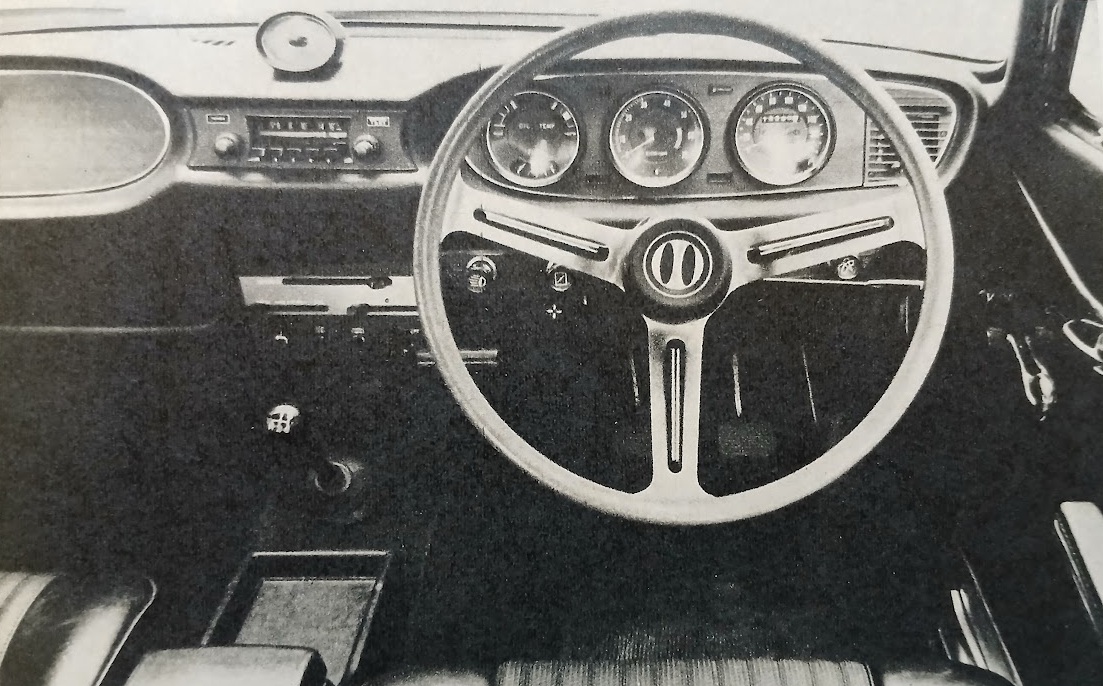
The Florian has already earned a good reputation for its spacious accommodations, and the TS carries these over while adding a suitably sporting atmosphere. Separate seats with a center console, round gauges, a three-spoke steering wheel, and interior trim finished all in black are examples. The interior dimensions are also generous enough to seat five adults comfortably.
The separate seats in the TS differ from those of the standard model in both their frames and padding, and are designed for high-speed driving. The seating position is somewhat low, though not to the extent of the Bellett GT. The steering wheel is also well positioned relative to the seat, giving a very natural and comfortable driving position.
The seats themselves are generously dimensioned, with thick, moderately soft cushions, good lateral support for the back, and good support beneath the thighs. Fore-and-aft adjustment is 140mm, with an 8° angle of inclination, and of course the seats are fully reclining. A headrest is provided only for the driver’s seat, while 2-point seat belts are standard on both front seats.
In our Florian test report in the January 1968 issue, we wrote that the fender mirrors gave too wide an angle of view, but on this TS they have been improved to give a more natural view, closer to that of a flat mirror. The test car was also fitted with the optional matte-black hood treatment. It looks a little ostentatious, but proved effective under the strong midsummer sun. If the car had been painted ivory, the benefit would probably have been even more evident.
The rear seat accommodates three, and its full width is usable because the wheelhouses do not intrude at either end. Even with the front seats adjusted all the way back, plenty of legroom remains. The assist grips above each door are also convenient.
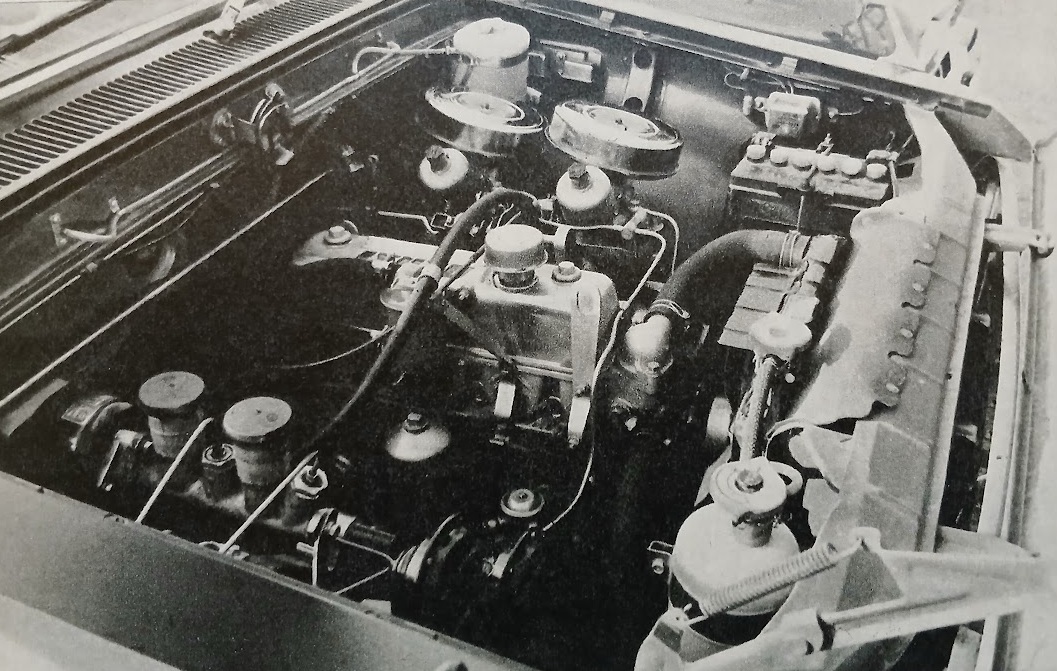
The engine is basically the same as that of the Bellett 1600GT, fitted with twin SU carburetors and developing 90ps/5400rpm and 13.0kgm/4200rpm. The gearbox is the same fully synchronized 4-speed used in the standard Florian, but instead of the 4.1 final-drive ratio it is combined with the Bellett GT’s 3.727. With 90ps to propel a car weighing 950kg, the power can be summed up as both necessary and sufficient. The gear ratios, too, are generally well matched to the power and weight of the car.
When we picked up the test car, the idle had been set rather high at 1000rpm, although during the test it occasionally dropped to 700-800rpm. The tachometer’s yellow zone extends from 5500-6000rpm, with the red zone from 6000-7000rpm. Taken to 6000rpm, the car reaches 52km/h in first gear, 85km/h in second, and 130km/h in third (all indicated). The engine revs up smoothly and quickly, producing a distinctive exhaust note reminiscent of the 117’s twin-cam engine. At normal road speeds there is a comfortable reserve of power, and acceleration is more than adequate.
Engine noise is on the low side for this type of car, with no tendency to suddenly become noisy beyond a certain engine speed. Even at around 100km/h, the noise level is lower than the general standard. We did not conduct performance measurements at the test course this time, but the catalog figures are 18.1 seconds for 0-400m and a maximum speed of 160km/h (against 150km/h for the standard model). Judging from the performance curves, 160km/h corresponds to around 5700rpm, and, as Paul Frère also noted in his road impression, the figure does not appear to be exaggerated.
The clutch uses the same pressure plate as the Bellett GT, and its engagement is extremely smooth, allowing even a novice to make clean starts. The shift lever falls naturally to the driver’s left hand when lowered from the steering wheel; its movement traces an exact H-pattern, and it slots positively into every position.
We cruised the Tomei Expressway at 100km/h (the tachometer showed 3250rpm) to measure fuel consumption. The noise level was reasonably low, and there was a comfortable reserve of power. In crosswinds, however, the car is quite easily disturbed, and its straight-line stability leaves something to be desired.
The suspension—independent wishbones and coil springs at the front, with a rigid rear axle on semi-elliptic leaf springs—has been given a more high-speed-oriented specification than that of the standard model. At the front, the coil springs have been stiffened somewhat and De Carbon-type dampers, which proved successful on the 117 Coupe, are fitted; at the rear, the camber of the leaf springs has been revised. The result is a more firmly controlled chassis than the standard model, and the tendency toward pronounced body roll, due to the relatively high center of gravity, has been reduced to some extent.
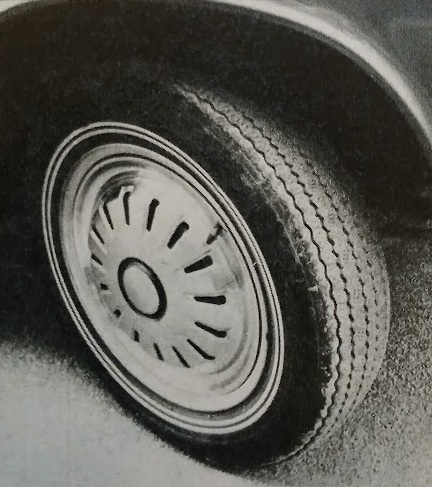
The steering is the same recirculating-ball type as in the standard model, but its response is much better with the firmer suspension and Dunlop GS1 tires. The basic handling characteristic is moderate understeer—about what one would expect for a modern, practical sedan.
The TS has servo-assisted disc/drum brakes, with leading-trailing drums at the rear, and their performance is fully in keeping with the car’s capabilities. Despite the servo assistance, the pedal is not too light, but has an appropriate degree of firmness, and the brakes come in progressively and positively in proportion to pedal pressure. Even under hard braking from around 100km/h, the car stopped in a straight line. It is unfortunate that, as a carryover from the standard model, the handbrake is still an umbrella-handle type beneath the dashboard.
Fuel consumption was measured over approximately 500km, returning a fairly average figure of 8.3km/l overall. On the first measurement, which included a round trip to Odawara on the Tomei as well as urban and Tokyo driving, the average was 8.42km/l. The third measurement, under much the same driving conditions, returned 7.78km/l. On the second, cruising the Tomei at 100km/h, we obtained 10.74km/l. For a 1.6-liter, 90ps sporting sedan, the fuel consumption can be considered reasonable.
One of the Florian’s characteristics is the solid construction of its body. The TS supplied for our test by Isuzu’s public-relations department had already covered some 12,000km and had apparently been treated fairly roughly in tests by various magazines. One tire was completely bald, the power antenna was broken, the trim on an armrest had come loose, and the glovebox lock was not working. Nevertheless, there was no sign whatsoever of looseness or fatigue in the body itself, and even when driven hard over rough roads it produced no extraneous noises. This would seem to indicate unusually high body rigidity and painstaking construction. The doors give the same impression, closing with a satisfying click.
As for the car’s equipment, one of its best features must be its intermittent wipers. Unfortunately, we had no rain during the test period, but while washing the car we were able to get some idea of how useful they can be. By means of a transistor and condenser built into the wiper switch, the frequency of operation (not the speed of the wipers themselves) can be varied through four settings.
Turn the switch knob one position to the right, and the wipers operate intermittently at a rate of 10 times per minute; the second position gives 30 times per minute, the third 55, and the fourth continuous operation at 75 times per minute. On the first, least frequent setting, they suddenly sweep the windshield just about when one has forgotten about them. In light rain, or when driving on roads with standing water, there is no need to go through the bother of repeatedly switching the wipers on and off; one can simply leave them on the intermittent setting. We found this an extremely useful feature.
The washer is operated by pressing the switch knob, and the wipers automatically make several sweeps at the same time, another welcome feature. This useful intermittent-wiper system is standard equipment only on the TS. Another feature fitted only to the TS is an electrically heated rear window with printed heating elements. Needless to say, this comes into its own when the rear window fogs in winter or on rainy days and obstructs rearward visibility. We were unable to try this feature during the test period either, but as a means of clearing the rear window, it would seem more effective than an air defogger.
Among the smaller details, at night, pale green lamps illuminate the locations of the wiper and light switches, the ignition key, ashtray, and cigarette lighter. These are not the least bit distracting while driving. The parking lights can also be selected in three ways: left side only, both sides, or right side only.
As we said at the beginning, the Florian TS has no single outstanding feature, but its many small accessories show considerable thought and a conscientious approach. The same can be said of such things as the jack, which should be easy to handle even for women, and the comprehensive tool kit.
Postscript: Story Photos