Isuzu Bellett 1600GT (1966)
Publication: Motor Fan
Format: Test Drive Report
Date: December 1966
Author: Atsuro Sasaki
The Bellett GT in All-Weather Driving
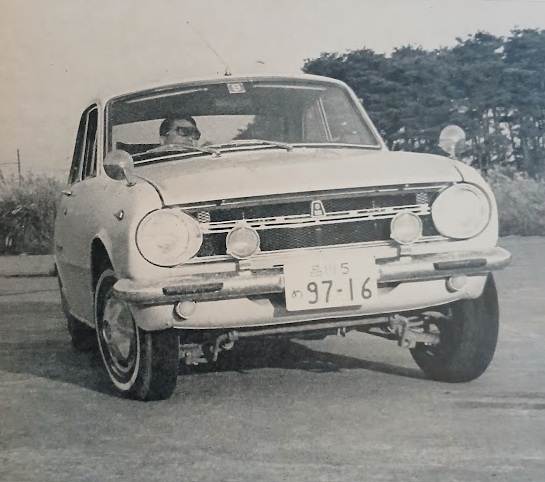
It has been about two and a half years since the Bellett 1600GT went on sale in the spring of 1964, and I now have the opportunity to test-drive the newly revised model. Although described as a minor change, the revisions go well beyond alterations to the grille and instruments. Output has been increased by 2ps to 90ps, while mechanical improvements include a five-bearing crankshaft, a fully synchronized 4-speed transmission, a revised final-drive ratio, and closer-spaced transmission ratios. Clearly, a considerable amount of work has gone into improving the car’s performance, making this a test drive I was very much looking forward to. The question was, where should I take it, and what sort of roads should I drive?
Choosing a Route Befitting a GT
For this test of the Bellett 1600GT, I wanted to choose a setting that would suit the term “Gran Turismo.” How about the highlands in late autumn? There would be good roads comparable to highways, as well as rough roads suitable for giving the car a workout. Why not venture as far as the foothills of the Northern Alps? The Kashimayari International Ski Resort in Nagano Prefecture seemed a promising destination. The journey there would offer a wide variety of public roads on which to evaluate the car. At roughly 300km each way, it would also provide an opportunity to measure fuel consumption. With that in mind, I decided to take the Koshu Highway.
On the day of the test, a heavy-rain warning was issued for the afternoon (the same day that a record-breaking rainfall struck Aichi Prefecture), and Nagano Prefecture lay directly in the path of the passing weather front. In the mountains, we encountered fog, torrential rain, and rough roads under construction. The following day brought clear skies, though with rather strong winds. Quite unexpectedly, the journey turned into an all-weather test drive, with everything but snow and ice. I hope I won’t be accused of excessive praise, but this car provided fully satisfactory answers to every question I put to it. That is rather a lengthy introduction, but I hope readers will take what follows as a firsthand account of the drive—a sort of motoring journal.
Improved Instrument Panel Layout and Readability
The Bellett 1600GT provided by Isuzu Motors was still virtually a new car, having covered only about 1,500km, perhaps because so little time had passed since its introduction. When I showed some hesitation at this, Mr. H, the representative in charge, confidently assured me, “Please don’t worry about it. It’s already had its 1,000km inspection, and we’ve checked it thoroughly.”
Come to think of it, while things might have been different with cars of five or six years ago, to insist on nursing a modern car through 3,000 or 4,000km of careful running-in is simply an old habit followed unconsciously. At the very least, a car that needs to be treated so gingerly and coddled from the outset cannot be considered up to international standards. Armed with this rather peculiar logic, I started the engine and entered Metropolitan Expressway Route 1 at the Suzumori interchange in Omori, Tokyo.
I had already driven the previous Bellett 1600GT for about 20km some two years earlier. How, then, did the cockpit feel by comparison? Caught in the afternoon rush-hour traffic, with little opportunity to build up speed on Route 1, I took the chance to look around.
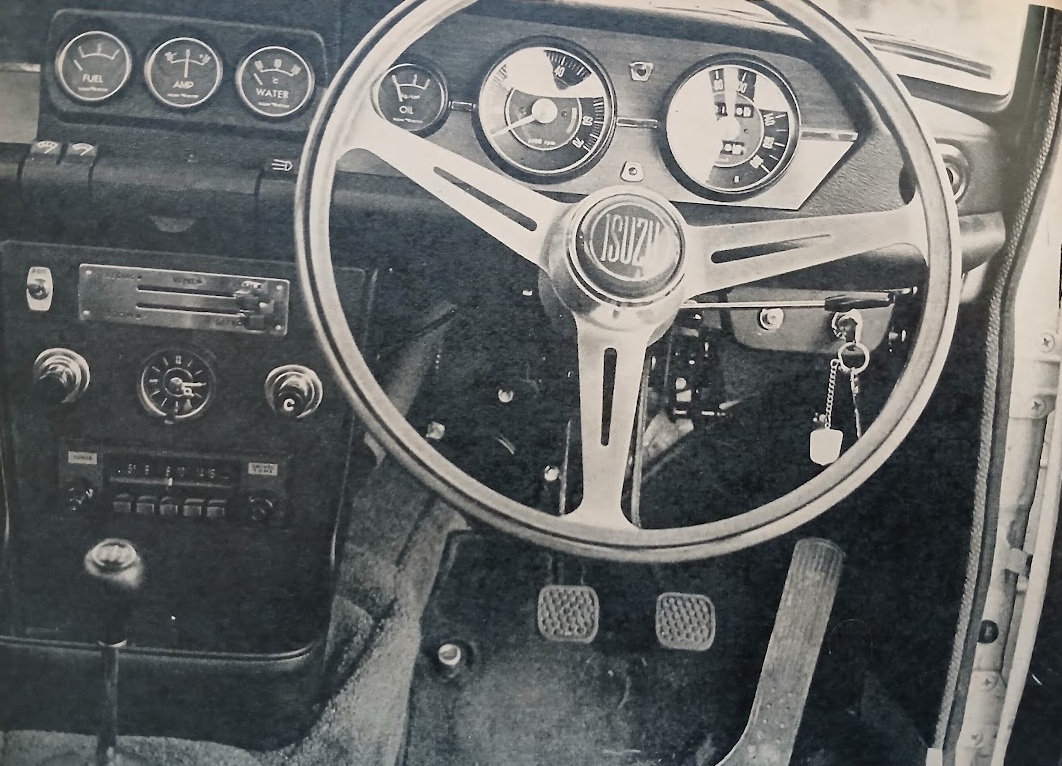
First, the instruments. The instrument panel has been changed. It now follows the same basic design as the recently revised 1500 sedan, but incorporates woodgrain trim. The oil-pressure, water-temperature, ammeter, and fuel gauges, previously housed in the console, are now arranged along the central axis of the instrument panel, with a straight chrome strip running from right to left. A quick glance across the gauges is enough to read their needles. They are certainly easier to see. Moreover, the gauges have been cleverly spaced so that the upper-left portion of the steering wheel does not obscure them. A particularly thoughtful touch.
As a result of this change, the console has been rearranged. The heater controls occupy the upper section, with the fog-lamp switch to their left. Below these, from left to right, are the cigarette lighter, clock, and choke knob. The clock remains in the same position as before and is still rather difficult to see. At the bottom is the radio. Its low position makes it rather difficult to search for a station when the frequency changes during a trip through the countryside, particularly when traveling at high speed. But then, operating the radio is really the navigator’s or co-pilot’s job. I suppose this cannot be helped.
Returning to the gauges directly ahead of the driver, the speedometer is on the right and the tachometer on the left. The yellow zone still begins at 5500rpm, with the red zone at 6000rpm. Both gauges have thin needles that are easy to read. The tachometer also has fine graduations at every 500rpm, making it even more legible. The needle points straight up at 3500rpm, while at the engine’s maximum-torque speed it is at approximately the one-o’clock position.
Between the two main gauges are two fan-shaped chrome bezels containing round indicator windows. The upper one is the green turn-signal indicator, while the lower is the red high-beam indicator. Compared with the green turn-signal light, the one for high beams seemed rather dull and dim, which bothered me. My concern was whether it would be visible enough when my eyesight had been affected by the headlights of an oncoming car. Of course, one should notice from the brightness of the headlamps themselves, and in any case, oncoming drivers will promptly remind you by repeatedly flashing their high beams. Nevertheless, it would be better if the indicator itself were easier to see. The turn-signal indicator is clearly visible even in daylight, and at night it is almost too bright.
I think the high-beam indicator would be improved by replacing its dark red color with something less obtrusive, such as violet or orange, while increasing its brightness.
There is one more improvement worth mentioning in the instrument layout. Ahead of the console, between it and the gear lever, a tray has been provided, about 5cm deep and large enough to accommodate an A5-size magazine. This is extremely convenient. Cigarettes, a camera, valuables, chewing gum, sunglasses, and other small articles can all be placed there. Change from toll roads, a wallet, and similar items can be left in the tray and quickly picked up when leaving the car. I found it especially useful for keeping loose change and my camera close at hand, without having to stow them somewhere each time. It also saved me the trouble of constantly searching for my cigarettes. This feature is especially welcome when traveling alone. I regard this kind of consideration as part of what grand touring ought to mean.
There is also a parcel shelf in front of the navigator’s seat, together with pockets in both doors, providing plenty of storage space.
Fully Synchronized Gears and Diaphragm Clutch
We passed quickly along Route 4 and headed west on National Route 20, reaching and passing through Hachioji in about an hour. But from Otarumi Pass on Mount Takao until beyond Lake Sagami, there was a long line of trucks and an almost continuous stream of oncoming traffic, making it difficult to overtake as I wished. On the steep gradients, I found myself repeatedly downshifting as the vehicles ahead slowed, making full use of the advantages of the fully synchronized transmission. The gearbox was still new, so the shift action was rather stiff, but each gear engaged positively. Lever travel is extremely short. Being used to driving cars with long, tall gear levers, I was initially rather bewildered by the Bellett, in which the distance between second and top is no more than about 10cm from side to side.
When shifting quickly from second to third, I had to make a conscious effort to guide the lever carefully through the proper angles. Anyone accustomed to driving a sports car with a short-throw gear lever would probably have laughed at me.
The diaphragm clutch has a distinctive, almost snappy feel underfoot. There is a strong sensation of the clutch engaging firmly and positively, which is reassuring.
Beyond Kofu and Nirasaki, we came to the Ryuo Bypass, a broad, pleasant road rising gently uphill. The rain had become quite heavy, but even on the wet surface the Bellett accelerated strongly. The tires were new, and the car’s good road holding also helped to make easy work of overtaking.
The Bellett is a car that accelerates particularly well above 50km/h. I have often noticed this even in the 1500, and have heard others say the same. One person remarked, “I thought there must be something wrong with the speedometer.” Certainly, acceleration in this everyday speed range leaves nothing to be desired. According to the catalog, the maximum speed remains unchanged at 160km/h, but climbing ability has improved from sin θ = 0.405 to 0.409. The owner’s manual specifies maximum speeds of 48km/h in first gear, 78km/h in second, and 115km/h in third to avoid over-revving the engine. It is hardly surprising, then, that the car accelerates so effortlessly to around 70-80km/h.
On the descent toward Chino, a bus was stopped in the oncoming lane ahead. Although I was approaching with my fog lamps and headlights on, trucks coming the other way were overtaking it one after another. I thought the first three would clear the bus safely, but downshifted into third and began reducing speed. There is always some fool, though. Despite the trucks having to climb the hill at full power, a fourth began pulling out from behind the bus. Could I squeeze past the bus just in time, keeping as close as possible to the ditch on my left? No. I braked as hard as I could.
The pedal was so light that there was hardly any resistance underfoot. More worrying was the road surface, soaked by the torrential rain. I knew perfectly well what sudden braking in such conditions could lead to. Still, I managed to avoid the medium-sized truck, instinctively correcting the steering as I braked. At any rate, I came to a stop without skidding… A splendid performance by the disc brakes.
I was badly shaken, and the truck driver must have been equally alarmed. He hurriedly pulled back in front of the bus, almost struck the guardrail, and swerved to the right. Meanwhile, the driver following me was sounding his horn furiously…
That is something of a digression, but despite their almost resistance-free, feather-light pedal action, the brakes ultimately bring the car to a remarkably firm stop. If one presses lightly just because the pedal feels light, the braking effect seems rather weak. The same is true of the 1500. With disc brakes, however, it is better to press down firmly and decisively. That, I suspect, was what made the difference this time.
Pushing Through Mud and Water
After refueling and taking a break at Kami-Suwa, we began the climb to Shiojiri Pass. It was an unfamiliar road, at night and in torrential rain, so I had some misgivings, but the Bellett climbed without difficulty. At the pass, from which all of Lake Suwa can be seen, fog began to mingle with the heavy rain. Oncoming cars appeared through a misty veil, like a lace curtain illuminated by our headlights. I was constantly switching between high and low beams. Being used to a car in which the headlights are dipped by moving a stalk up and down, I found that my foot would not immediately go to the floor-mounted switch. Then an oncoming driver would suddenly flash his high beams, and I would hurriedly dip mine. In the past, I drove cars with foot-operated dimmers myself, but how quickly we become accustomed to conveniences.
Still, if this is a grand touring car, why not fit something like Isuzu’s much-vaunted “Extinguisher” automatic headlamp-dipping system, as used on its buses? So grumbled the part of me that prefers an easy life.
From Matsumoto to Omachi, we took National Route 147, the Itoigawa Highway, a narrow road that climbs gently for 34km. Along the way, some 4km was undergoing paving work. There were pools of rainwater across the road. Avoid one, and another appeared in its place. Sometimes we plunged into deep mud. Driving in top gear was out of the question, and even in third the revs fell so low that the engine seemed on the verge of knocking. I pressed on, shifting back and forth between second and third.
Despite the fully independent suspension, pronounced shocks came through the car, with heavy thuds and rattles clearly audible even in the rain. Muddy water splashed up as high as the hood. I had heard that cars like this were not particularly suited to such roads, but provided one could put up with the vibration and jolting, there seemed little reason to worry. The Bellett could get through them well enough, even if it could hardly maintain the pace possible on a smooth road. There were, however, occasional shocks transmitted through the steering wheel. With rack-and-pinion steering, that is only to be expected.
Speaking of the steering, its sharpness in cornering is outstanding. This was something I came to appreciate particularly on the following day’s drive. On the climb to the Kashimayari ski slopes, at Shiojiri Pass, through the hairpin bends of Otarumi Pass, and during circuit testing at the Ministry of International Trade and Industry’s Murayama proving ground, the Bellett demonstrated excellent cornering behavior on each occasion. Isuzu does not publish the steering ratio, so I cannot be certain, but compared with the 1500, the steering seems somewhat heavier, despite both cars using rack-and-pinion systems.
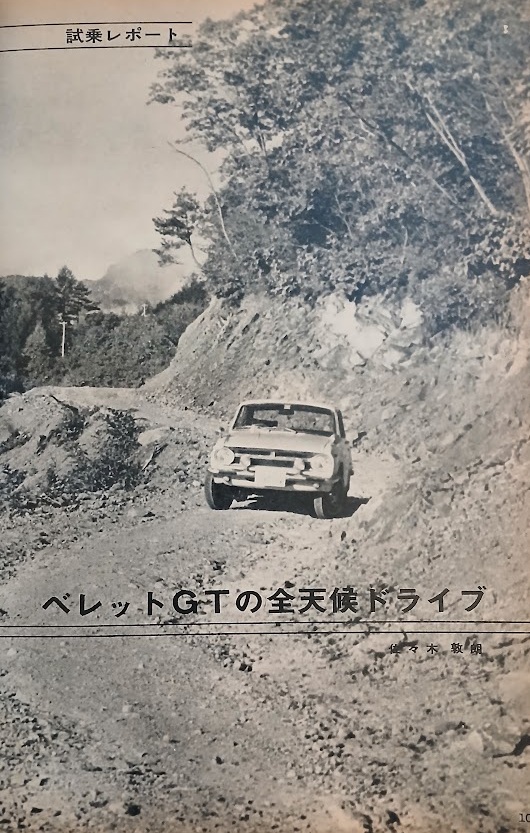
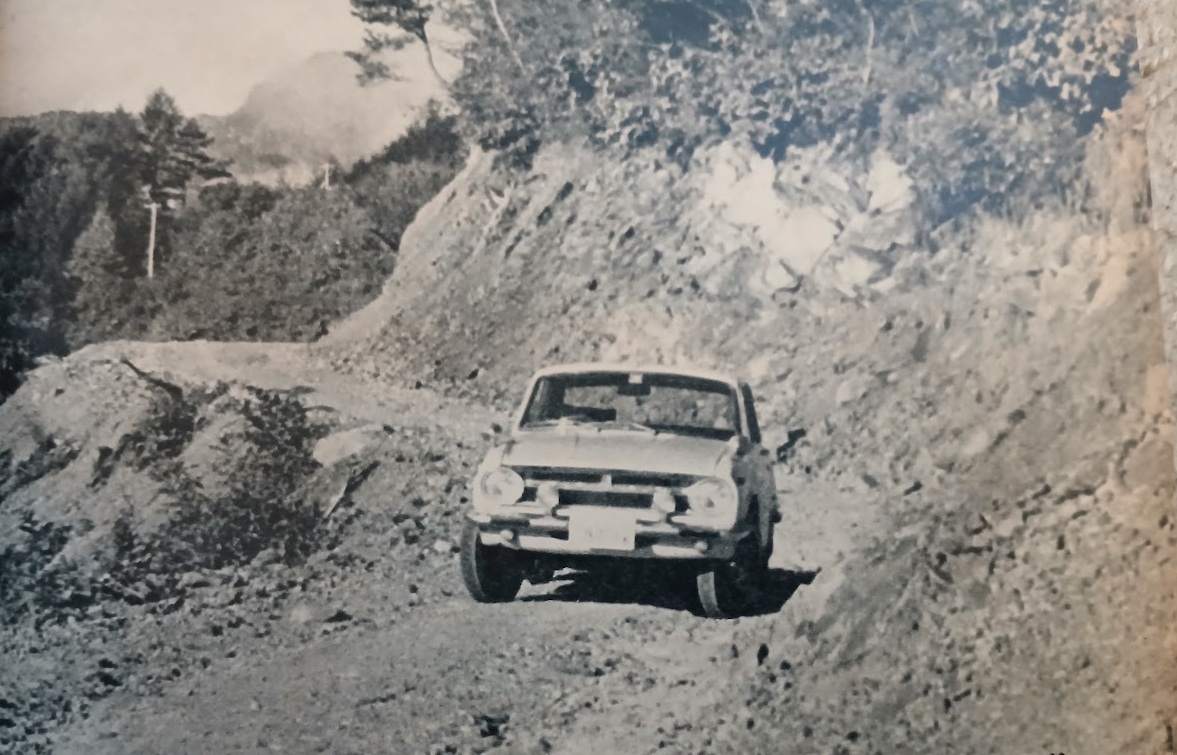
The following morning dawned clear and bright. We set off at 6:30am, passed Lake Kizaki, and began the climb from Yanaba on Lake Nakatsuna toward the Kashimayari ski slopes. The road had been cut into the mountainside and was covered with loose stones. Now this was promising. On the valley side, rocks as large as a fist lay scattered across the track, and the climb was almost like making one’s way up a rocky streambed.
I wondered whether this might be asking a little too much of the Bellett 1600GT, a car whose character suggests the spirited cleverness of a refined lady. But she proved strong and remarkably sure-footed, completing the 15-minute climb without difficulty. If a car can negotiate a road like this, it should have little trouble with almost any road in Japan that is passable by car. There is just one point to bear in mind: because of the low ground clearance, stones can easily strike the underside of the car. That is something to watch out for.
Good Stability at 100km/h
The return journey followed almost the same route as the outbound trip, except that we avoided the muddy stretch under construction. From Omachi, we headed through Akashina and then swept south along the Matsumoto Bypass. After overtaking groups of trucks making scheduled runs to Tokyo, I would continue for some time with the road to myself. At one point, a 2000cc car with Nagano plates doggedly tried to keep up, but on Shiojiri Pass, which begins with a gentle climb, I had no difficulty leaving it behind through acceleration and cornering.
The climb from Kami-Suwa to Chino is quite gentle but long. Here, there was no need for downshifting whatsoever. I completed the climb in top gear, with the speed never falling below 60-70km/h. Acceleration on this sort of gradient is usually rather sluggish, but by feeding in the throttle in stages, the Bellett gathered speed with pleasing eagerness. It certainly lived up to its name as a high-speed touring car.
On the new road along the Kamanashi River, with Mount Yatsugatake to the left and a sweeping view of the Southern Alps to the south, the road was so deserted that there was hardly ever another car ahead or behind. Here, I decided to give the accelerator a good, hard push. The speed climbed through 100, 110, 120, and toward 130km/h, at which point I eased off. It was a public road, after all, and the tachometer needle was entering the yellow zone. At around 4000rpm, the car exceeds 130km/h. At that speed, vibrations and shocks from the road surface were barely noticeable, and running stability was extremely good. Perhaps it is more accurate to say that there was a noticeable weight to the steering at around 100km/h.
Even in this age of high-speed driving, the most common speeds will probably be between 50-100km/h. Judged on that basis, the Bellett is a car in which one can travel comfortably and without undue fatigue.
From Omachi to the proving ground at Higashimurayama, we covered approximately 250km in 5.5 hours, including two stops of about 15 minutes each, giving an average speed of around 50km/h.
The engine and the rest of the car showed no signs of fatigue. Perhaps because we had just completed a long-distance run, the engine note took on a slightly high-pitched quality as the revs rose.
A 2+2, but the Rear Seats Are Cramped
Finally, there are two practical matters to consider: fuel economy and accommodation.
On the outbound journey, when I refueled at a service station in Suwa, fuel consumption averaged 8.5km/l. This was probably due to my unfamiliarity with the car, the repeated shifting between second and third while caught among the trucks, the torrential rain north of Kofu, and the evening rush-hour congestion in Suwa. The following day, after completing the tests at Murayama, I refueled on the Koshu Highway and recorded 10.5km/l. I came away convinced that, without any hard driving and with a thoroughly relaxed approach, the figure could exceed 11km/l.
It may seem rather strange to discuss fuel economy in a GT like this. Even so, considered as a high-speed touring car, I am inclined, as a practical-minded motorist, to place great value on these figures. After all, grand touring cars are not only built for heroes of the racing circuit.
Next, accommodation. The bucket seats remain almost unchanged. The Bellett’s backrests seem rather thinly padded. Still, after covering 640km, I felt almost no physical fatigue, having reclined the backrest by only one notch. This came as something of a surprise, given what I had heard about the seats. Naturally, much depends on driving conditions and differences in individual physique, but I experienced no pain whatsoever in my lower back or spine. Perhaps it would be more accurate to say that the driving position simply felt natural.
The rear seat, however, is another matter. Although the Bellett is described as a 2+2, there is far too little headroom for anyone with a tall sitting height. This is especially true when the driver’s seat is pushed all the way back. It intrudes into the rear passenger’s legroom, and the protective panel on the back of the front seat presses against the knees. Sit well back in the rear seat, and the back of your head presses against the upper edge of the rear window. Perhaps the rear seats of a 2+2 should be regarded as little more than a luggage shelf, but from a practical standpoint, this is rather disappointing. Could the rear cushion not be positioned a little lower?
In other respects, the ventilation, reflections, switch positions, and instruments inside the cabin left nothing to be desired. For a husband and wife touring with two children, the Bellett would be extremely comfortable, almost excessively luxurious. In summary, I would say that the revised Bellett GT is a more appealing car than its predecessor, and one in which the emphasis on the driver has become more pronounced.
Postscript: Story Photos