Isuzu Bellett 1600GTR (1970)
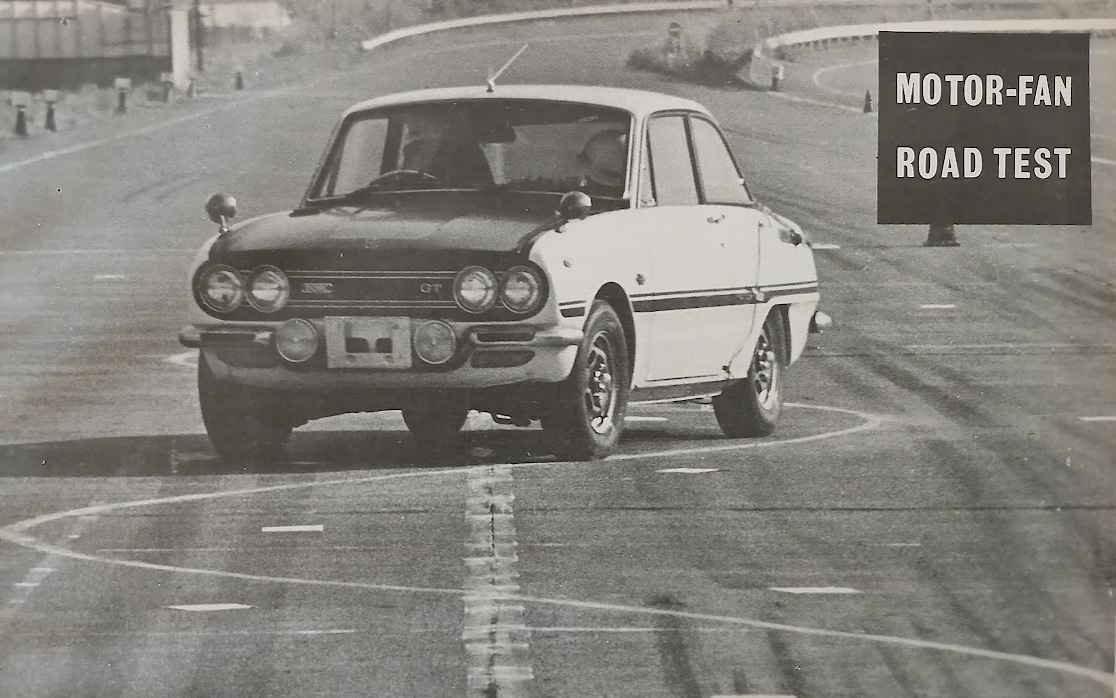
Publication: Motor Fan
Format: Road Test
Date: March 1970
Authors (Roundtable): Yozo Shimizu, Osamu Hirao, Ichiro Oka, Ren Ueda, Mineo Yamamoto, Hiroshi Toishi, Hiroshi Hoshijima, Hiroshi Okazaki, Kiyoshi Suzuki, Akio Miyamoto, Kunitaka Furutani, Masahide Sano, Katsuji Takanami, Taizo Tateishi, Atsushi Watari, Ichiro Kaneshige, Kenji Higuchi, Kenzaburo Ishikawa, Zo Doi, Kenichi Noguchi, Toshihide Hirata, Minoru Onda, Motor Fan Editorial Staff (uncredited)
Aiming for a High-Performance Car
Magazine: To begin, could we ask Mr. Shimizu to tell us about the development aims behind the Bellett 1600GTR?
Shimizu: This car was released in the autumn, and at the time there were quite a few opinions suggesting that a car like this wouldn’t sell in large numbers. However, once it was introduced, it received unexpectedly strong support, particularly from younger buyers, so we feel it was worthwhile bringing it to market.
Because we set out to create a high-performance car, it required considerable care both technically and in terms of production, and from a safety standpoint as well, there was a great deal we had to study and learn. Since we’ve been given this opportunity today, I hope we can take the chance to learn from your comments.
As for the aims of development, we have now been producing the Bellett for six years. The GT came first, followed by the move to a floor-mounted shift, and we proceeded with a focus on sportiness, expanding from 1300cc to 1600cc models. However, as the performance of GT cars from other manufacturers steadily improved, we felt that if things continued as they were, we would fall behind in terms of performance.
By coincidence, the 1600cc DOHC engine—following its use in the 117 Coupe—was ready for mass production, and its cost had begun to come down. By fitting this engine, and aiming to fill in the gaps where the car had been lacking, we arrived at this model.
At the same time, driver skill has improved considerably in recent years, and there are now many people who can handle a car of this level of performance safely. So part of our aim was to respond to those users.
The price is, of course, somewhat higher, but among younger buyers who purchase a Bellett GT, it’s not uncommon to spend close to a million yen on tuning. From that perspective, there are those who see a car like this, already tuned from the outset, as representing good value, and that was also part of our thinking.
Hirao: Is this the same engine as the Bellett R6, with only differences in tuning?
Oka: That’s right. The R6 uses a tuned-up version of this unit.
Hirao: The GTR is rated at 120 horsepower. Does that mean that by adopting DOHC, you’ve gained about 20 horsepower?
Oka: Yes. The SOHC version produces 103ps, so it’s an increase of about 20ps.
Magazine: Are there any differences in the body or chassis compared to the standard GT?
Ueda: I’ll briefly outline the main changes. Because of the DOHC engine, and the associated strengthening of the driveline, the weight is slightly higher than the GT. Curb weight increases from 940 to 970kg. Top speed is 190km/h. The tires are 165HR-13, and the fuel tank capacity has also been increased to 46 liters.
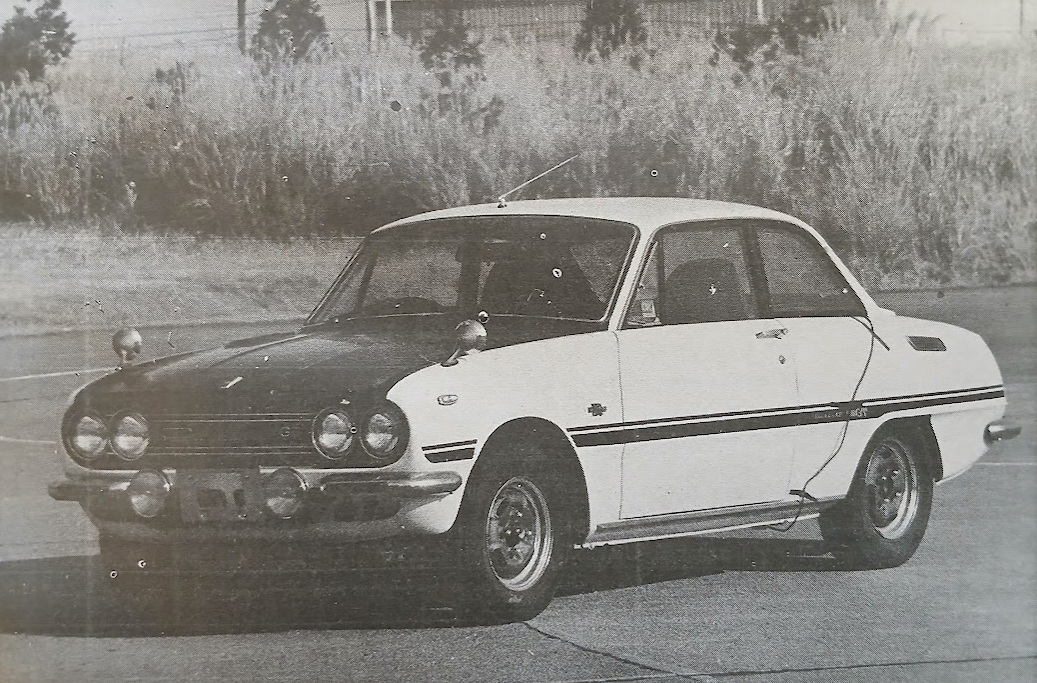
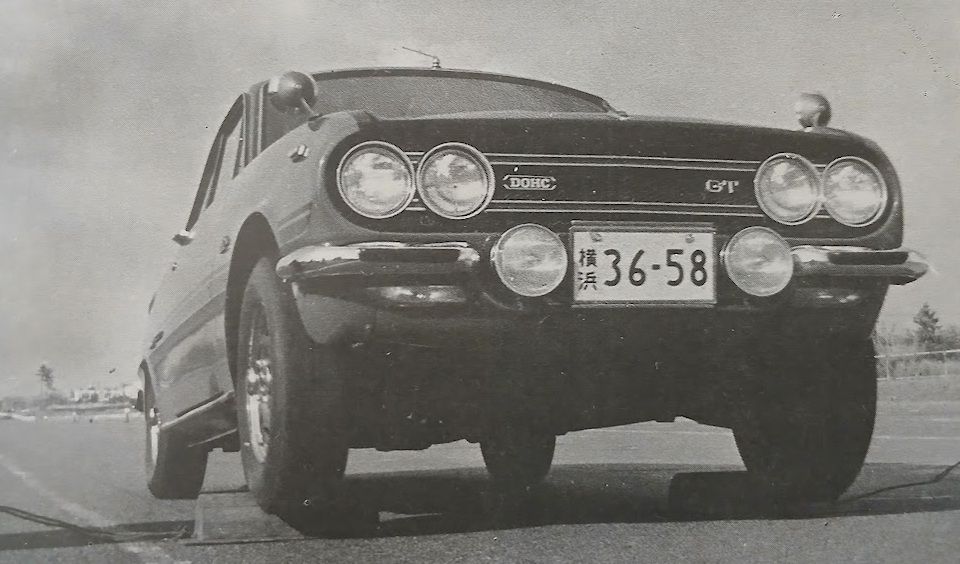
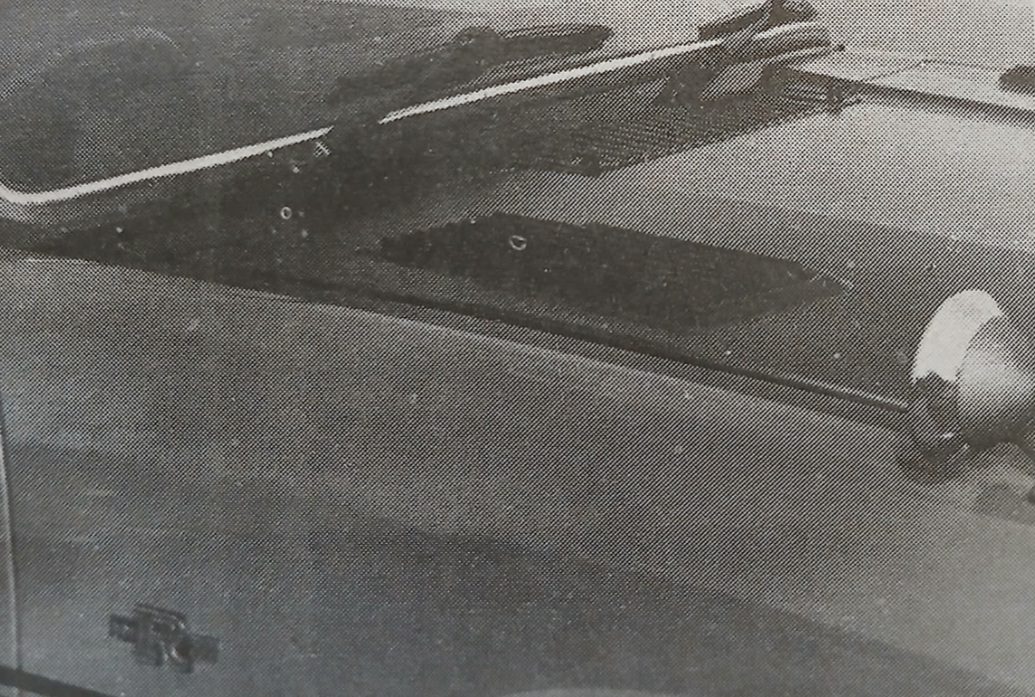
In terms of design, at the front we’ve added an air scoop to the hood, and adopted black paint treatment at both front and rear. A stripe has been applied along the side of the body to enhance the overall mood. The bumper is split into two sections, with fog lamps mounted on the inner side. Capless disc wheels are also used on the standard GT, but here the rims are chrome-plated to give it further distinction.
Inside, the seats are one-piece FRP molded units with integrated headrests, designed with ergonomics in mind to provide good support. The steering wheel is leather-wrapped, and we produced several prototypes, then selected the final design based on user feedback.
As for other details, we’ve incorporated a day/night rearview mirror, a wooden shift knob for the gear lever, a clock with a second hand, a rear window defogger with printed heating element, high-speed wipers, and other small improvements. Needless to say, we have also adopted a collapsible steering column and flexible fender mirrors.
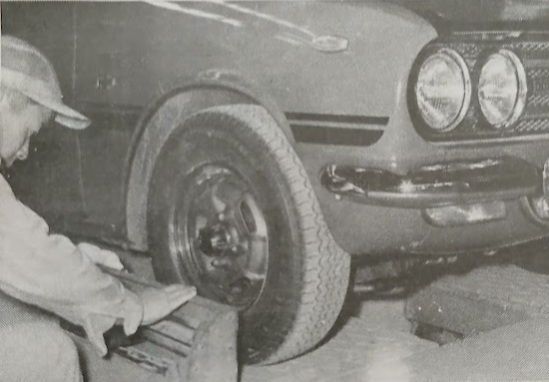
In the chassis, the increase in engine torque required strengthening of the driveline. This includes revisions to the clutch and transmission, with a higher first-gear ratio, the adoption of a universal joint in the rear axle shaft, a limited-slip differential, and radial tires.
In the braking system, we’ve used a tandem master cylinder in combination with a Hydrovac servo, and added a pressure control valve for the rear wheels, with particular emphasis on stabilizing front-to-rear brake balance.
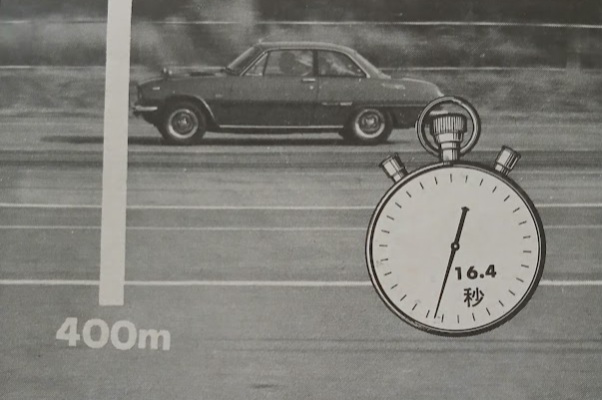
0–400m in 16.4 Seconds
Yamamoto: Was this car developed as a successor to the existing Bellett? How does it compare in terms of structure, dimensions, and so on?
Ueda: Rather than a successor, we see it more as a car to lead the model line. As for dimensions, the body shell itself is almost unchanged. However, with the adoption of capless disc wheels, the track has increased slightly—by 15mm at the front and 25mm at the rear.
Magazine: Is the air scoop functional, or is it mainly for styling?
Ueda: It allows hot air to be vented from that area, so it does contribute to cooling.
Toishi: The air scoop serves both purposes–design and heat extraction. The right-hand side is functional and helps release heat, while the left is a dummy. Also, details like the matte-black bonnet and the black side stripes are all intended to give a sharper, more purposeful impression.
Hoshijima: The matte finish on the bonnet has a functional effect as well.
Suzuki: Yes, very much so. If the bonnet is reflective, it can be fatiguiing for the eyes.
Toishi: It serves a similar purpose to painting the wiper arms black.
Miyamoto: When driving toward the sun, it’s very effective. Like the anti-glare finish in front of an aircraft cockpit–it’s a good idea.
Magazine: How were the performance figures measured by the Hirao laboratory?
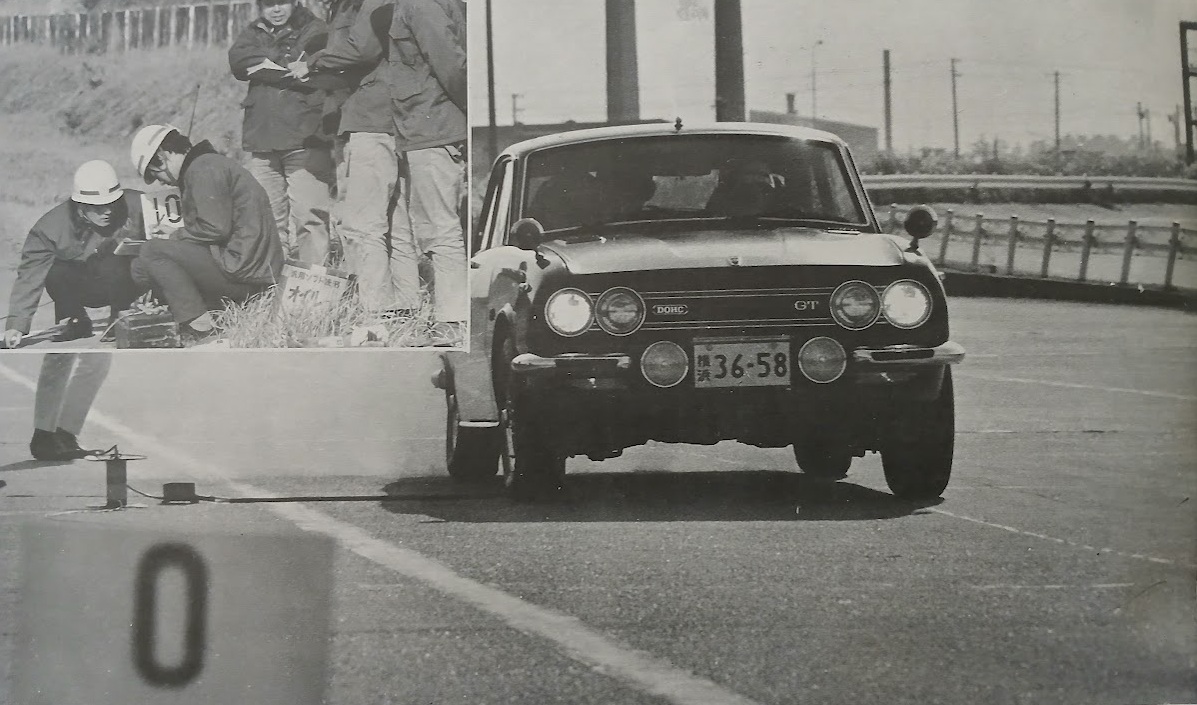
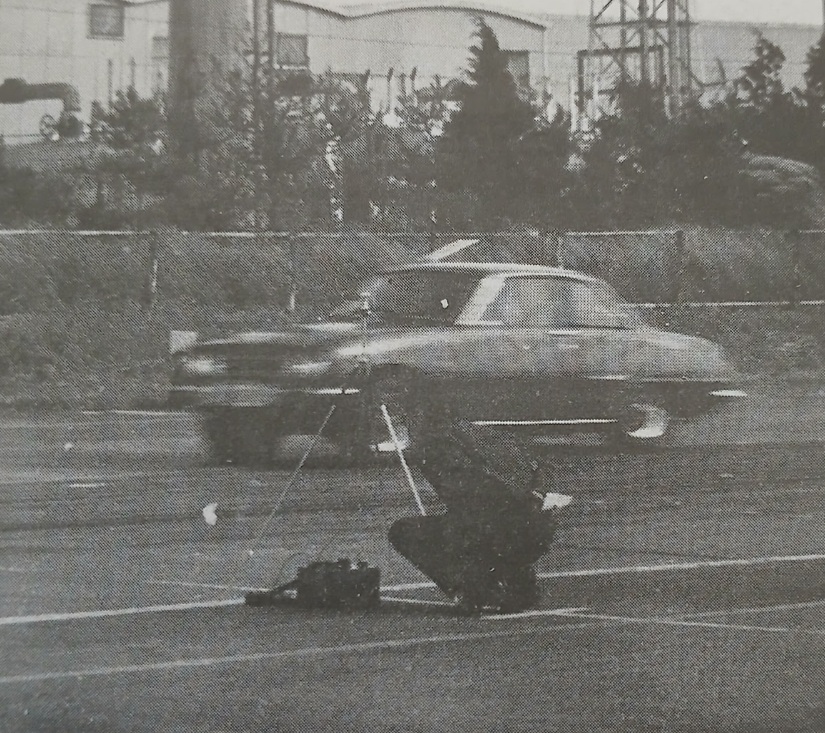
Furutani: Standing-start acceleration times were 0-50m in 4.4 seconds, 0-100m in 6.7 seconds, 0-200m in 10.4 seconds, and 0-400m in 16.4 seconds. This car uses the engine from the 117 Coupe, but with a slightly lower first-gear ratio. The 117’s 0-400m time is 16.7 seconds, so with this car being about 180kg lighter, along with the shorter gearing, the time improves by roughly 0.3 seconds.
Magazine: Looking at the data, it seems there was almost no wheelspin.
Furutani: There’s no slip even at launch. Perhaps it’s due to the wider tires.
Toishi: The quality of the radial tires is very good. Under braking as well, they hardly slip at all.
Magazine: Let’s have the fuel economy results from the Oguchi laboratory.
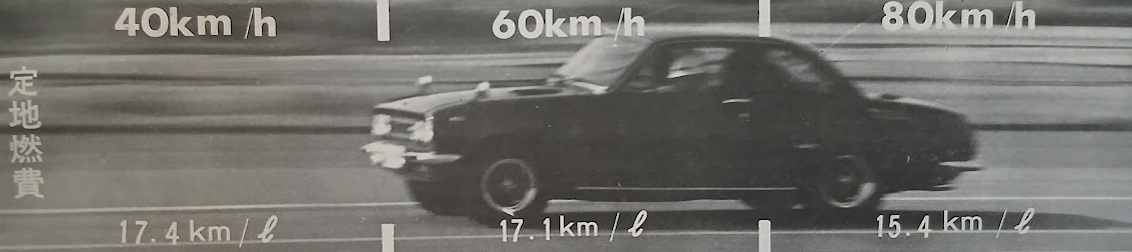
Sano: In steady-speed fuel consumption tests, we recorded 17.2km/l at 30km/h, 17.1km/l at 60km/h, 15.4km/l at 80km/h, and 12.5km/l at 100km/h. Around 40, 50, and 60km/h the figures are very close, showing almost no variation, and overall the curve is quite flat.
We conducted steady-speed testing with the 117 Coupe at the same time, and under these conditions the GTR shows slightly better figures. This may be due to its lower weight.
Quiet High-Speed Noise
Magazine: At the Tokyo Motor Show, a 117 Coupe equipped with ECGI (electronically controlled fuel injection) was exhibited. If that uses the same engine, then such a system could presumably be applied to the GTR as well. If a car like that were to appear in the near future, how much difference would there be in terms of power and fuel economy?
Oka: I think the appearance of such a model is certainly possible. I can’t say exactly what the horsepower difference would be, but of course there would be a gain in output.
Also, electronic fuel injection was originally developed in connection with exhaust-emissions measures for Volkswagen’s exports to the US, so it’s reasonable to expect improved fuel economy as well.
Another point is drivability–the engine would operate more smoothly, with good response even at very low speeds, allowing for more precise control. And with exhaust emissions becoming an increasingly troublesome issue, especially for sports cars, this could also be a means of addressing that problem.
Magazine: Compared with the standard GT, the GTR’s suspension has been significantly strengthened. To be specific, how much higher are the spring rates?
Takanami: Our aim was essentially to bring the production car close to what we had previously offered as an optional sports kit for the GT–something like the Stage II specification.
As a result, the front spring rate has been increased by roughly 50-60%, and the rear by about 20-30%. The shock absorbers have also been tuned for overall higher damping force.
Magazine: From the measurements carried out by the Watari laboratory, how are the vibration, noise, and overall ride characteristics?
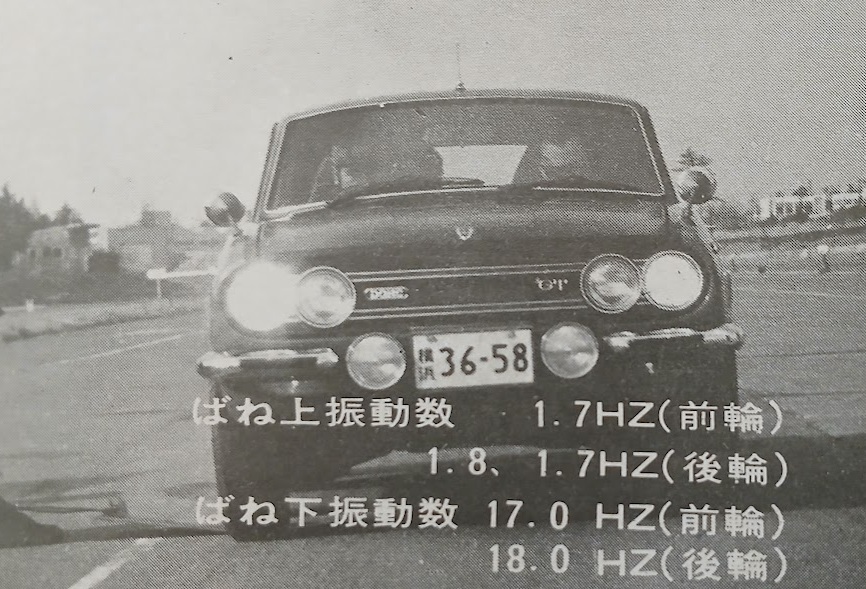
Tateishi: The suspension vibration frequencies are as follows: sprung-mass frequency is 1.7Hz at both front and rear; for the unsprung mass, the figures are 11.7Hz at the front and 18Hz at the rear.
As for the sprung frequencies, although we’ve just heard that the rear spring rate is increased by about 20 percent, the measured values seem quite high.
The interior noise level is 67 phons at 40km/h, 72 phons at 80km/h, 76 phons at 100km/h, and 81 phons at 160km/h.
Exterior noise measures 70.5 phons under steady running and 79 phons under acceleration. For a GT, the external noise level is quite low, and considering high-speed noise as well, I think these are good figures.
Watari: With a car like the GTR, I wonder whether it even makes sense to judge ride comfort in the usual vertical-motion sense, or to focus too much on interior noise–apart from cornering performance, that is.
Speaking just from my impression, the engine is rather noisy and vibratory at idle. Once underway, that harshness becomes less noticeable, but if you were to do long-distance driving on the expressway, it might become an issue.
If you look at it from what you might call a “husband’s specification” standpoint, this car seems to have pronounced peaks in vibration and noise at low, medium, and high speeds alike–so that’s something to consider.
The idle vibration in particular is unpleasant. I assume the engine mountings have been made quite stiff—was there a reason for that? If they weren’t stiff, would there be problems with engine movement in operation?
Kaneshige: It wasn’t treated as such a major issue. In a car like this, space around the engine becomes increasingly tight, so the mountings are set up to prevent interference between components while driving.
If everything is too rigidly constrained, shocks can increase stress, so it becomes a balancing act. Whether one can simply say “that’s the nature of the car” is another matter, but since this is a GTR, compared with a normal sedan, some roughness at idle is probably unavoidable for the time being.
Hirao: Well, that comes down to things like valve timing–you can’t really avoid it, especially if it’s designed to hold together up to 7000rpm.
Kaneshige: If you raise the idle speed, the vibration becomes easier to live with, but managing both vibration and noise in a car of this character is inherently difficult.
Higuchi: My impression, looking at the engine bay, is that you’d have to give up on fitting air conditioning altogether.
If that’s the case, I get the feeling some users might go all the way—start with a 1600 GT, tune it, and even swap in a different engine. But that would drive the cost up, so if you can run a car with a properly tuned engine from the outset, that might be better.
But you can’t chase two goals at once–so does that mean abandoning the “husband’s specification” idea?
Kaneshige: If you completely abandon it, things become clearer–but when it comes down to the final balance, it’s not so simple…
Using Endurance Racing as a Development Ground
Hirao: In that sense, having an overdrive gear makes quite a difference. At 120km/h, the engine is turning at about 4000rpm. So if it could cruise normally at just under 3000rpm, that would be a significant improvement. The difference between 4000 and 3000rpm is considerable–having an overdrive gear really changes things in that respect.
Hoshijima: The first time I saw the Bellett GTR was back in 1968. It was entered in the Suzuka endurance race under the name “GTX.” After that, it appeared mainly in endurance racing, and I followed it with great interest–I had always thought it would be interesting to install the 117 engine in the Bellett.
At first, though, it struggled to finish races; almost every time, something would go wrong and it would retire. But by 1969, its endurance was gradually improving, and by August it had achieved an overall victory. Not long after that, the production car was released in essentially the same form under the name GTR.
I found it very interesting that endurance racing itself was used as a development test bed, and I think it also worked extremely well from a publicity standpoint.
Having driven the production car, the first thing that struck me was how quiet it is. Below about 40km/h, however, it’s essentially at idle, so the noise at those speeds is no different than just after the engine is started—that’s unavoidable.
But around 3000rpm, it’s remarkably quiet. And while there are moments around 120km/h when it feels a bit noisy, at both higher and lower speeds it becomes quiet again. In particular, the quietness at 130-140km/h is almost unmatched. The figure of 70 phons reflects that quite well.
Watari: There are peaks at 120 and 140km/h, and it’s actually quieter in between.
Hoshijima: Comparing ride comfort with the 117 Coupe, I would say the 117 has the better ride in terms of suspension feel.
Also, regarding the transmission—since Professor Hirao mentioned the benefits of overdrive—when driving on the Tomei or Meishin expressways at around 140km/h, there are many situations where you hesitate: should you shift down to third, or apply the brakes?
In practice, if you’re in fifth, it’s natural to drop to fourth in those situations. It’s not that I don’t trust the brakes or the tires, but I do feel that it’s reasonable for a car like this to be offered with a 5-speed transmission.
Hirao: It would definitely be worth considering either a 5-speed, or a setup where overdrive can be used on third and fourth gears.
Watari: The issue is that the change between quiet and noisy is too pronounced. If that variation could be smoothed out, it would be better–even if the overall noise level were slightly higher.
A Successful Seat
Kaneshige: We’ve been under increasing pressure on the emissions front, and that side of things has gradually improved. At the same time, we’ve tried to eliminate the raw mechanical noise of the engine, as well as high-frequency noise, as much as possible.
However, our countermeasures don’t really show up in those noise peaks, as has been noted by many people. So I still feel that the car may be somewhat noisy overall.
Yamamoto: In terms of vibration and noise, when I first drove it, I did notice something like idle-related noise. But when I had the chance to drive it over cobblestones, the car was extremely good. I’m not entirely sure why.
Miyamoto: That may be due to the independent rear suspension. When the Bellett was first introduced, I drove it over some fairly rough roads, and even then I thought it performed quite well.
Higuchi: I tried driving it at around 40km/h over a section of road on campus that had been dug up for construction, expecting it to be quite rough–but there was really no need to brace for it. In fact, it seems to handle poor roads rather well.
Hirao: That may be because of the somewhat stiffer springs and larger-capacity shock absorbers.
Suzuki: Yes, that’s right.
Ishikawa: I think the seats themselves may also have contributed significantly.
Toishi: To improve damping characteristics, we’ve used molded urethane padding. Another feature is the use of an FRP shell for the seatback.
Hirao: The transition between the backrest and the seat cushion is also quite well executed.
Toishi: Yes–we consider it a success.
Excellent Responsiveness
Magazine: Next, let’s have the handling and stability data from the Saito laboratory.
Doi: The practical minimum turning radius is 5.32m on the outside and 3.02m on the inside. Compared with other cars in this class, these values are on the slightly larger side.
As for understeer and oversteer characteristics, measured at V² = 100, the R/Ro value is 1.35, with testing carried out up to 50km/h. The car maintains understeer throughout, and an R/Ro of 1.35 is actually somewhat on the low side compared with others in the class.
Maximum steering effort during the test was 4kg, at a lateral acceleration of 0.4g–again, slightly heavier than comparable cars.
The roll angle was 3.5° at 0.5g. Isuzu’s internal figure is 3.75°, so it actually exhibited slightly less roll in our test.
Magazine: Professor Hirao, how was it in crosswinds?
Hirao: We drove on the Tomei on a fairly windy day. On the way out, it was mostly a tailwind, but after passing through the Atsugi cutting, it turned into a crosswind from the right.
When it was mostly a tailwind, there was little effect. But as we exited the cutting and caught the crosswind, even with both hands on the wheel, it was pulled slightly to the left–by about three degrees or so.
From that perspective, if the corrective tendency from the opposite direction were reduced slightly, I feel I might not have had to make so many steering corrections.
On the return trip, Furutani was driving. The most difficult condition seemed to be a diagonal front-left crosswind. Once it became a direct headwind, it wasn’t so bad, but around Atsugi it was quite unsettled, and even from the passenger seat you could feel it clearly.
I’m not sure whether introducing a bit more solid friction would help, or whether viscous damping would be better–but it may be something that can be adjusted through steering setup.
Takanami: As far as the Bellett’s reputation goes, there are quite a few people who say it’s no good without its rack-and-pinion steering.
Hirao: I think that’s focusing on just one aspect of it. If you were to drive it somewhere like the Turnpike at around 100km/h, or climb Otome Pass at around 70km/h, you might better appreciate its strengths.
One of the Bellett’s virtues is its very good steering response on roads like that. If you focus only on high-speed expressway driving, you may lose sight of that.
Hoshijima: It’s true that variable-ratio steering cars have become more common recently, and compared with those, this one feels relatively light on center at highway speeds.
Okazaki: On winding roads it is certainly very good. I tried similar conditions myself, and on roads like that it is genuinely excellent.
It is quite rare to find a car that follows the intended line so easily and precisely. The response is very good, and its corrective steering behavior is also excellent.
Headrest Obstructs Rearward Visibility
Magazine: Next, please give us the results of the Ship Research Institute’s measurements on weight and braking.
Ishikawa: The weight distribution is 538kg in the front and 435kg in the rear, for a balance of 54:46. In terms of alignment, the front end shows a very small amount of toe-in and camber. The rear values are not too large either.
The braking system uses discs in the front and leading-trailing drums at the rear. Only the front is equipped with a Hydrovac vacuum booster, together with a tandem master cylinder. As a result, the brake pedal effort curve is about 1kg/mm, which sits between a car with a brake booster and a car without a booster, and I think it’s a reasonable value.
Left-right braking balance is fairly well matched both front and rear. However, overall operating forces are somewhat heavy: shift lever operation is around 3-4kg, and the lateral movement into reverse is 6kg. Accelerator pedal effort is 2.5kg for steady driving at 50km/h, rising to 4kg when accelerating–these values are heavier than in a typical sedan.
Magazine: And the braking feel?
Ishikawa: I didn’t notice anything particularly distinctive, but it did feel slightly “stretchy” in response.
Okazaki: The servo assist didn’t feel very strong, either.
Yamamoto: The front uses disc brakes and the rear drum brakes, with a PCV system and a limited-slip differential as well. Could you explain that combination?
Noguchi: Only the front wheels use the Hydrovac unit. Since the Hydrovac becomes effective at around 30-40kg of pedal effort, the PCV is set to bias the system accordingly. It also helps balance braking force at the rear.
Ishikawa: In bench testing, the system clearly shows that biasing effect, and you can see the braking force drop. But in actual driving, I can’t say it is all that noticeable…
Magazine: Please continue with the Ship Research Institute’s visibility measurements.
Hirata: The forward field of view within the horizontal plane, including the eye point, is 31.5° to the right and 60.6° to the left, for a total of 91.5°.
The view to the rear is a problem because the headrest is integrated with the seatback and is quite large. It is 27.5° to the left and 19.5° to the right, meaning it is obstructed on the left side.
Within the same horizontal plane, the total blind angle comes to 91.5°, again because of the headrest. I think we may need to reconsider the methods we have been using to measure the driving visibility in the horizontal plane.
Yamamoto: We also tested the Bellett 1500, with a similar body structure, when it was released (December 1966). Comparing the two cars, the visibility is better this time, and the evaluation is better overall.
The blind angles to the left and right sides in the horizontal plane are about average compared to a normal car. The blind angles have become larger relative to the total field of view, but that is due to the protruding headrest, which is obstructing visibility.
Magazine: Next, please report the measurements from the Higuchi Laboratory.
Onda: The overall width has hardly changed compared to the Bellett 1500, but the front tread is now 1255mm, which is slightly wider than the previous model.
Externally, the biggest change is the use of 165x13 radial tires. Other changes are mostly minor styling updates such as the split bumper, small decorative elements, and accents that visually differentiate the GTR from standard models.
The most notable change in interior dimensions is the integrated headrest, which raises the seatback height to a very high 770mm.
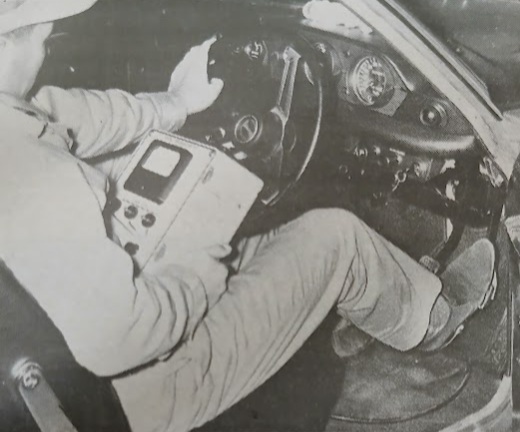
The pedal arrangement hasn’t changed much from the previous model, but one thing that remains notable is that while the clutch pedal in most cars straddles the steering shaft, the Bellett’s pedals are all together to the right of the steering shaft, and the shaft is shifted to the left.
Yamamoto: One thing I would like to see fixed is the angle of the toe board.
Hirao: That’s right. It could pose a big problem for the driver.
Higuchi: There is a relationship between the seat height and the angle of the toe board, and in this case I think it needs to be more upright. This close, flat toe board would only work if the seat was much higher. The most fundamental thing is whether it matches the overall height of the seat.
Hirao: I think the lower bending point of the toe board should be moved forward by about 20mm. That might also solve the pedal geometry issues.
Magazine: Finally, Professor Higuchi, let’s hear your comments on safety.
Higuchi: In terms of safety results, if we take 100 points as the benchmark: modern 1500cc sedans generally score around 90 points, while GT sports cars are typically in the 80-85 range. This car scores 84 points, so it is slightly low by sedan standards.
The deductions include three points for the front bumper being split into left and right halves and not attached in the middle, and another three points for not using laminated safety glass.
However, at over 80 points, I do not believe there is any serious issue.
Magazine: Thank you all very much.
Postscript: Story Photos