Isuzu Bellett 1600GTR (1970)
Publication: Motor Fan
Format: Road Test
Date: March 1970
Authors (Roundtable): Yozo Shimizu, Osamu Hirao, Ichiro Oka, Ren Ueda, Mineo Yamamoto, Hiroshi Toishi, Hiroshi Hoshijima, Hiroshi Okazaki, Kiyoshi Suzuki, Akio Miyamoto, Kunitaka Furutani, Masahide Sano, Katsuji Takanami, Taizo Tateishi, Atsushi Watari, Kenji Higuchi, Kenzaburo Ishikawa, Zo Doi, Ken Noguchi, Toshihide Hirata, Minoru Onda, Motor Fan Editorial Staff (uncredited)
Aiming For High-Performance Cars
Magazine: To get things started, I would like to ask Mr. Shimizu about the aims of developing the Bellett 1600GTR.
Shimizu: This car was released in the fall, and at that time, some people were of the opinion that a car like this would not sell well. However, we received unexpected support from young people after we released it, so we feel glad that we did. Since our aim was to develop a high-performance car, we had to be thoughtful both technically and in terms of manufacturing, and we studied a great deal about safety as well. Thank you for giving us this opportunity today. I would like to take this opportunity to learn a lot from you.
As for the aim of the design, we have been making Belletts for six years now. We made the GT first, which stood out from the beginning with its floor shift and other sporty design features, and then moved on to the 1300 and 1600. However, the performance of GTs made by other companies kept gradually improving, so if we remained at the same level, we would have fallen behind in terms of performance. By coincidence, the 1600cc DOHC engine was ready for mass production after the introduction of the 117 Coupe, and the price was also coming down. We made this car by adding this engine and filling in the gaps.
Nowadays, the driving skills of private car owners have improved quite a lot, and there are now many people who can drive such high-performance cars safely, so we are aiming to cater to these people with the GTR. The price is also quite high, but if a young person buys a Bellett GT and then tunes it up, the total cost can reach 1 million yen. In that respect, some people believe that a car that has already been tuned up from the factory, like this one, is quite inexpensive, so we aimed for that point as well.
Hirao: Is this an engine based on the Bellett R6, but with slightly different tuning?
Oka: That’s right. The R6 uses a tuned-up version of this engine.
Hirao: The GTR has 120 horsepower, right? Does that mean the DOHC adds 20 horsepower?
Oka: That’s right. The SOHC version makes 103 horsepower, so it’s about a 20 horsepower increase.
Magazine: Are there any differences in the body and chassis compared to a regular Bellett GT?
Ueda: Well, to briefly explain what has changed, the weight is slightly heavier than the GT due to the addition of DOHC and the strengthening of the drivetrain, the unladen weight is 970kg instead of the GT’s 940kg, the top speed is 190km/h, the tires are 165HR-13, and the fuel tank capacity is larger at 46 liters.
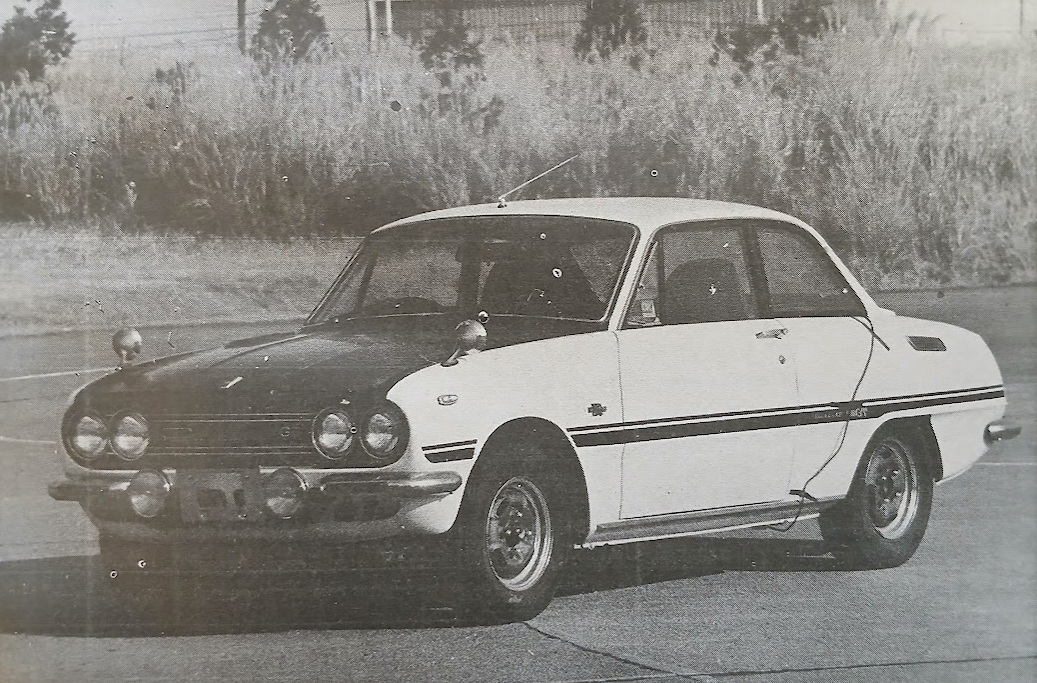
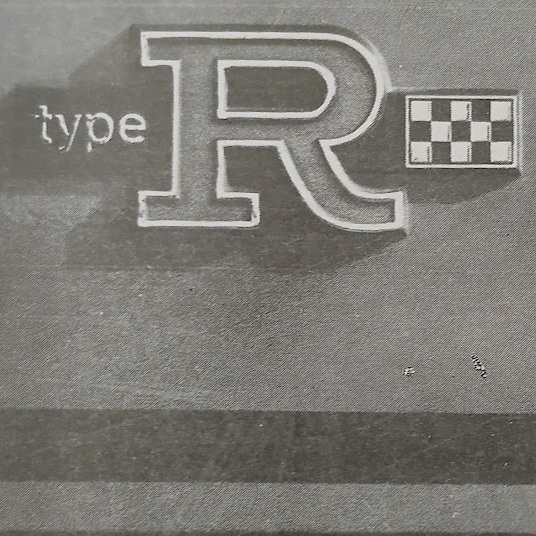
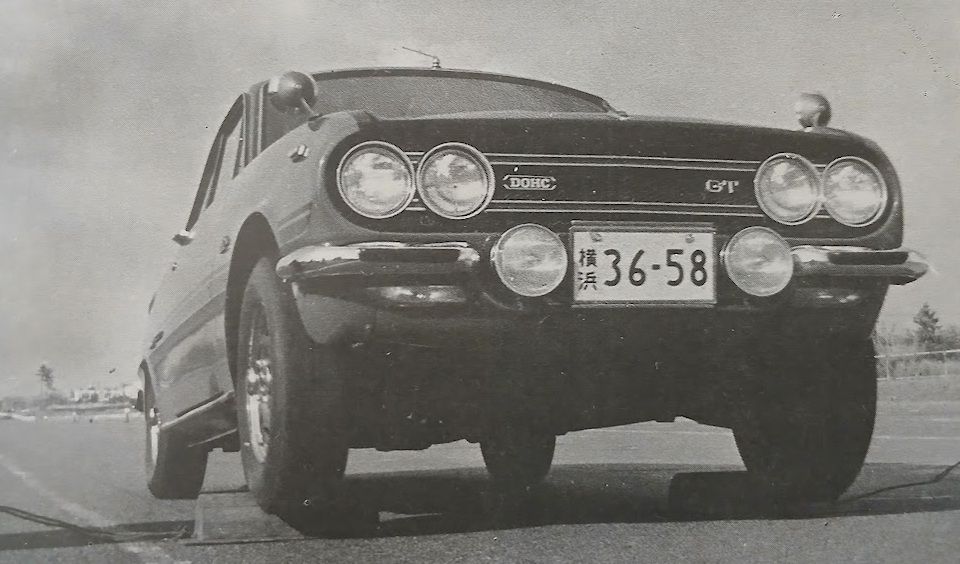
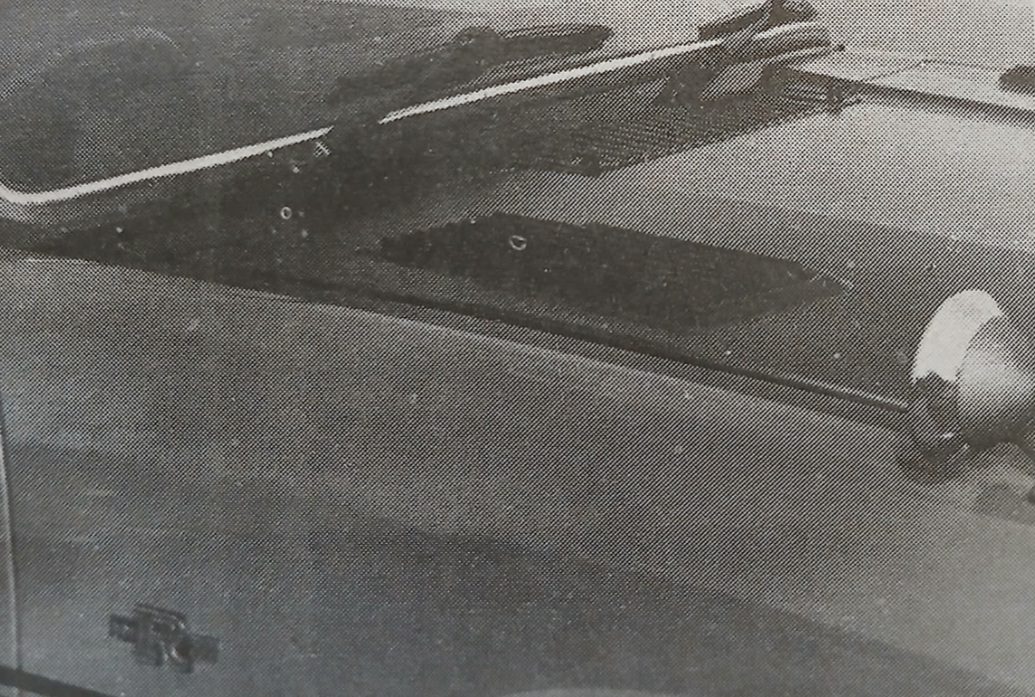
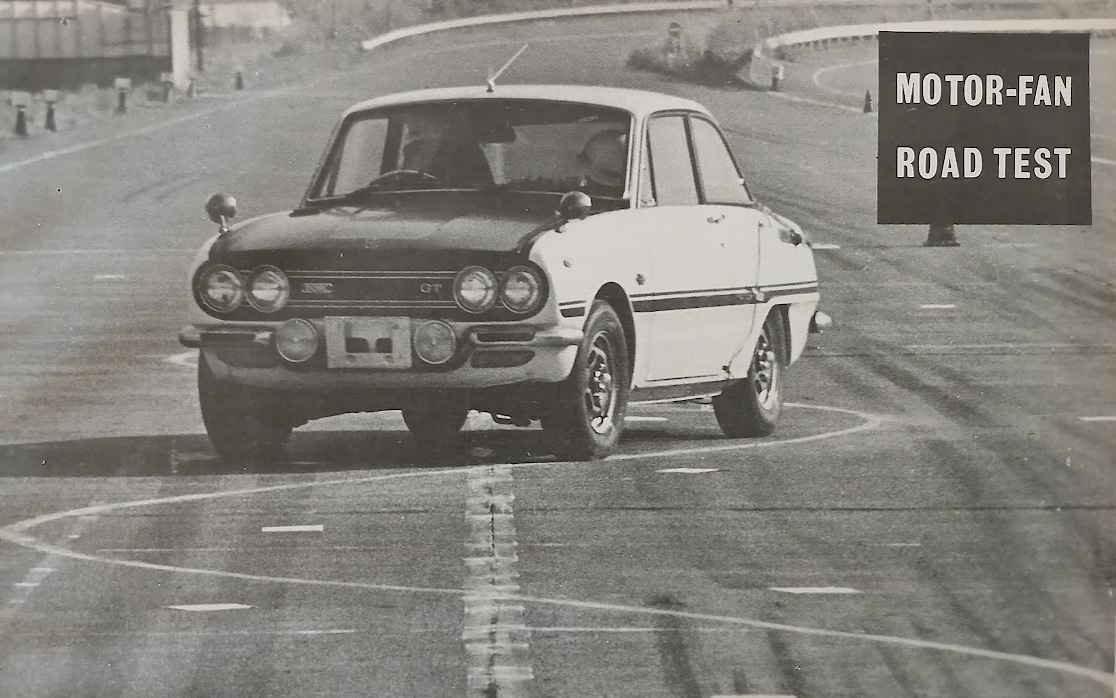
In terms of design, the exterior has an air scoop on the hood at the front, and the front and rear are painted black. Stripes are added to the sides of the body to create a more stylish atmosphere. The front bumper is divided into two parts, with fog lights installed on the inside. The capless disc wheels are also used in the regular GT, but the rims are chrome-plated, which sets it apart. Inside, the seats are made of FRP molded parts with integrated headrests, which are ergonomically appropriate and provide a good grip. We created several prototypes of the leather-wrapped steering wheel and then selected one from among them by conducting a survey.
Other small improvements include a day/night switching rearview mirror, a wooden shift knob for the gear lever, a clock with a second hand, a defogger with a heat wire printed on the rear window, and high-speed wipers. Needless to say, we also included a collapsible steering column and flexible fender mirrors.
In terms of the chassis, the drive system has been strengthened to match the increased torque of the engine. This includes a strengthened clutch, and the transmission has a higher gear ratio for first gear, and a stronger universal rear axle shaft. A limited-slip differential and radial tires are also used. In the braking system, emphasis has been placed on stabilizing the front and rear brake distribution by combining a tandem master cylinder with a Hydromaster servo and using a pressure control valve for the rear wheels.
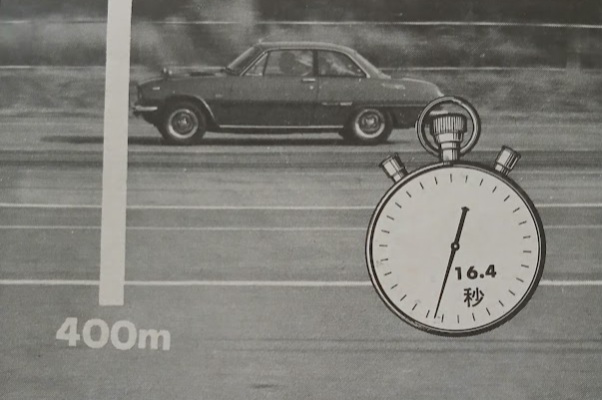
0-400m: 16.4 Seconds
Magazine: The GTR’s style is based on the Bellett GT, but the matte finish on the hood and sporty stripes on the sides give it an even more powerful and rugged look.
Yamamoto: Was this car made as a successor to the existing Bellett? How does it compare to the existing model in terms of structure, dimensions, etc.?
Ueda: It was released as an updated vehicle rather than a successor. In terms of dimensions, the body shell is almost unchanged. The tread width has increased slightly, 15mm in the front and 25mm in the rear, due to the addition of capless disc wheels.
Magazine: Is the air scoop functional? Or is it more of a design thing?
Ueda: It has an effect on cooling, as hot air is blown out from there.
Toishi: The air scoop is both a design thing and a way to let heat out. The right side helps to let out heat, and the left one is just a dummy. Also, the front bonnet is matte black, and there are black stripes, all of which give it a bold look in terms of design.
Hoshijima: The matte finish on the hood is also functional.
Suzuki: It’s very functional. If the bonnet is shiny, it’s tiring for the eyes.
Toishi: It’s just as useful as painting the wiper arms black.
Miyamoto: It’s very good when you’re driving towards the sun. I think it’s good to have a matte finish like the front of an airplane cockpit.
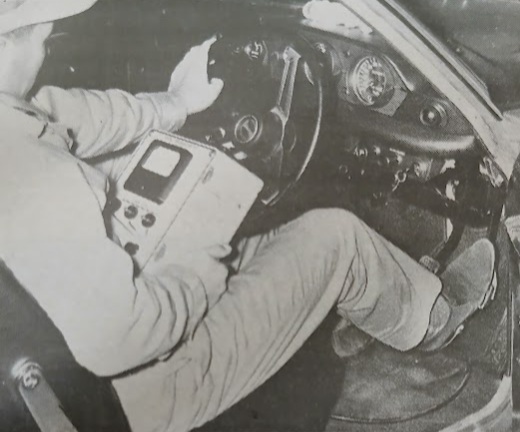
Magazine: How did it do in terms of the power performance measured at Hirao Laboratory?
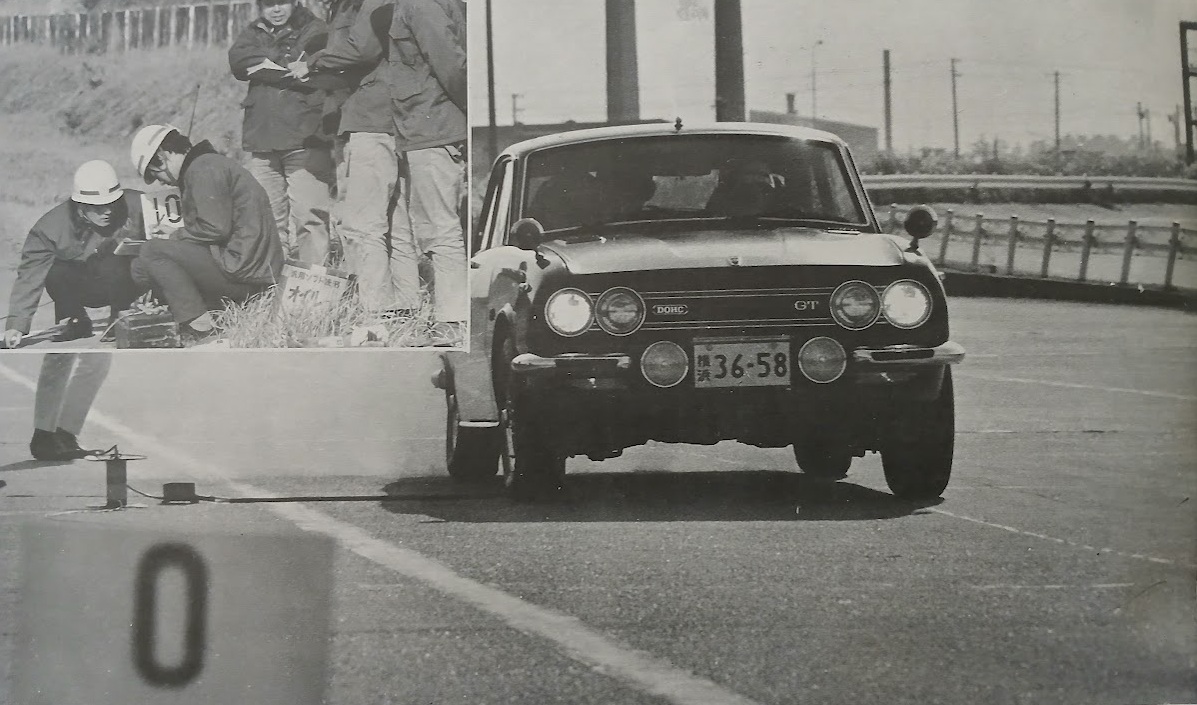
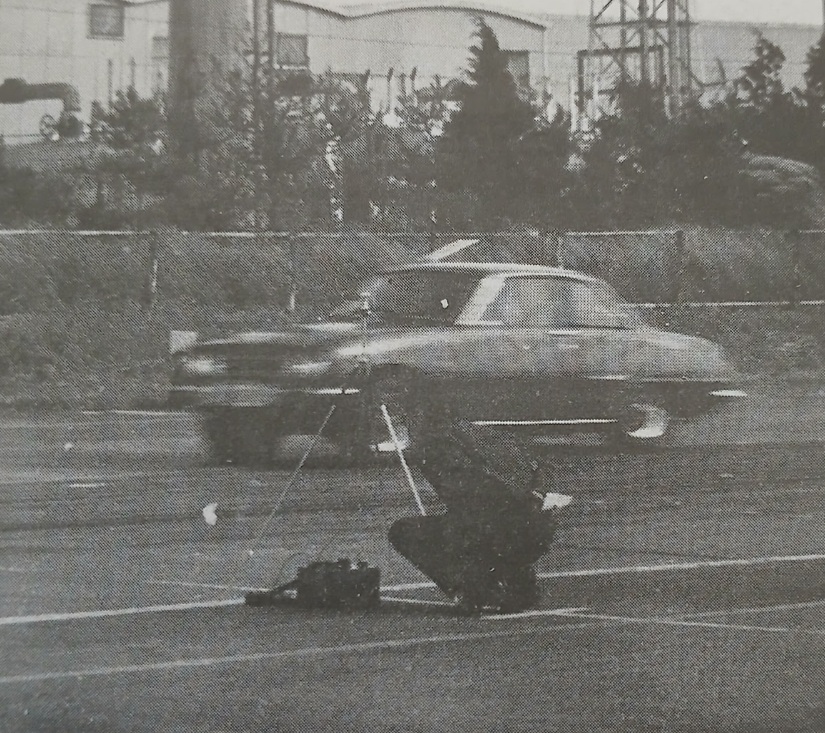
Furutani: The standing-start acceleration was 4.4 seconds for 50m, 6.7 seconds for 100m, 10.4 seconds for 200m, and 16.4 seconds for 400m. This is because it’s equipped with a 117 engine and the low gear ratio has been increased a little, but the starting acceleration time of the 117 is 16.7 seconds for 400m, so between the 180kg lighter body and the increased first gear ratio, the GTR is about 0.3 seconds quicker than the 117.
Magazine: Watching the acceleration runs, it seemed that there was hardly any wheelspin.
Furutani: There was no wheelspin when starting off. I think it’s because of the grippy tires.
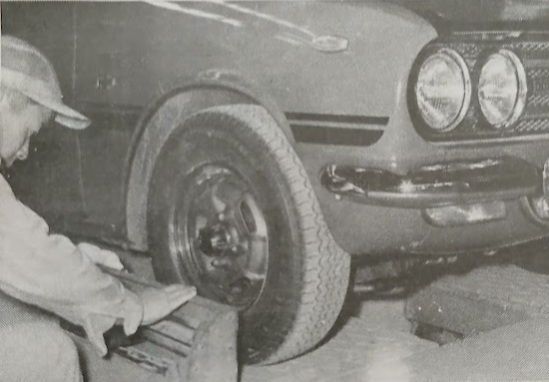
Toishi: The quality of the radial tires is very good, and they don’t slip, even when braking hard.
Magazine: Next, please give us the Oguchi Laboratory’s fuel economy report.
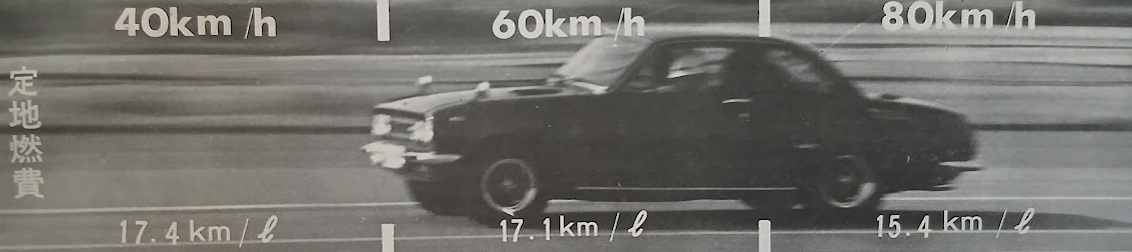
Sano: In terms of constant-speed fuel economy in top gear, the results were 17.2km/l at 30km/h, 17.1km/l at 60km/h, 15.4km/l at 80km/h, and 12.5km/l at 100km/h. The results at speeds around 40km/h, 50km/h, and 60km/h are very close with almost no change, and the curve is generally quite flat. We were also conducting a road test with the 117 Coupe at the same time, and the GTR was slightly better in constant-speed fuel economy. This may be because of its lighter weight.
Quieter at High Speed
Magazine: At the Tokyo Motor Show, a 117 Coupe with ECGI (electronic fuel injection) was exhibited, and if this is the same engine, it can be used in the GTR as well. If such a car is released in the near future, how much will it differ in terms of power and fuel efficiency?
Oka: I think it is possible that such a car will appear. I can’t say how much horsepower it would have, but of course there will be benefits in terms of output. Also, considering that electronically controlled gasoline injection was created as a measure against exhaust emissions for Volkswagen’s exports to the United States, we can expect it to be more economical in terms of fuel consumption. Another benefit is that it will improve the smoothness of control, even at very low speeds, allowing for smoother driving. Furthermore, the issue of exhaust fumes is becoming a very noisy one lately, and sports cars like this are having a hard time dealing with exhaust regulations, so it may also be a solution to that problem.
Magazine: The suspension of the GTR has been significantly strengthened over the regular GT, but what is the specific spring rate?
Takanami: Our aim was to release a sports kit as an optional part for the regular GT, and the GTR comes with a specification close to that of the Stage II kit, so the front spring constant is about 50 to 60 percent higher. The rear is also about 20 to 30 percent higher. The overall damping force of the shock absorbers has also been increased.
Magazine: How is the ride comfort, including vibration and noise, as measured at Watari Laboratory?
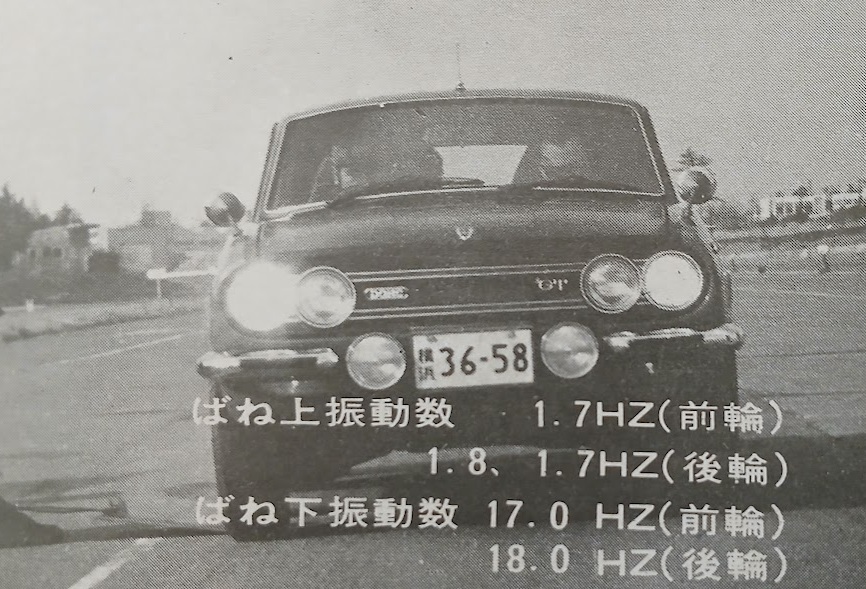
Tateishi: The vibration frequency is 1.7Hz for the front sprung vibration, 1.7Hz for the rear, and 17Hz for the unsprung vibration at the front wheels and 18Hz for the rear wheels. The spring rate for the sprung vibration is said to be 20% higher at the rear than in the GT, but it seems to be a lot higher.
The interior noise level is 67 phons at 40km/h, 72 phons at 80km/h, 76 phons at 100km/h, and 81 phons at 160km/h. Outside the car, the noise level is 70.5 phons when driving steadily, and 79 phons when accelerating. The exterior noise is very quiet for a GT, and considering high-speed noise and other factors, I think these are good results.
Watari: I’m not sure the GTR is the kind of car that focuses on ride quality in the normal sense, other than maintaining flat cornering, or on interior noise. However, when I drove it, there was a lot of engine vibration and noise at idle. Once I started driving, I didn’t notice the noise, but if I was going to drive long distances on the highway, I think that would be an issue.
From the point of view of “husband’s specifications,” I think this car has just the right vibration and noise levels, peaking at low speeds, high speeds, and medium speeds, but there is one problem. I don’t like the vibrations at idle, and I think that’s because the engine mountings are too stiff. Is there any reason for this? I wonder if, if they’re not stiff enough, there will be problems with linear motion of the engine.
Kaneju: It’s not that much of a problem. With this kind of car, the space around the engine gets tighter and tighter, so it’s designed to prevent the engine from interfering with or contacting other parts under the hood while driving. If it hits something, you get a shock, and it’s stressful on the components as well, but the vibration at idle isn’t relaxing either. I don’t know if I can say that it’s just the nature of the car, but it is a GTR, after all, so it’s a little worse at idle than a normal sedan, and I think it’s inevitable that you’ll notice that for the time being.
Hirao: Well, it can’t be helped how the valve timing was chosen. It revs up to 7000rpm.
Kaneju: Setting the idle speed at a higher speed reduces the vibration, but dealing with the vibration and noise of a car of this nature is difficult.
Higuchi: From my perspective, if we look at the space around the engine, you have to at least give up on the idea of an air conditioner. But I get the feeling that some users will go ahead and tune up the 1600GT and replace the engine with this one. That will be expensive, so if you can get a good engine from the start, that would be better, but you can’t have it both ways, so you have to give up on the “husband’s” specifications. Is that right?
Kaneju: It simplifies things to give up on the “husband’s specs” completely, but in the end, it doesn’t quite feel right.
Development at Endurance Racing Venues
Hirao: In terms of noise and vibration, it would be much easier to live with this engine with an overdrive gear. As it is, it turns about 4000 rpm at 120km/h. If you could drive normally at those speeds at just under 3000rpm, it would make a big difference. In that sense, having an overdrive is a big advantage.
Hoshijima: I first saw the Bellett GTR in 1968. It was called “GTX” then, and it was entered in an endurance race at Suzuka. Since then, it has mainly participated in endurance races, but I was very interested in it because I always thought it would be interesting to put a 117 engine in a Bellett. However, at first it had a difficult time finishing races, and every time something went wrong and it had to retire. In 1969, the distances it could complete gradually increased, and in August it won the overall championship. Soon after, it was released in its production form under the name GTR. I was very interested in the fact that the endurance race itself had been used as a testing ground for development, and I think it was a very good way to promote it to the market.
When I drove the car after it was released, the first thing I noticed was how quiet it was. However, below 40km/h it felt similar to what you describe when idling, and the noise and vibration there is no different from when the engine is first started, so this is unavoidable. However, the sound around 3000rpm is very quiet. And while it is true that it can be a little noisy when driving at around 120km/h, it is quiet above or below that speed. In particular, the quietness at 130km/h and 140km/h is almost unparalleled. It was definitely around 70 phons at that point.
Watari: There are peaks in the noise level at 120 and 140km/h, and it’s quiet in between.
Hoshijima: Comparing the ride quality of the GTR with that of the 117, I think the 117 has a better ride due to the suspension. Also, Professor Hirao mentioned the benefits of an overdrive transmission earlier, but to add to that, when driving on the Tomei Expressway at around 140km/h, I noticed there were many times when I needed to slow down and hesitated about whether to put it in third or apply the brakes. But if I had been driving in fifth gear, it would have been natural to drop down to fourth gear. It’s not that I don’t trust the brakes or tires to slow the car, but I think a car like this deserves a 5-speed transmission.
Hirao: I think you should consider whether to make it a 5-speed, or to make overdrive available on third and fourth gears.
Watari: It’s unsatisfying when there are changes in the engine sound that make it too quiet or too loud at different speeds. It would be better if there were no such dramatic changes at all. It’s okay to raise the overall sound level, as long as it’s consistent.
Successful Seats
Kaneju: Pollution has gradually improved as the industry has been bullied, but the raw engine noise you mention is a problem, and we want to eliminate the high frequency noises as much as possible. These don’t seem to affect the peak periods that people often point out in the measurements, but I still think they are noisy.
Yamamoto: Regarding vibration and noise, when I first drove it I did notice the idling harshness, but when I drove it on cobblestone roads, the car felt really good. I don’t know why that was.
Miyamoto: I think that’s because of the independent rear suspension. When the Bellett was released, I drove it on some pretty bad roads, but I also thought it was pretty good.
Higuchi: I drove it at about 40km/h inside the university campus, avoiding some areas that had been dug up for construction work, but there was no need to do that at all. On the contrary, it’s actually good on bad roads.
Hirao: This may be because the springs are a little stiffer and the shock absorbers are stronger.
Suzuki: That’s right.
Ishikawa: I think the seats are very good.
Toishi: We used molded urethane for the padding to improve the damping effect. Another feature is that the seatback is made of FRP.
Hirao: The connection between the backrest and the base of the driver’s spine is quite good.
Toishi: Well, we think it was a success.
Excellent Responsiveness
Magazine: We would like to ask the Saito Laboratory for their data on maneuverability and stability.
Doi: The practical minimum turning radius is 5.32m on the outside and 3.02m on the inside, which I think is a little on the large side for this car compared to cars in the same class. To evaluate the understeer and oversteer characteristics, we drove in a circular course, measuring the V²/100 while gradually increasing the vehicle speed up to 50km/h. In this case, the resulting R/Ro value of 1.35, which was maintained in understeer up until the end, is on the small side compared to other cars in the same class. This is what we call “weak understeer,” or minimal understeer. The maximum steering force in the test was 4kg at a lateral acceleration of about 0.4g, which is on the heavier side compared to other cars in the same class. The roll rate was 3.5° at 0.5g, while Isuzu’s internal data was 3.75°, so our test results showed that it is a car with relatively little roll.
Magazine: Mr. Hirao, how did it handle crosswinds?
Hirao: It was a fairly windy day on the Tomei Expressway, with a tailwind on the way to the test track, but as we left the Atsugi pass, the wind turned to the right. I hadn’t felt any impact when the wind was mostly a tailwind, but when we left the pass and caught the crosswind, even though I was holding the steering wheel with both hands, it was pulled about three degrees to the left. In that sense, I feel that if the steering weren’t quite so light at the center position, I wouldn’t have had to move my hands as much.
On the way back, Furutani was driving, and it seemed that the hardest part was when the wind hit the car diagonally from the front. It wasn’t so bad when we were driving directly into the headwind, but when we left Atsugi, it was again quite blustery, and I felt it even from the passenger’s seat. Could you add some solid friction to the steering in that position? Or maybe viscous friction is better, but either way, I think you can do it directly by tightening that part of the steering mechanism.
Takanami: There are quite a few people who say that rack and pinion steering is the reason for the Bellett’s reputation for good handling.
Hirao: I think that’s probably just one aspect of it. If I had tried going up the turnpike at around 100km/h, or up Otome Pass at around 70km/h, I might have been able to see its good points. I think one of the Bellett’s strengths is its excellent handling on roads like that. However, from the perspective of driving on the highway, you may not see its benefits.
Hoshijima: It’s true that there are a lot of cars with variable-ratio steering these days, and compared to those, the Bellett’s steering feels lighter around the straight ahead position when driving on the highway.
Okazaki: It’s definitely good on twisty roads. I drove it in conditions like Mr. Hirao described, and it’s amazing on roads like that. It’s a little unusual to have the car go exactly where you want it to go and drive so easily. It’s very responsive and the understeer/oversteer characteristics are very good.
Headrests Obstruct Vision
Magazine: Next, please tell us the results of the weight and brake tests from Ship Research Institute.
Ishikawa: The weight distribution is 538kg in the front and 435kg in the rear, for a balance of 54%/46%. The front end has a very small toe-in and camber alignment. The rear is not too large either. The brakes are discs in the front and leading/trailing drums in the rear, with a vacuum booster only in the front, and a tandem master cylinder, so the spring constant of the brake pedal is 1kg/mm, which is between a car with a brake booster and a car without a booster, and I think it is a reasonable value. The balance of the left and right braking forces is fairly good in both the front and rear. The operating force of each part is generally heavy, at 3kg to 4kg for the shift lever, 6kg of lateral movement to select reverse. The accelerator pedal force is 2.5kg for steady driving at 50km/h and 4kg when accelerating, which are heavier than in a normal sedan.
Magazine: And the feel of the brakes?
Ishikawa: I didn’t feel anything in particular, but the pedal stroke did feel a bit stretchy.
Okazaki: Yes, and I didn’t feel that the servo was very strong.
Yamamoto: It has disc brakes at the front, drum brakes at the rear, and has a pressure control valve and a limited-slip differential, correct?
Noguchi: We use a hydrovac brake booster only on the front wheels. The hydrovac only comes into play at about 30kg to 40kg of pedal force, so the PCV is used to match that. It also serves the purpose of balancing the rear wheel braking force.
Ishikawa: The bench test results clearly show the increase in braking force as the pedal is pressed, but it doesn’t feel that way when you actually drive the car…
Magazine: We would like to hear the results of the Hirata Laboratory’s field of view tests.
Hirata: The field of view in the horizontal plane, including the viewpoint, is 31.5° to the right and 60.6° to the left from the windshield, for a total of 91.5°. The rear window is a problem because the headrest is integrated with the seatback and is very large, but it is 27.5° on the left and 19.5° on the right. The blind angle created in the same horizontal plane is 91.5° overall, again because of the headrest. I think we may need to reconsider the methods we have been using to measure the driving visibility in the horizontal plane.
Yamamoto: We also measured the Bellett 1500, with a similar body structure, when it was released (December 1966). Comparing the two cars, the visibility is better this time, and it’s better overall. The dead angles to the left and right sides in the horizontal plane are about average compared to a normal car. The dead angles have become larger in relation to the total field of view, but the headrests are protruding, which is obstructing the visibility.
Magazine: Next, let’s take a look at the measurements by the Higuchi Laboratory.
Onda: The overall width has hardly changed compared to the Bellett 1500, but the front tread is now 1255mm, which is slightly wider than the previous model. The radial tires are 165x13, which is a big change in the numbers, but other than that, besides the divided front bumper, the small decorations, and the accents that make it recognizable as a GTR, the dimensions are basically the same. The most notable change in the interior dimensions is that the headrest is integrated, so the seatback height is a very high 770mm. The pedal arrangement hasn’t changed much from the previous model, but one thing that remains notable is that is that while the clutch pedal in most cars straddles the steering shaft, the Bellett’s pedals are all together to the right of the steering shaft, and the shaft is shifted to the left.
Yamamoto: One thing I wish they would fix is the angle of the left footrest.
Hirao: That’s right. It poses a big problem for the driver.
Higuchi: There is a correlation between the seat height and the angle of the footrest, and I think the footrest needs to be more upright. This close, flat footrest would only work if the seat was much higher. The most fundamental thing is whether it matches the overall height of the seat.
Hirao: I think the lower edge of the footrest should be moved 20mm forward. I think that would solve the pedal problem.
Magazine: Finally, Professor Higuchi will tell us about safety.
Higuchi: Regarding the safety results, on a 100-point scale, recent 1500cc class sedans generally score around 90 points, while GT sports cars score around 80 to 85 points. This car scored 84 points, which is on the low side for a sedan. The fact that the front bumper is divided into left and right halves and is not attached in the middle, and that it uses tempered glass instead of laminated glass, both lowered its score by 3 points each, but I don’t think a score above 80 points is a problem.
Magazine: Thank you all very much.
Postscript: Story Photos