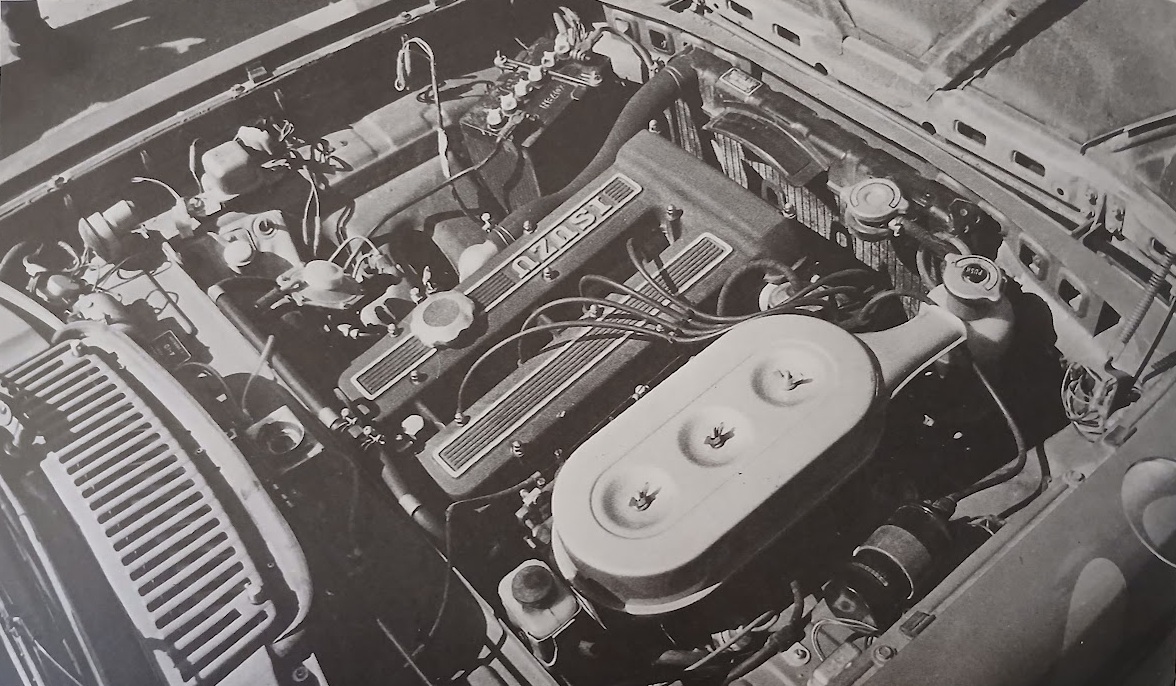
Isuzu Bellett 1600GTR (1971)
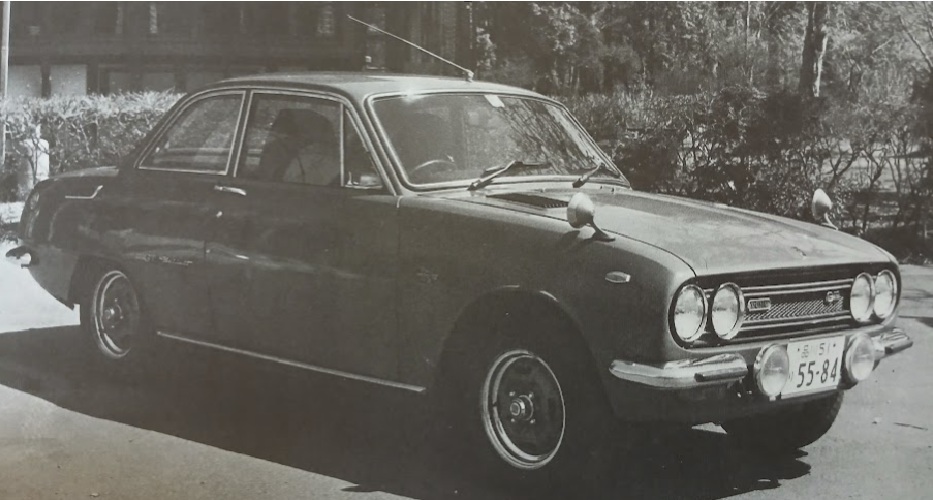
Publication: Car Graphic
Format: Road Test
Date: June 1971
Author: “C/G Test Group” (uncredited)
Summary: The ultimate Bellett GT. The ride is excessively firm at low speeds and noise becomes excessive at high speeds, but performance and handling are the best in its class. The steering is exceptionally quick and precise. Power-off oversteer, inherent in the swing-axle rear suspension, is kept within reasonable bounds, making the car exceptionally fast and exhilarating on winding roads. Rear-seat space is limited, making it effectively a 2+2. The inadequate ventilation and heating system betray the age of the design.
Road testing the Isuzu Bellett 1600GTR
A full road test of the Bellett 1600GTR has long remained unfinished business for us. At the time of its debut in the autumn of 1969, the editor had only recently broken his left leg, and hesitated at the prospect of operating the GTR’s heavy clutch for extended periods with a plaster cast still on. We therefore settled for publishing a brief road impression by the editorial staff.
From that time until now, however, there has been a steady stream of letters from devoted Bellett enthusiasts urging us to conduct a proper test of the GTR. Their number reached a peak after we left the Bellett 1600GTR out of our comparison test of 1.6-liter sports coupes in the August 1970 issue of Car Graphic. We had done so for a variety of reasons, but the result was a desk piled high with indignant letters.
Nothing could better illustrate how strongly the Bellett, though produced in relatively small numbers, has captured the loyalty of its fans—or how completely the GTR represents the ideal to them. Our own desire to give the GTR a thorough evaluation has been no less strong. So, while fully aware that it is somewhat overdue, we have decided at last to give it the comprehensive test it deserves.
Returning to the Bellett GTR after so long confirmed one thing above all else: despite its many old-fashioned features, it still possesses the finest handling of any Japanese production car. We will begin with that subject.
The GTR’s suspension is considerably stiffer than that of the standard GT. Front spring rates have been increased from 3.5kg/mm to 5.3kg/mm. At the rear, the coil springs remain unchanged, but the transverse leaf spring has been increased from a single leaf to three, raising its spring rate from 0.94kg/mm to 3.1kg/mm. The dampers have also been strengthened significantly, with both front and rear providing 160kg rebound and 43kg compression damping (at 0.3m/sec). Ride height has been lowered by 10mm.
Taken together, these specifications are broadly equivalent to the Stage I suspension previously offered for the Bellett GT. Tires are 165HR-13 radials mounted as standard on 4.5J rims.
Among Japanese production cars—whose steering generally errs on the side of excessive sluggishness—the GTR’s steering is exceptional. Even compared with European GTs and sporting sedans, it is remarkably quick.
Throughout this test, we drove alongside an Isuzu 117 Coupe EC, and it was astonishing that the two cars could have come from the same manufacturer, so completely opposed were their handling characteristics. Accustomed to the 117’s pronounced understeer, several Car Graphic testers found themselves steering the GTR too far into the first two or three corners, only to unwind the wheel after realizing how light and responsive its steering was.
Even on ordinary roads, the GTR is enormous fun to drive. Its firm suspension and exceptionally sharp steering allow corners to be taken at surprisingly high speeds. To bring out its full potential on a racing circuit, however, demands rather special technique and careful control.
With 120ps to move a modest 970kg, the GTR has more than enough power for its weight. As long as the correct gear has been selected, the car can be guided neatly and very quickly through a corner by combining delicate throttle inputs with steering. Naturally, this is possible because of the characteristics of its swing-axle rear suspension—but those same characteristics are also the car’s fundamental weakness.
Ease off the throttle while cornering at speed and the nose suddenly tucks toward the inside of the bend, almost like a front-wheel-drive car—though for entirely different reasons. This makes it clear that, under power, the GTR exhibits a well-judged degree of understeer. Equipped with its standard 165HR-13 radial tires (our test car wore Yokohama GT Special XXs), sustained power through a corner will ultimately cause the outside front tire to break away, and to do so rather abruptly.
As a result, one instinctively adopts a specific technique for driving the GTR quickly on its standard tires. The approach is to continue straight toward the apex, then brake just before reaching it while simultaneously applying a small steering input. The accompanying weight transfer lightens the swing-axle rear suspension, increasing positive camber and reducing rear-tire grip. The rear wheels therefore slide readily, allowing the car to turn through a tighter radius than the steering angle would suggest. The instant the car has changed direction, full power is applied immediately.
In other words, rather than following the conventional line of maximum cornering radius, the GTR is driven—in extreme conditions—by linking one straight with the next through only a very small arc, exploiting the oversteer characteristics of its swing axle.
This technique offers two advantages. First, because it follows the shortest possible path, it is quicker than the conventional wider-radius line. Second, by remaining in a straight line nearly all the way into the corner, braking can be delayed significantly.
This was a technique favored by Stirling Moss in racing, and one he frequently used to overtake faster cars under braking. Needless to say, such cornering cannot, and should not, be attempted on public roads. Even so, it is worth understanding as one of the GTR’s distinctive handling characteristics.
One point, however, deserves emphasis: abrupt steering inputs must be avoided at all costs. Sudden braking and steering are inadvisable in any car, but in the GTR—even though its suspension has been lowered and stiffened—the inherent shortcomings of the swing-axle layout remain. In the worst case, they can make the car particularly susceptible to rolling over.
Steering effort is appropriately light except at parking speeds. The price paid for the GTR’s outstanding handling is a considerable amount of kickback through the steering wheel. Expansion joints in concrete pavement and raised lane markers are not only heard—they are transmitted directly to the driver’s hands.
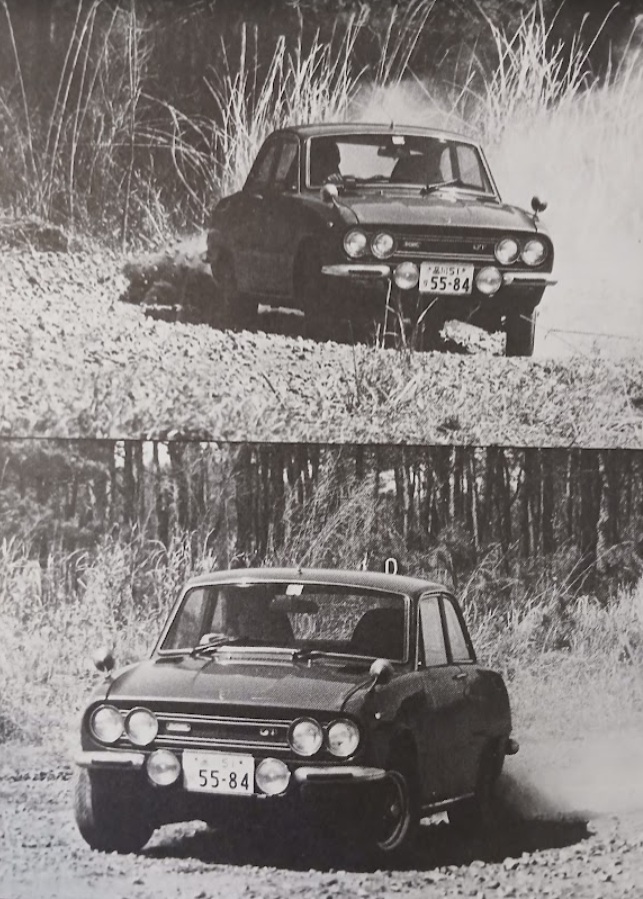
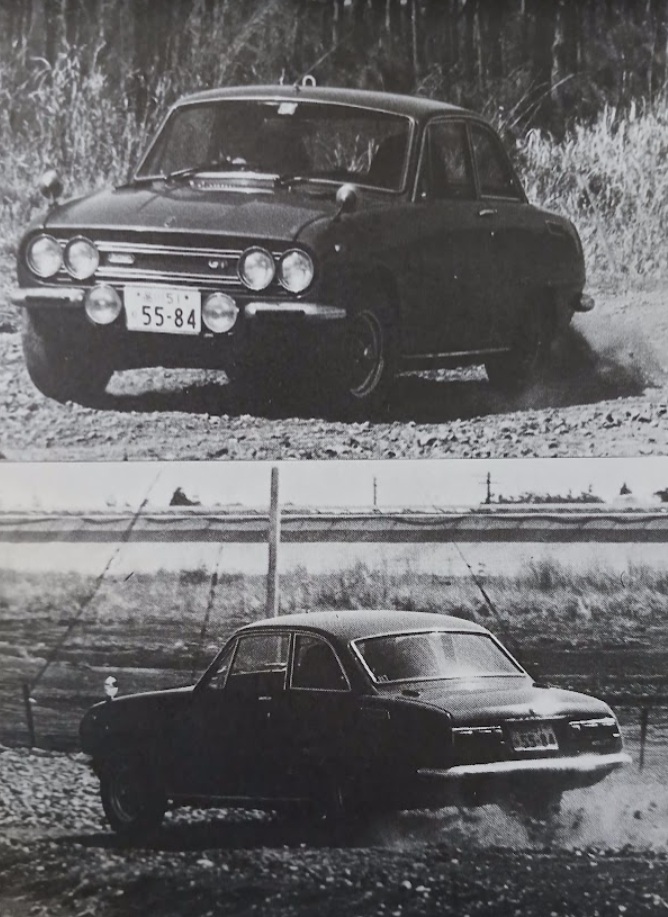
At Yatabe we also drove the car over gravel roads resembling a rally stage, where the advantages of its fully independent suspension and limited-slip differential became particularly evident. Straight-line stability, especially, proved exceptional. With a generous ground clearance of 195mm, there is virtually no risk of striking the underside.
The braking system combines front discs with Alfin rear drums, using the highly fade-resistant M33S brake pads (the GT employs M59 pads). The increased pedal effort resulting from these pads has been compensated for by fitting a small-diameter Hydromaster servo. In addition, the rear brake circuit incorporates a pressure-control valve (PCV) to prevent premature rear-wheel lock-up.
Braking performance is entirely adequate for the GTR’s level of performance. Although servo-assisted, pedal effort is generally rather high by modern standards, particularly during low-speed driving in the city. Braking itself, however, is progressive in proportion to pedal pressure, and front-to-rear balance is excellent, making this a thoroughly confidence-inspiring system in an emergency.
The 0-100-0 fade test likewise produced excellent results. By the tenth stop, pedal effort had increased by only about 20%. The minimal change in body attitude under hard braking is another welcome characteristic.
With the exception of maximum speed, which we will discuss later, the GTR’s performance proved every bit as impressive as expected, confirming it to be among the world’s finest cars in the 1.6-liter class. The table below compares its acceleration figures with those of two other DOHC-powered 1.6-liter rivals, the Mitsubishi Galant GTO MR and the Toyota Celica GT.
| Bellett GTR | Galant GTO MR | Celica GT | |
|---|---|---|---|
| 0-50m | 4.2s | 4.3s | 4.5s |
| 0-100m | 6.8s | 6.7s | 7.0s |
| 0-200m | 10.7s | 10.5s | 10.8s |
| 0-400m | 16.8s | 16.3s | 16.8s |
| 0-1000m | 31.9s | 31.2s | 32.0s |
According to these figures, the Bellett is slightly slower than the Galant GTO MR (125ps/6800rpm, 14.5kgm/5000rpm, power-to-weight ratio 7.84kg/ps), while almost exactly matching the Celica GT (115ps/6400rpm, 14.5kgm/5200rpm, 8.17kg/ps).
Naturally, both of these rivals are equipped with 5-speed gearboxes, whereas the Bellett has only four speeds. Although all three cars run on 165-13 tires, the GTO and Celica use numerically higher final-drive ratios (4.222 and 4.111 respectively, compared with the Bellett’s 3.727), made possible by their overdrive fifth gears. At least during the 0-1000m acceleration test—where more than half the distance is covered in top gear—this should put the Bellett at a disadvantage.
In practice, however, the Bellett’s acceleration figures are almost identical to those of the Celica and GTO. The most likely explanation is that its taller overall gearing—and therefore lower driving force—is effectively offset by the smaller frontal area of its body.
Our greatest disappointment, however, was in maximum speed. On the previous day, while driving at high speed on the Tomei Expressway, the engine had appeared to be in excellent condition. But when the maximum-speed test began at Yatabe, it simply refused to pull in either third or fourth gear.
In the lower gears the engine would rev happily beyond 7000rpm, but in third it stubbornly refused to exceed 6000rpm, while in fourth it would go no higher than 5100rpm. As a result, the average speed over the 1km straight was a dismal 147.54km/h.
Suspecting an ignition fault, we cleaned the spark plugs and tried every remedy we could think of, but without success. We had asked the manufacturer more than a month in advance to prepare the car carefully for testing, yet there is no doubt that this poor result was caused by the engine’s condition, and did not reflect the GTR’s true capabilities. The catalog claims a maximum speed of 190km/h, corresponding to approximately 6700rpm in top gear.
We regret the outcome as much as anyone and intend to repeat the test at the earliest opportunity.
Fuel consumption, especially in a car like this, varies greatly according to driving style. The constant-speed fuel-consumption figures were as follows:
| 40km/h | 50km/h | 60km/h | 80km/h | 100km/h | 120km/h | 140km/h |
| 18.5km/l | 19.5km/l | 16.1km/l | 14.6km/l | 13.1km/l | 9.1km/l | 7.6km/l |
Under practical driving conditions, the poorest figure we recorded was 6.8km/l over 226.5km, a route that included the constant-speed testing at Yatabe. Medium-speed suburban driving between Yatabe and Tokyo returned 8.5km/l, while high-speed touring on the Tomei Expressway and through Hakone averaged 7.5km/l.
The test car also proved to have a fairly healthy appetite for oil. During the course of our 603.8km test, it required an additional one liter.
The 4-speed gearbox is very well matched to the engine’s output and the car’s weight. Extended to 7000rpm, it will reach 58km/h, 102km/h, and 148km/h in first, second, and third gear respectively.
The engine itself displays exceptional flexibility for a high-output unit. Because the overall gearing is relatively tall, however, about 40km/h in top gear (approximately 1400rpm) is the lowest speed it can maintain smoothly under steady throttle.
As mentioned previously, the engine refused to pull cleanly at the upper end of third and fourth gear during our maximum-speed testing. Below 150km/h, however, it behaved entirely normally and remained in good condition throughout the four-day test.
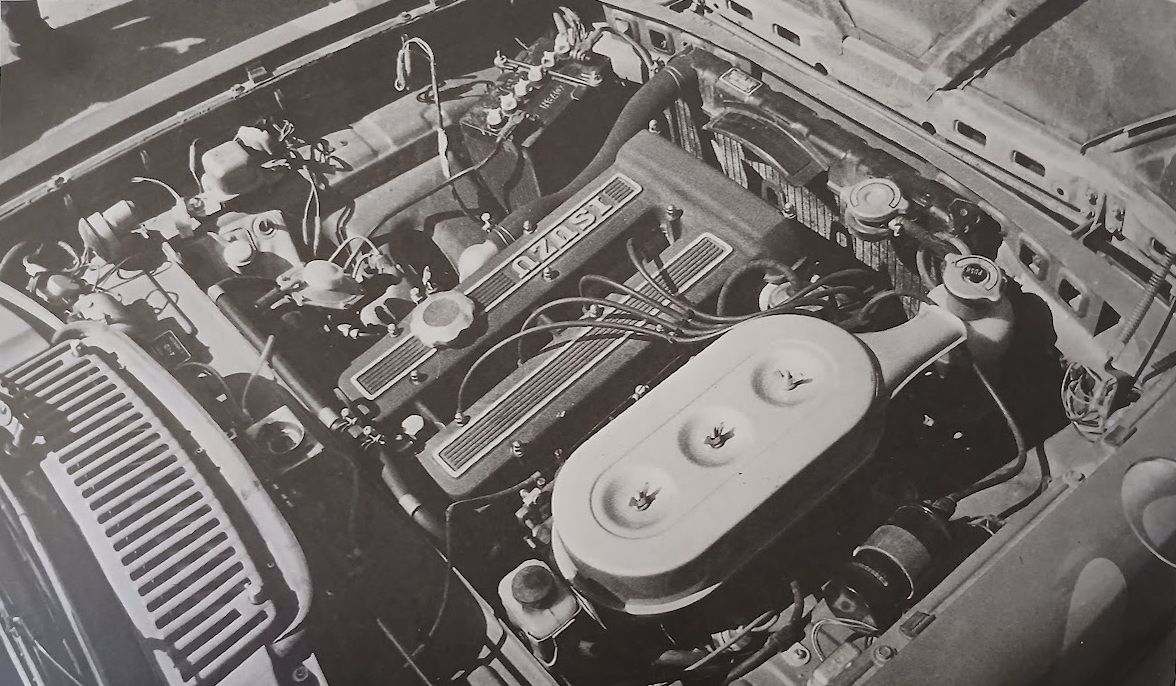
Cold starts in the morning were equally trouble-free. Without using the choke, two or three strokes of the accelerator to draw fuel through the twin Solex N40PHH-3 carburetors were enough for the engine to fire immediately, settling into a smooth 900rpm idle.
With its relatively high compression ratio of 10.3:1, a momentary trace of detonation can occur if the throttle is opened abruptly below 2000rpm. Apart from this, throttle response is crisp over an exceptionally wide operating range.
The engine is remarkably smooth from idle all the way to 7000rpm, though the rigidity of its mountings seems rather high, transmitting a constant fine vibration through the body. The driveline is equally rigid, responding to the throttle with an immediacy more like that of a rear-engined or front-wheel-drive car, where there is no long propeller shaft to absorb the response.
Overall noise levels are high by modern standards, though this is perhaps inevitable in such a long-running design. To the committed enthusiast who appreciates the GTR’s uncompromising character, however, the noise at high speed will seem only a small price to pay for its performance.
One day of our test was conducted in particularly poor weather, with gusting crosswinds approaching 15m/sec. Even under these conditions, the GTR proved far less affected by crosswinds than the accompanying 117 Coupe. Whereas the latter struggled to confidently maintain 140km/h, the GTR could easily maintain speeds some 10km/h higher.
In calm conditions its directional stability is quite exceptional. It runs literally as straight as an arrow, and under ideal circumstances 160km/h (approximately 5600rpm) would present no difficulty as a sustained cruising speed.
Sharing both its engine and gear ratios with the heavier 117 Coupe, the smaller and lighter GTR has little need for a fifth gear. The 4-speed gearbox is entirely sufficient. Its thick, short gear lever falls readily to hand, and the shift action is positive and quick. Early Belletts suffered from considerable gear noise, but the transmission has now been improved to the point where there is virtually nothing left to criticize. Likewise, the gear noise transmitted from the chassis-mounted differential is no longer noticeable.
The clutch pedal is on the heavy side, but its comparatively short travel—by Japanese production-car standards—is welcome. Because of the limited-slip differential, hard standing starts are less likely to induce wheelspin, making greater clutch slip necessary. Fortunately, the clutch is well suited to this kind of use. The pedal layout is also excellent, allowing heel-and-toe downshifts to be performed completely naturally.
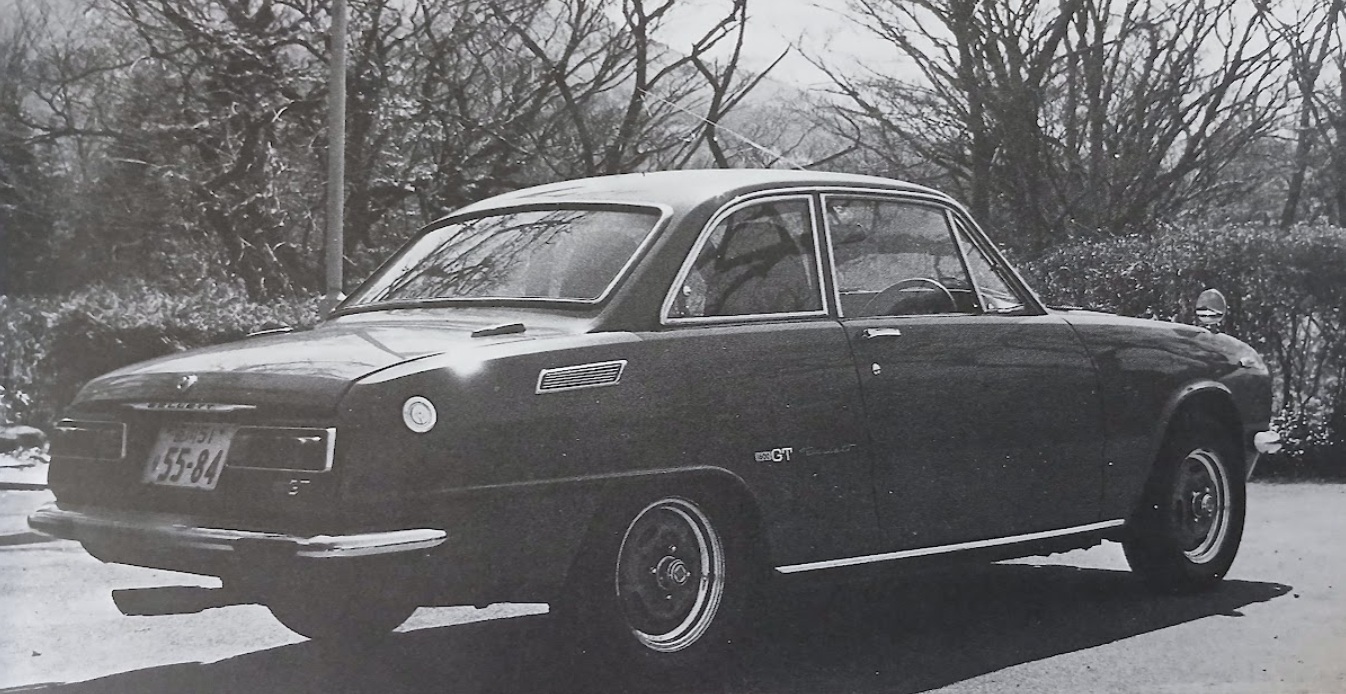
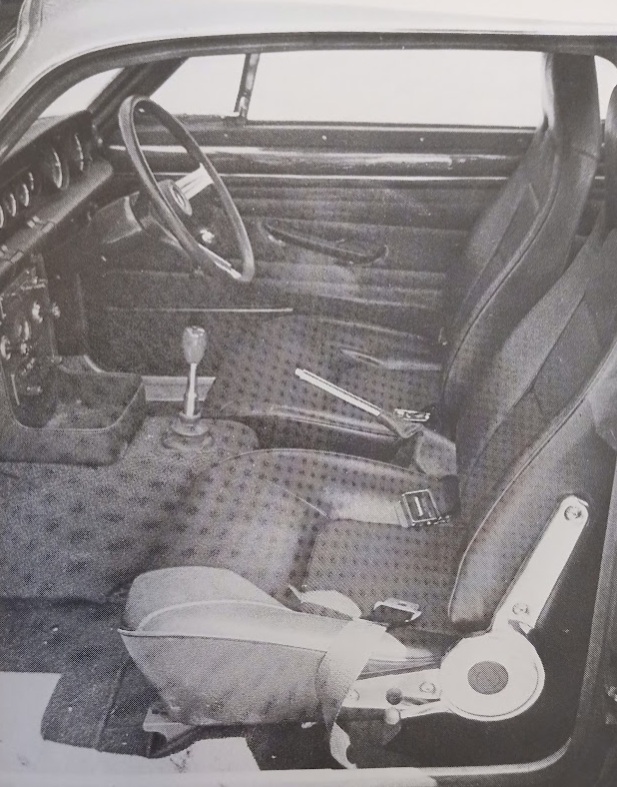
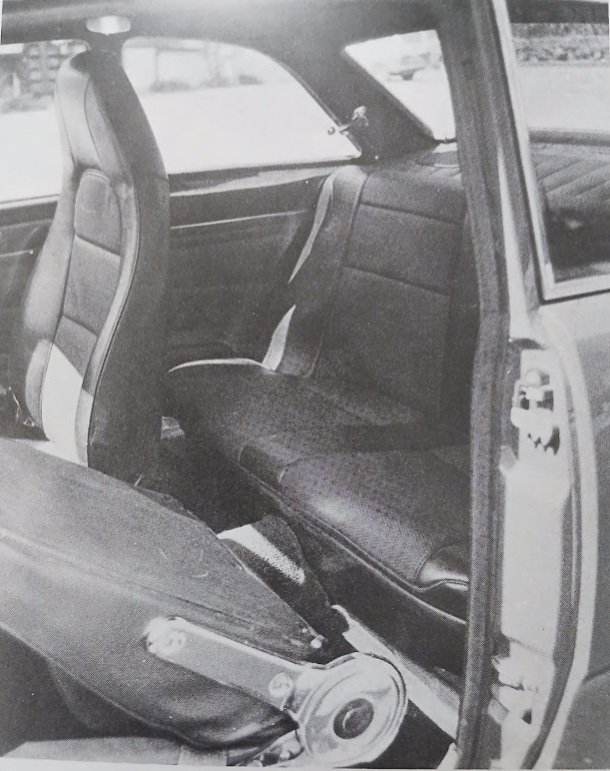
The GTR is, in practice, a two-seater. Its cramped rear seat is really no more than an auxiliary seat, suitable only for squeezing in two extra passengers in an emergency. Accept that, and it becomes an exceptionally comfortable two-seat GT. Between the rear seat and the trunk, there is enough space for everything required on a long journey.
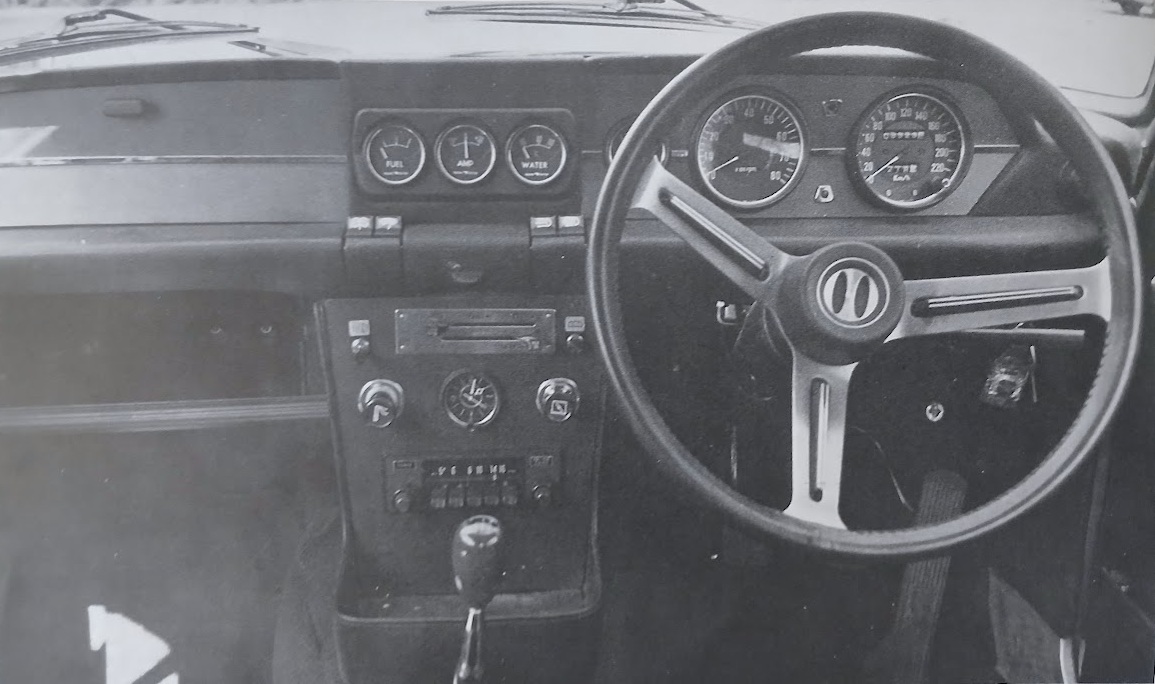
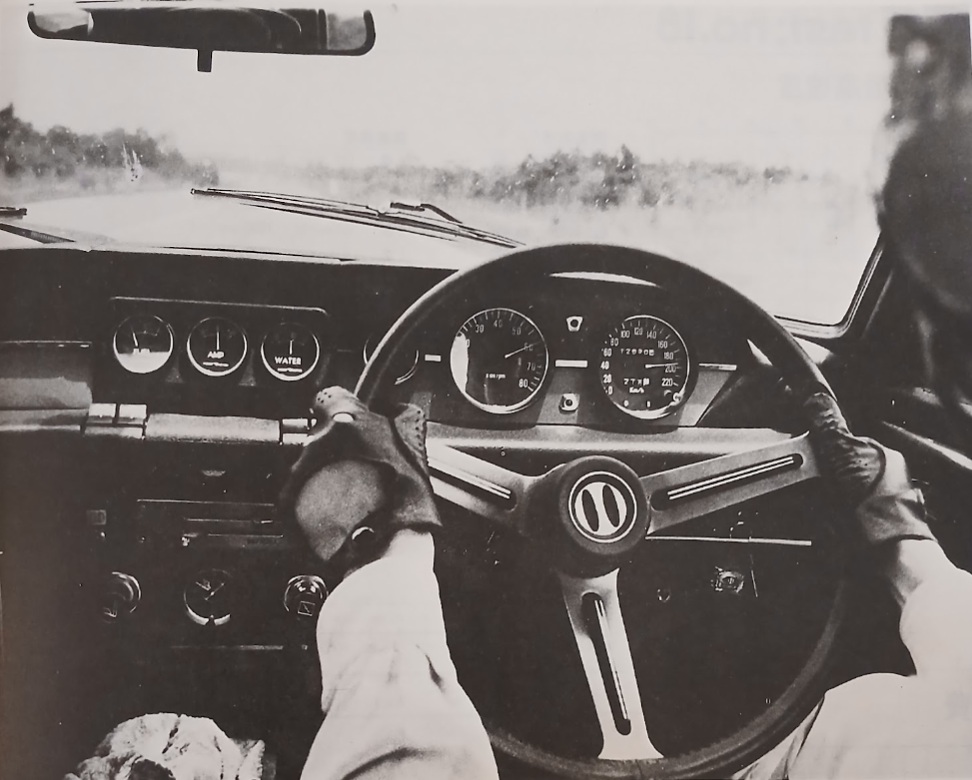
The driving position is exceptionally good. Climbing out of one of today’s cars—which seem almost to place their occupants inside a glass box, providing excellent visibility while making them equally visible from outside—and into the GTR, with its relatively small glass area and low seating position, one feels somehow reassured.
The thick leather-covered steering wheel sits comparatively high, as does the scuttle, producing a driving position reminiscent of an Italian GT such as an Alfa. The high-back seats, with integral headrests, are extremely comfortable. The front compartment offers exactly the amount of space required—no more, no less—and one is left wondering why manufacturers insist on making each new model wider than the last.
Given the character of this car, the provision of only two-point seatbelts must be regarded as inadequate.
The heater and ventilation system are what most betray the Bellett’s age. Heater control is limited to blower speed alone; temperature is regulated by a tap on the engine itself and cannot be adjusted from inside the cabin. The outlets at either end of the dashboard supply only heated air, leaving the triangular vent windows as the sole source of face-level fresh air. Ventilation is insufficient, and the windows have a tendency to fog up in wet weather. The standard rear window defogger, fortunately, proves very effective.
It is certainly true that the Bellett GTR, whose basic design dates back nearly a decade, is an old car in many respects. Yet viewed another way, it displays the kind of painstaking design and workmanship throughout that could hardly survive today’s relentless value-engineering practices.
In practical terms, the only major shortcomings are the heater and ventilation system. Improve these details alone, and there is every reason to believe the Bellett GTR still has a long future ahead of it.
Its price of 1.11 million yen admittedly remains a substantial obstacle. Even so—“Long live the Bellett!”
Supplement (Car Graphic, July 1971)
As readers will recall, the Bellett 1600GTR tested in last month’s issue was not in perfect mechanical condition. The disappointing maximum speed of 147.54km/h (average over the 1km straight) fell far short of expectations. Although the engine would rev happily beyond 7000rpm in first and second gear, it stubbornly refused to exceed 6000rpm in third or 5100rpm in fourth. There could be no doubt that this did not reflect the GTR’s true capabilities—the catalog claims a maximum speed of 190km/h.
Naturally, this was a source of considerable disappointment not only to Bellett fans throughout the country, but to ourselves as well. We therefore returned to Yatabe this month for the sole purpose of confirming the car’s maximum speed. The test car was the same one used previously, but its carburetors had been overhauled and the distributor replaced, along with several other adjustments.
The results are shown in the accompanying data table and may be regarded as representative of the performance of a standard production GTR.
This time, the engine pulled cleanly to 7000rpm in third gear and slightly beyond 6000rpm in top.
Car Graphic’s maximum-speed test consists of running continuously at full throttle around Yatabe’s 5.5km high-speed circuit while measuring both the elapsed time over the level 1km sections of the two long straights and the overall 5.5km lap time.
On the day of the test, a southerly wind averaged 2m/sec with gusts reaching 4m/sec. Under these conditions, the best speed recorded over the 1km straight was 182.0km/h. On the opposite straight, where the wind was unfavorable, the figure was 179.1km/h. Over the complete 5.5km lap—which includes both the additional resistance of the banking and a section directly exposed to the headwind, offset in part by a tailwind elsewhere—the GTR consistently averaged 179.02km/h.
At maximum speed, engine speed reached 6050rpm on the fastest section of the circuit and never fell below 5900rpm at its lowest. As usual, the speedometer proved optimistic. The true road speeds corresponding to each indicated speed are shown in the accompanying table. At an actual speed of approximately 180km/h, the car’s speedometer indicated 195km/h.
We were unable to measure the accuracy of the tachometer directly. However, comparison with the calculated performance data (which does not allow for the increase in tire diameter due to centrifugal growth) suggests that it reads approximately 5% lower than expected. Even allowing for tire expansion at speed, it appears to indicate slightly fewer rpm than the engine is actually turning.
Standing-start acceleration differed little from the figures recorded during last month’s test. During hard launches this time, however, the engine lurched so violently as the clutch was engaged that it struck somewhere against the body, making a clean start difficult to achieve. This behavior did not occur during the previous test and appears to have cost approximately 0.1 second in the 0–400m acceleration time.
Once accelerating in third and fourth gear, however, the improved condition of the engine more than compensated. As a result, the 0–1000m time was, in fact, 0.2 second quicker than before.
To summarize the results confirmed by this second test, the 1600GTR’s performance—a maximum speed of 182.0km/h and a 0–400m time of 16.8 seconds—still places it among the front ranks of the world’s 1.6-liter GT coupes. Compared with other cars in the same class equipped with DOHC 1.6-liter engines, the figures are as follows. Data for the Japanese cars are based on Car Graphic test results; those for the foreign cars are taken from Autocar magazine.
| Galant GTO MR | Celica GT | Alfa Romeo GTV | Fiat 124S | |
|---|---|---|---|---|
| Max speed | 182.02km/h | 176.78km/h | 185km/h | 180km/h |
| 0-400m | 16.3s | 16.8s | 17.7s | 17.8s |
Needless to say, all four of these cars are equipped with 5-speed gearboxes, whereas the Bellett is handicapped by only having a 4-speed. However, the Bellett’s smaller, lighter body largely offsets this disadvantage.
Naturally, judged by modern standards, its smaller body—particularly the cramped rear seat—together with its higher noise levels and firmer ride, put it at something of a disadvantage overall. Given the age of its basic design, this is hardly surprising.
Throughout the test period, engine performance remained consistently unchanged. Even after more than ten minutes of continuous laps at maximum speed, water temperature remained constant at 85°C, while oil pressure fell only slightly, to 3kg/cm².
Sustained cruising at 160km/h (approximately 5600rpm) can therefore be considered well within the car’s safe operating range.
The Yokohama GT Special XX 165HR-13 tires were initially set to pressures of 1.8kg/cm² at the front and 2.1kg/cm² at the rear. Immediately after the maximum-speed test, these had risen to 2.0kg/cm² and 2.4kg/cm² respectively—an entirely normal increase.
Postscript: Story Photos