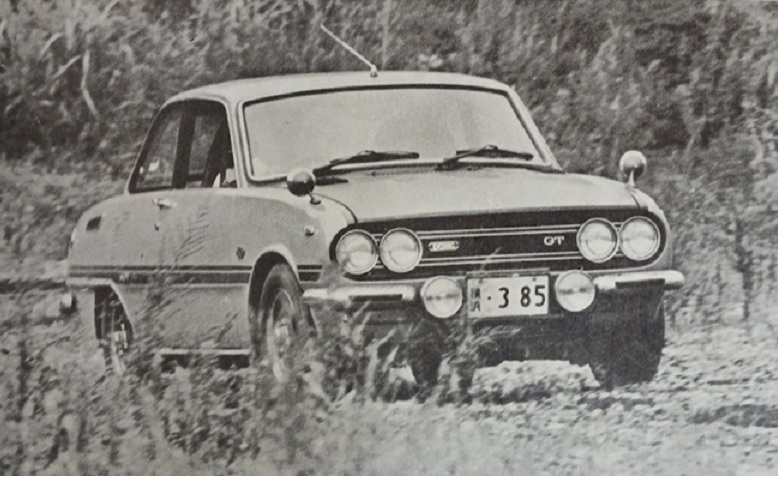
Isuzu Bellett 1600GTR (1969)
Publication: Car Graphic
Format: Road Impressions
Date: December 1969
Author: Shotaro Kobayashi
Road testing the Isuzu Bellett 1600GTR
When Paul Frere visited Japan, he remarked that among the domestic cars he had driven, his favorite was the Isuzu Bellett 1600GT with its low and stiff suspension tuning. He further suggested that the Isuzu Bellett GTX, which had been competing in races with the twin-cam engine from the Isuzu 117 Coupe, ought to be placed into production. Evidently the manufacturer had already been thinking along similar lines, for the result appeared almost immediately as the Isuzu Bellett 1600GTR tested here, priced in Tokyo at 1.16 million yen.
To outline the GTR, it combines the body of the 1600GT–equipped with radial tires and suspension lowered and stiffened to a specification similar to that of the former Stage I sports kit (intended for gymkhana)–with the 1600cc DOHC four-cylinder engine from the 117 Coupe.
Although the 117 and GTR share the same engine, their characters are entirely different, just as their body styles would suggest. Whereas the 117 is a graceful grand touring car for fast highway travel, the GTR is designed with outright performance in mind, and is sufficiently “hot” to enter gymkhana competition as it is. Yet despite this, it is by no means an ill-tempered machine, and one of its greatest virtues is how remarkably easy it is to drive quickly.
In addition to the engine itself, the clutch and gearbox are also shared with the 117 Coupe, while the final-drive ratio remains the same 3.727 used in the 1600GT. This twin-cam engine has already earned a strong reputation for its quick response and smoothness at high rpm. The following figures, though unofficial, represent passing-acceleration times measured in fourth gear, and they demonstrate clearly that the engine delivers strong, well-distributed torque throughout the range, at least up to around 140km/h, beyond which aerodynamic resistance rises sharply:
40-60km/h: 7.5 seconds
60-80km/h: 5.0 seconds
80-100km/h: 5.5 seconds
100-120km/h: 6.0 seconds
120-140km/h: 7.0 seconds
140-160km/h: 10.4 seconds
Because there is such ample reserve power, pressing the throttle at almost any engine speed produces consistently strong acceleration. The catalog maximum speed of 190km/h appears entirely believable, without exaggeration.
The test car suffered from imperfect carburetor adjustment–the twin-choke Solex units producing a noticeable hesitation around 2500rpm–but beyond that the engine pulled smoothly and willingly all the way past 7000rpm. (The yellow zone begins at 6500rpm, with the red zone starting at 7000.) Even at speeds well above 100km/h, mechanical noise was relatively subdued, and it became apparent–particularly when depressing the clutch, when the cabin suddenly grew quieter–that the main source of noise was in fact exhaust resonance.
Around 4000rpm, corresponding to approximately 120km/h, exhaust boom began to resonate noticeably inside the cabin, though beyond roughly 4500rpm it subsided once again. Up to about 100km/h there was also a pronounced whine from the Yokohama GT Special tires, but after replacing them with Bridgestone Radial 10s, the noise disappeared entirely.
The idle speed, set at approximately 900rpm, is somewhat rough, with a fair degree of vibration. The very short gear lever emerging from the transmission tunnel has the characteristic crisp, mechanical feel long associated with Isuzu cars, though operation requires considerable effort. Clutch engagement, by contrast, is quick yet perfectly smooth.
One of the car’s most outstanding characteristics is its excellent handling, due in large part to the lowered and stiffened suspension. As mentioned previously, the chassis has been tuned to a specification very close to the former Stage I setup. Compared with the standard 1600GT, the spring rates are 5.3kg/mm vs 3.1kg/mm for the front coils, and 3.5kg/mm vs 0.9kg/mm for the rear transverse camber-compensator leaves, incorporating three leaves instead of one.
Apart from this, the stabilizer bars and rear coil springs remain unchanged, though the dampers have been strengthened front and rear. The rack-and-pinion steering feels somewhat heavy at low speeds, but at high speed its response is extraordinarily sharp, with virtually no free play at all. Straight-line stability is excellent–to the extent that it can be driven hands-off at high speed with little anxiety–and the benefits of this are appreciated even more on winding roads than on straight highways.
Body roll during high-speed cornering is almost nonexistent, while the radial tires provide very strong grip. While driving on the twisting sections of the Metropolitan Expressway, there were occasions when the surrounding traffic suddenly seemed to have slowed dramatically, only for a glance at the speedometer to reveal that the car had quietly reached a very considerable speed.
The moderately stiffened suspension gives exceptionally good handling for a swing-axle rear suspension system. Mild understeer gradually gives way to final oversteer, yet tail slide can be controlled very easily through delicate throttle modulation.
Inevitably, however, some sacrifice in ride comfort accompanies such excellent handling. The combination of stiff springs and stiff tires transmits road irregularities quite faithfully, and the steering exhibits noticeable kickback over rough surfaces. Fortunately, the leather-covered steering wheel rim absorbs much of this harshness before it reaches the driver’s hands.
On unpaved country roads, the stiff suspension naturally causes the car to bounce about somewhat, though it never bottoms against the road surface, and ride comfort is not nearly as objectionable as one might expect. The Bellett has always had a relatively good ride on poor roads. Noise and vibration from steering kickback tend to create a worse impression than the actual ride itself, but prospective buyers of the GTR are unlikely to find this especially bothersome.
On gravel surfaces, the limited-slip differential proves extremely effective, preventing the single-wheel spin so common in powerful cars. Previously, this differential had been offered only as an option.
The brakes are front discs and Alfin rear drums. Because the brake pads have been changed to the more fade-resistant Type M33S compound (the GT uses M59 pads), pedal effort has increased, and accordingly a vacuum servo has been fitted to compensate. In addition, a pressure-control valve has been installed to prevent premature rear-wheel lock during heavy braking, improving reliability at high speeds.
Pedal effort remains somewhat heavy in city driving, but at speed the brakes are exceptionally reassuring, with excellent stability and a very natural feel. Front-to-rear balance is well judged, and there is none of the unpleasant delay often associated with servo assistance. The floor-mounted handbrake is also notably easy to use.
Turning next to the interior, the front seats use a distinctive design in which the backrests are extended upward to serve simultaneously as integrated headrests. Rearward seat travel is extremely generous–more than sufficient, in fact–and the bucket-type seats provide very good lateral support. On the other hand, the tall integrated backrests impair rearward visibility when backing up.
As mentioned earlier, the steering wheel is a three-spoke leather-covered type, and its moderately thick rim feels exceptionally good in the hands. The driving position itself retains the characteristic Isuzu Bellett 1600GT layout, with the seat mounted low while the steering wheel and dashboard are relatively high. When the seat is adjusted to suit the steering wheel and shift lever, however, one becomes aware that the pedals are rather too close to the driver. Ideally, the brake and clutch pedals ought to be positioned slightly farther away, roughly where they are now when fully depressed. The difference in height between brake and accelerator pedals is also fairly pronounced, making heel-and-toe operation less easy than it could be.
The dashboard is fundamentally the same as in the 1600GT, though the instrument panel is finished in black. Since the wipers and hood are likewise painted matte black to reduce reflections, one rather wishes the chrome rings around the gauges had also been removed.
By the standards of its class today, the Bellett’s body is relatively small, and as a result the GT’s rear seat must be regarded as little more than auxiliary accommodation. For taller occupants, even with the front seats moved fully forward, both knee room and headroom are effectively nil. In the GTR especially, the front seats’ integrated headrests further obstruct forward visibility, creating an undeniable sense of confinement in the rear cabin. Realistically, the car is best regarded as a three-seater.
Among the more distinctive detail features are the electrically heated rear-window defogger, a windshield washer that operates simultaneously with the wipers, and standard halogen fog lamps which also illuminate the instrument and tail lamps when switched on.
Finally, fuel consumption over approximately 300km of driving–including a round trip to FISCO via the Tomei Expressway, together with city driving in Tokyo–averaged 9.2km/l, a relatively good figure for a car of this type.
For now we have limited ourselves to these brief impressions, but a full-scale road test is planned for a future issue, and we hope readers will look forward to it.