Honda Z GL and GTL (1972)
Publication: Motor Fan
Format: Road Test
Date: June 1972
Authors (Roundtable): Yoshio Nakamura, Ryozo Mabuchi, Osamu Hirao, Yasuhei Oguchi, Hiroshi Okazaki, Katsuzo Kageyama, Kenji Higuchi, Tomoaki Yoshioka, Hiroshi Hoshijima, Taizo Tateishi, Teruhisa Oki, Kunitaka Furutani, Masahide Sano, Kenzaburo Ishikawa, Toshihide Hirata, Hiroshi Sase, Motor Fan Editorial Staff (uncredited)
The Life’s Mechanicals Transplanted
Magazine: First, could you give us an outline of the new Honda Z?
Nakamura: We introduced the Honda Z—the air-cooled model—in the autumn of 1970, and it won particular support among younger customers, pioneering a new category of its own within the kei-car class. Over the past year, however, the car industry as a whole has entered something of a transitional period, with changes in the direction of the market as well. For kei cars in particular, it has been a rather confused situation.
In response to these changes, we introduced the Life in May 1971, reconsidering what a kei car should fundamentally be. The new water-cooled Z represents a transformation of the Z along the same basic principles established with the Life. Consequently, in such areas as the pursuit of greater passenger space, its thinking is exactly the same as the Life’s.
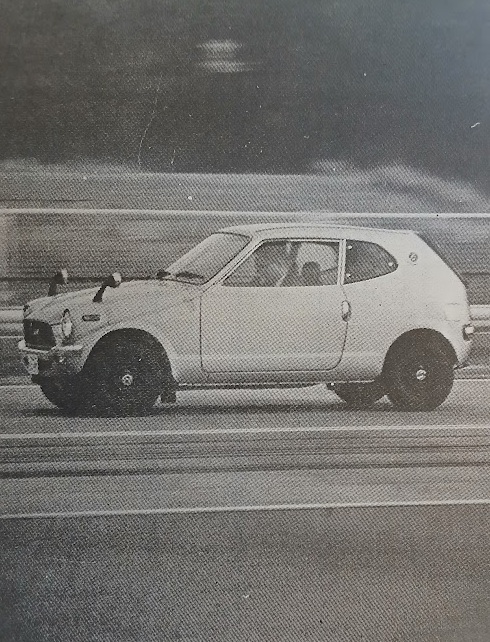
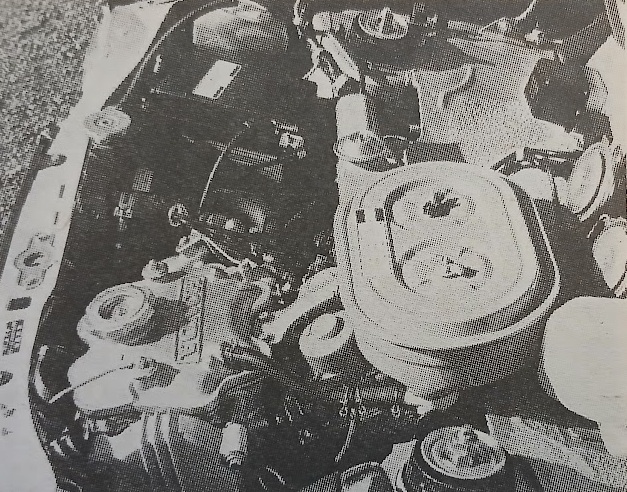
More specifically, changing to a water-cooled engine allowed us to make the powertrain more compact and extend the wheelbase by 80mm. At the same time, we moved the toe board 80mm forward, providing more generous legroom. The move to water cooling also allowed us to make the heater more efficient and easier to control, while the ventilation system was improved as well.
The engines in the new Z and the Life are fundamentally the same, but the character they convey is different. In contrast to the Life’s smooth, mellow character, the new Z has been given performance suited to its more youthful and individualistic image. Specifically, our aim was to make it a car with good response. We weren’t pursuing horsepower, although as it turned out, power increased as well. Since our emphasis was not on power itself but on good response, the car should respond well right from low engine speeds.
The same thinking applies to the brakes. There is no particular need for disc brakes on this car, and from the standpoint of response as well, one cannot necessarily say that discs are better on a small car. From the standpoint of product appeal, it may seem like a step backward, but for the new Z we chose the more practical drum brakes.
Mabuchi: The range is divided into the Dynamic Series and the Golden Series. The Dynamic Series uses twin carburetors, while the Golden Series uses the same single downdraft 2-barrel carburetor as the Life. The compression ratio has been raised from the Life’s 8.8:1 to 9.0:1 on both the single- and twin-carburetor engines. We also made some changes to the cylinder head to improve intake efficiency.
As with the air-cooled Z, a 5-speed transmission is available, but instead of the previous dog-engagement transmission, second through fifth gears are now synchronized.
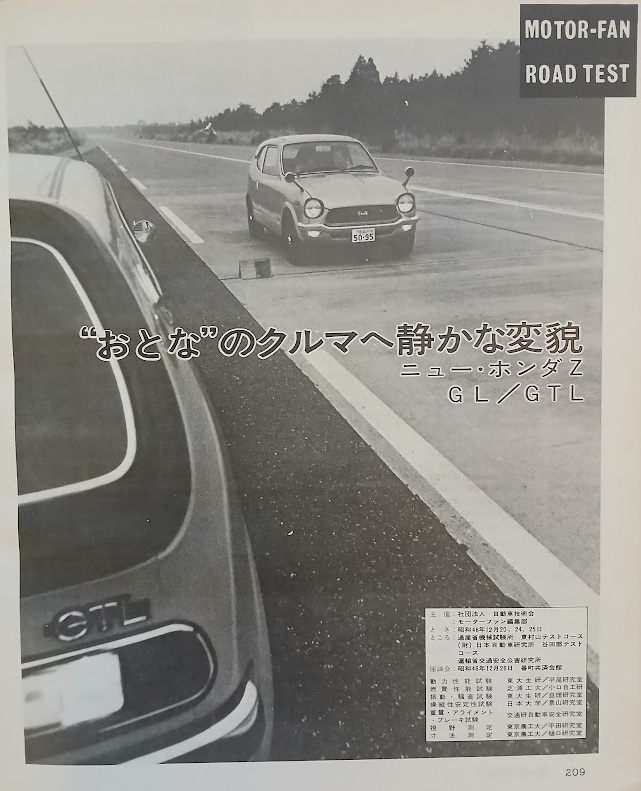
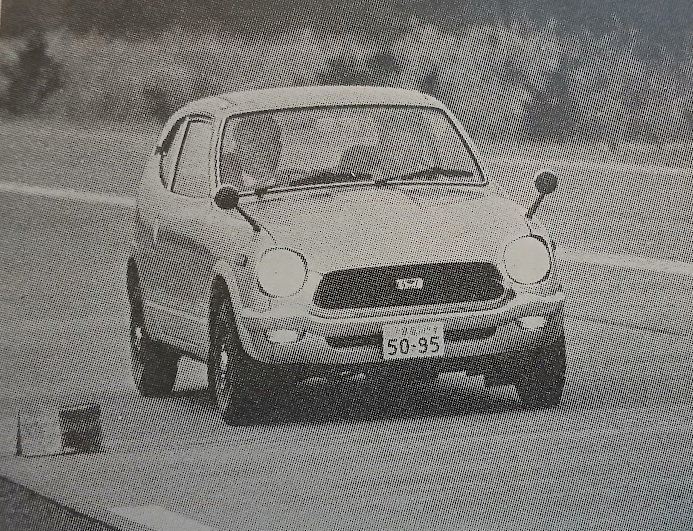
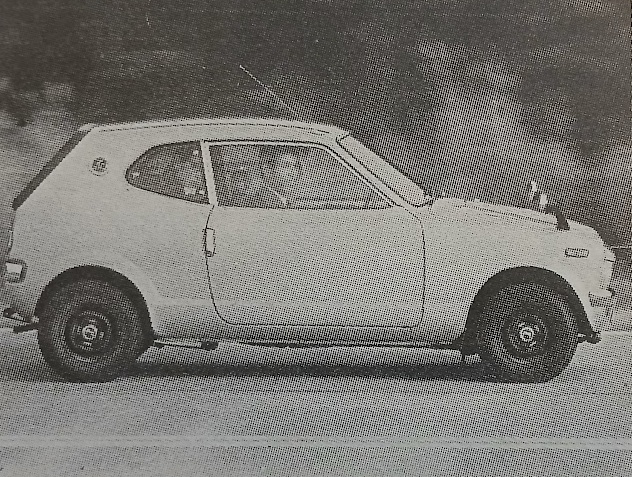
As for the body, the underpinnings and floor pan are carried over from the Life, while the upper body is based on the previous Z. You could call it an improved version that keeps the Z’s existing image intact. The compact water-cooled engine allowed us to extend the wheelbase by 80mm, but unlike the Life, we did not move the instrument panel forward as well; we simply extended the legroom of the air-cooled Z forward. I think this has improved the driving position. The front grille also necessarily has a larger air intake because of the water-cooled engine, and we gave it a more aggressive image.
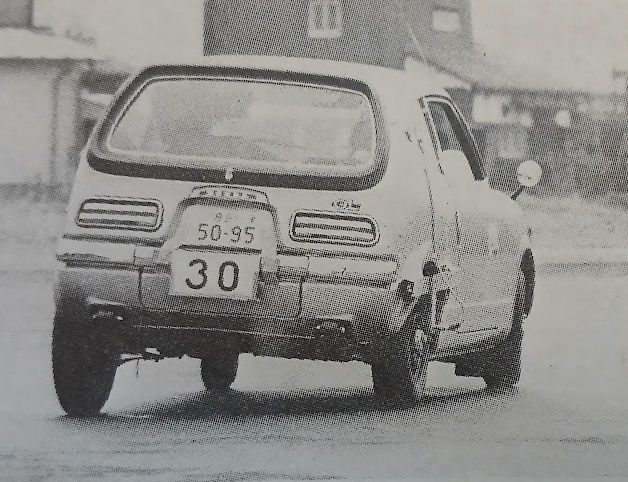
On the safety side, we fitted a warning buzzer that sounds above 80km/h, and changed the rear combination lamps to a two-color arrangement for improved visibility.
Magazine: The Z is a 2+2, with seating for four, but other manufacturers have introduced true two-seaters. What are your thoughts on that?
Nakamura: We believe a sporting kei car should be different from an ordinary sports car. A pure two-seater may make sense in a larger car, but our view is that such a car in the kei class would not really be true to the fundamental character of the kei car.
Magazine: Is that because you want to sell it in larger numbers?
Nakamura: It’s not only a question of numbers. When we export the car, it isn’t described overseas as a 2+2, but as a four-seater. It’s a little better than the sort of arrangement where you would say, “You can sit back there, but only if you really want to.” I think there is somewhat more room than in the smallest rear seats found in some larger cars.
Even in our export markets, we don’t regard the Z as a sports car. We see it more as an individualistic car for recreation and enjoyment. If we made it a pure two-seater, the range of potential customers would become limited. In that sense, I suppose it does come back to sales volume.
Pursuing Utility
Magazine: One of the main features of the Z is its styling. In particular, the angle of the windshield and the shape of the rear gate seem novel and interesting. How did those features come about during the design process?
Mabuchi: We started with the idea of whether we could somehow make an interesting car that would still seat four people. Rather than styling for styling’s sake, we began with styling that took utility into account.
Hirao: It certainly seems as though you first considered how the rear window could be used, and then arrived at things like its angle from there. In other words, you started with utility and then managed to combine it successfully with the styling. Having the rear glass open like that is certainly convenient.
Magazine: You might call it the “television window.” What was the thinking behind that?
Mabuchi: At first we drew a wedge-shaped design, but if four people were to fit inside, we couldn’t simply slope the rear down that way. We gathered together some of our younger designers and divided them into two groups, and as they worked on it, the design gradually evolved into this form. Once we had gone that far, we thought we might as well emphasize the fact that there was a window at the rear that opened.
Magazine: It doesn’t seem quite so striking now that we’ve gotten used to it, but when we first saw it, that frame around the window made a very strong impression.
Mabuchi: Some people said that the black surround stood out too much and bothered them, so on the Golden Series we made it the same color as the body. On balance, though, I think there are probably more people who prefer the black surround.
Oguchi: Someone—I forget who—called it “underwater goggles.” (laughs) It certainly makes an impression when you first see it. There is the question of strength, of course, but there are other cars whose rear windows are virtually nothing but glass. This provides exactly the opposite sort of accent, which is why the impression is so strong. Yet strangely enough, after a while you stop noticing it. Looked at another way, perhaps that means there was nothing really objectionable about it after all.
Magazine: Perhaps because it’s such a small car…
Oguchi: Exactly. If you put something that prominent on a 2000cc-class car, I think the unpleasant impression would stay with you to the end.
Okazaki: Leaving space itself aside, in terms of both its feel and the ways in which it can be used, I think this is the most versatile car in the kei class. It has the feel of a two-seater, the practicality of a 2+2, and it can also be used as a two-seater plus luggage space. In that sense, I think it offers a high degree of utility.
Hirao: I think that impression comes through even more strongly now, particularly because the car is so much quieter than the air-cooled Z. And perhaps it’s because the wheelbase has been extended, but the steering feel has improved tremendously. I don’t think someone accustomed to driving 1000–1600cc cars would feel at all out of place if they switched to this one.
I drove it at the Yatabe test course, and even at a little over 120km/h, you can hold the steering wheel quite casually, without tensing up. When I drove the old Z on the Tomei Expressway, my whole body would tense up, and by the time I got back my shoulders would be stiff. It was quite a pain…
Magazine: When you say that the floor area is carried over from the Life, does that include the steering system?
Nakamura: It’s based on the Life’s system, yes.
Magazine: The rear suspension is a little different from the Life’s, though, isn’t it? Things such as the mounting position of the shock absorbers.
Nakamura: Yes. The camber and so forth aren’t the same either.
Hirao: The spring mounting points have been moved as well, so perhaps the camber changed as a result of that.
Mabuchi: On the N, the spare tire was located in the engine compartment, but with the Z we moved it to the rear. The new Z retains that arrangement.
Oguchi: So that also reduces axle steer and brings the handling closer to neutral.
Mabuchi: That’s right. It should have less understeer than the Life.
The Same Tire Pressure Front and Rear
Magazine: Since the subject of handling has come up, could we have the results of the handling and stability tests?
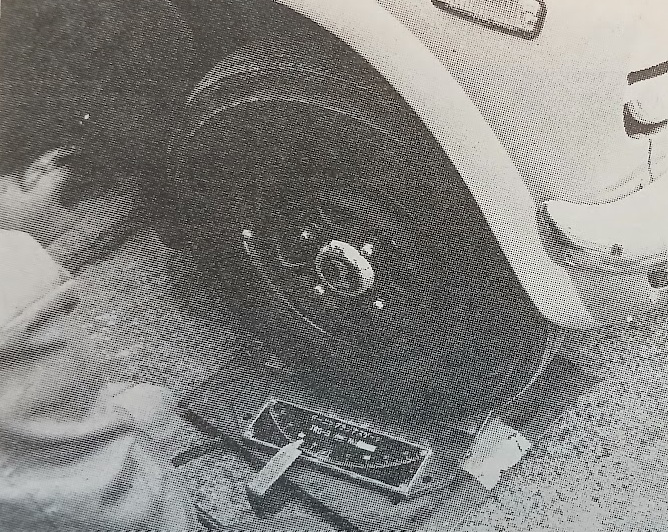
Kageyama: The practical minimum turning radius was 5.0m at the outside and 3.08m at the inside, which are very large figures compared with other kei cars. (For reference, the Fellow MAX measured 4.27m outside and 2.20m inside, and the Subaru R-2 4.3m outside and 2.3m inside.) It’s larger than the Cherry, and about the same as the Subaru 1000 Sports.
Hirao: The maximum steering angle is 32°, so I suppose that’s why. Normally you can get about 35° on average.
Kageyama: The overall steering ratio is very high at 20.0:1—a figure more typical of a 2000cc-class car. Another characteristic is that the difference between the inner and outer wheel angles is extremely small. Stationary steering effort is only 7-8kg, so the steering is light. I think the high steering ratio contributes considerably to that.
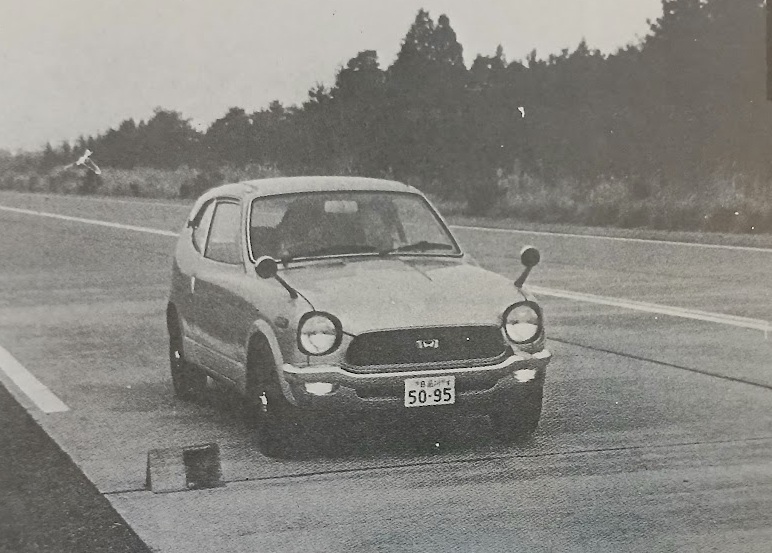
The roll rate was 4.75° by photographic measurement, and 4.6° when calculated from lateral acceleration. So it is around 4.6-4.7°, which I would say is slightly higher than average for a kei car. As for the understeer/oversteer characteristics, understeer is fairly strong overall and appears to increase rapidly from around 0.4g. I think it is weaker than in the Life, but stronger than in the air-cooled Z.
The specified tire pressures on this model are 1.5kg/cm² at both front and rear, compared with 1.75kg/cm² at the front and 1.3kg/cm² at the rear on the air-cooled Z, so naturally this would increase the understeer. I suspect the difference in tire pressures accounts for much of it.
Another thing that stood out was how little the car “tucks in” when the power is lifted during a turn.
As for the effort to hold the steering in a turn, it increases gradually with lateral acceleration, showing a clear and straightforward characteristic throughout. Compared with the air-cooled Z, I think it is easier to use. Here again, I have the feeling that tire pressure has a considerable influence. Steering effort is neither too heavy nor too light, but just about right.
In the hands-off stability test, convergence is quite good up to around 80km/h. As with any car, there is a tendency for it to worsen rather suddenly from around 80km/h, but the convergence does not become particularly poor; it only gets somewhat worse.
Hirao: I think more should be done to publicize the importance of tire pressures, and particularly the relationship between front and rear pressures. If the front and rear pressures were reversed, for example, the car’s behavior would change quite a lot. Rather than simply telling people what pressure to use, I think it should be made generally understood that the relationship between front and rear is important.
Nakamura: Tire pressures have been getting lower and lower lately, so even a small difference has a considerable effect.
Magazine: Is using the same pressure front and rear better from the standpoint of maintenance?
Mabuchi: Kei-car owners in particular tend not to pay much attention to tire pressures. We felt there was a limit to how complicated we could make the instructions… So we investigated whether, through the suspension and other factors, we could set things up so that the same pressure could be specified front and rear.
Higuchi: Having the same pressure front and rear is a good thing for the ordinary user. But for the enthusiast, it would be interesting if you could provide a guide explaining how the car’s behavior changes when the tire pressures are changed.
Mabuchi: In addition to the owner’s manual, we distribute a safe-driving pamphlet and do various other things, but we haven’t gone as far as explaining the balance between front and rear tire pressures.
Oguchi: I think making the pressures the same front and rear was a good idea. It’s certainly helpful to the user. In practice, you think you remember the correct pressures, but you don’t. Even when you go to a service station, you end up saying, “Just a moment…”
Higuchi: All you’d need is a sticker in the door jamb.
Mabuchi: There is one.
Magazine: Is the overall steering ratio the same as the Life’s?
Yoshioka: The steering gear ratio is the same.
Oguchi: On the question of steering gain, I tried changing lanes at around 120km/h, and the gain is higher than in a 1000cc-class car. The first time I did it, I did think, “That’s right, this is a small car.” But once you get used to it, you can do it without any difficulty. In that sense, I found it easy to control.
Okazaki: The steering isn’t particularly quick, but the initial response is good. And I think there’s relatively little free play as well.
Hirao: Yes, there certainly isn’t much free play. And because the steering wheel is small in diameter, I think what matters more to the feel isn’t so much the angular movement as how many degrees of steering you get when the part of the rim you’re holding moves, say, 1cm.
Mabuchi: That’s right. The steering-system rigidity involved in producing the actual road-wheel angle has a considerable effect on the feel in practice.
Magazine: What about steering friction?
Okazaki: It seems fairly high overall. I drove three cars, and each one felt different, so there appears to be some variation from car to car.
Mabuchi: We control it by means of an adjustment mechanism, but the cars you drove were built before production began, so I imagine that accounts for the variation.
Life + Z Running Gear
Magazine: Is the reduction in tuck-in when the power is lifted due to changes in the alignment?
Yoshioka: At the front, the Life has a rather more sluggish feel, and we have carried over its front running gear virtually unchanged. In that sense, you could say that we’ve taken the rear characteristics of the air-cooled Z and the front characteristics of the Life and averaged the two. To make them work together, however, we changed the rear camber slightly to match the front. I think you can regard the reduction in tuck-in as the result of the reduced axle steer.
Magazine: Is the roll rate the same as on the air-cooled model?
Mabuchi: By design, it’s the same.
Higuchi: I once read a study which concluded that, as a means of improving a car’s product image, reducing the roll rate has the least effect on cost. There is the question of striking a balance with safety, of course, but I think roll rate could be used as one way of establishing the sort of image you want a car to have.
Mabuchi: Certainly, the way a car rolls in ordinary driving runs counter to the body’s natural physiological response, so in that sense I can see how reducing roll could help increase a car’s product appeal.
Higuchi: On the question of safety, though, I think it may also be necessary for the user’s sake to give some sense of danger, without the car actually being dangerous.
Hirao: In that sense, a car with a higher roll rate does provide more of a warning to the driver.
Mabuchi: There’s another point as well. Rather than simply how many degrees the car rolls at 0.5g, what matters more is how the roll develops in the transient state—the way the roll builds up.
Higuchi: Something like its initial roll response.
Hoshijima: I think the impression one gets from roll is also influenced by the styling. Even if the amount of roll is about the same as in the N or the Life, with this Z you don’t feel as much anxiety through your body. The lower part of the body is broad and the upper part tapers inward. And because the cabin feels enclosed, I think it actually gives you a greater sense of security. Even when you feel the same sort of rolling motion, somehow you still feel secure.
Oguchi: I think that’s true as long as the roll remains within a certain range. At something like 5° or less, I think subjective impressions play a fairly large part. But once the roll becomes greater than that, I have the feeling it is no longer simply a matter of perception.
Magazine: The test car, the GL, was fitted with ordinary tires, but the GTL we drove had radials. What effect do they have on the handling? Does it become sharper…?
Hirao: Or, rather than sharper, would you say the steering returns better?
Nakamura: I think it might be better to say that the car becomes steadier. Even on a wet road, the tires don’t lose nearly as much grip. In that respect, perhaps the time will come when radials become as common in Japan as they are in Europe.
Magazine: Are there any disadvantages to fitting radial tires?
Higuchi: They’re expensive. (laughs)
Hirao: Aren’t the sidewalls rather vulnerable? On mountain roads and places where there are sharp stones lying around, I think I’d be a little worried.
Tateishi: On a poor road surface at low speeds, even relatively small inputs from the road produce considerable tire deformation. So I don’t think you can necessarily say that the ride is good at low speeds.
Higuchi: With a car this light and tires this small, the relationship is somewhat different from that with larger radial tires. So you can’t evaluate them in quite the same way as radials on a larger car.
Oguchi: If the value of radial tires is more from the standpoint of product appeal, then what about your decision to use drum brakes…?
Kageyama: You can’t see the brakes. (laughs)
Nakamura: For Japan, disc brakes in particular have gone somewhat beyond what is actually necessary…
Hirao: You could say the same thing about radial tires.
Nakamura: No, in the case of a kei car, drum brakes simply don’t fade in practical use. But radial tires do have a practical justification—for example, they provide a certain degree of improved roadholding, even on wet surfaces, such as in the rain.
Tateishi: From the standpoint of safety, they’re certainly a good thing. The only problem at present is that they’re expensive.
Magazine: Are the springs different between the GL and GTL?
Oki: They’re exactly the same, and there is no difference in damping either. They were different on the air-cooled models, but with the new water-cooled Z we’ve made them the same.
Okazaki: With the air-cooled model, you specified that radials should only be fitted to the GS and TS, but with this car it’s all right to fit radial tires to any model in the range?
Oki: That’s right.
A More “Grown-Up” Shift Lever
Magazine: Could we have the performance-test results?
Furutani: In the standing-start acceleration test, it covered 0-50m in 5.7 seconds, 0-100m in 8.7 seconds, 0-200m in 13.7 seconds, and 0-400m in 21.9 seconds.
In terms of time to speed, it accelerated from 0-40km/h in 4.6 seconds, 0-60km/h in 8.4 seconds, 0-80km/h in 14.2 seconds, and 0-90km/h in 18.8 seconds. Maximum speed was 122.44km/h.
Magazine: Apart from the carburetors and intake system, is the engine the same as the Life’s?
Nakamura: The cylinder head is different, and the exhaust ports are different as well. It’s the basic engine that’s the same.
Magazine: What did everyone think of the shift lever, compared with the previous one that came out of the dashboard?
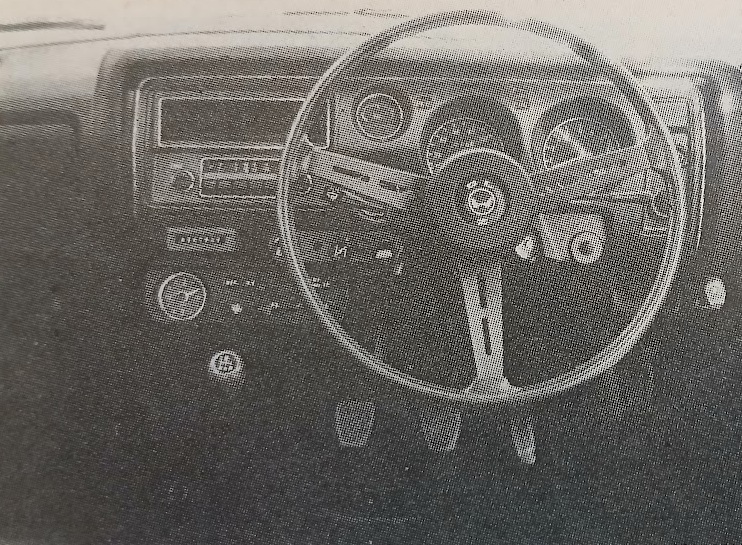
Oguchi: Reverse is quite clearly defined. The lever is rather long, though, which makes it a little awkward to use.
Hirao: I certainly don’t think the new one is bad, but I thought the old one was quite good too. The feel of the gears engaging was really excellent.
Oguchi: I think the shift itself is very good, although some people may find the shift pattern a little difficult to accept.
Kageyama: You mean the position of reverse?
Nakamura: With the previous layout, people driving it for the first time apparently found it rather strange and were somewhat put off by it. Once someone had bought the car and driven it a little, though, they quickly got used to it, and we received a great many compliments about how good it was. But it did present a certain difficulty when it came to selling the car to a customer seeing it for the first time.
Hoshijima: I think I prefer the new layout.
Kageyama: For all its small size, this car has the cheek to be rather “grown-up.” I get the impression that anything that wasn’t grown-up was thrown out, and everything was made grown-up instead. And then there isn’t anything superfluous like a center console.
For a kei car, there is an extraordinary amount of room around your feet.
Magazine: The Z was the first kei car to adopt a center console, and then everyone else began fitting them too. Now you’ve also been the first to do away with it again.
Higuchi: When I got into the GTL, I’d been told it had a 5-speed transmission, but once I started driving I completely forgot about it. I pulled away smoothly without using first gear, and it wasn’t until I went for reverse that I thought, “Oh yes, this is the 5-speed.” It’ll putter along quite happily in top at 20km/h.
Oguchi: First gear is almost like an “emergency low,” while over-top is fairly close to an ordinary top gear, so you can pull away in second without any trouble. Someone who wants to enjoy driving fairly hard can still have plenty of fun with an engine of this size, while if, like me, you want to take things easy, you can skip gears as you shift. In that sense it’s extremely easy to drive, and I thought this kind of 5-speed gear arrangement was enjoyable in its own way.
Higuchi: Unlike the 5-speeds in larger cars, this 5-speed doesn’t seem to have been designed to provide quiet cruising on the expressway. It strikes me more as a matter of product appeal. In practical terms, I think four speeds would be quite sufficient.
Nakamura: Certainly, there isn’t much real need for it. There is a slight element of having an emergency low gear, while someone who wants to be constantly working the gear lever can use it that way as well. So it’s rather different in character from the 5-speeds found in 2000cc-class cars.
Magazine: Could we have the results of the fuel-economy tests?
Sano: In the constant-speed tests, fuel economy was 27.0km/l at 30km/h, 30.6km/l at both 40 and 60km/h, 20.5km/l at 80km/h, and 14.6km/l at 100km/h. Overall, that’s about 2-3km/l better than the Life Custom we tested previously.
In the simulated real-world fuel-economy test, the result at an indicated speed of 40km/h was 16.8km/l. That’s the best figure we’ve obtained from any kei car we’ve tested so far. At an indicated 60km/h it returned 12.1km/l, which is also better than the Life.
Magazine: The Life has a single carburetor, while this Z has twin carburetors. Does the twin-carburetor version actually do better?
Sano: It’s better than the single 2-barrel carburetor. The difference is particularly noticeable around 40-50km/h—slightly more so than at higher speeds.
Hirao: What are the CO, HC, and NOx figures in g/km? I would imagine that kei cars may be the only ones already meeting the 1972 standards.
Nakamura: In terms of g/km, it meets the 1972 standards.
Magazine: Since the standard is based on the absolute quantity emitted, kei cars have a considerable advantage.
Noise Peaks at 60km/h
Magazine: Could we have the suspension vibration and noise results?
Tateishi: The bouncing frequency was 1.5-1.6Hz at both front and rear, and the pitching frequency was 1.8-1.85Hz. The unsprung frequencies were 13.4Hz at the front and 15.5Hz at the rear.
Interior noise measured 66.5 phons at 40km/h, 75 phons at 60km/h, 77 phons at 80km/h, 83 phons at 100km/h, and 85 phons at 120km/h.
As for the suspension vibration frequencies, the Life showed no particular tendency toward pitching, but perhaps because the body is different, the Z does show a little. As for the noise characteristics, there is a peak at 60km/h. With the Life, the noise curve tended to flatten out somewhat at higher speeds, whereas here it continues to rise. Above 80km/h the warning buzzer sounds continuously, but at those levels I don’t think it has much effect on the sound-level meter reading.
Hirao: You do get the impression when driving it that it’s a little noisy.
Oguchi: The 5-speed GTL didn’t have any booming noise, but the 4-speed GL test car seemed to develop some booming at around 60km/h.
Mabuchi: The engine speed at that point is different from the Life’s, and so is the resonance zone. Even with the same engine and a broadly similar body, things such as the angle of the glass alter the reflected sound reaching your ears and various other acoustic effects. And since the Z’s passenger compartment itself is smaller than the Life’s, I think that also accounts for some of the difference.
Oguchi: But that zone is very narrow. It just happens to appear quite suddenly at 60km/h.
Higuchi: In normal driving, if you simply accelerate smoothly through it, you probably wouldn’t even notice it.
Nakamura: As for the overall sound level—this may be an odd way of putting it—we didn’t make quite the same effort to make the Z as quiet as the Life. We felt that having a certain amount of noise…
Oguchi: If that’s the case, I would have liked you to change the character and frequency of the sound. I’d like to be able to hear the radio clearly even at around 80km/h. And then there’s that high-pitched warning buzzer. In decibel terms it isn’t particularly loud, and the fact that it hardly shows up in the overall reading is good evidence of that. But even if it doesn’t register on the sound-level meter, listening to that sound for a long time wears a person down. It’s the quality of the sound that’s the problem.
Tateishi: Roughly what frequency is the warning buzzer?
Mabuchi: I think it’s around 3000Hz.
Oguchi: So it stands out clearly from the rest of the interior noise. It’s rather like gear noise in an ordinary car catching your ear—the warning buzzer alone comes through very distinctly.
Hoshijima: As far as interior noise is concerned, driving this car at around 70km/h feels about the same as driving a 1200-1300cc-class car at 100km/h.
Hirao: In the air-cooled Z, once you got up to 100km/h the engine noise became so loud that you began to wonder whether something bad might happen. It felt as though about 90km/h was the most you would want to maintain continuously. With this one, the noise is low enough that even at 120km/h you don’t feel uneasy. I think that’s about how big the difference is in the sense of anxiety produced by the sound.
Are Disc Brakes Really Necessary?
Magazine: Could we have the results from the Traffic Safety Research Institute?
Ishikawa: Curb weight, including the spare tire and tools, was 541kg, with a weight distribution of 59:41.
With four people on board, the distribution changes to about 51:49.
As for alignment, the front toe-in and camber were moderate, and both became zero with four people on board. At the rear, they were almost zero to begin with and showed no change with four people on board.
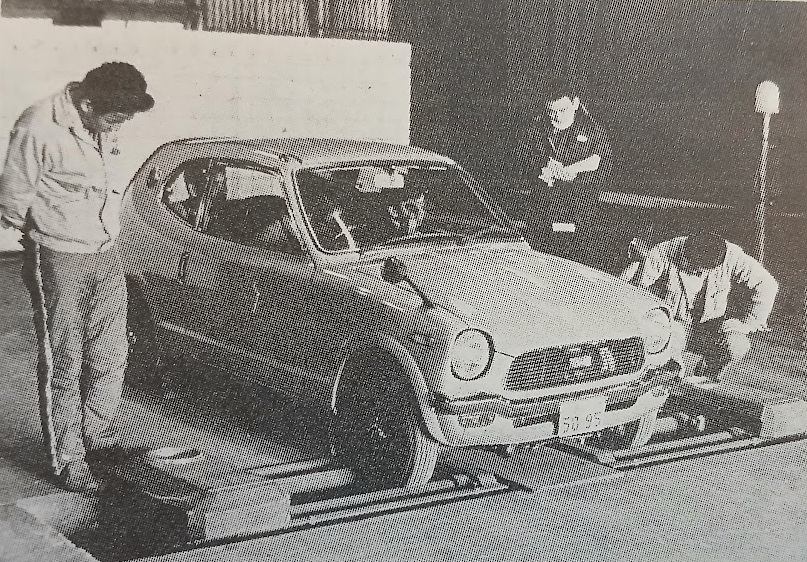
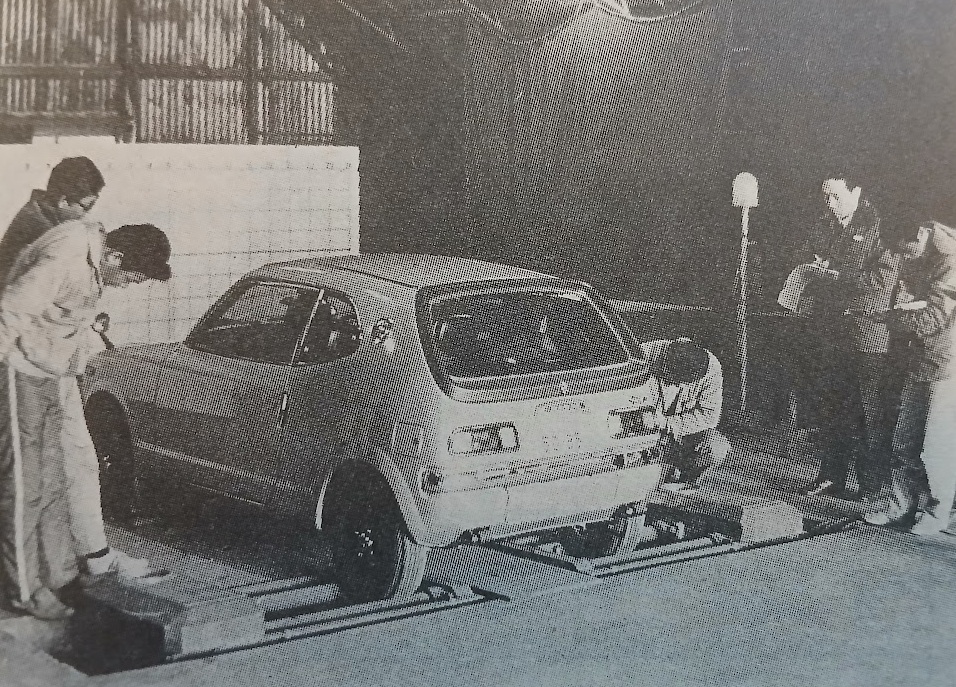
The brakes are leading-trailing drums at both front and rear. On the test bench, a pedal force of 23kg produced the equivalent of 0.6g deceleration, while on the road it took about 24-25kg. The front brakes begin to take effect at around 6kg pedal force and the rears at around 8kg, after which the pedal feels quite firm. The pedal spring rate remains at about 2.0kg/mm through and beyond the pedal force required for 0.6g deceleration.
Left-to-right balance was even at the front, although there was a slight imbalance at the rear. The front-to-rear braking distribution was 8:2, so the front brakes are doing a considerable proportion of the work.
Magazine: You use leading-trailing drums at both front and rear. Do you consider those entirely sufficient?
Nakamura: The brake test showed a slight left-to-right imbalance at the rear, but we wanted a type of brake that is inherently less prone to imbalance, as well as good linearity in relation to pedal force. And there simply isn’t any real necessity to use a twin-leading-shoe arrangement.
Hoshijima: I thought the brakes themselves worked well. I wasn’t especially fond of the pedal feel, though. I wondered whether that might be because the pedal lever bends away too much from the position of its pivot.
Okazaki: One thing I noticed was the accelerator pedal. Perhaps it’s the relationship between its height above the floor and its angle, but you have to control it with your ankle bent all the time. And the accelerator is extremely light. When cruising at a constant speed, you have to make a conscious effort to support your ankle, and that becomes very tiring.
I thought an organ-type pedal might be better, although I understand those have problems of their own…
Mabuchi: With an organ-type pedal, there’s a possibility that a vinyl floor mat can work its way up over the pedal. If that happens in cold weather, the mat can harden and there is a danger that the pedal may not spring back. That’s why we prefer not to use an organ-type accelerator pedal.
Nakamura: When you’re covering a long distance at a fairly high, constant speed, though, it does seem better to have a somewhat firmer accelerator and somewhere to rest your foot.
Magazine: Could we have the results of the visibility tests?
Hirata: The driver’s overall field of view around the car was 2.7-2.9 steradians, which I think represents a very large visible area. Of that, the area through the windshield was 0.57-0.77 steradians. That too is a very large figure. The rear window was only slightly below average.
The area swept by the wipers was about 53%, which is roughly average. The right-hand fender mirror lies just outside the swept area.
I think it would be better if the wiper extended a little farther to the right.
Higuchi: What about the blind area to the front?
Hirata: The position and shape of the blind area are somewhat different from those of other cars we’ve tested up to now. I wouldn’t necessarily call it good or bad; it simply falls outside the range we’ve encountered in previous tests.
Higuchi: Because the pillars are so steeply raked, wouldn’t they present a greater width when viewed in a horizontal plane?
Hirata: I think that’s certainly a factor.
Advantages in Utility
Magazine: Could we have the data from the Higuchi Laboratory?
Higuchi: The car we measured was the GTL.
Basically, it’s very similar to the air-cooled Z. The exterior dimensions make full use of the kei-car limits, while the wheelbase, as we’ve already discussed, has been lengthened slightly. Looking at the exterior, one difference is that radial tires are standard equipment. This isn’t unique to the Z, but the ventilation outlets are located out of sight behind the inside door handles. Then, because of the switch to water cooling, the openings in the radiator grille have been enlarged, and the bumper has been bent downward slightly to accommodate them.
Inside, the legroom we discussed earlier has been extended forward. The relationship to the driver’s seat is such that, despite this being a mini-car, the dimensions will accommodate a long-legged driver. Rear-seat headroom is cleverly provided by the rather squared-off roofline, and the dimensions are generous. Even by 1000cc-class standards, it is actually on the roomy side. Rather than giving priority to seating comfort, the rear cushion has been lowered almost to the floor in order to increase space. If you don’t expect four people to spend long periods in a car this small, I think this is the better approach.
There are plenty of gauges, and since the engine is water-cooled, there is a water-temperature gauge as well. In addition to the speed-warning buzzer, the speedometer is color-coded to call the driver’s attention to speed.
As for utility, the doors are quite long for such a small car, with an opening width of 1035mm, so access to the rear seat isn’t tight. The trunk is occupied by the spare tire, tools, and jack, so it can’t really be used as luggage space, but there is a large shelf behind the rear seat which can be put to good use carrying luggage.
It scored 84 points in our safety check. I would say that’s about an average figure for a kei car.
Hirao: The ventilation is quite good. You can have fresh air coming in at face level while directing warm air to your feet.
Magazine: The adjustment for the airflow is rather elaborate too.
Hirao: One thing I’d like you to look into is the door detent. I’d like it to hold the door rather more positively.
Nakamura: You mean the door’s open stop.
Magazine: You export the Z600, but that’s still air-cooled, isn’t it?
Nakamura: Yes. It’s already on sale in America, and shipments should just about be beginning to arrive in Europe as well.
Magazine: About how many have you exported?
Sase: Around 2,000 to America, and about 3,000 in total including Europe. It has been very well received overseas, particularly in America and France.
Hirao: What about the automatic?
Nakamura: We aren’t exporting it right now, although there does seem to be some demand. In Europe, when an automatic version of a small car first appears, there’s an immediate burst of popularity and the magazines make quite a fuss about it. But after two or three months things settle down, and I got the impression that, if anything, utility tends to come first.
Magazine: What are your production plans?
Sase: When you consider traffic conditions and the economics for the individual owner, kei cars have qualities that make them uniquely well suited to Japan.
Taking those factors into account, we plan to produce 20,000 kei passenger cars a month for the domestic market. Recent demand has been running at 60% Life, 30% Z, and 10% NIII, so for the time being we plan monthly production of 5,000-6,000 Zs alone. Demand in overseas markets is also growing steadily, so I think production will increase.
Magazine: And how many of those are automatics?
Sase: Still only about 7%. For kei cars as a whole, I think the figure is around 6%.
Magazine: That’s all for now…
Postscript: Story Photos