Honda S800 Live-Axle Specification (1966)
Publication: Motor Fan
Format: Test Drive Report
Date: December 1966
Author: Hiroshi Hoshijima
Born of Honda’s Own Dreams and Ideas
If I remember correctly, it was at the autumn 1962 Tokyo Motor Show that Honda first presented the S360 and S500 to the public as its first four-wheeled sports cars. The Fairlady had already been around for some time, of course, but the appearance of the S500, imbued with Honda’s own dreams and ideas in everything from its engine to its suspension, attracted considerable attention both at home and abroad as Japan’s first genuine sports car.
In the end, the S360 never reached full-scale production, but the S500 caused quite a sensation with its remarkable performance—47ps/8500rpm from an engine of just 531cc, and a top speed of 142km/h—together with a selling price of less than 460,000 yen, an exceptionally low figure for the time.
As everyone knows, the S500 subsequently grew into the S600, and then into the S800, which remains in production today.
Now, of all the mechanical features embodying Honda’s own dreams and ideas, the most distinctive was the rear suspension.
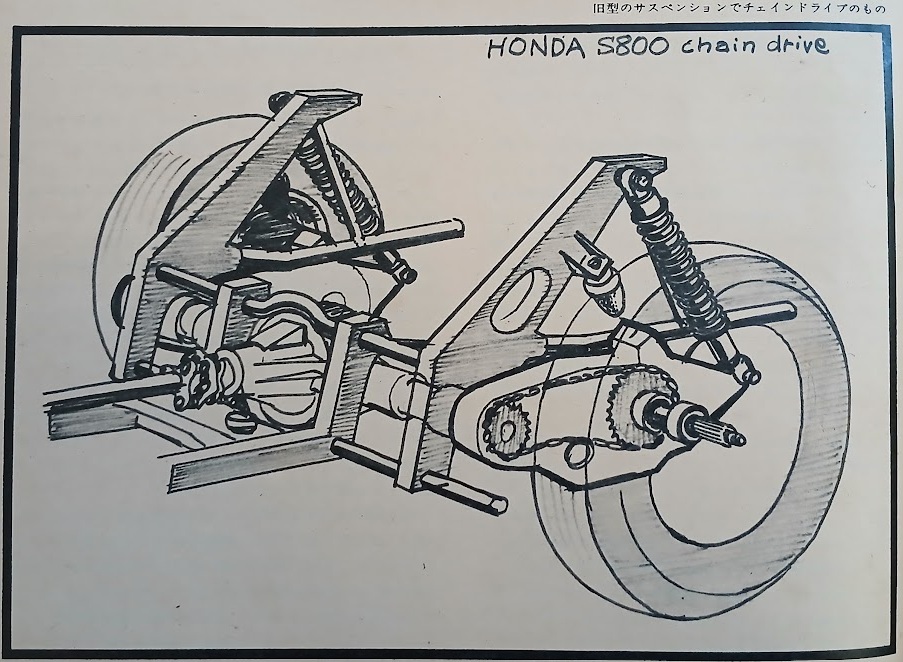
This was a chain-drive arrangement conceived along motorcycle lines. The final-drive gearbox (differential) was fixed to the frame, while the rear wheels, at the outer ends of the axle shafts extending to either side, were carried in chain cases that also served as trailing arms.
When this mechanism was first announced, four principal advantages were cited:
-
The differential gear assembly could be made extremely light.
-
Because the suspension employed trailing links and the differential was fixed to the frame, unsprung weight was low, contributing to good ride comfort. Vertical movement could be absorbed through the action of the trailing arms.
-
Since the differential was positioned ahead of the rear axle line by the length of the trailing arms (chain cases), the luggage compartment could be made both deeper and larger.
-
The wheelbase could be lengthened without increasing the length of the propeller shaft.
These, broadly speaking, were the four main advantages.
At the time of its introduction, there were certainly those who questioned this unusual independent suspension system, which seemed to owe much of its conception to motorcycle practice. Nevertheless, the role played by the S600 in the development of sporting motoring in Japan over the following four years or so was certainly a very significant one.
An Advantage for Exports and Production?
It was earlier this year that I first heard Honda was preparing to introduce a rigid-axle version alongside its distinctive chain-drive system.
The main reasons, I was told, were that a conventional rigid axle would be more readily accepted than chain drive in export markets, particularly America and Europe, and that it would reduce production costs.
If Honda is seriously considering exports on a large scale, a conventional arrangement would also have advantages from the standpoint of servicing. In Japan, with its network of AHSF (All Honda Service Factory) facilities, the unusual mechanism probably presents no real problem, but overseas it may prove inconvenient.
Moreover, just as there were some people in Japan who questioned the chain-drive arrangement when it was first announced, there apparently are people abroad who regard it with skepticism. Perhaps this tendency is even stronger in Europe and America, where the history of the automobile goes back much further than in Japan. For my part, I feel rather inclined to tell these foreigners, “There’s really no need to worry. This mechanism has some very interesting qualities, and a character all its own.”
As for production costs, there can be little doubt that the rigid-axle arrangement will be cheaper to manufacture than the chain-drive system. The light-alloy cases and chains are by no means inexpensive, and the conventional arrangement should also offer advantages in ease of assembly and production efficiency.
The problem, however, is that the four advantages of the chain-drive system outlined earlier will simply disappear. If we turn those advantages around, the result is as follows:
-
The differential gear assembly will be heavier than before.
-
Since the differential will no longer be fixed to the frame, unsprung weight will increase, and ride comfort will be worse than before.
-
With the differential moved rearward, it will no longer be possible to provide such a deep, spacious luggage compartment.
-
The propeller shaft will be longer.
That, then, is what the change would mean…
I Wish Tojiro Ukiya Could Have Driven It
At this point, I am reminded of something Tojiro Ukiya, who died last summer while practicing at Suzuka Circuit, once told me around the time he first began racing the Honda S600. From early last year, he had been driving the S600 extensively at Suzuka, studying the circuit and trying to explore the car’s handling characteristics to the fullest. Some of his findings were published in Auto Sport, Motor Fan’s sister magazine, under the title “Cornering at Suzuka in the Honda S600,” so some readers may already be familiar with them.
He had modified the body of his S600 for racing, and it was then that he told me:
“I wish the Honda S600 were another 100kg lighter. Or, even at its current weight, it would be nice if it could take a 1000cc engine developing 90 or 100ps. No, perhaps if the S600 had a rigid rear axle, it might be possible to go a little faster even as it is.”
He went on to build his own lightweight body and made every effort to reduce air resistance, eventually achieving his first racing victory. At the time, I replied that the S600’s weight was unavoidable if Honda was to improve its durability and, with touring use in mind, keep engine and running noise to a minimum. As for its unusual rear suspension, I proceeded to list every advantage I could think of in its defense.
Nevertheless, when cornering hard on a racing circuit, the rear wheels, in combination with the stiff springs, would sometimes begin hopping almost like rabbits. After charging into a corner, then accelerating hard with the throttle wide open, there was a sensation of the rear end lifting and the wheels hopping sideways. In particular, the inside rear tire seemed to have less grip than on cars with a conventional rigid axle.
Of course, the Honda S600 had a distinctive way of sliding that made cornering enjoyable. Above all, the fact that a completely standard car, despite its engine capacity of only 600cc, could lap Suzuka Circuit in around 3 minutes 10 seconds was so astonishing that it hardly left any of us inclined to consider alternative mechanical layouts.
The 1000cc engine Ukiya had spoken of never materialized, and the capacity increased only to 800cc. Nevertheless, after completing my test drives of the Honda S800 with its new rigid rear axle, I found myself reflecting on his words with considerable emotion. I have driven the car only twice since last month, for a total of barely two hours, and have not had the opportunity to try it at Suzuka Circuit. But I do wish I could have let Tojiro Ukiya drive it.
Torque Arms and a Panhard Rod
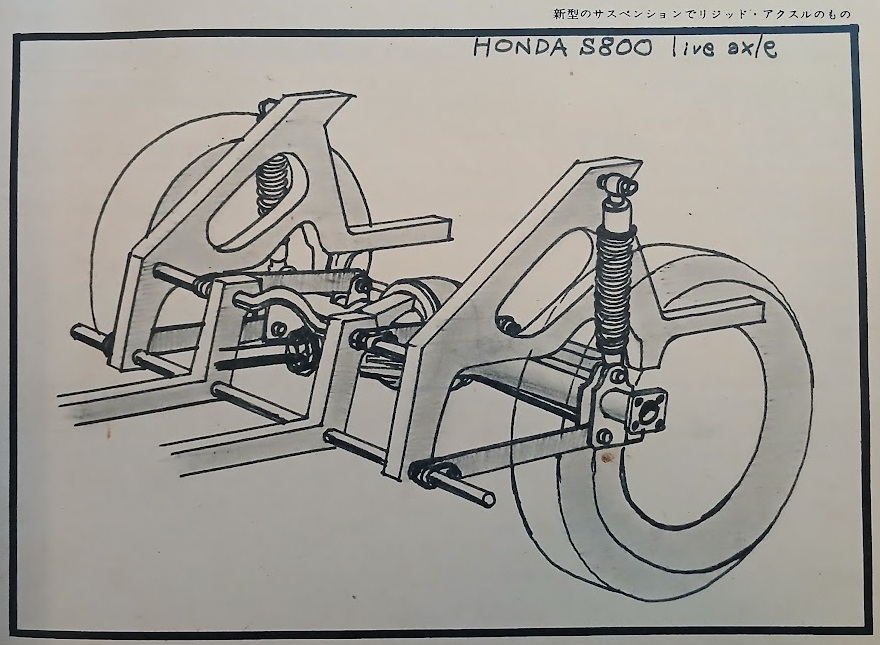
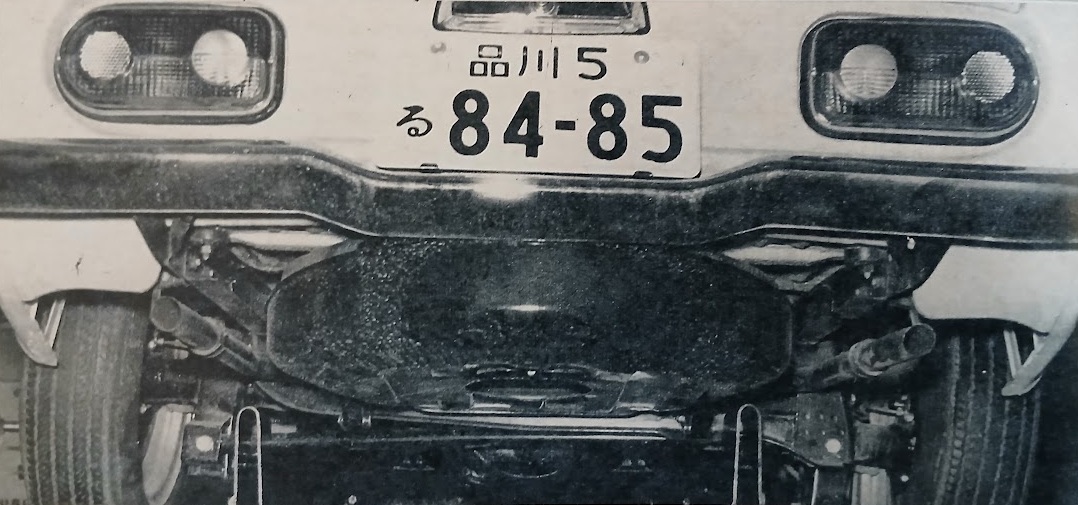
Let us take a look at the new rigid-axle rear suspension. Compared with the conventional arrangement using parallel longitudinal leaf springs, Honda’s system is rather more complicated.
Naturally, the differential has been moved back to the rear axle line. Previously, the final-drive reduction ratio was 3.15, with a further reduction of 1.84 through the chain sprockets, giving an overall ratio of 5.796. Accordingly, the transmission ratios had been kept relatively low, at 3.20, 1.98, 1.29 and 0.91.
The new final-drive ratio is 4.714, considerably lower numerically than before. Given the size of the differential, it would probably be difficult to retain a reduction ratio of 5.796.
The transmission ratios have therefore been increased correspondingly, to 4.001, 2.480, 1.613 and 1.143, maintaining the balance of the overall reduction ratios. These now stand at 18.8 (18.5), 11.7 (11.5), 7.61 (7.35) and 5.39 (5.18), respectively, representing a slight increase across the range.
In first and second gears, the difference was hardly noticeable. In third and top, however, the overall reduction ratios have increased considerably, bringing them closer to second gear and giving substantially stronger overtaking acceleration in both ratios. It is only natural, then, that the climbing ability has also improved, from sin θ = 0.355 to 0.371.
On the road, there is certainly a noticeable improvement in the feeling of power—or perhaps more accurately, the extension—in third and top gears. It is also possible that transmission efficiency has improved through the elimination of the chain drive.
While we are at it, let us look at some of the other changes. The upper arms of the front suspension have been changed from the previous I-section type to pressed-steel A-shaped arms. There also appear to be quite a number of improvements to such items as the clutch release lever, radiator drain, cylinder block, fuse box and brake wheel cylinders, although these changes are not exclusive to the rigid-axle version.
Inside, the instrument panel has been changed from the former bright, polished finish to matte black, while the wooden steering wheel has been replaced by imitation wood made of synthetic resin. These changes, of course, are also found on the chain-drive version.
Some readers may be disappointed to hear the words “imitation wood made of synthetic resin,” but the feel of the wheel is actually better than before. Moreover, in the event of a collision, even if the wheel should break, it will merely bend rather than splinter into sharp fragments as wood can. From the standpoint of safety, this is surely a welcome change.
A More Stable Feel in a Drift
The familiar little “hop” of the rear end when starting off has disappeared with the rigid-axle version.
Compared with the previous layout, in which the differential was fixed to the frame, the grinding, vibrating noise from behind the seats has also gone. In terms of noise, at least, ride comfort can be said to have improved. Naturally, there is no longer any chain noise, either.
On the other hand, when driving over tram tracks and similar surfaces, the car bounces and jolts considerably. Having abandoned independent suspension, this is probably unavoidable. In that respect, ride comfort may be said to have deteriorated somewhat. As for the stiffness of the springs, anyone who is used to driving a Honda will hardly think anything of it, but…
Where I felt the rigid axle was decidedly better was in cornering on paved roads. When I first changed from the S600 to the S800, the increase in power, together with the wider tires, gave a much greater sense of stability in corners. But even between the two versions of the S800, I could clearly recognize a further improvement in the stability of the car’s behavior when drifting through a corner.
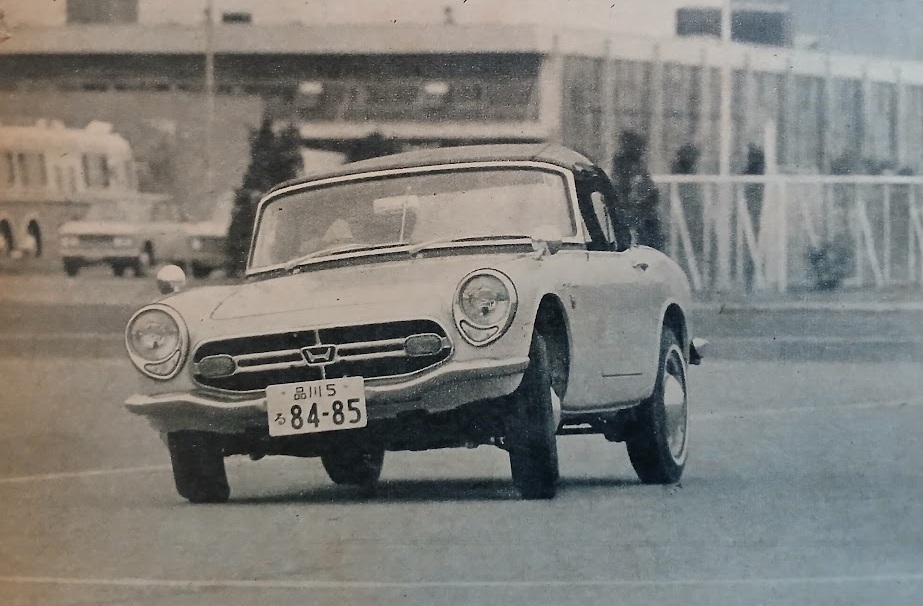
In a large open area, I repeatedly tried cornering as though negotiating the hairpin at Suzuka Circuit. The rear wheels seemed to have considerably greater lateral grip, and I was able to enjoy a drift that responded faithfully to the amount of throttle applied from midway through the corner. Even when I floored the accelerator suddenly, there was no sensation of the rear end lifting and losing traction, nor did I encounter any unstable sliding of the rear wheels that would have required countersteering.
Judging from this, I suspect that corner-exit speeds on a racing circuit would increase, even if only slightly. And naturally, a higher exit speed would mean a higher average speed along the following straight, with a corresponding improvement in lap times.
The fact is, however, that the racing version of the S800 with the rigid axle has not yet been driven at Suzuka Circuit.
As a result, although the chain-drive car has been lapping the circuit in around 2 minutes 52 seconds, it would be premature to say that the rigid-axle version could manage 2 minutes 51 seconds, or perhaps even faster.
I asked two or three friends who race Honda S800s what they thought, but they, too, said it was still too early to tell.
Produced Alongside the Chain-Drive Version
Incidentally, Honda refers to the rigid-axle arrangement as the “live-axle” version. It appears that the company intends to produce it alongside the chain-drive model, rather than discontinue the latter in favor of the new arrangement.
The chain-drive system has its own advantages, just as the live-axle version has its merits, and the choice between them should depend on the intended use and personal preference.
Since the two versions differ in both frame and body construction, converting a chain-drive car to a rigid axle would be difficult. The live-axle version weighs 725kg, an increase of 5kg, but this does not necessarily mean that the rear suspension itself is heavier. Rather, I suspect the difference is due to the fuel tank and spare-wheel compartment.
The exact date of the official announcement is not yet clear, but I understand it will be sometime around May or June.
Postscript: Story Photos