Honda S800 (1966)
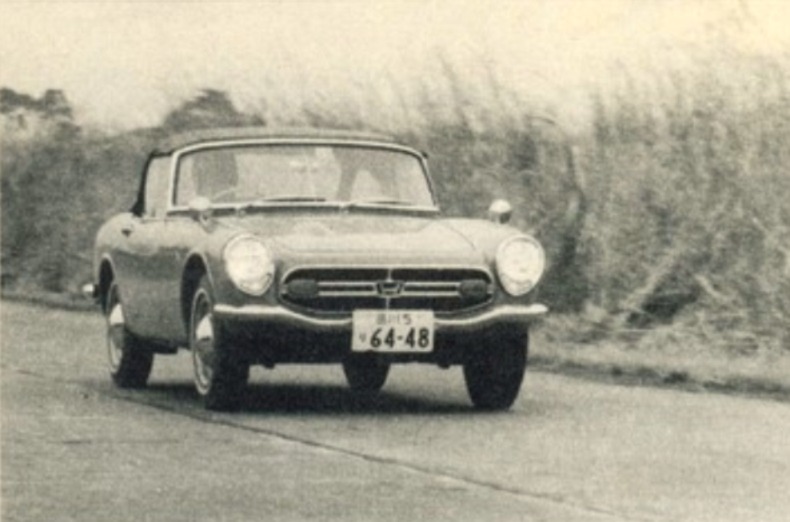
Publication: Auto Sport
Format: Auto Sport Road Test
Date: May 1966
Author: Nobuo Koga, Hiroshi Hoshijima
A 30-Hour Nonstop Run in the Honda S800
It has been said that with the change from the S600 to the S800, the Honda Sports has finally matured into a true grand touring car. To put that claim to the test, we subjected the S800 to 1,300km of hard driving, and conducted instrumented tests to measure its performance.
I Have a Bad Feeling
We had arranged to test drive the Honda S800 in early March. A cold wave had just hit, causing snow to pile up on the Hakone Shindo road, and traffic was halted the night before our drive. When traffic is shut down on parts of the Tokaido road and mountain passes, all the cars that are held up, especially large trucks, tend to start driving again at the same time the following day. This usually causes huge traffic jams on the highway. Thinking about this before our departure, I already had a bad feeling.
However, the S800 provided by Honda Motor was tied to a schedule, and the date could not be changed, so we decided to leave Tokyo in the middle of the night when the roads were less crowded. The original plan was to drive west from Tokyo, turn around at the 1,000km mark, and cover a total of 2,000km non-stop. Assuming an average cruising speed of 45-50km/h, it would take 40 to 44 hours. We calculated that if we left at night, we could return to Tokyo the day after next.
In reality, the drive was supposed to start at 11:00pm on the 12th, but after noticing a problem with the Halda tachograph and speed pilot instruments, we had to turn back, fix them up, and then set off again. It was a pity that these problems persisted and we were unable to get satisfactory instrumented test results. We restarted at 12:55am on the 13th, but the tachograph did not start working until 7:00am.
Driving at a Crawl
What’s more, my bad feeling turned out to be correct.
Shortly after passing Numazu, the traffic slowed to a crawl from Senbon Matsubara. The traffic was also heavy between Fuji and Shimizu, and at Utsunoya Pass, and just as we finally felt some relief and started to move at normal speed, we found that a truck had collided with another car passing the Oigawa River, and one of the vehicles overturned, completely blocking the road. We had to take a long detour through Shimada City and cross a bridge upstream. We also encountered traffic jams in Hamamatsu, and by the time we arrived at the Nishihama Drive-In I was exhausted. The distance between Tokyo and Nishihama is a little under 300km, including the driving within Tokyo. According to the plan, we should have gotten there in an easy six hours. The original plan was to arrive at 5:00am, but it actually ended up being 8:30am, so we were already three and a half hours behind schedule.
We reconsidered our plan while having breakfast. As a result, we decided to abandon the 2,000km non-stop route. Instead, we would take the Meishin Expressway, do a hill climb in the Ura-Rokkō area, continue through the newly built Hanshin–Nara National Route and Meihan National Route, head out to Kameyama, stop by Suzuka Circuit, and then return directly to Tokyo. The revised total distance was about 1,200km.
After starting off again, we encountered repeated traffic jams around Toyohashi and just before Okazaki, and we didn’t enter Nagoya city until noon, and arrived at the Komaki interchange just before 1:00pm.
We took a short break at the rest area in Yoro for an inspection. We then continued on the Meishin Expressway, but near Yokaichi, the left front tire suffered a puncture. We quickly replaced it with the spare, but decided to take it to a service center at the Otsu interchange to have the flat tire repaired. The tube had been split by a nail, leaving a series of holes like a perforated edge, and we realized it would be difficult to repair. We decided to replace the tube entirely, but neither 6.15-13 or even 6.00-13 size tubes were available, so we ended up driving to Otsu city in search of a replacement tube. Here too, we lost one full hour of driving time.
Retelling the story, it occurs to me that this really was an ill-fated test drive.
High-Speed Drive
With our tire problems resolved, from the Nishinomiya interchange, we took National Route 2 and headed towards Aoyo Road. Of all the routes we tried with the Honda S800, the one that suited this car best was the series of scenic toll roads, or driveways, around Mount Rokko, starting from the Aoyo Road.
The route went from the Aoyo Road through Arima Onsen, following the Kobe Electric Railway Shingu Line to the entrance of the Ura-Rokko climbing trail. From there we entered the Ura-Rokko Driveway, passed below Kinenhidai, continued on to the Rokko Mountain Hotel, then linked up with the Nishi-Rokko Driveway. Near the Forest Botanical Garden we joined the Oku-Futatabi Driveway and the Futatabi Mountain Driveway. The end point was near Motomachi in Kobe City. There were so many toll gates that it was impossible to keep going indefinitely, but I was able to enjoy the route to my heart’s content between 4:00pm and 5:00pm, when the usual driving crowd had thinned out. The area around Mount Rokko is full of sharp, tire-squealing curves, making it the perfect place to show off your driving technique. However, I’ve heard that in the summer, traffic, cyclists, and hikers make it difficult to drive as hard as you’d like.
Considering how difficult it is to find hill climbing courses in the Tokyo area, drivers in this area are quite fortunate. However, almost all the driveways are toll roads, so if you drive around for half a day, it can get quite expensive. As we stopped to rest near Futabayama Park, looking down at Kobe port, the view was magnificent as the sun was setting.
Mileage: 1,300km
Night fell while driving between Kobe and Osaka. From Taisho Bridge near the southern tip of Osaka, we passed through Uehonmachi 6-chome and Kawachi-Hiraoka, then entered the Hanna Expressway, continuing from Tenri onto the Meihan Road to Kameyama. The Meihan Road opened this year and is currently toll-free. The road conditions are excellent, and the quality of the pavement is top-notch.
After stopping by Suzuka Circuit, we took a short break in Hamamatsu to refuel, and arrived back in Tokyo at 6:20am on the 14th. From our start at Akasaka in Tokyo, the drive had taken 29 hours and 25 minutes, covering a total distance of 1,298.3km at an average speed of 44 km/h. The total time spent stopped for refueling, maintenance, repairs, meals, etc. was 2 hours and 20 minutes.
The amount of high-octane gasoline consumed was 120.2 liters, and the total fuel economy for the trip was an average of 10.7km/l.
In addition, I refilled the oil three times, 0.5 liters at a time, for a total of 1.5 liters. The only troubles we had were with the tachograph and speed pilot instruments, which had nothing to do with the Honda S800 itself, and the flat tire on the expressway. We didn’t need to refill the coolant either.
Lighter Weight Per Horsepower
Now, I would like to move on to the main road impressions. The April issue of Auto Sport has already featured a detailed description and test drive of the Honda S800, so the vehicle’s layout and mechanisms, as well as its differences from the S600, have been thoroughly covered, and there is little need to repeat them here. So, to briefly describe the Honda S800, it retains almost the same body as the S600, but with a larger-capacity 800cc engine under the hood and 6.15-13 low-profile tires on its wheels–that’s essentially it.
In terms of the exterior, the radiator grille has been redesigned with a black-painted mesh and a cross-shaped chrome molding, a hood bulge has been added near the air cleaner, and the rear grille has been completely redesigned with the adoption of combination lamps. The bumper also has a larger protrusion in the front and larger taillight lenses than the S600, giving it a sturdier appearance. Yellow has been added to the palette of body colors, and our test car was painted this color.
When you think of yellow used for a car, the unpleasant image of a taxi immediately comes to mind, but the actual color is very bright, and has a pleasant character that is different from the shade used on Porsches.
The stronger-looking cross-shaped front end now features horizontal turn signal lamps, and the tail lamps have been changed from round units to slightly larger horizontal ones. The clever integration of white cutouts for the backup lamps is a great idea.
Apart from the engine, the chassis is almost the same as the S600, and its overall length, width, and height are 3335 x 1400 x 1200mm (1195 mm for the coupe). The overall length is 35 mm longer than the S600 due to the bumper improvements mentioned earlier. The weight is also slightly heavier at 720 kg (735 kg for the coupe). Even so, the weight per horsepower is much lighter than that of the S600.
Powerful Engine
The engine is, of course, an enlarged version of the S600’s unit, and the previous bore and stroke of 55 x 65mm have been increased to 60 x 70mm, about 5mm each. Total displacement is now 791cc. Maximum output has increased from 57ps/8500rpm to 70ps/8000rpm, and torque has increased from 5.2kgm/5500rpm to 6.7kgm/6000rpm. As a result, the weight per horsepower has improved from 12.6kg/ps to 10.3kg/ps.
From the outside, the cylinder block looks almost exactly the same as the S600’s. The S600’s engine has been improved considerably since it was first released, for example, by combining the original separate cylinder liners into two siamesed units to increase rigidity, and the S800’s engine represents the most advanced state of these improvements. The compression ratio is 9.2. The four Keihin Seiki variable venturi carburetors have had their bore diameter increased from 26mm to 32mm. With the increased power and torque, the gear ratios of the transmission have been made taller at 3.20 / 1.98 / 1.29 / 0.91 (the S600 was 3.89 /1.98 / 1.43 / 1.09). The overall reduction ratio has also been lowered from 5.9 to 5.8. As you can see from the figures, the gear ratios are now slightly closer to each other. A 5-speed transmission is again available as an option, just as it was on the S600.
The propeller shaft also appears to have been made slightly thicker.
Smooth Acceleration
What struck me most when I drove the S800 was how much extra margin, or flexibility, the engine seemed to have. I once wrote that the S600 felt like it had “two engines,” with one character at low rpm and another, completely different one at high rpm, but the S800 delivers power evenly from low to high speeds. The revs rise smoothly, with more than 6.0kgm of torque available from 2500rpm to 8000rpm. Although the torque peak is 500rpm higher than before, maximum horsepower is reached 500rpm lower. In practice, it delivers excellent acceleration from anywhere above 2500rpm, and although we did not reach the catalog top speed of 160km/h, it pulled easily to 7700-7800rpm in top gear. Our test car was a convertible, but I think that the coupe would likely have an advantage in top speed due to its lower air resistance, if not acceleration due to the weight of the car.
The 0-400m acceleration test was conducted at the Honda test course in Arakawa, Saitama, but we were not able to match the figures listed in the catalog data, and our best time was 17.5 seconds. It is generally impossible for a new car to show its full potential in 0-400m acceleration, and the best times tend to be recorded when the engine and drivetrain are well broken in.
It’s a great relief that the gearbox is now fully synchronized, so you can shift into low gear anytime.
The Pleasure of Grand Touring
The recorded lap times of S600s competing at Suzuka Circuit have gotten significantly faster over the past year, and many drivers can now post times under 3 minutes 10 seconds even with a stock car, provided the suspension is stiffened up a bit. Naturally, that raises the question of how the S800 would perform, and judging from the feel at the driver’s seat, shaving an additional seven to ten seconds off these lap times seems entirely possible.
In other words, it is likely that by simply strengthening the S800’s suspension, breaking the 3-minute mark at Suzuka is well within reach.
The increased power and torque raise exit speeds out of corners, and the maximum speeds are higher on the straight from Spoon Curve to the 150R, and from the final corner to the first corner. In addition, the wider tires contribute to greater cornering stability. All of these factors combined would have a significant effect on lap times.
Even in the mountains around Rokko, there were two or three moments when I wondered if the S600 would have hung on as well. The increased tire contact area and greater driving force available when cornering make the S800 not only more enjoyable to drive, but safer as well.
At the same time, the engine’s greater power reserves and generally lower revolutions not only increase durability, but also reduce noise and vibration, and combined with the improvements in ride comfort, these factors all make it easier to use this car as a business vehicle.
Sitting in the driver’s seat, you can see that the previous polished instrument panel has been replaced with a matte black finish. At first glance, it looks less flashy, which some may consider a downside, but on a long drive, you’ll realize that this small improvement goes a long way in reducing driver fatigue.
It’s been about three years since the Honda Sports series was released, and it has matured remarkably. That was my honest impression after the test drive. The Honda S800’s excellence, which was a sharp contrast to the bad feeling I had before setting off, seemed to be the saving grace of this grand touring trip.