Honda S600 Coupe (1965)
Publication: Auto Sport
Format: Auto Sport Road Test
Date: Autumn 1965
Author: Nobuo Koga, Hiroshi Hoshijima
2,000km of Endurance Touring
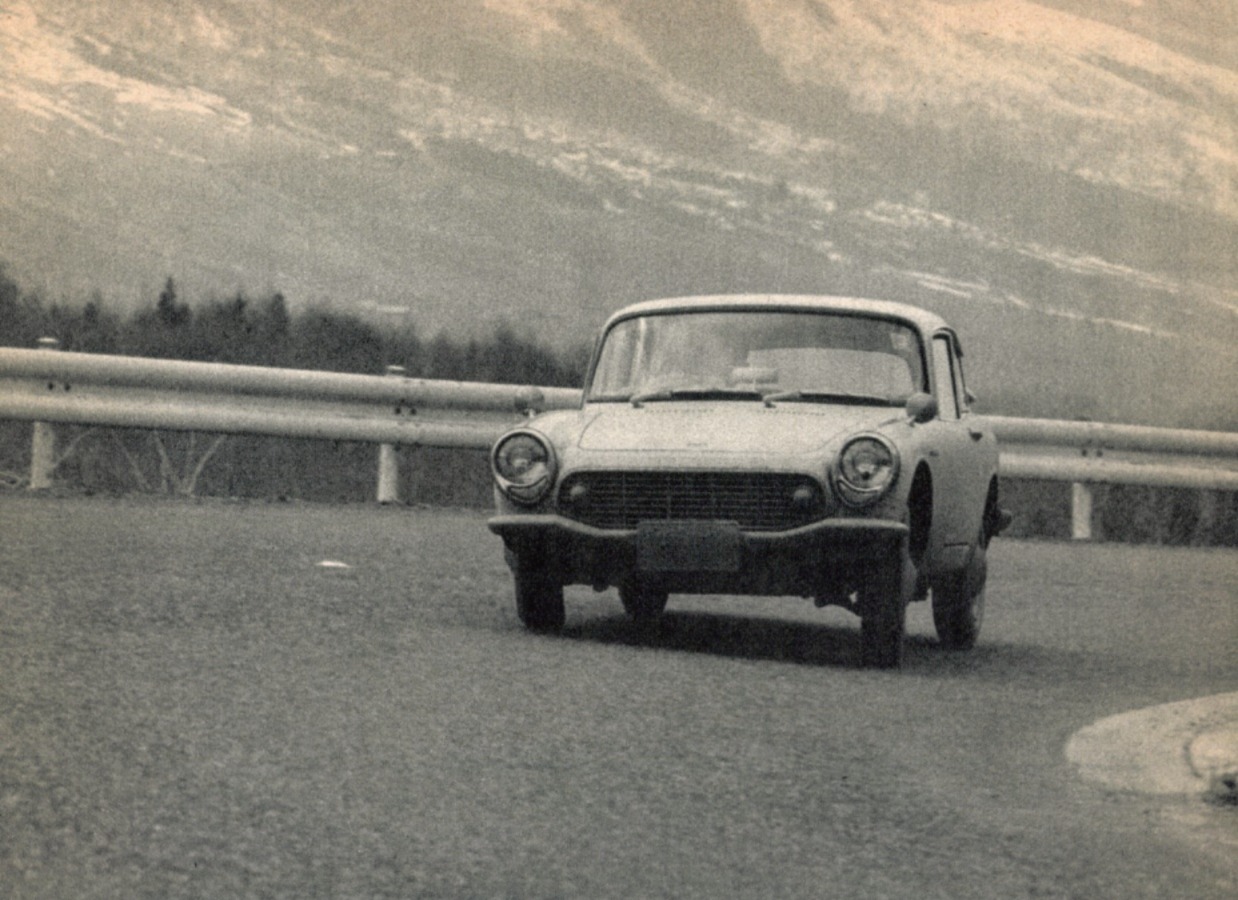
We passed through the Bandai-Azuma Skyline early in the morning. Although it was early summer, the weather had been unusually cold, and there was still snow remaining here and there. The Honda S600’s headlights are impressively bright, as they meet U.S. Highway Patrol standards… here is the story of 2,000km of grand touring in Honda’s new S600 Coupe.
A Cute Fastback
Last year, when the Honda S600 won the Nurburgring 500km race, it also won the distinction of beating Marcos in the GT category. Along with the Marcos, almost all the cars competing in this category were of the fashionable fastback style, and in this company, the Honda S600, the only one with a hardtop, looked conspicuously “cute.” At the same time, although I shouldn’t say this about Honda, which is considered the most avant-garde manufacturer in Japan, it also gave off an impression of naivety and a little lack of class, like a girl who has just come to Tokyo from the countryside. Thinking about it later, I wondered if this was because, these days, with the fastback style and slightly flipped-up tail being new and trendy, the style of the hardtop gave off an old-fashioned feeling, like arriving in a bowler hat.
The Honda S600 Coupe was released in April of this year. There was a bit of a gap between its announcement and its actual launch, and it’s said that this was because Honda originally intended to turn the two-seat convertible into a 2+2 or 2+1 three-seater. In fact, if you slide the front seats forward a little, it does seem like it would be relatively easy to accommodate another person in a back seat. However, the Ministry of Transport has strict certification standards, and it seems that a back seat was not approved in the end. Considering that the Fairlady was initially a three-seater, then changed to a two-seater, perhaps it was fortunate that the officials in charge of certification did not go along with the idea.
In any case, I think the styling has definitely improved in the transformation. Although the Coupe weighs 10kg more than the convertible, it has lower air resistance and greatly improved body rigidity. Aside from the fastback-style body, it is almost identical to the open-top S600, but its selling points as a practical and business car, which Honda emphasizes heavily in its advertising, are a much more natural fit for this Coupe version.
On an early summer morning, we left Tokyo in the S600 Coupe for an endurance touring test of about 2,000km, totaling more than 15 hours of continuous driving. The driver was Nobuo Koga, and the co-driver was your author (Hoshijima).
Departure For the Endurance Touring Test
The course covered three days of driving, with the following itinerary. Day One would take us from Tokyo through Fukushima, the Bandai-Azuma Skyline, Aizu-Wakamatsu, Niigata, Nagaoka, Naoetsu, Nagano, Matsumoto, and Shiojiri, stopping at Shimosuwa for an overnight stay. Total distance: 833km. Day Two would take us out of Shimosuwa to Shiojiri, Toki, Ogaki (via the Meishin Expressway), Kyoto (for the Hiei Hill Climb, Otsu (on the Meishin Expressway again), Ritto, and Kameyama for the second night. Total distance: 454km. Day Three would take us through Kameyama to Suzuka Circuit (for competition-style driving), then back to Tokyo via National Route 1. Including city driving within Tokyo after returning, the total driving distance was 2,008.5km.
Even though it was early summer, the temperature was at record-breaking lows, and there was even snow remaining on the Bandai Azuma Skyline. With no heater, it was downright cold. We left Tokyo at midnight, and it rained as far as Koriyama. Of course, a heater is available as an option, but the test car was in completely standard trim, with no windshield washer, no heater, and no radio. Just recently, there was the story of how the Bluebird that competed in the Safari Rally was forced to carry bumper overriders and other equipment that is commonly considered to be standard equipment in Japan, but is usually optional overseas, and that because of this (plus the fact that the homologation model was the Deluxe version), it was at a considerable disadvantage in terms of weight. In this sense, the fact that the Honda S600 treats equipment that is typically considered standard as optional is, in many ways, a very sound philosophy. After all, anything not essential to driving can simply be ordered and installed as desired.
For Business or Sports
In the end, this shows that the Honda Coupe’s selling point is not necessarily that its closed roof makes it a “practical car” or “business car,” as claimed in its advertising, but that it can also become a sports car and run wild when the time is right. Since last year, in the Sunday races held at the Suzuka Circuit, the Honda Coupe has been outperforming cars with twice its 606cc displacement.
Having received homologation as a touring car (two-seaters under 700cc can qualify for the Touring category as long as more than 1000 units are sold per year), the open-top Honda S600 can already be used as a business car on weekdays and a strong contender in races on Sundays. The Honda Coupe will probably also be certified in the Touring class soon. Apart from being more comfortable as a practical car, none of its sports-car characteristics have been lost.
Practicality Has Improved Dramatically
There is no doubt that the S600 convertible is light and nimble, and I certainly understand the joy of driving with the top open. However, the sounds made by the convertible top while driving are not very pleasant, and although this may be a personal opinion, I’m not fond of the way the metal fittings on the inside of the top can feel oppressively close to the driver and passenger. Also, in Japan, where the humidity and dust are high, convertible tops seem to wear out quickly. There’s also the risk of nasty pranksters cutting the top.
The Coupe’s cargo area offers the convenience of being able to load and unload luggage without opening the trunk, and its spaciousness (the spare tire is under the floor, the gas tank is on the side, and the trunk space is flat) is enhanced by the fact that the passenger seat back can be folded forward, so even very long items can be loaded inside. Rear visibility has improved over the convertible, and by opening the hinged rear quarter glass, cowl ventilator, and windows, ventilation is excellent. In terms of all-weather capability and overall practicality, it can be said that the Coupe is a great improvement.
The fact that I didn’t feel tired even while riding or driving for long periods of time is probably due to the near-ideal angle, depth, and firmness of the seats. There were some pretty poor roads around the Fukushima-Niigata border and the coast, but the seats never once caused the unpleasant sensation of being bounced off the cushion. However, I do think it would be better if headrests for long-distance touring were offered as an option. In Japan, you don’t hear much about touring in sports cars. However, I hear that in Europe, most GT cars, except for special racing versions, are generally recognized as being suitable for long-distance, high-speed touring. I think that such an era will come soon to Japan. It could be said that the role of the Honda Coupe is to pave the way for such an era.
High Noise Level, But Pleasant Sounds
The interior noise level is somewhat high for a touring car (as measured at the Watari Institute, University of Tokyo), but is normal for a sports car. The exterior noise level is on the high side even among domestic sports cars, but the tone is good. Of course, the volume of a sound can still be perceived as too loud even if its tone is pleasant, so you may need to be careful in residential areas late at night.
Some people feel that the pedals are positioned a little too far to the right, and others say that for racing or sports driving, the accelerator pedal doesn’t extend far enough down to allow heel-and-toe. But the former is largely a matter of preference, and as for the latter, anyone serious enough to enter a race surely wouldn’t hesitate to add a small extension plate to make heel-and-toeing easier.
One Honda S600, Two Engines
No one who has driven a Honda S600 will laugh if I say that this car has two engines. It can cruise quite comfortably in top gear at 2000rpm (just over 30km/h), but once you exceed 5000rpm, it’s as if an entirely different engine comes to life. It’s as if it transforms from a business car into a sports car, making you think, “Is this really all coming from one 606cc engine?” It only begins to make sense when you consider the Honda 7 Formula car, which competes in the top ranks overseas. Of course, nothing in this car is transferred directly from formula racing machines. However, the needle roller bearings which minimize friction loss to obtain more power at high speeds, the double overhead camshafts that create an ideal combustion chamber, and the use of four carbs, which may seem extravagant by normal standards, all reflect what Honda has learned from developing cars for formula racing.
The fact that the same car that we drove on rough roads could also be driven at a fast cruise on the Meishin Expressway, happily climb the hills of Mount Hiei, and be driven in a sporty manner on the Suzuka Circuit clearly demonstrates that the 57ps/8500rpm engine is by no means a peaky unit suited only to high-speed driving.
The water temperature never rose above 80°C, either on the hill climb of Mt. Hiei or on the Meishin Expressway. At the Suzuka track, the car exceeded 150km/h on the straightaway in front of the grandstand, with a lap time of just over 3 minutes, 23 seconds. Preparations for the timed laps were minimal. The car used street tires, Dunlop Dunsafes, the air cleaner was left in place, the spark plugs were changed from NGK D8E to D9, and the tire pressure was increased from 1.4kg/cm² to 1.7kg/cm² at both the front and rear.
Fuel Consumption is 15km Per Liter
The brakes presented absolutely no problems. They are Alfin drums front and rear and are well-known for being fade-resistant. However, in a recent race at Funabashi Circuit, the brakes of the participating S600s did seem to worsen in the second half. On the other hand, that course is widely recognized for being so demanding that no matter what car you bring, the standard specification won’t be enough to handle it.
Overall fuel consumption was 14.6km/l, excluding the laps at Suzuka. On the return journey along the Tokaido line, the figure was 15.5km/l.
As for practical troubles while driving, there were only a few minor issues. The fuel gauge would sometimes read incorrectly, the hood lock popped open once, the turn signal lever didn’t return properly a few times, and the handbrake warning light wouldn’t go out. More significant, though still not serious, was that when driving through puddles, even the powerful wipers couldn’t remove mud that splashed onto the windshield, which was a pain.
Cornering and Acceleration Tests
After returning to Tokyo, cornering tests (by the Kondo Laboratory at the University of Tokyo) and standing-start acceleration tests (by the Hirao Laboratory at the Tokyo Institute of Technology) were conducted on the Murayama test course. The average recorded 0-400m acceleration time was 18.7 seconds, and the cornering tests revealed a tendency for fairly strong understeer right up to the limit.
Comparing the standing-start acceleration data with that of the Toyota Sports 800, the results are somewhat disappointing. Even allowing for the difference in displacement, one might have expected the Honda’s 57ps/8500rpm engine to show a greater advantage, although this is perhaps asking too much. At 730kg, the Honda Coupe’s weight must be regarded as a little on the heavy side. Of course, given Honda’s expertise in developing formula cars, making it lighter would present no great difficulty.
However, as long as they are selling it as a business car with a two-year or 50,000km warranty, some increase in weight may be unavoidable. For a sports car, it is almost too practical: easy to drive, comfortable, and thoroughly user-friendly.