Honda N360 (1967)
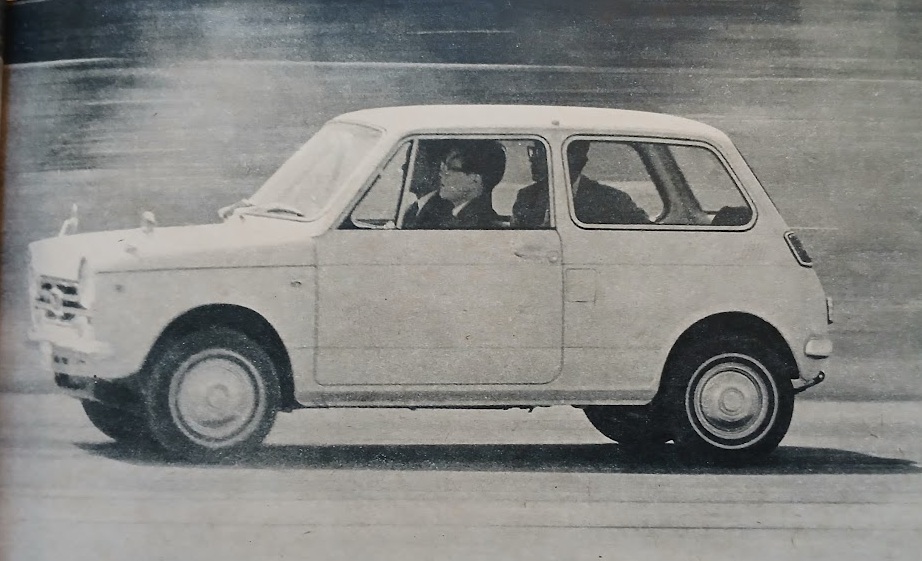
Publication: Motor Fan
Format: Road Test
Date: June 1967
Authors (Roundtable): Yoshio Nakamura, Osamu Hirao, Hiroshi Hayano, Atsushi Watari, Kenji Higuchi, Kiyoshi Mori, Masaichi Kondo, Minoru Onda, Hisashi Tamai, Kazuo Kumabe, Yasuhei Oguchi, Nagao Yoshida, Taizo Tateishi, Kenzaburo Ishikawa, Toshihide Hirata, Motor Fan Editorial Staff (uncredited)
Emphasis in the Design Was on Passenger Space
Magazine: First, could you tell us about the background to the development of the N360?
Nakamura: Honda has already produced a number of four-wheeled vehicles, including sports cars, kei trucks, and light vans, but these were all, so to speak, vehicles of a rather specialized character. They had their strong points, but at the same time they also had their shortcomings. As a result, we felt that the time had come for us to turn our attention to a passenger car aimed at the general user, and development was begun on that basis.
Our aim was a distinctly Japanese type of car—the kei passenger car—but one incorporating technical features that would be fully competitive anywhere in the world. We began with the conviction that this could be achieved within the kei-car limits of 3m in overall length and 1.3m in overall width.
As a kei car, we wanted to make it as practical and economical as possible. Specifically, we felt that the first requirement was to improve passenger accommodation. So the primary aim in the design was to provide room for four adults and a reasonable amount of luggage, without making the occupants feel cramped. At the same time, a kei car that is simply slow would no longer be acceptable, so a certain level of performance was also necessary. Maintenance, safety, and all the other considerations that would apply to a normal passenger car were taken into account as well.
Of these, the greatest emphasis was placed on passenger accommodation. When we began the design, we set the entire powertrain aside and started by designing the passenger compartment itself. The compartment was laid out on the condition that none of the mechanical components would intrude into it or get in the way. Only after the passenger compartment had been established did we begin designing the mechanical parts. In this way, front-wheel drive became the inevitable result, rather than something we had set out from the beginning to adopt.
For a car like this, we have made no distinction between the usual Deluxe and Standard versions. Everything we regard as necessary is fitted as standard equipment. We consider such items as the windshield washer and heater indispensable to the car. Everything else is available from an extensive list of optional or variation parts, allowing the customer to equip the car in various ways according to their preferences.
An N600 for Export as Well
Magazine: We understand you also exhibited a model fitted with a 500cc engine at the recent Geneva Motor Show.
Nakamura: Quite apart from whether or not we actually intended to sell that car, one reason for exhibiting it was that we wanted to see how people in Europe would respond to it. As expected, it attracted a variety of reactions. Among them, it has been reported that BMC Technical Director Alec Issigonis, well known as the designer of the Mini, said, “That is a complete copy of the Mini.” What he actually said, however, was, “It looks very much like the Mini, but once you get inside, it is a completely different car.” His remark was misreported.
In any event, we feel that our purpose in exhibiting the car at the Geneva Motor Show was achieved. Incidentally, it now appears that this model will ultimately become the N600.
Magazine: Please tell us about your choice of an air-cooled inline two-cylinder engine for the power unit.
Nakamura: As I mentioned earlier, we first established the passenger compartment and then tried various ways of fitting the mechanical components into the space that remained. An air-cooled inline two-cylinder engine proved to be the most straightforward solution. It was the best arrangement not only in terms of space, but also in terms of transmitting power to the wheels and maintenance. There remained the problems of vibration and other considerations, but we were confident that these could be reduced to a level that would present no problems in practical use.
Hirao: You said that you first established the passenger compartment and used what remained as engine space. But within the dimensional limits of a kei car, if you provided passenger space comparable to that of a compact car, wouldn’t there be no room left for the engine? Although you say “room for four adults,” I assume you still had the kei-car dimensions very much in mind. However much priority you give to passenger space, it would hardly be possible to provide accommodation comparable to that of an 800cc-class passenger car.
Nakamura: In concrete terms, that’s correct. One of our objectives, however, was to provide enough room for four adults of somewhat larger build than the average Japanese person to sit without feeling cramped.
Hirao: In that case, setting the existing kei cars aside, roughly what size of car would you say the N360’s passenger accommodation can be compared with?
Hayano: Among cars of a similar type, something like the Contessa 900 would be the closest comparison. In terms of passenger accommodation, it can be compared with a car of that size. The 140mm of seat travel is also something quite remarkable for a kei car, and we believe it allows drivers over a fairly wide range of body sizes to find a driving position that suits them properly.
Passenger-Compartment Space and Seat Position
Watari: There’s no question that the interior gives the impression of being quite spacious, but various things protrude into the driver’s area, and once you actually get in, somehow it doesn’t feel as roomy as you might expect. In fact, I found it rather cramped. I’d also like the driver’s seat to be able to slide farther back when there’s no one in the rear. I had it all the way back, but there still wasn’t enough room for my legs. The shift lever was constantly touching the side of my knee. And that shift lever actually tends to slip out of gear rather easily, so I found myself holding it in place all the time. It really isn’t very satisfactory. There seems to be quite comfortable space for the rear-seat and front-seat passengers, but as far as the driver’s seat itself is concerned, I found it cramped.
Hirao: I can easily understand what Professor Watari is saying. When you make the passenger compartment spacious, the front wheel housings protrude into the front-seat area. In other words, although the overall dimensions of the passenger compartment are large, in actual use it feels smaller than they would suggest. That’s a common characteristic in front-wheel-drive cars.
Watari: And yet this is the most important point when it comes to making use of space in a front-wheel-drive car. How you solve this problem is, I think, one of the key points in the design…
Hirao: In other words, however spacious the passenger compartment may be overall, that doesn’t necessarily mean the driver will feel that they have been particularly well provided for. With a small front-wheel-drive car, that is certainly a difficult problem.
Higuchi: If you want to provide a full-size rear seat, with enough room for four adults to sit comfortably, while also giving the driver a feeling of spaciousness, wouldn’t it be better to provide a greater range of seat adjustment? In other words, there’s not much that can be done when four people are on board, but when the driver is alone, or only the front seats are occupied, the seat could be moved much farther back to provide lots of legroom. In that situation, it wouldn’t matter if there were no rear-seat legroom at all—if I may put it in extreme terms…
Of course, depending on the driver’s build, moving the seat back far enough to suit his legs could leave the steering wheel at an unsuitable distance. One way of dealing with that, I think, would be to offer a wide range of adapters and accessories, as BMC does for the Mini, so that the driver could alter the length of the steering column and the angle of the wheel to suit his own preference. As for the problem of the protruding shift lever, perhaps it could simply be moved a little farther to the left.
One respect in which I think the N360 can be said to be superior to the BMC Mini is in the space around the driver’s feet. In the Mini, the necessary space is obtained entirely in the vertical direction, whereas in the N360 it also extends a considerable distance fore and aft. For that very reason, I think a little more thought is needed here to make the fullest possible use of this advantage.
Watari: The shift-lever travel also seemed quite long. That, too, strikes me as something that could be improved.
Few Drivers Match the Average Dimensions
Mori: Well, I’m sure there are various opinions on this, but if you compare the car not with a typical small car but with other kei cars, I think there is a very considerable difference, particularly in the rear seat. As for the amount of front-seat travel, our design was based throughout on accommodating four people, so we didn’t consider it necessary to provide enough adjustment for the rear-seat legroom to be reduced to zero…
Hirao: It isn’t only a question of seat travel. Even with something like the rear trunk lid, there’s no harm in allowing anything that moves to move through the greatest possible range. The person using the car can simply use whichever part of that range suits them best.
Nakamura: Actually, we did consider another arrangement with a greater amount of seat travel. It provided about 40mm more, for a total of around 180mm. But that would have given the car more of a 2+2 character than that of a true four-seater, which didn’t fit the way the car will be used in Japan. So we decided against it, although we intend to use it specifically for export.
Higuchi: This is something that can be said about cars more generally, but if you adjust the seat to suit your distance from the pedals, the steering wheel ends up in the wrong position; and if you adjust it to suit the steering wheel, your reach to the pedals and shift lever becomes awkward. There are very few cars in which everything fits exactly as it should. That’s why it would be useful to have corrective accessories available, such as the adapters I mentioned earlier.
Kondo: There’s a related point here. One company took detailed body measurements of 5,000 male and female employees. Naturally, they arrived at average figures for height, sitting height, leg length, and so forth, but interestingly enough, they found that surprisingly few people were average in all of those dimensions.
I think that sort of thing presents a major problem in designing automobile seats as well.
Hirao: Yes, I’m sure that’s true. American cars are generally set up so that both large and small people can drive them, whereas among European cars there are some that people who are particularly large or particularly small simply can’t drive. They cover as much of the variation as they can within the available range of adjustment.
A Rear Seat That Is Easily Removed
Magazine: Next, let’s please have the data from Professor Higuchi’s laboratory, which actually measured the dimensions of the various parts of the interior.
Onda: In terms of dimensions, it is certainly larger than the average kei car. However, things such as the protrusion of the wheel housings and the shift lever do not show up in the interior dimensions. The figures represent the long, flat central portions of the space, so they may not necessarily correspond to the impressions our colleagues have just described.
Another very useful feature is that the rear seat can be easily removed. Simply release the hooks and the rear portion becomes a cargo area rather like that of a van. We also measured the space with the car arranged this way, and it provides a load length of as much as 2400mm—enough to carry skis. If the front-seat backrests are brought one more notch upright, even larger items can be carried. Used in this way, it should also be a very convenient car for two-person leisure use.
I also think it is useful that luggage can be put in and taken out from inside the car, without having to go around outside and open the trunk. The recessed areas alongside the rear seat, which can be used as magazine trays, should also be appreciated by users.
As for reach to the various controls, there was almost nothing inconveniently far away, and operation was easy. The ventilator control and the hood-release catch are among the more distant items, but these are not used very frequently, so they present no difficulty in practice.
The gearshift feels slightly reluctant when engaging reverse, but otherwise there are no problems. There is nothing particularly awkward about the pedal layout either, and I think it is quite satisfactory.
As for the instruments, the speedometer has lines showing the usable range of every gear, all the way through top. We are told that these correspond to approximately 80% of the engine’s maximum allowable speed.
Magazine: There was also some comment that the gearshift travel might be a little long.
Onda: There are cars with much longer travel, but even with the same amount of movement, I suppose it tends to feel long when the car itself is small…
Kondo: I’m one of those who drives with the seat fairly far forward, and the uppermost part of the speedometer—just around the 60-80km/h range—is hidden by the black hood over the dashboard. I’d like to see something done about that hood.
Hayano: I don’t think that would be the case for most drivers, but we have had the same comment from others, and we have decided to change the curvature of the instrument-panel hood. That seems to solve the problem.
Every Resource Brought to Bear on the Engine Design
Magazine: Another distinctive feature of this car is its air-cooled inline two-cylinder engine, and its excellent performance is attracting considerable attention. Could you tell us something about the difficulties encountered in developing this engine?
Tamai: The need to keep the engine from intruding on the passenger compartment led us to the inline two-cylinder arrangement. The greatest difficulties were noise, vibration, low-speed idling, cooling within the confined engine compartment, ease of maintenance, and the arrangement of the various auxiliaries… Really, we were faced with one difficult problem after another.
Kumabe: Installing an air-cooled four-stroke two-cylinder engine in that way is a first for a passenger car, and I found it both extremely interesting and impressive. The engine also makes very effective use of die-cast components, and it is clear that consideration has been given not only to performance but to ease of production as well. The difficult part, however, is how to reconcile improved production efficiency with ease of use for the owner.
Tamai: This engine was designed from the outset with mass production in mind. The cylinder head, cam case, and other components are all produced entirely with dies.
Kumabe: It has a 4-speed transmission, but first and second seem extremely close together, while the gap between third and top seems to be too large…
Tamai: Yes, that opinion has certainly been expressed. But here too we tested a variety of gear ratios, including, of course, versions with a lower top gear. Our main consideration was how the car would be used as a passenger car. With a truck, the emphasis would be on driving force, while with a sports car maximum speed would take priority. But when we considered the N360 as a passenger car, we concluded that these ratios gave the best overall result. There are also limitations imposed by noise…
Nakamura: The ratios are certainly relatively widely spaced, but we made first gear low with hill starts by inexperienced drivers especially in mind. Looked at from the other direction, that makes top gear appear rather widely separated.
Hirao: I think the fact that it has only two cylinders is also one reason why first gear has to be low.
Specific Output Approaching Sports-Car Levels
Magazine: Next, let’s have the results of the performance tests carried out by Professor Hirao’s laboratory.
Oguchi: The test conditions were the usual three members of the testing crew plus the instruments, giving a load of 190kg. On the day of the test, however, there was a fairly strong wind from about 45° to the left front, at 4-5m/s, so conditions could not necessarily be described as favorable. Please bear that in mind when looking at the data.
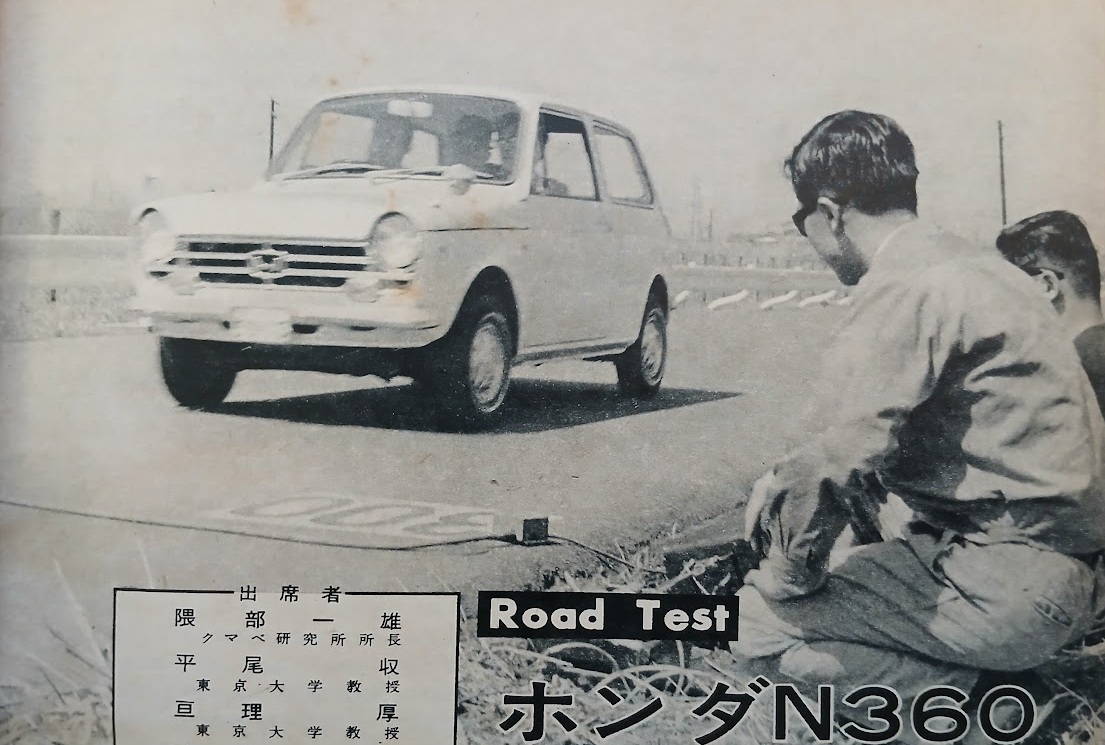
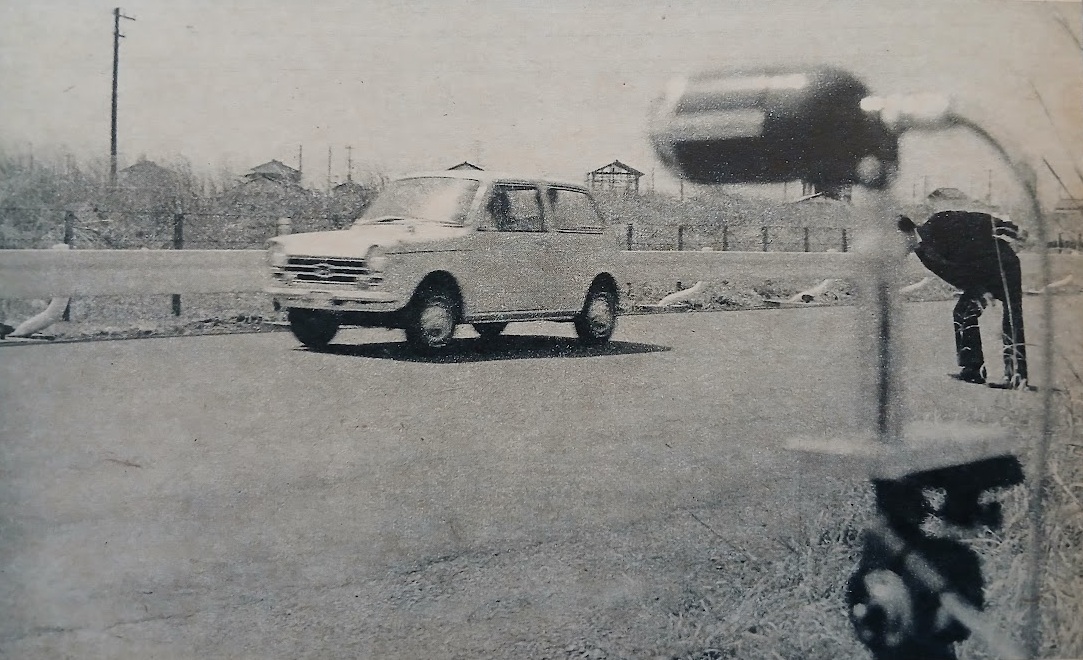
First, in standing-start acceleration, the time-to-distance figures were 0-50m in 6.0 seconds, 0-100m in 9.2 seconds, 0-200m in 14.4 seconds, and 0-400m in 23.1 seconds. In terms of time to speed, the figures were 0-40km/h in 5.2 seconds, 0-60km/h in 9.1 seconds, 0-80km/h in 14.5 seconds, and 0-90km/h in 19.6 seconds.
Next, in overtaking acceleration, starting from 30km/h in third gear, it took 8.8 seconds to reach 60km/h and 14.0 seconds to reach 80km/h. Starting from 40km/h in top gear, it took 12.7 seconds to reach 60km/h and 22.3 seconds to reach 80km/h. In practice, starting from 40km/h in top felt as though it was asking rather too much of the engine.
Then there is the speedometer error. Every car we have tested so far in Motor Fan, Japanese or foreign, has had an optimistic speedometer, indicating higher than the car’s actual speed. Rather unusually, this car’s speedometer reads slightly low. The difference is very small, of course, and hardly enough to be of any concern.
Those are the main test figures, but this engine is in fact extracting a considerable amount of power from its displacement. I did a quick calculation and came up with 87.6ps/l. That is a very high figure, closer to what one would expect of a sports car than a normal passenger car. Maximum output is developed at 8500rpm, and in actual driving I had the impression that you have to extend it quite a long way through the gears before its true character comes through.
Magazine: With a kei car, a strong wind has an immediate effect on the acceleration figures, doesn’t it?
Nakamura: Our own figures are generally in the 22-second range. In fact, when we later calculated the effect of a 4-5m/s quartering headwind, it did indeed bring the figure to around 23 seconds.
As for the speedometer error, we aim for plus or minus zero. Because of the gearing, however, it isn’t possible to make the error exactly zero.
Oguchi: Although it is an OHC engine, at the speed of maximum output the mean piston speed works out to around 16.4m/s, doesn’t it? That is an exceptionally high figure, and it does raise some concern regarding durability and other considerations…
Nakamura: It is true that the piston speed is around that figure at the engine’s maximum output speed, but the car isn’t driven at that speed all the time. When you’re traveling at around 60km/h, it isn’t anything particularly severe.
As for using high piston speeds in themselves, racing engines routinely operate at 22 or 23m/s, so we are quite confident about durability.
A Kei Car That Can Hold Its Own on the Expressway
Hirao: There is still the question of how the engine can be used. When accelerating, for example, you might run it up to around 9000rpm before shifting up. Is it all right to use it that way?
Nakamura: That presents no problem. If you over-rev it, valve bounce and the like will change the sound of the engine, and of course the power will fall off, so you notice it immediately.
Hirao: Then would it be all right, every time you start off, to take it to 9000rpm in first, shift into second and take that to 9000rpm, then skip third and go straight into top?
Nakamura: Even in that case, the time spent at 9000rpm is very short. For more than 90% of ordinary driving, at around 60km/h, the engine is turning at only about 3000rpm, so the average piston speed does not become particularly high. There is no problem.
In other words, ordinarily you use the engine at much lower speeds, but you have a certain reserve in hand that can be called upon when you need it. Of course, normally a reserve is used up when you draw on it, but this is one reserve you can use as much as you like. (laughs)
Hirao: That would be extremely useful when entering an expressway, for example.
Higuchi: To exaggerate just a little, you might say this is the first kei car that can really be driven on an expressway. It was the first kei car in which I could reach 100km/h easily on the Murayama test course. In that respect, I felt it was quite a remarkable car. And that wasn’t all. I also tried the trick of slowing to 20km/h in top and then accelerating again, and it managed that perfectly well.
Yoshida: On level ground, it is quite happy at around 30km/h in top. Then there is the question of engine speed that came up earlier. With maximum output at 8500rpm, if we assume that the engine will ordinarily be used at around half that speed, the normal range would be somewhere around 4500rpm. Looking at output alone, at around 5000rpm it is already producing roughly as much power as the maximum output of an ordinary kei car, so everything beyond that can be regarded as reserve power.
Tamai: As for torque, one of the engine’s main characteristics is the flatness of its torque curve.
Maximum torque occurs at 5500rpm, but as was just mentioned, 20km/h in top corresponds to somewhere around 1500-2000rpm, and even there it still has plenty of torque.
Hirao: Yes, it is certainly a flexible, tractable engine.
Higuchi: When we occasionally drive a car with a two-stroke engine, we have a tendency to stall it rather often. But since this car is a four-stroke, and the torque curve is flat, there is no such worry. In that respect, I found it very easy to drive without concern.
Magazine: What kind of fuel economy does it return? We did not conduct a fuel-economy test this time, so perhaps we could have the figures from the test conducted with the Ministry of Transport.
Hayano: In the running fuel-economy test, it returned 31.3km/l at an average speed of 45km/h. The figure quoted in the catalog is 28km/l, though…
In the constant-speed fuel-economy test, the figures were 32km/l at 30km/h, 33.1km/l at 40km/h, 32.8km/l at 50km/h, 29.5km/l at 60km/h, and 27.0km/l at 70km/h.
Every Effort Devoted to Taming the Noise
Magazine: Next, let’s have the vibration and noise test data from Professor Watari’s laboratory.
Tateishi: I’ll begin with the ride vibration frequencies. As usual, we drove slowly over an obstacle plate and measured the frequencies with instruments placed at the front and rear seats. The sprung-mass frequency was 1.6cps at both the front and rear wheels, while the unsprung frequency was 10cps at both front and rear.
Next, noise. Interior noise was measured under our usual conditions, with all the windows closed. On the A scale, we recorded 70 phons at 40km/h, 73 phons at 50km/h, 74 phons at 60km/h, 77 phons at 70km/h, 81 phons at 90km/h, and 83 phons at 100km/h.
Exterior noise was measured by the JIS method in third and top gears, under full acceleration from the specified 50% and 75% points. In third, the figures were 73 phons from 50% and 75 phons from 75%; in top, they were 72 phons from 50% and 73 phons from 75%.
Hayano: Those figures seem to be rather higher than our own data.
Watari: Where do you conduct your measurements?
Hayano: At the Arakawa test course.
Watari: The results can differ considerably depending on where they are measured. The surface at the Higashimurayama course is generally poor, so most cars give higher figures than the manufacturers’ own data. It always causes complaints. (laughs) The difference is usually as much as two to four phons.
As far as noise is concerned, this car has just about every disadvantage working against it: front-wheel drive, an air-cooled two-cylinder engine, high engine speeds, and the fact that it is a kei car. Considering all that, I don’t think it does badly. I would like to see more of the noise allowed to escape outside, as it is in American cars, so that the interior noise, at least, could be brought down a little further.
Hayano: There is transmitted noise and there is resonant noise within the body. In any case, we were faced with the worst possible conditions. Reducing the overall noise level is important, of course, but even at the same phon level, some sounds strike the ear as unpleasant while others are much less objectionable. So rather than concentrating solely on making the car quieter, we focused our efforts on making the sound easier on the ear. Above all, we devoted ourselves to eliminating the kind of noise that resonates inside the car and gives you a headache.
Kondo: Last night we drove the car around the campus at Tokyo Institute of Technology. Maybe because the surroundings were so quiet, the engine seemed quite noisy. It was almost as though the engine were asserting its importance… (laughs) while we humans were being allowed to ride along quietly at its pleasure.
Higuchi: There are some remarkably quiet kei cars appearing these days, too, which makes this one seem that much noisier by comparison.
Watari: The noise figures from the cars we have measured in previous Motor Fan tests fall within a certain range, but this car’s A-weighted figures lie slightly above it. With this kind of car, you would expect the C-weighted figures to be higher still, so I would at least like to see the A-weighted level brought down by another 2-3dB. From driving the car today, I wouldn’t say the noise is beyond fixing. Quite a lot of it seemed to be the sort that could be reduced with a little more effort.
High Power or Ride Comfort?
Hirao: With a motorcycle, having an excellent engine can certainly be your winning card. But with a car, and particularly a passenger car, the engine isn’t necessarily the winning card. In a passenger car, wouldn’t that be the accommodation provided for the occupants rather than the engine? Even with the noise we’ve just been discussing, I think the way things are conveyed to the occupants as pleasant sensations can be a major element in what becomes the car’s winning card. To achieve that, you might be better off sacrificing two or three of the other cards in your hand if it means holding a stronger winning card; in the end, that is what wins. Couldn’t you look at it that way? For example, if reducing the engine’s performance somewhat would make it quieter—I don’t know whether it actually would—you could perhaps say that the car would have a stronger hand overall.
Kondo: That is also what I meant earlier when I said that “the engine was asserting its importance.” I would like to see the engine move in the direction Professor Hirao has just described: something that remains quiet in relation to the occupants, yet has plenty of strength in reserve when it is called upon.
Nakamura: We certainly haven’t disregarded that way of thinking. From the very beginning of the design, we treated the engine as secondary, prioritizing passenger-compartment space above all else, and that is how the car developed into its present form. The idea of having power in reserve was not necessarily an essential requirement either, and we thought we had been quite restrained in that respect. But since there is no disadvantage in having power available, that ultimately led us to the high-output engine.
Higuchi: I understand what you’re saying, but surely something more can be done about the noise. Once you take the engine up to 4000 or 5000rpm, the sheer volume of the sound almost discourages you from revving it any higher. These days, so many people are accustomed to larger, quieter cars…
Hirao: On a circuit or a test course you could probably rev it out, but on public roads or around your own neighborhood, with that much noise you would find yourself lifting off the accelerator before you got that far.
That said, the quality of the sound itself certainly isn’t unpleasant. But, as I’ve said several times now, I would still like it to be a little quieter.
Watari: That is why, although the car was initially described to us as a kei-class passenger car for the general public, judging from the car that has actually emerged, I can’t help feeling that it is less everyday transportation for the general public than a recreational car for leisure use. I think the same conclusion can also be drawn from the steering behavior.
Ishikawa: Still, it has become quieter compared with the early cars. When I drove one some time ago at our institute—the Ship Research Institute in Mitaka—I thought it was quite noisy. But this time, driving it at Higashimurayama, the noise didn’t bother me nearly as much. Some of that may be due to the course, but I think it also reflects the considerable effort that has been made.
Hirao: Yes, you often hear people say that the recent cars have improved tremendously compared with the early ones.
Higuchi: I had an opportunity to drive one just a month ago, and the sound has already changed since then.
Handling and Stability of an FF Car
Magazine: How do the ride vibration frequencies compare with other cars in this class?
Watari: I don’t think the frequencies can be lowered much further. When we measured the car previously, I had the impression that the rear-wheel frequency alone was somewhat on the high side, but this time the front and rear were about the same. For a car in this class, I think this is about the right level. Trying to lower them any further would probably introduce other problems.
Hirao: There are cars with lower frequencies, of course, but then it becomes a matter of preference.
Watari: Even so, I felt that the amount of roll was surprisingly large. In other words, it seemed as though the suspension didn’t have quite enough resistance to roll…
Hayano: The roll rate is about 5.5°. That certainly isn’t small, but I don’t think it can be called excessively large either.
Higuchi: The thing is, this car’s engine has quite a lot of power, so you naturally tend to take curves at higher speeds. Other cars would be driven through them more slowly, and I think that may make the roll angle feel greater than it actually is. If you compare the cars at the same lateral acceleration in g, this may not necessarily prove to be a car with an especially large amount of roll.
Magazine: Professor Kondo, perhaps you could tell us about the results of the handling and stability tests conducted by your laboratory at Tokyo Institute of Technology.
Kondo: Following yesterday’s road driving, today at Higashimurayama we carried out our usual handling and stability tests. The data has not yet been analyzed, so we will publish the details in the test report. Here, using Mr. Akutsu’s report on the tests he conducted, I would like to talk mainly about our impressions.
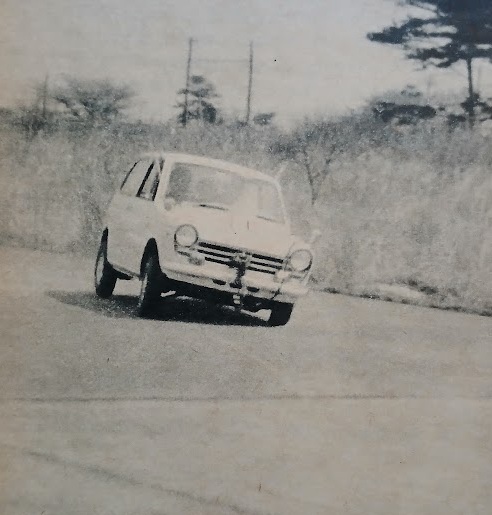
First, in the understeer/oversteer test, the car understeered strongly right to the limit. The steering effort was about 2.2kg at a lateral acceleration of 0.58g. We don’t yet have the results for roll rate.
We also conduct a figure-eight test to measure steering effort at low speeds. At the maximum lateral acceleration of 0.46g, the figures were 6.7kg to the right and 7.0kg to the left. At the 0.25g lateral acceleration we normally use, I would expect the figures to be somewhere around 3-4kg.
The stationary steering effort was unexpectedly heavy for a kei car: at a steering-wheel angle of 360°, it was 9kg to the right and 11kg to the left. I think this is related both to the front-wheel-drive layout and to the relatively low number of turns from lock to lock.
Then there was the hands-off directional-stability test, which we carried out up to around 90km/h. At approximately 70km/h, Mr. Akutsu reports that the period was 1.2 seconds and that the oscillation did not settle particularly well.
I think this is also related to the roll we were discussing earlier. During last night’s road driving, when coming out of a curve onto a straight, even a slight relaxation of one’s grip on the steering wheel—or while driving along the road, a momentary relaxation of the right hand holding the wheel while changing gear—would cause the car to start yawing. I think this involves the characteristics of the steering system and the front and rear suspension. Perhaps the overall rigidity of the car is insufficient.
How Does It Manage Hill Starts?
Hayano: With this car, suppressing vibration and noise was a primary consideration, so the engine mounting system was designed with that objective in mind. There is a primary mounting system, and this in turn is attached to what might be called a secondary mounting system—a subframe—which is itself rubber-mounted to the body. All of the suspension components are also attached to this subframe. So when you mention a lack of rigidity, setting aside the rigidity of the body itself, you are absolutely right as far as the rigidity of the overall structure is concerned. Because this subframe is rubber-mounted, we have taken various measures to prevent it from moving laterally, but it is entirely possible that this is contributing to the yawing. We are doing everything we can to eliminate it.
Then there is what I suppose is one of the inherent characteristics of front-wheel drive: the handling characteristics change between the power-on and power-off conditions. Our task was to suppress that difference somehow. To be more specific, when you lift off the throttle to change gear, the directional behavior of the car changes, whether you are traveling in a straight line or through a slight curve. In other words, it becomes more prone to yawing. Anyone will notice it.
To prevent this, we brought both the camber offset and caster almost to zero, and rely solely on kingpin inclination to achieve the necessary balance. As for the poor damping of the yawing moment at high speed, however, the car itself is light and the steering is light as well, so we believe that simply maintaining a light hold on the steering wheel supplies enough damping to the steering system to prevent the yawing.
Hirao: Well, front-wheel drive does have its own various peculiarities, but among recent front-wheel-drive cars there are quite a few that, if you didn’t know otherwise, would feel no different at all from an ordinary rear-wheel-drive car. So I would still like to see something done about it.
Higuchi: I imagine cost enters into it as well, but it is certainly true that nowadays there are cars you could drive without realizing they were front-wheel drive.
Watari: The situation I find most worrying is something like being struck by a sudden crosswind and then having to correct for it. If the aim really is to sell the car to the general public, I think it needs to be a car that anyone can handle, under any circumstances and in any conditions.
Kondo: We actually have a slope at Tokyo Institute of Technology for hill-start testing, so we tried starting the car on it. It could start without any difficulty on gradients of 10° and 12°. You would hardly encounter a slope that steep on an actual road, but what is the car’s maximum climbing angle?
Hayano: The calculated figure is 21°20′. At our own test course we have gradients of 12°, 14°, and 17°. Since the car is front-wheel drive, we too had some concern about its climbing ability, but it went up the 17° slope without difficulty, so that put our minds at ease.
Brakes That Resist Fade
Magazine: Next, let’s have the data from the Ship Research Institute on weight, brakes, and wheel alignment.
Ishikawa: As for weight, with the spare tire and tools, the car weighs 494kg unladen. The weight distribution is 336kg at the front and 158kg at the rear, or 68:32, so this is a very front-heavy car. Even with its full complement of four occupants, the figures are 425kg front and 309kg rear, giving a distribution of 58:42, so there is still considerably more weight on the front. Among the cars we have tested so far, including foreign cars, the most front-heavy had a distribution of 65:35, so this car goes beyond even that. Present Japanese kei cars range roughly from 410kg to 575kg, so at 494kg this car can be regarded as somewhat lighter than average.
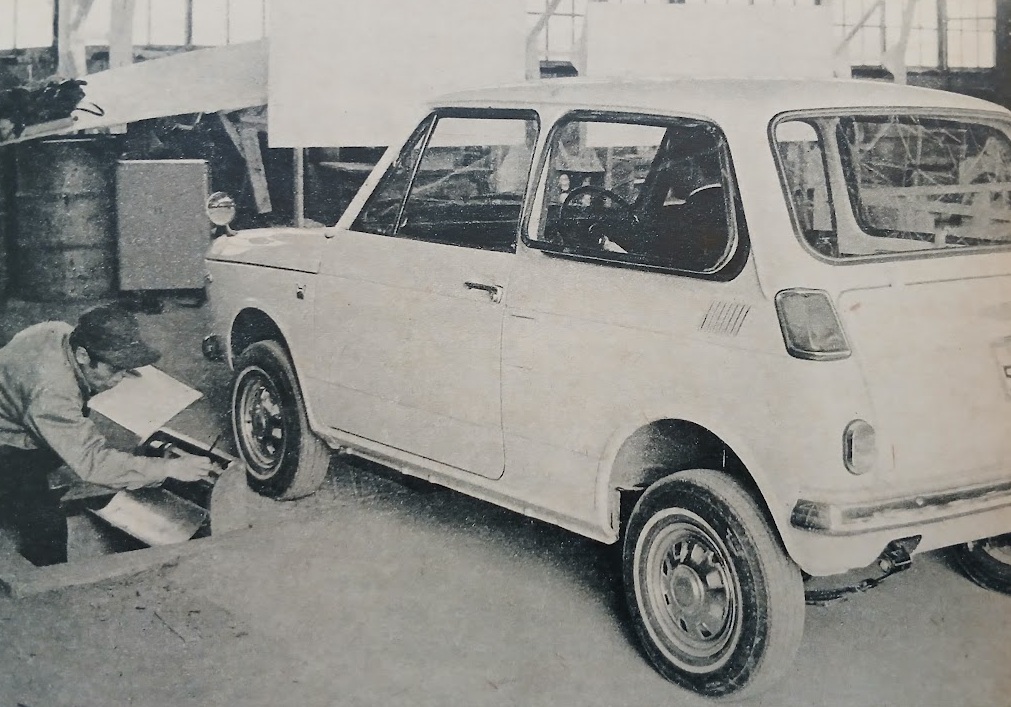
Next, wheel alignment. These are the results obtained with a side-slip tester. With only the driver aboard, the front wheels show slight toe-out, but with a full load of four occupants they move markedly into toe-in. The rear wheels have zero camber, with a slight amount of toe-in. Overall, the wheel alignment changes very little with variations in load.
Turning next to the brakes, leading-trailing drums are used both front and rear. 0.6g of deceleration requires a pedal effort of 17kg, which is quite light. Pedal travel is 26mm before the brakes begin to take effect, and 39mm at 0.6g, so the travel is relatively short. The pedal spring rate is 1.4kg/mm, which puts it somewhat on the firm side by the standards of recent cars.
The brake-force distribution is 84% front and 16% rear, again placing an unusually large proportion at the front.
For this test, we also used the Higashimurayama test course to investigate brake fade. Using the standard Society of Automotive Engineers of Japan method, we measured the change in pedal effort required for 0.1g of deceleration at 50km/h, 80km/h, and 90km/h. Up to 80km/h there was almost no change in pedal effort, and no fade was apparent. At 90km/h, however, fade began to appear, and pedal effort increased by about 50% compared with the figure at 80km/h. So as far as pedal effort is concerned, there is no cause for concern at speeds up to 80km/h.
The problem, however, is the steering instability we have been discussing. Up to around 60km/h you can apply the brakes with confidence, but at 80km/h I found it a little frightening. Now that engine performance and acceleration have been raised to this level, I would very much like to see equally secure performance on the deceleration side.
Next, the parking brake is a mechanically operated, floor-lever type. To obtain 0.2g of braking force—or roughly the braking force required to hold the car on a gradient—requires an effort of 27kg. It tends to hold more effectively in the reverse direction than in the forward direction, so our results indicate that it is better to park the car facing uphill.
One particularly good point was that there was no reduction in braking force after the ratchet had engaged and the lever was released.
We also measured the operating effort of the various controls. The shift lever is of an unusual type, but it is very light, requiring only about 1-2kg, and engages each gear positively. The clutch is light as well, requiring 6kg to disengage and 3kg to engage. The accelerator is also light: about 1kg at a steady 50km/h and around 2.5kg under acceleration.
Hirao: Related to the steering instability we were just discussing, how many turns is the steering from lock to lock?
Oguchi: About 2.5 turns, I believe.
Hirao: I think you’re bound to have problems unless you make it closer to three turns.
A Wide Field of View to the Front
Magazine: Next, perhaps we could have the results of the visibility measurements carried out by Professor Hirata’s laboratory at Tokyo University of Agriculture and Technology.
Hirata: For this test, a fisheye lens is placed at the eye position of a dummy driver, and photographs are taken in various directions to measure the extent of the field of view. With the equipment set up, the center of the camera lens was 113cm above the ground with the seat in its fully forward position and 112.5cm with the seat all the way back. The horizontal distance from the front edge of the lens cap to the windshield was 35cm with the seat forward and 50.5cm with it back.
We took various photographs from these positions. Expressed as an angle in the horizontal plane through the eye point, the forward visible range was 92-110° in total from left to right. That is quite a wide field of view. In the vertical direction, the range was 28-38°. That is also quite large, and it appears that even when stopped near the front of an intersection, traffic signals should remain readily visible. In any case, forward visibility is very good. To the rear, the rear window is shaped rather like that of a light van, so the field of view is somewhat narrower, at around 42.5-48° horizontally.
The area swept by the windshield wipers is about 66-83°, which is also relatively wide. The blind areas in the horizontal plane through the eye point amount to approximately 16-17% of the full 360°. To the front, there is a blind spot around the right-front windshield pillar and vent window that is somewhat bothersome.
Expressing the solid angle of the visible field in steradians, the forward field is 1.48 steradians, the windshield itself accounts for 1.02 steradians, and the area swept by the wipers is 0.55 steradian. In other words, the wipers sweep approximately 60-65% of the visible area of the windshield.
An Outstanding Level of Safety
Magazine: Next, Professor Higuchi, please give us the results of your safety evaluation.
Higuchi: There are various problems with this sort of safety evaluation, and I would like you to regard it not as anything absolute, but simply as one possible way of looking at the question. We draw up a list of 30 points covering such areas as the body, interior, seats, and steering wheel, and score each one on a scale from one to five. Five points represents something so good that it could serve as an example to other cars, while one point means something we would like to see fixed as soon as possible. Three points is average.
Ever since this car was first announced, Honda has placed a great deal of emphasis on safety, and its total score is 108 out of a possible 150, or 72 when converted to a 100-point scale. When we have evaluated other kei cars using the same list, the usual score has been around 55-60 out of 100, so this car can be said to have an outstanding level of safety. It is good enough in this respect to outweigh all the shortcomings we have discussed so far.
More specifically, we gave especially high marks for such things as the use of laminated safety glass in the windshield; the fuel tank being arranged so that gasoline will not spill into the passenger compartment in a rear-end collision; the ample padding around the instrument panel and elsewhere in the interior, leaving no bare metal exposed; recessed interior door handles that cannot catch on a sleeve or clothing; an inside rear-view mirror that is unlikely to cause injury if an occupant’s head strikes it; and padding at the center of the steering wheel.
Overall, these provisions are roughly comparable with those found on cars in the 800-1000cc class, or even larger cars.
Magazine: And the price?
Yoshida: It is 313,000 yen delivered at the Sayama factory. In late May, a van-type model called the LN360 will go on sale priced at 308,000 yen.
Magazine: And what are your production plans for the N360?
Yoshida: The car actually went on sale and began reaching customers on March 6. We expect to produce about 2,500 cars during March and around 4,000 this month, April. The van will be added in May, and by around August we plan to be producing 13,000 of the two models combined. By the end of the year, the target is 20,000 units.
Magazine: Thank you very much for your time.
Postscript: Story Photos