Honda Life Touring GS (1972)
Publication: Motor Fan
Format: “Bubble Index” Road Test
Date: August 1972
Authors: Osamu Mochizuki, Katsuzo Kageyama, Shigeki Asaoka, Yasuhei Oguchi, Reiko Ikuuchi, Kensuke Ishizu, Masahide Sano, Motor Fan Editorial Staff (uncredited)
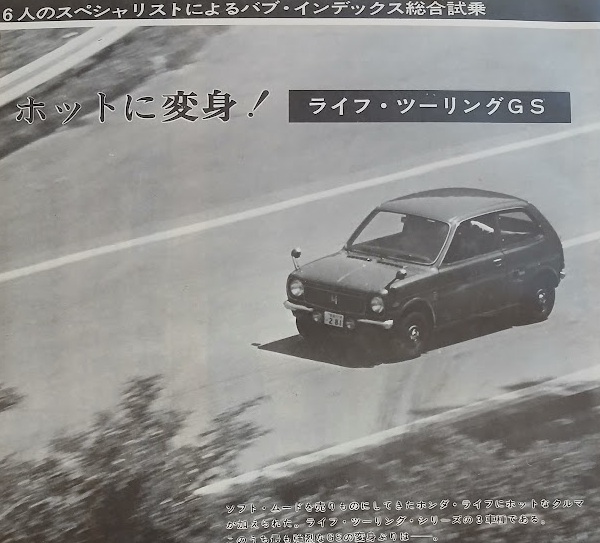
Transformed into a Hot One!
The Honda Life, which until now has made its appeal through a soft, easygoing mood, has been joined by something hotter: the three models of the new Life Touring series. Just how dramatic is the transformation in the hottest of them all, the GS?
Fitted with the Z Engine
Our test drive took place on Saturday, June 10.
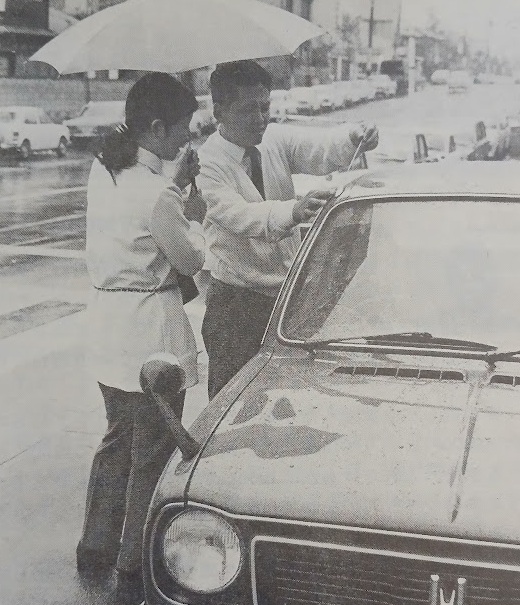
Although the rainy season had yet to be officially declared, temperatures throughout the Kanto region had climbed above 30°C in the humid early summer. At 10:30am, three of our six specialists (Ishizu, Oguchi and Ikuuchi had already driven the car before June 10) opened the hood of the Life Touring GS in the parking lot of the “Fantasy” drive-in, our usual base.
While carrying out a simple pre-drive inspection, we spent a few minutes discussing the car’s mechanical features. Shortly afterward, we set off with Mochizuki in the driver’s seat, Kageyama in the passenger seat, and Sano in the back.
On the outbound run on the Tomei Expressway, numerous instrumented measurements were taken over the 88.4km from the Tokyo Interchange to the Gotemba Interchange.
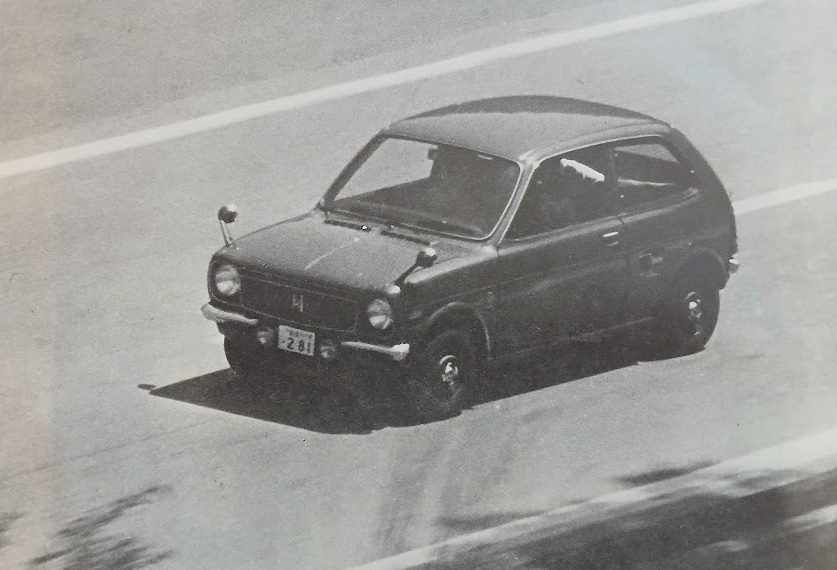
“A level of performance beyond the conventional idea of what a kei car can offer,” as test driver Mochizuki put it. The car simply goes very well. As readers will know, the Life Touring GS is the hottest of the three models in the new Life series that Honda placed on sale May 1.
Its water-cooled, two-cylinder, four-stroke OHC engine develops 36ps/9000rpm and 3.2kgm/7000rpm, and is fitted with two CV carburetors. It is the same engine used in the Honda Z. The SS (389,000 yen) and SL (419,000 yen) have 4-speed transmissions, while the GS (449,000 yen) has a 5-speed.
Partway through the test, we pulled the car into the Nakai Service Area, where Kageyama took the wheel from Mochizuki.
Kageyama, responsible for evaluating handling and stability, remarked, “Ah, this is comfortable—really comfortable. And it goes great,” then checked that there were no cars immediately ahead or behind and took his hands off the wheel to test hands-off stability. His conclusion: “It settles quickly and well.”
The comfortable ride made it easy to forget the heat.
After leaving the Gotemba Interchange, we stopped for fuel. Fuel economy was 16.7km/l, including the acceleration and deceleration while taking measurements—a better result than we got in our test of the Honda Z.
After lunch, Asaoka, our interior and comfort specialist, took the wheel for the run over the Otome Pass. For an active racing driver, the 9000rpm redline and 5-speed transmission apparently made for highly enjoyable driving.
“The car is so small that you really get a sense of speed. The transmission feels good, too.” Sailing through the curves on an outside-inside-outside line, he swept past the cars of the weekend-driving set.
In the Hakone mountains, we measured hill-climbing performance. Afterward, the specialists took turns at the wheel, forming their overall impressions through tests of standing-start acceleration, passing performance, handling and stability, and other aspects of the car.
At 5:20pm, we returned to our starting point at Fantasy. “This is surprising—the high-speed fuel economy over the third section was 21.5km/l,” announced Sano, who was responsible for the measurements, and the discussion began.
The results are shown by the hexagon on the title page. The black circles within each category are uniformly large, indicating high scores in every area. The reports from our specialists describe the car’s characteristics in greater detail, and we invite you to read them on the following pages.
Performance: Improved Overall Balance (Osamu Mochizuki)
In terms of performance, the Life Touring GS ranks among the very best in the kei-car class. Its outstanding characteristic is probably the excellent overall balance of its various qualities. In other words, handling and stability, roadholding, ride comfort, noise, acceleration, maximum speed and the other aspects of its performance have all been brought together and harmonized at an appropriately high level.
As a result, it achieves a standard of performance beyond the conventional idea of what a kei car can offer, while at the same time remaining an easy car to use.
The GS engine develops 36ps/9000rpm and 3.2kgm/7000rpm, which is plenty for a vehicle weighing 495kg. In addition, the transmission’s five speeds are set up almost as though an extra ratio had been inserted within the range formerly covered by four. Fifth is not a true overdrive ratio; at 80km/h the engine is turning 5600rpm, ensuring more than enough response.
The distribution of gear ratios is appropriate and broadens the range of useful response. In particular, hill-climbing ability—a weakness of earlier Honda kei cars—has been greatly improved. Even on the steep mountain roads of Hakone, the GS displays such lively performance that one is hardly aware of its handicap as a kei car.
Even with three people on board, as long as engine speed is kept above 5000rpm in second and third, the car never struggles on hills.
On level roads, provided engine speed is above 3000rpm in fourth or fifth, there is no lag in keeping with the flow of traffic to frustrate the driver; in third, useful response is available from as little as 2000rpm. At that point road speed is 15km/h, demonstrating the extent to which the Life Touring engine has been given flatter torque characteristics. Considering that the old air-cooled engine abruptly lost power below 7000rpm, this represents a remarkable advance.
Engine vibration and noise are kept to very low levels. Although somewhat noisier than the regular Life, the GS still ranks among the quietest kei cars. Even when taken to 9000rpm, it creates no sense of psychological strain, making it possible to enjoy engine speeds that are exceptional among passenger cars. And when driven that way, of course, it provides lively performance beyond the normal idea of a kei car.
The fact that handling and stability have been improved in parallel with the increase in performance shows that the manufacturer has considered the matter carefully. The key to this success comes down to the suspension settings. Although relatively firm, the springs and dampers are well matched, keeping roll to a minimum without sacrificing ride comfort. Together with a normal degree of understeer, good steering response provided by the radial tires, and stable straight-line behavior, there is little in this area to criticize.
“Even climbing in Hakone, it can keep up with mass-market cars.” — Kageyama
“The engine is superbly balanced, and exceptionally smooth.” — Oguchi
“In the hands of a skilled driver, it can be faster than a compact car.” — Asaoka
Handling & Stability: Good Hands-Off Stability (Katsuzo Kageyama)
The interior is remarkably spacious, giving the impression of riding in a mass-market car one class higher than a kei car. The aim of the Life is to provide as much interior room as possible within the dimensional limits of the kei-car class, and in this it has succeeded admirably. Inevitably, however, the engine compartment looks rather tight.
The spacious interior also provides an excellent driving position for a kei car. If one were to find fault, the lack of room to the right of the accelerator pedal is somewhat limiting, but that is the result of the 1300mm overall-width limit and must simply be accepted as the fate of a kei car. On the other hand, there is plenty of room to the left of the clutch pedal. This is the favorable result of not fitting a useless center console, and I think other kei cars would do well to follow its example.
The switches are also easy to operate, and I never found myself confused. In particular, the frequently used light switch is conveniently positioned and easy to use. The cleverly designed overhead panel is also easy to use. Skillful interior design is something of a Honda specialty, and as always, one can only admire their savvy in knowing how to delight the user.
As with the regular Life, the steering is quite light. In this respect it feels very different from the company’s NIII. Steering response is extremely quick. Yet the steering grows progressively heavier as speed rises, so that even at higher speeds it never feels frightening. In this respect, it is neither oversensitive like the Honda Z nor so heavy that it feels ponderous, as in the NIII.
It is remarkably natural and easy to use.
The one point that bothers me is that friction around the straight-ahead position is somewhat high, and as a result its straight-line behavior is not very good. I have noticed the same trait in other Life models, while also experiencing examples that did not exhibit it, so I suspect this is probably due to variations in adjustment during assembly. With everything else so well executed, it is a little disappointing.
Roll, so often a problem in kei cars, is also kept sufficiently under control that it presents no trouble. The degree of understeer is naturally not small, since this is a front-wheel-drive car, but neither is it excessive. I make the comparison often, but next to the NIII it is far more docile and free of peculiarities.
Hands-off stability is extremely good, and the car settles quickly. In this respect it is completely different from the N series, which often presented problems; their characters are so different that it is hard to believe they are siblings. If they are, this younger one is by far the more even-tempered and mature adult.
The regular Life was unusually restrained and docile compared with earlier Honda cars. The Life Touring was presumably created in response to those who found that character somewhat unsatisfying: retaining the good qualities of the Life while creating a car that could also be driven hard in true Honda fashion.
“The friction and dead zone around the steering’s center position bothered me.” — Oguchi
“Circumstances meant that I drove the car on a different day, but even though I happened to be right in the middle of a tremendous downpour, it showed sure, stable behavior on the Tomei Expressway.” — Ikuuchi
“The degree of roll is kept low.” — Sano
Interior & Comfort: A Spacious Cabin (Shigeki Asaoka)
The kei car is a uniquely Japanese phenomenon, with few parallels elsewhere in the world and an engine capacity limited to 360cc. The Japanese car market itself is unusual, of course, but over its 15-year history the kei car has continued to grow steadily in its own way.
There are now six manufacturers of kei cars. Toyo Kogyo, which had been out of the fray for some time, suddenly announced the new Chantez, along with the startling declaration that it intended to sell it in volume this summer and rejoin the battle. Once again, developments are forcing the industry to take another look at the market potential of the kei car from a variety of angles.
Among the various kei-car manufacturers, Honda devoted considerable effort to racing at home and abroad, building up its corporate image in the process. This gave it a strong appeal among younger buyers and helped make the N360 a success.
Kei cars also enjoyed certain advantages under the licensing system, but before long the class found itself caught up in a horsepower race. Honda, with considerable expertise in that field, gained an increasingly strong advantage. On the other hand, performance scarcely imaginable from 360cc brought accidents increasingly into the public eye, and Honda was the first to be singled out for criticism, putting the company in a difficult position.
Perhaps partly for that reason, Honda, which had previously appealed so strongly to young people, introduced the Honda Life in May of last year, with a campaign completely opposite in character to those of earlier kei cars, being aimed instead at salaried workers with nuclear families.
In contrast to the way kei cars were typically promoted, the Life was designed deliberately not to go too fast; it was economical, offered plenty of passenger space and had four doors. It was extremely docile, almost as though Honda wanted to declare that it had nothing whatsoever to do with sporting character.
And yet now it has turned into a wolf again, and I no longer know quite what to make of it. Perhaps Honda could no longer contain all the frustration it had been holding back…
The engine is the sportiest 36ps unit from the Honda Z, with twin CV carburetors, while the increasingly popular water-cooling system has also been adopted. The transmission is a 5-speed. As with all Honda engines, it revs extraordinarily freely, and the red zone of this two-cylinder OHC engine begins at no less than 9000rpm.
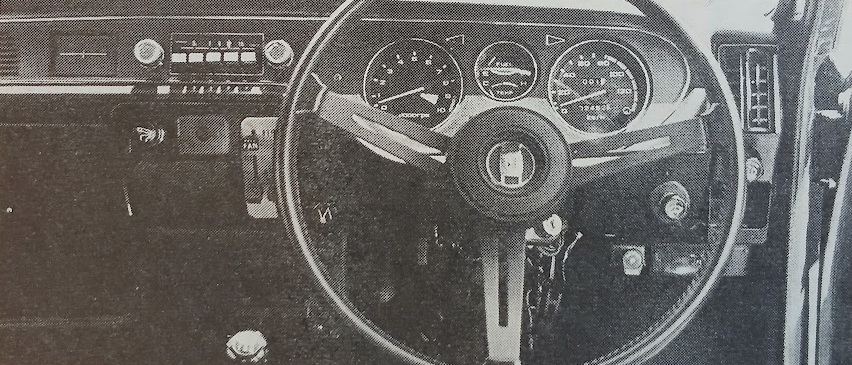
The engine is not so quiet that one particularly notices the benefit of water cooling, but seeing the tachometer needle pointing to 9000rpm is startling. To put it another way, 3000rpm in an ordinary car is roughly equivalent to 5000rpm in this one. As long as one does not mind making frequent shifts, the 5-speed transmission has good continuity from one ratio to the next, and the car delivers performance that is hard to imagine coming from a kei car. It even inspires the reassuring feeling that, after all, this is a Honda.
The cabin is exceptionally spacious for a kei car, and the rear seat seems genuinely usable. Nor is there one of those pointless consoles—another form of dash panel over-decoration—that are found in other cars, so there is plenty of room around one’s feet. If I were to find fault, I would like the instrument panel itself to be simpler, creating a greater sense of space visually as well. It seems to me that Honda could bring out more of the chic practicality found in cars like the Fiat 500 and Citroen Ami. Starting with this Life, I would like to see the kei car break free and grow into a car for adults.
“The 5-speed transmission has a narrow gate across the lateral plane, so it is rather easy to select the wrong gear.” — Kageyama
“It does not have the cramped, hemmed-in feeling of a kei car.” — Oguchi
Safety: A Margin in Reserve Is Fundamental to Safety (Yasuhei Oguchi)
Since the test car belongs to a new series of the existing Life, it does not have the freshness of an entirely new model. But developed to this extent within the limitations of the kei-car class, its appeal as a driver’s car has increased to an almost unparalleled degree.
In particular, fitting the Z engine has provided far greater reserves of performance. Combined with the chassis’ capabilities, this widens the window of time in which the driver can choose the right moment to accelerate—in other words, it increases the driver’s margin. I believe this contributes directly to an improvement in basic safety.
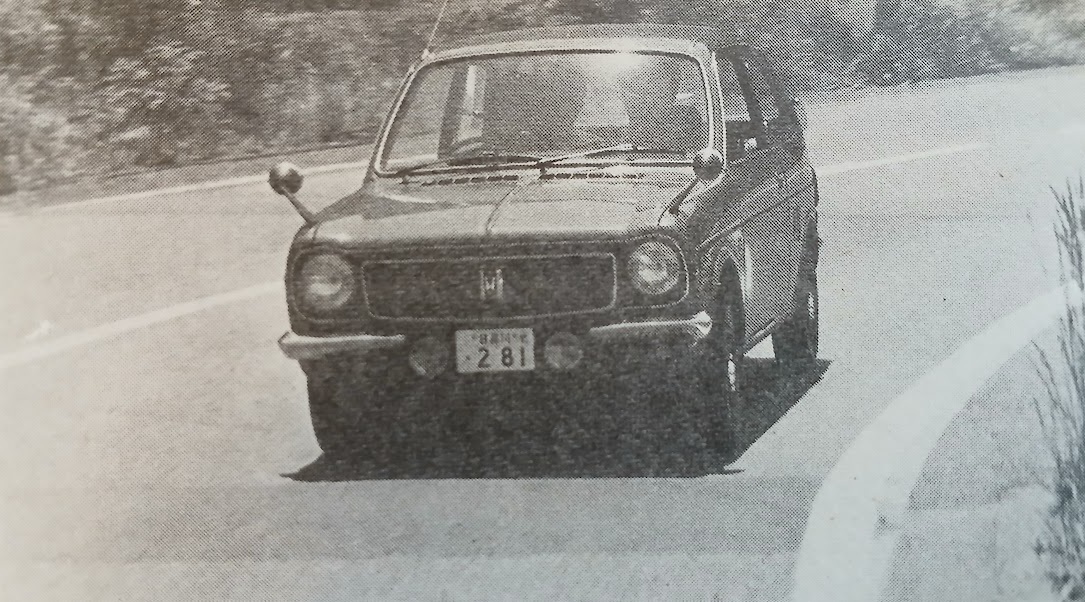
As far as visible safety equipment is concerned, nothing in particular seems to be different from before. In the details, however, the side marker lamps make the car’s indications to other road users clearer, while the greater projection of the fender mirrors broadens the field of view along the body sides.
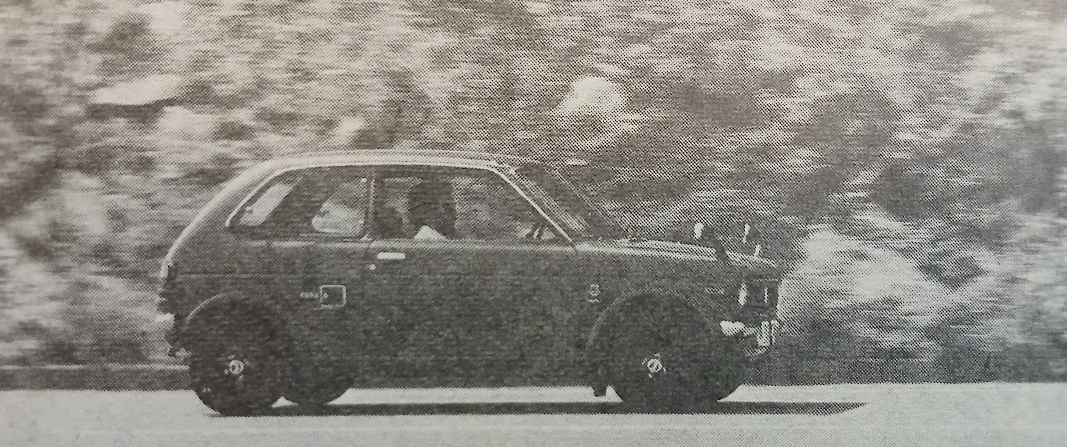
Speaking of visibility, with a box-shaped body like the Life’s, one worries about the rear window becoming dirty from mud thrown up when driving in the rain. The test car was fitted with mud flaps, and these appear to work quite well.
The speed limit for kei cars on expressways such as the Tomei is 80km/h, but this has no more practical significance than mochi in a painting. The gap between the regulation and the spirit in which it was originally framed has become far too great; one can only say that the mochi has gone rotten and is beginning to stink.
The car is also equipped with an alarm that sounds above 80km/h to warn the driver. It is certainly true that one’s sense of speed can easily become distorted in an environment such as an expressway, so I think an alarm has a certain value. But, generally speaking, I would like to see a little more thought given to the way in which that warning is given.
The test car seems to have received much attention in this respect. Compared with the alarm fitted to the Z we tested previously, either its tone or its sound-pressure level seems to have been changed.
Leaving that aside, the most basic requirement is that a car should be able to flow smoothly with the traffic. Kei cars and heavily loaded trucks can sometimes become a “vortex” in high-speed traffic. Avoiding such a vortex is a minimum requirement for efficient, safe driving, and improved performance for that purpose should therefore be regarded as beneficial.
As a Touring rather than a Town model, its performance is well suited to the purpose. It picks up well, but seems to run out of steam rather early. That is the one point I find disappointing.
“One can always ask for more, but I would still like to have an electrically heated rear window. I was the only one who drove it in the rain, and it was definitely needed.” — Ikuuchi
Economy: Outstanding Fuel Economy of 21.5km/l (Reiko Ikuuchi)
The kei car once had the image of something that could be bought for somewhere in the 300,000-yen range. But the variety of models has increased, and a quick look today shows that nearly half of all kei cars are priced in the 400,000-yen range.
Even so, the 449,000-yen price of the Honda Life Touring GS we tested puts it among the most expensive kei cars. For that much money, one can buy a 1000cc compact passenger car. In the Life series, it is the top model aside from the version with automatic transmission.
At first I was disappointed. The Life had succeeded by making a virtue of its emphasis on low- and medium-speed performance, yet here Honda had fitted it with a 5-speed transmission, twin carburetors, a tachometer and radial tires, apparently escalating once again in the direction of “hot” performance. But after driving it, I was impressed by its sure-footedness and stability, and by how well the car works together as a whole. I began to feel that 449,000 yen was not too much to pay for this level of performance.
The 5-speed transmission, twin carburetors and tachometer are all necessary to extract power reliably from such a small engine, while radial tires can likewise be considered essential if a body this small is to cope with that performance.
Catalog fuel economy is listed as 28km/l, but in actual use it is normal to see only around 50-60% of the catalog figure. Yet as our test data shows, the third section of our test route produced more than 20km/l. Moreover, this was under conditions that were quite demanding for a kei car, at an average speed of 88.4km/h. For comparison, the fuel-economy figures of kei cars previously tested in this Bubble Index series, listed in order from the first through third sections, were: Car A, 18.4, 9.9 and 18.7km/l; Car B, 14.2, 13.0 and 15.0km/l; and Car C, 15.1, 12.0 and 15.5km/l.
Car C, incidentally, was actually the Honda Z-GS that we tested on February 8, 1971. It, too, had twin carburetors and a 5-speed transmission. The differences are that the Z-GS had an air-cooled engine, whereas the Life Touring GS has a water-cooled engine, and the Life is about 30kg lighter.
The manufacturer says that no particular effort was made in the design specifically to reduce fuel consumption. Even so, the well-matched overall characteristics of the car, which allow its power to be extracted without undue effort, together with the move toward leaner mixtures in the pursuit of a cleaner engine, may well have contributed to the result.
Next comes oil consumption. We could not measure this during such a short road test, but whereas other kei cars use two-stroke engines, Honda’s kei cars use four-strokes, so their oil consumption should be lower. Admittedly, two-strokes now use separate oil rather than the premixed oil of the past, so the difference is not that large.
As for maintenance costs, twin carburetors naturally cost more to adjust. Even so, the charge is only 380 yen, compared with 230 yen for a single carburetor. The new-car warranty on most other kei cars is one year or 20,000km, whichever comes first (only Mitsubishi offers two years or 50,000km). Honda, by contrast, places no limit on mileage during the first year.
Finally, the greatest concern affecting the economy of kei-car ownership is the introduction of mandatory vehicle inspections. It appears, however, that cars registered by the end of September 1973 will only have to undergo their first inspection by the end of September 1975, so this is still some way off.
“I can understand how someone might want to own this as their only car rather than as a second car. Even so, that price…” — Ishizu
Product Appeal: Suited to the “King’s” Taste, but… (Kensuke Ishizu)
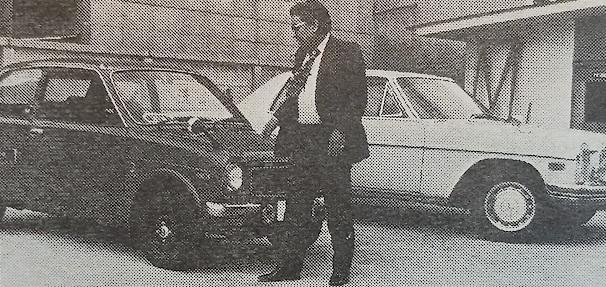
Every morning I drive to work in my automatic Mercedes-Benz 250CE.
It is only about 2km from my apartment in Roppongi to the VAN Jacket headquarters in Aoyama.
The morning rush hour is already over by then, but traffic is still unavoidable. Looking at the crowded roads, I have often thought to myself, “If I were to buy a second car, it would have to be a kei car.”
If all I happen to need a car for that day is commuting, I do not need the Mercedes. A Honda Life Touring GS would be perfectly adequate.
When the Honda Z first appeared, I mentioned this idea to some of my younger employees. They objected: “Mr. President, a man in your position? Please don’t!”
But my idea has not changed.
I recently returned from a trip to America more convinced of this view than ever.
The automobile is no longer a status symbol. This is an age when even Americans of lower social standing drive Cadillacs.
People may say that I “look smart” driving a Mercedes. I do not see it that way.
Driving a Life to work and casually taking it out shopping—surely it is this kind of clear-headed, pragmatic approach that really looks smart.
There is one thing, however, that gives me pause: the Life’s price.
I accept that it is a thoroughly upgraded product. But what are we to make of the 449,000-yen price of the GS we tested?
The kei second car I want is certainly not a GS (“Grand Sport”). I do not want anything this deluxe; I want an economy car. A car integrated into everyday life, as cars are for Americans. Naturally, that demands economy in all sorts of ways…
To put it simply, I do not need a tachometer, nor do I need a 5-speed transmission. I could even do without a radio, for that matter.
When I say things like this, there may well be users who respond, “What kind of nonsense are you talking?”
They say the consumer is king. A king has power and money. But there seem to be a great many foolish kings. I do not demand luxury from a kei car. Nor does it need extravagant mechanical features.
Americans were also praising “Made in Japan” products for their “craftsmanship.” Why not add an “Economy” to the Life range? If I could ask for more, I would like it to be a wagon. A price somewhere in the 300,000-yen range would be fine, too.
If such a car appeared, I would probably buy one over the objections of my employees.
The friend who met me in New Haven drove a Jensen. On the front license plate, instead of a registration number, he had his own name, “Gant,” inscribed on it. There was, of course, a proper plate at the rear, so apparently this was allowed.
His wife drove a Mercedes, his son a Saab and his daughter a Volvo. He knew a good deal about Japanese kei cars and said that he would not mind having one as a fifth car.
My own conviction is as I have already described it, but I think this car could sell quite well if it were introduced to the American market.
“The styling is appealing.” — Mochizuki
“It no longer has any freshness.” — Oguchi
“With this level of performance, it is tempting as a second car.” — Asaoka
How to Read the Bubble Index
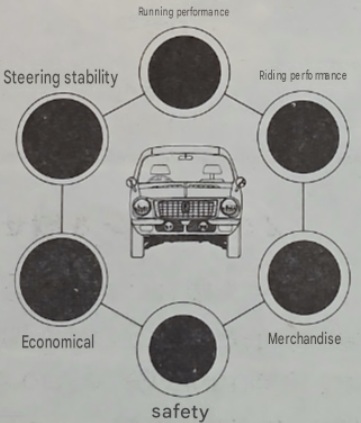
The aim of this comprehensive test drive series is to judge a car’s overall character by evaluating it across six key pillars: running performance, handling and stability, ride quality, safety, economy, and product appeal. For the evaluation, we use a format called the “Bubble Session”–a method from systems engineering in which six specialists from different fields gather around a hexagonal table (the “bubble,” or honeycomb) to exchange opinions.
Each black area within the six circles represents a specific evaluation. The more evenly sized the black areas are, the more balanced the car is across all aspects; if the sizes vary, it signals a vehicle with more pronounced personality in certain areas.
Postscript: Story Photos