Honda Life Step Van (1973)
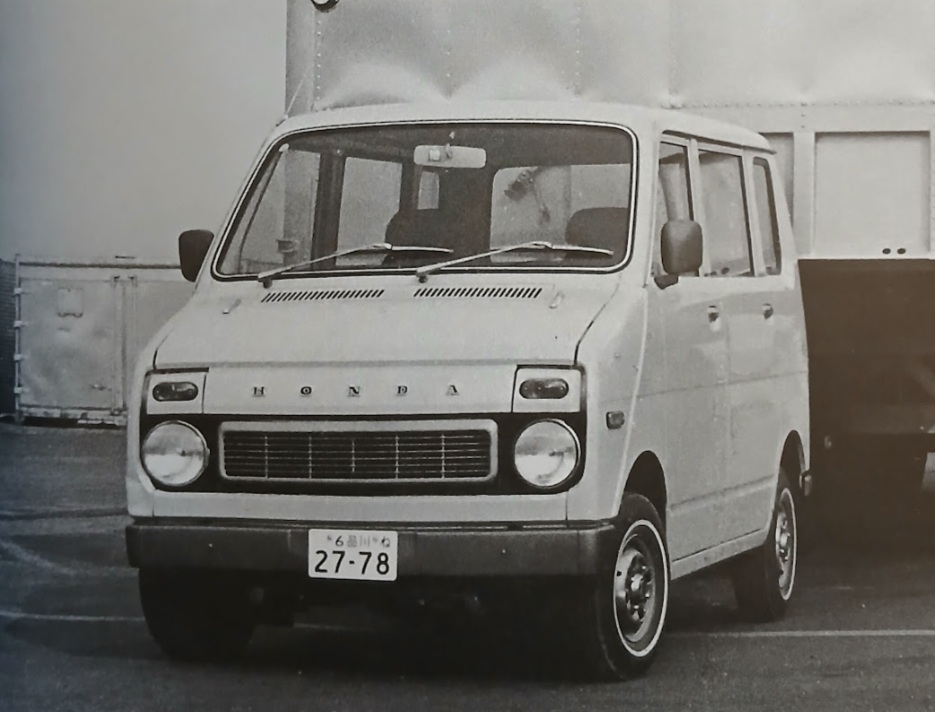
Publication: Car Graphic
Format: Road Impression
Date: February 1973
Authors: “C/G Test Group” (uncredited)
Road testing the Honda Life Step Van
Let us take another look at the light commercial vehicle. Even when one escapes the bustle of crowded cities for the countryside, Japan is a country of narrow lanes and farm roads once one has left the main highways. Kei cars, because of their small size prescribed by law, have firmly established themselves as a particularly useful type of vehicle in Japan’s motorization. They are no longer merely crude little cars intended as stopgap transportation—as was once so often said of them—much less toys. There is genuine demand for cars that are kei cars, and nothing else. This may be partly due to economic considerations, such as favorable treatment under the vehicle inspection system and tax laws. But the biggest factor is their small size. They are good precisely because they are small.
If smaller is better, then one possible approach is to consider just how small a vehicle can be made while still remaining practical as a means of transportation. In contrast to the kei cars of today, which have become so thoroughly passenger-car-like that they are virtually miniature family cars, this idea is beginning to be explored as a basis for a new kind of city runabout. C/G has also considered it, in a proposal to move beyond the conventional kei car (No. 122).
On the other hand, working within the strict limits of 3m in length, 1.3m in width, and 2m in height, there is also the challenge of making the fullest possible use of the allowed space—of obtaining the maximum from the minimum car. This is another task confronting designers of ultra-small vehicles. The history of Japan’s distinctive kei car over the past dozen or so years has also been a history of attempts to push against these limits. Although exterior dimensions have not increased by so much as 1mm, interior dimensions have continued to grow with the introduction of each new model.
So, if we take the efficiency of space utilization within the allowed length and width (the 2m height limit being academic) as our measure of a vehicle’s worth, the most valuable form of transportation today is probably the light commercial vehicle. And among these, the square, forward-control van must be the best of all.
Such a vehicle is useful not only for making deliveries for shops and other businesses, but also as economical and highly maneuverable transportation that makes good use of its generous interior space and compact exterior dimensions. For this reason, it should properly be called a “utility car” rather than a commercial vehicle.
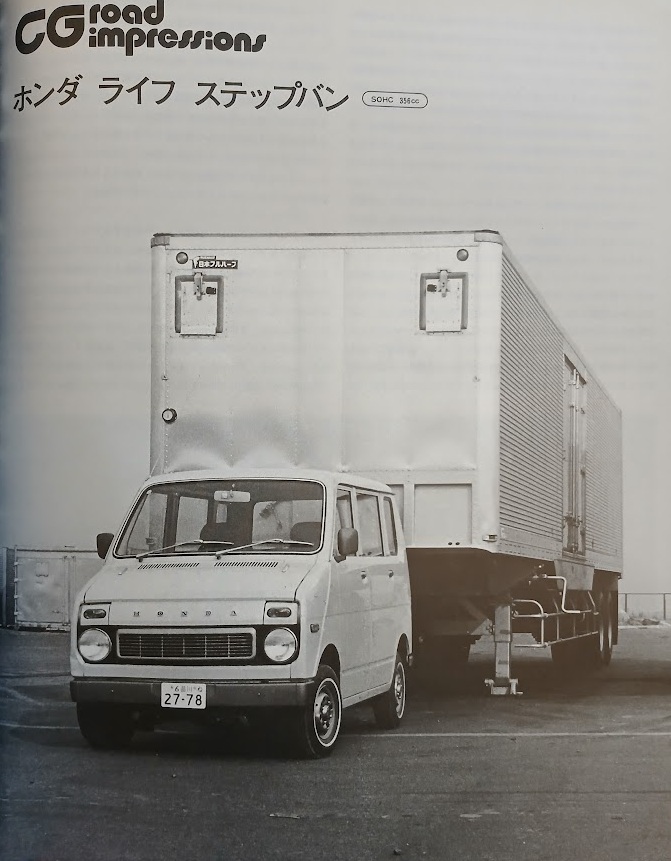
Today, every kei car manufacturer lists a model of this type in its catalog, but perhaps the most outstanding example is the Honda Life Step Van, introduced last September.
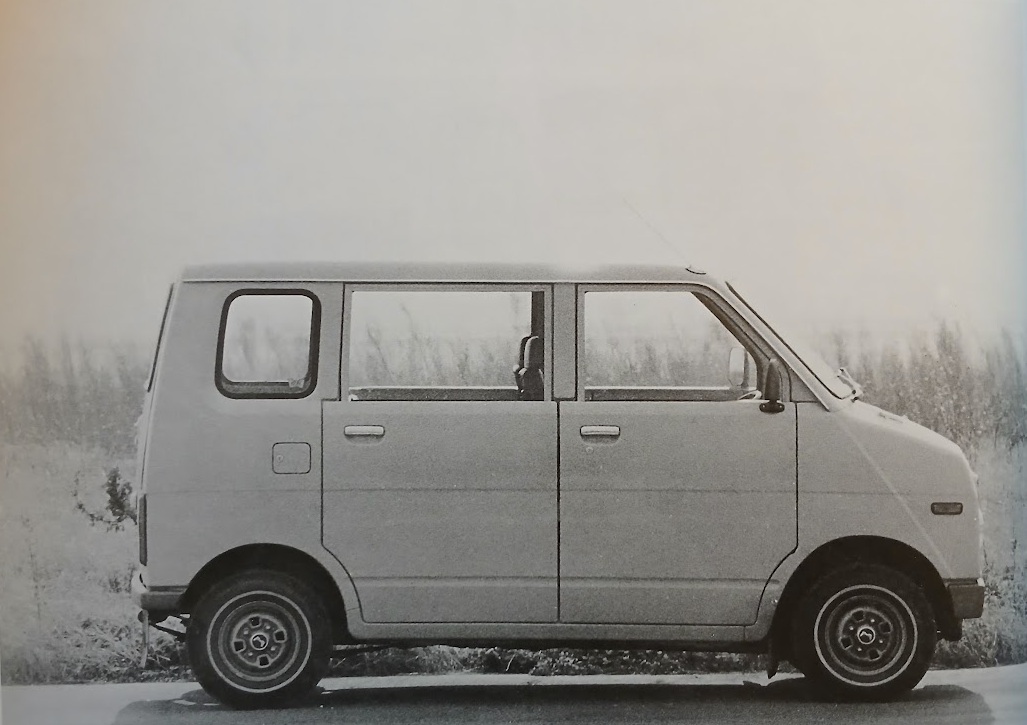
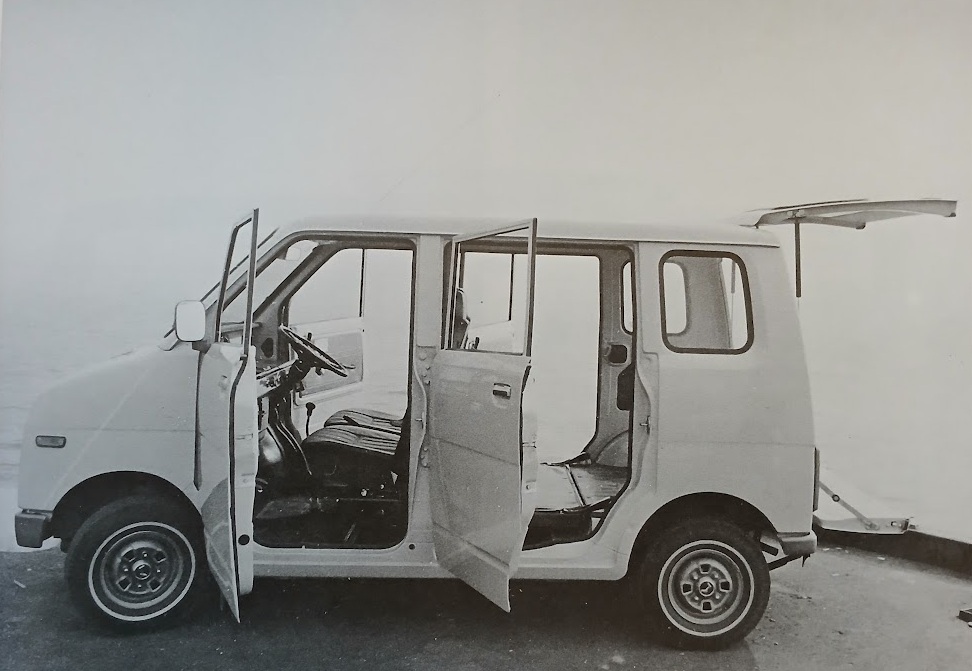
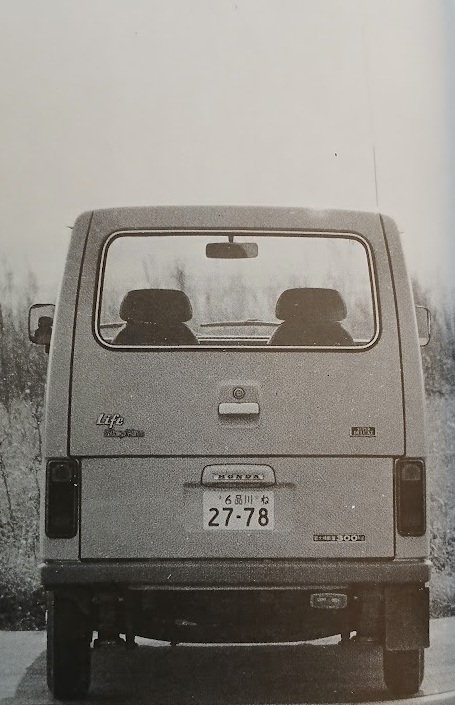
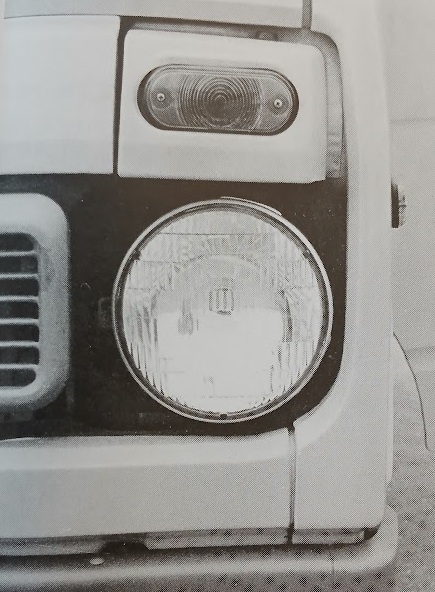
With its “humorous” box-shaped body, somewhat reminiscent of the Chevrolet commercial vehicle of the same name, the Life Step Van differs from Honda’s previous forward-control kei vehicles in being developed as a variation of the highly regarded Honda Life, making thorough use of its components. The monocoque five-door body (four normal doors plus a tailgate) is, of course, entirely different, but from the powertrain and chassis components down to the smallest details of the fittings, there is a high degree of interchangeability with the Life.
Thus, the Life series now comprises six basic models: the standard sedan and its sportier twin-carburetor version (both available with two or four doors), the Z kei-class specialty car, the wagon and van derived from the two-door sedan by adding a tailgate, and the Step Van itself.
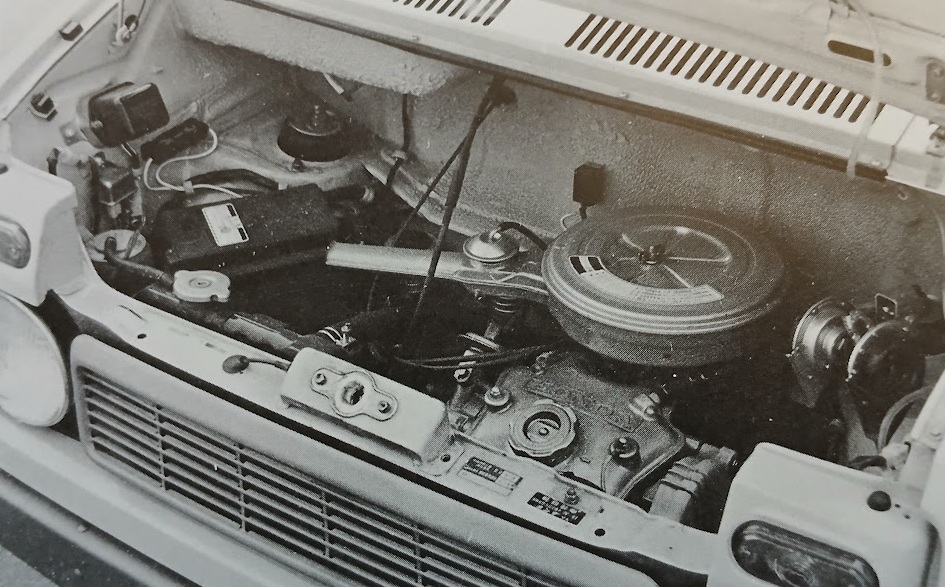
The engine is the same water-cooled, inline two-cylinder SOHC unit with cogged-belt camshaft drive used throughout the Life series, with a bore of 67mm, stroke of 50.6mm, and total displacement of 356cc. With a single carburetor and a compression ratio of 8.8, its output of 30ps/8000rpm and 2.9kgm/6000rpm is identical to that of the standard Life. It is likewise mounted transversely at the front and drives the front wheels.
The 4-speed gearbox, arranged in line with the engine, also shares the same ratios of 4.700, 2.846, 1.833, and 1.272. However, since the gross vehicle weight is some 300kg greater than that of the Life sedan, the final-drive ratio has been shortened from the sedan’s 5.429 to 5.923. The suspension is also the same as the rest of the Life series, with independent MacPherson struts and coil springs at the front and a rigid axle suspended on semi-elliptic leaf springs at the rear.
As a result, apart from the steering shaft—which stands unusually upright to accommodate the forward-control layout—the Life sedan and Step Van correspond almost exactly when viewed in plan. The wheelbase of 2080mm and the front and rear tracks of 1130mm and 1110mm, respectively, are also unchanged from the base model. Although described as “forward-control,” the front axle is actually positioned ahead of the driver’s legs. In every other kei commercial vehicle of this type, the seats are located over the front axle.
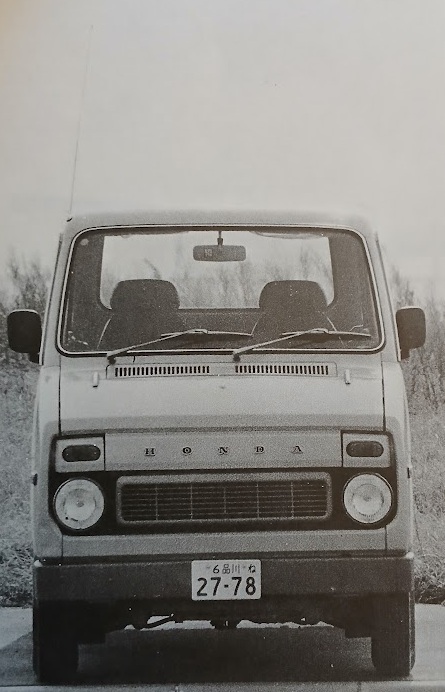
The cheeky van body built on this chassis is the Step Van’s most distinctive feature and a major part of its appeal. Indeed, it is because of this body that we have chosen to examine the car here. The Step Van takes the uniquely kei-car approach of “design by subtraction”—securing as much useful space as possible within strictly limited dimensions—to its logical conclusion. With its flat surfaces arranged to meet the legal limits, it is the most straightforward embodiment of the kei-car regulations.
Vehicles like this are inevitably very much alike in their basic design philosophy, but none before has carried it through with such uncompromising simplicity. Not even the highly regarded Subaru Sambar is an exception.
Certainly, in terms of absolute interior dimensions, the Step Van should be at a disadvantage because of its short but separate engine hood projecting from the front. In fact, compared with other forward-control kei commercial vehicles, it sacrifices some 20-40cm in the length of the load compartment, measured from behind the front seats to the inside of the tailgate.
Even so, in the way its appearance so clearly conveys a single-minded dedication to utility, I believe the Step Van stands above all of them.
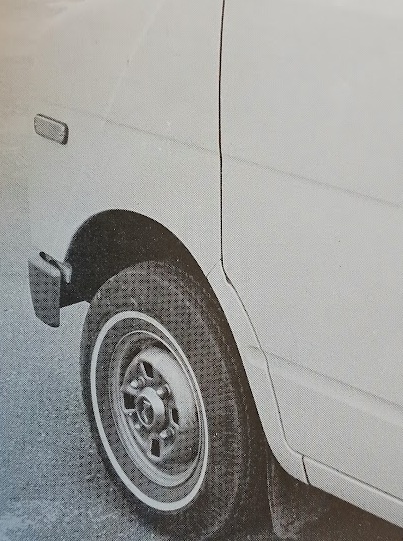
By rejecting conventional notions of attractive appearance, the Step Van has become an exceptionally practical vehicle. Its overall height of 1620mm is more than sufficient, and the seating position inside is as upright as that of a school chair. There is no need whatsoever to bend one’s back when getting in or out; one simply opens the door and sits down. Although the lower front corner of the front door is cut away slightly to clear the wheel arch, the footwell is directly beneath the seat, so there is no need to step over the wheel housing as in a rear-engined kei passenger car. Both getting in and getting out have a distinctly “outdoorsy” feel.
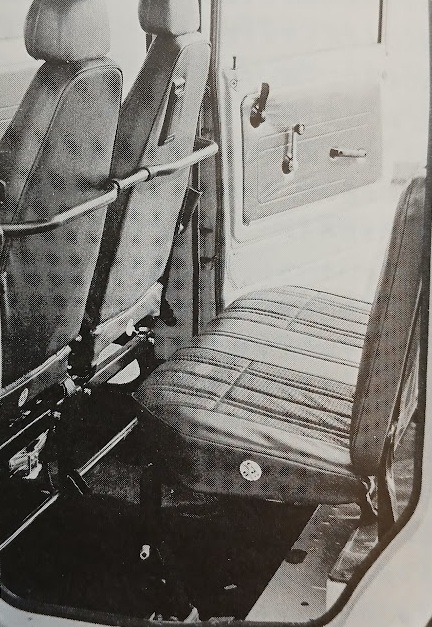
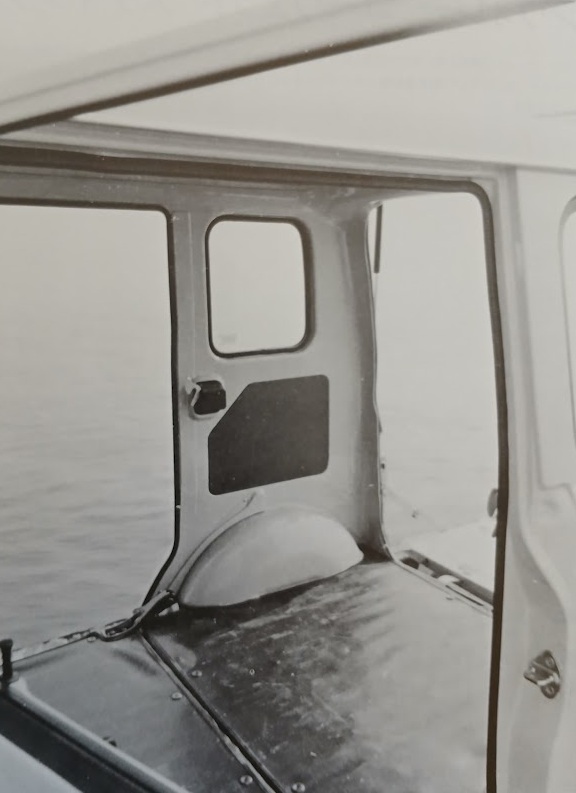
The rather too-upright driving position, typical of a forward-control vehicle, feels strange until one gets used to it, but the front seats themselves have sufficiently thick cushions and are reasonably comfortable. The folding rear seat naturally has thinner cushioning, but when climbing aboard, one briefly feels as though one has missed a step. Once over the substantial side sill required by the monocoque construction, the footwell is unexpectedly deep, so much so that one’s feet seem to take an unusually long time to reach the floor.
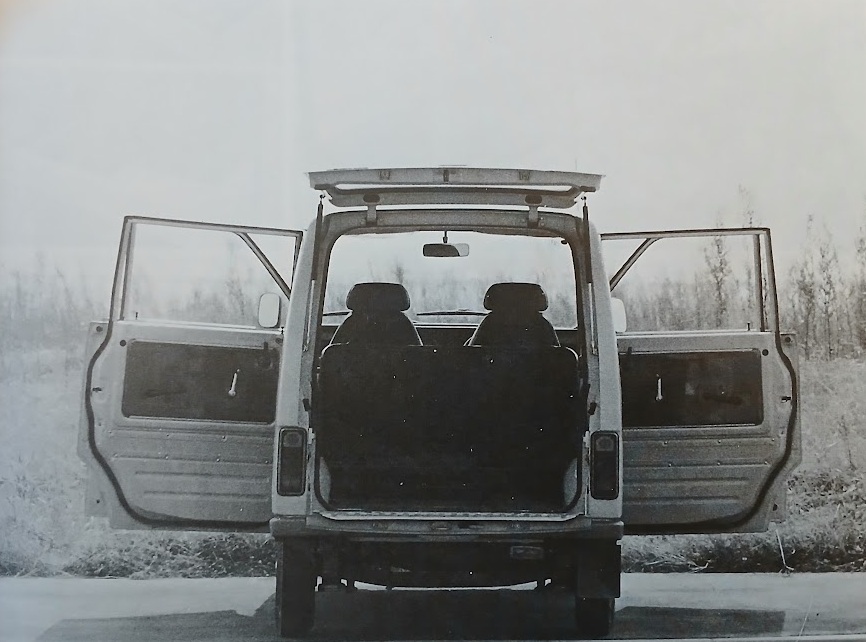
Together with the luggage space extending another 64cm behind one’s head, this creates a psychological sense of space and openness. However, I would like to see the door stops extended so that both front and rear doors could open a full 90°. This is particularly important for the rear side doors, since they are used for loading and unloading cargo from the sides when the rear seat is folded. Unless they open to a right angle (or even farther), they can sometimes be inconvenient.
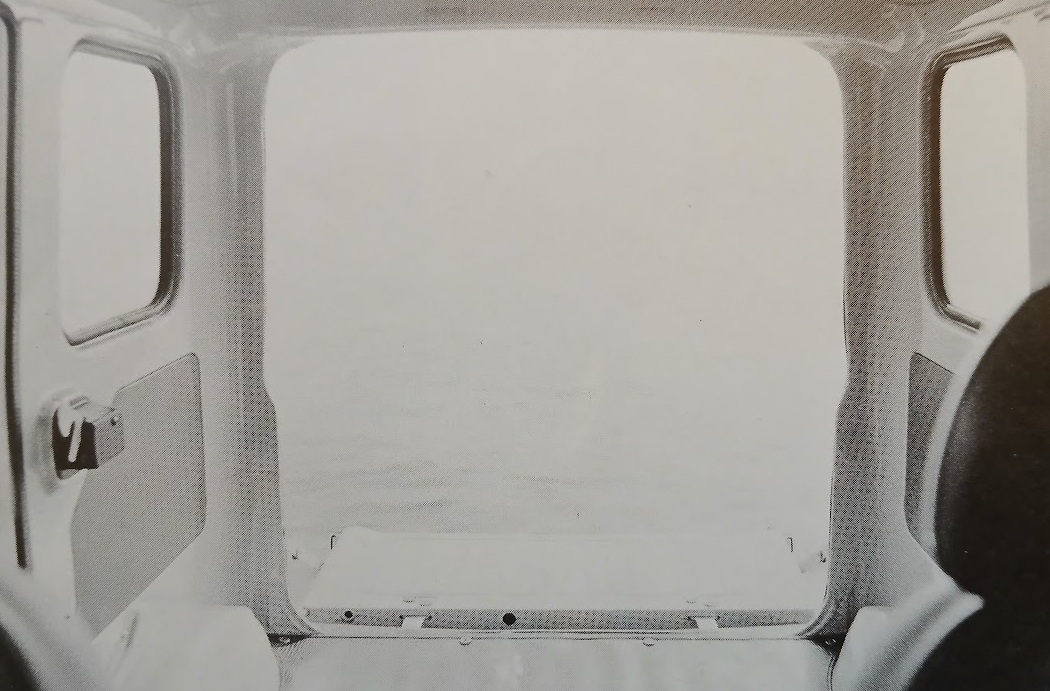
The tailgate is divided into upper and lower sections in a ratio of 2:1, with the two opening in opposite directions. Fold the rear seat, and an absurdly large space, measuring 1135mm up to the ceiling, appears before one’s eyes. The floor length in this configuration is also more than 1.2m, which should be quite enough for personal use. The guard rail extending across the body behind the front seats is intended to protect the driver and passenger from shifting cargo when the vehicle is fully loaded, but it also serves as a convenient handhold for rear-seat passengers.
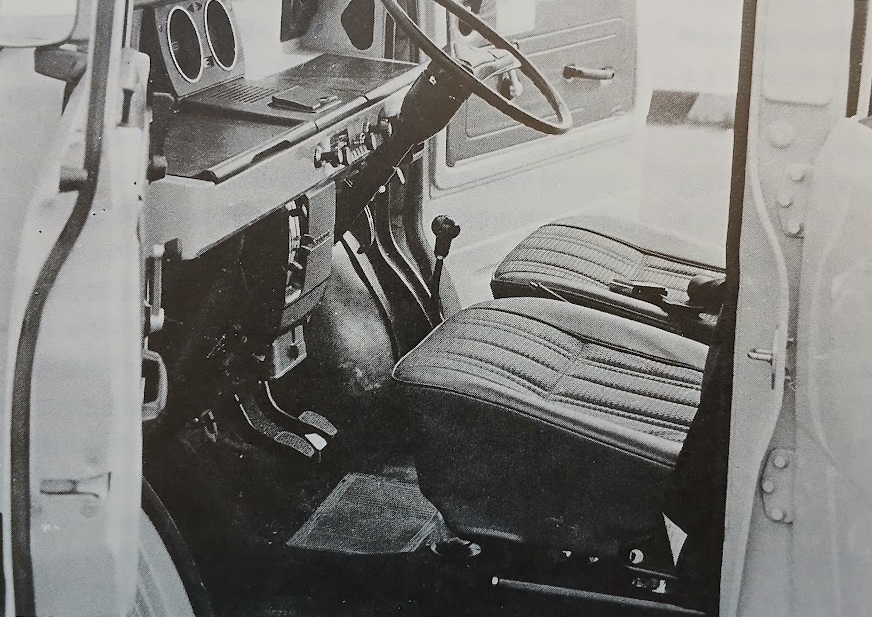
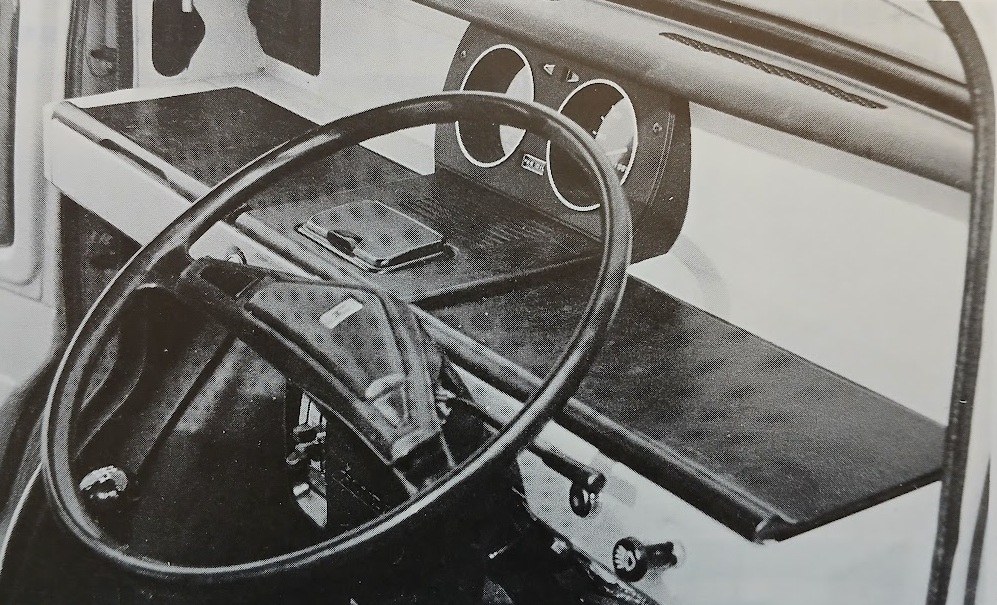
The fascia is thoughtfully designed as well. Directly in front of the occupants is an enormous, flat shelf, with the instruments neatly arranged on the wall at the far end and the switches along the near edge. The earlier Sambar also made effective use of its instrument panel as a place to put small articles, but the Step Van takes the idea even further. With a depth of some 30cm, the shelf can be used as a proper table.
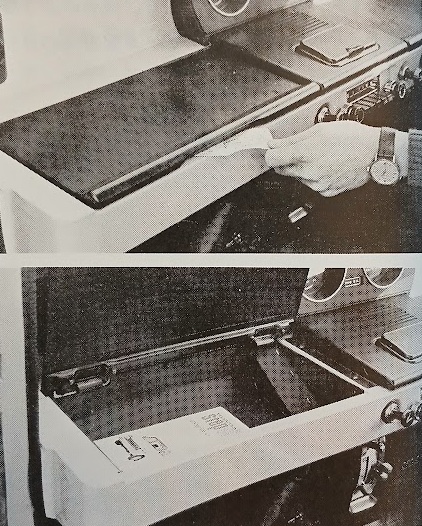
One might, for example, install a calculator in the glovebox, which opens like the lid of an elementary-school desk. The provision of pencil holders on both sides, each accommodating two pencils, is another thoughtful touch.
Honda’s water-cooled engine is unusually quiet for a small-displacement four-stroke twin, but it is already widely known that it performs considerably better than its on-paper 30ps rating suggests. In the Step Van, with its final-drive ratio substantially lower than that of the sedan, the available driving force is more than sufficient, relatively speaking. If a rev counter were fitted, its needle would surely sweep across the entire dial. The power peak of 8000rpm corresponds to approximately 96km/h in fourth gear, but for short periods the car can be pushed to 110km/h on a level road, without any sign of mechanical distress. The legal limit for kei cars, 80km/h, can be maintained as a perfectly comfortable cruising speed.
Visibility from the high driving position, with the nearly horizontal steering wheel held between one’s legs, is excellent. With the pedals directly beneath one’s feet, operating them feels just like playing a piano, and the accelerator pedal in particular is so small that it seems strange until one gets used to it. Since the pedals must be pressed almost vertically downward, braking requires somewhat greater effort.
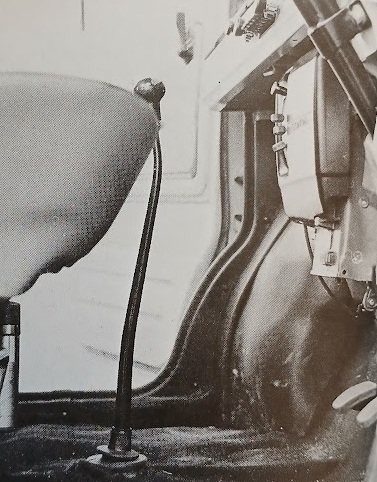
The gear lever, extending some 50cm above the floor, has a long throw, particularly in the fore-and-aft direction, and is thoroughly truck-like. The gear change itself is positive. Handling is characterized by very strong understeer throughout, as is usual with FWD, but before one has much opportunity to worry about that, the roll experienced from such a high seating position becomes alarming enough to make one slow down. One consolation is that changes in the car’s behavior when the throttle is opened or closed are relatively small for an FWD vehicle. With a high-center-of-gravity vehicle like this, the first concern should probably be the possibility of tipping over.
Perhaps surprisingly, ride comfort is very good. Even when driven hard over rough pavement without a load, there is no danger of the driver being thrown out of the seat. It is comparable to that of an average kei passenger car with slightly firm suspension. The difference is that, because of the driving position, the movement is transmitted to the body purely as vertical motion.
The rear seat, with its thin cushion necessitated by the folding arrangement, naturally transmits road irregularities more directly, but even so, it is much softer than that of an ordinary 1-liter-class van, such as the Cherry. And despite its monocoque body, assembled from large, flat panels, there is no rattling or vibration from any of them, and by normal standards the Step Van is on the quieter side.
Below 80km/h, all that reaches the ears is a distant rumbling from the commercial-vehicle tires (5.00-10-4PR ULT). Above that speed, the exhaust note, mechanical noise, and even the wind roar produced by the railway-car-like body are all drowned out by the overspeed warning buzzer, which makes them virtually inaudible.
Setting aside its usefulness as a commercial vehicle, the Life Step Van is a rather appealing proposition for personal use as well. Provided one is not in too much of a hurry, it can serve for almost any purpose, and at very little expense. Moreover, in an age when choosing a car is also a matter of choosing one’s “costume,” there is something rather stylish about driving around in such a crude tin box without the slightest self-consciousness.
Jeans were once synonymous with rough, unsophisticated clothing, but because they are durable and somehow convenient, one finds oneself unable to do without them. Perhaps the same applies here.
Even apart from that, a van like this would be ideal for a young enthusiast with little (or next to no) money in his pocket, who has spent all his savings on a fun car for weekend enjoyment and now has to find a way of keeping it running. The Step Van could serve both as everyday transportation during the week and as a truck for carrying parts.
One could occasionally put on a close-fitting work outfit and imagine oneself as Barney from “Mission: Impossible” (although his vehicles were actually Chevrolets and International Harvesters). Or one could don a leather jacket and, for some reason, a pair of wide herringbone or flecked trousers, and imagine oneself as Gabin in a 1950s film (in which case the vehicle would probably be a Citroën H).
The trouble is that, on such occasions, any woman one encounters is all too likely to be on the run because she knows where a large sum of money has gone. And if one happens to get involved with her, one may find oneself with a Luger aimed at one’s back.
Postscript: Story Photos