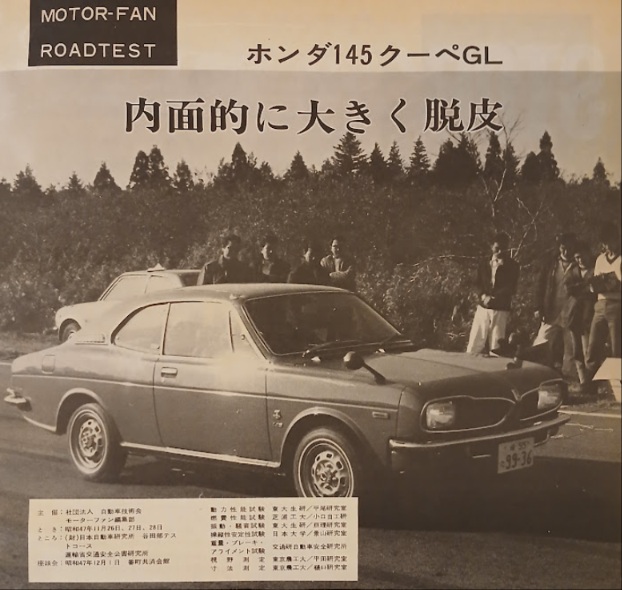
Honda 145 Coupe GL (1973)
Publication: Motor Fan
Format: Road Test
Date: February 1973
Authors (roundtable): Yoshio Nakamura, Osamu Hirao, Hajime Matsuo, Hiroshi Hoshijima, Kenji Oda, Kenji Higuchi, Hideo Takeda, Atsushi Watari, Taizo Tateishi, Kunitaka Furutani, Hiroshi Okazaki, Kenzaburo Ishikawa, Masahide Sano, Soichi Nakano, Seiichi Motomiya, Katsuzo Kageyama, Kyoichi Yamaguchi, Minoru Onda, Motor Fan Editorial Staff (uncredited)
Changes in Substance and Character
Magazine: To begin with, could you give us an outline of the Honda 145?
Nakamura: Starting with the aims behind its development, we introduced the air-cooled Honda 1300 in May 1969, followed by the coupe version, and that has brought us up to today. With its air-cooled engine using the so-called DDAC (Duo Dyna Air Cooling) system, I think it was a car with a very strong character, for better or worse. Put another way, it was a car that asserted its individuality very strongly.
Since then, social conditions have changed, particularly with regard to safety and pollution, and I think the general trend has been away from strongly individualistic approaches, and toward something more uniform. With our own products, such as the Life and, more recently, the Civic, we have deliberately toned down some of those distinctly “Honda” characteristics, which had both their good and bad sides, and moved toward more conventional, standardized products. In that sense, I think the 1300 has now undergone a similar transformation.
Outwardly, it may appear to be no more than a minor facelift, but we believe we have made significant changes in its substance and character. As a result, the transformation is essentially an internal one, with relatively little change in appearance.
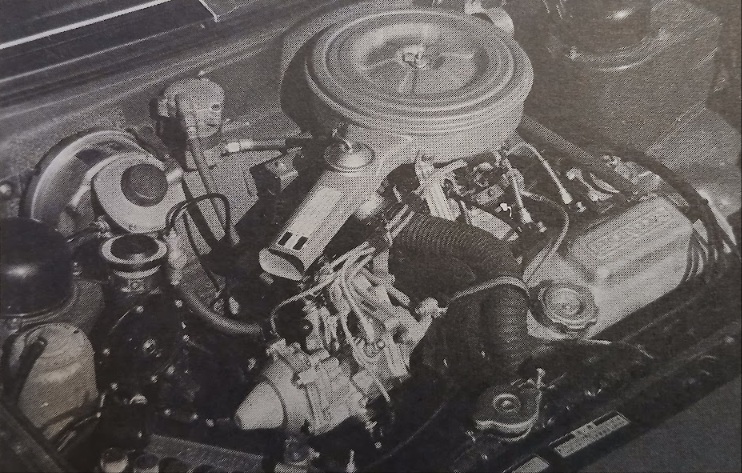
The biggest of these changes is the engine. Although air cooling has its advantages, and the DDAC system had unique qualities such as making an air-cooled engine remarkably quiet, it seems these did not necessarily translate into direct benefits for the user. We took that as something to reflect upon, and adopted a thoroughly orthodox approach this time.
The engine is also lighter, and we have changed the weight distribution to a more suitable balance, correcting the previous car’s front-heavy character. We have been rather conservative with the power output as well: 80ps/5500rpm for the carbureted version, and 90ps/6000rpm for the fuel-injection version. Compared with the previous figures of 95ps/7000rpm and 110ps/7300rpm, these represent a significant concession. Rather than extracting every last bit of power available, I think we have aimed for a more subdued, understated character.
The suspension has also been changed slightly to suit the character of the engine, and I think the car has become more conventional in other respects as well.
That, broadly speaking, was what we set out to achieve with the 145, and the form it has ultimately taken.
We have also introduced a fuel-injection version, so perhaps I should explain that as well. At Honda, we have been working with low-pressure intake-manifold injection, mainly on racing cars. In the course of that work, we gained a number of technical benefits. For example, fitting fuel injection can greatly improve an engine’s transient response. Even with the same maximum speed, it is possible to produce a smoother engine with much better response to changes in operating conditions.
Also, several years ago, when the exhaust-emissions problem was beginning to attract attention, there was quite a lot of discussion about dealing with it through modifications to the engine alone. One of the promising methods considered was fuel injection, because of its consistency, its ability to supply fuel in close accordance with the quantity of intake air, and its very good fuel distribution. For these reasons, it was regarded as a means of gaining a certain advantage in controlling exhaust emissions.
At the level of requirements that existed at the time, we believed that fuel injection could solve the emissions problem to some extent, and continued development on that basis. The injection system developed through that work is the one we are now using on the 145.
Today, however, with the subsequent appearance of the Muskie Act and other developments, the emissions standards have become so strict that even the addition of fuel injection to conventional engine modifications is nowhere near sufficient to meet them. So, at this stage, we are mostly including fuel injection in the range to take advantage of its superior transient response.
Structurally, it is a mechanical injection system using radially arranged plungers, somewhat similar to the Kugelfischer system. However, for the metering and other functions, we use what might be called a “Honda-type” mechanism, developed through our experience with racing cars.
Magazine: Was there any particular reason for choosing mechanical fuel injection?
Nakamura: One reason was that, if the emissions-control problem could be solved simply by fitting fuel injection as it is, we would have to install it on every one of our products. But at this stage, in considering emissions countermeasures, we had not envisioned fitting fuel injection to our entire range. So electronic control would not be suitable for small-scale production.
Another reason is servicing. At Honda, maintenance and repairs are handled by our SFs, or service factories, but an electronically controlled system would be rather beyond their capabilities. With a mechanical system, they can carry out maintenance to a certain extent. Those were the main reasons we chose mechanical injection.
Smooth Transient Response with Fuel Injection
Hirao: With 10ps more than the carbureted version, how much higher is the price?
Matsuo: Exactly 100,000 yen.
Hirao: So that works out to 10,000 yen per ps, then.
Nakamura: But I think the advantage of fuel injection is not just in maximum output, but in its response to changes in throttle opening.
Hirao: So what you’re paying for is the pleasure of that kind of acceleration.
Magazine: Is it worth the extra 100,000 yen?
Hoshijima: Very much so, I’d say. The carbureted version has become such a mild-mannered car that you notice the difference especially strongly.
Magazine: Is the engine itself changed as well?
Oda: The engine itself isn’t changed, but the valve timing is different.
Hirao: That’s only natural, I would think. Unlike a carburetor with its venturi, there’s no restriction obstructing the intake airflow, so more air can enter than with a carburetor. To take advantage of that, I would naturally expect the valve timing to be changed as well.
Higuchi: But while there may be a difference between the carbureted and fuel-injected versions of the new 145, it’s another matter if you compare the injection engine with the old air-cooled engine with four carburetors.
Hoshijima: I think there’s quite a difference at low and medium speeds. Although the difference may become smaller as you get into the higher speed ranges.
Higuchi: When you press the accelerator suddenly, I would think that the time involved in the transient response of the entire car is more than an order of magnitude greater than the time lag associated with the transient response of the throttle valve. So I have a feeling that if you drove the fuel-injected car and the four-carburetor car side by side, you wouldn’t be able to tell the difference in their response.
Nakamura: Certainly, if you’re comparing a single carburetor with four carburetors, there probably isn’t much difference in such things as full-throttle power at 2000rpm, or how many seconds it takes to accelerate from 2000-3000rpm. But with fuel injection, a difference does appear. For example, when you press the accelerator suddenly, there’s a feeling of the engine responding immediately and strongly, whereas with four carburetors there’s a slight time lag. Whether there’s really any need to be so particular about that is another matter, of course.
Magazine: You’ve said that the car’s substance and character have changed. Apart from the engine, what changes have been made to its setup?
Takeda: Along with changing the engine, we have also changed the engine mounts. The powertrain is basically similar to that of the Civic, but we have adopted a different mounting arrangement to suit this car. As for the body, although its outward appearance is unchanged, we have made a number of minor modifications in various places to deal with vibration and other problems. We have also made the springs and dampers somewhat firmer.
The steering has become lighter as a result of the reduced load on the front wheels, but that isn’t the only change. The previous 1300 had a tendency to make you feel as though you were winding the steering wheel around and around, so this time we have reduced the steering gear ratio to give it a quicker response. We have also revised the front-to-rear brake balance to suit the new weight distribution.
Magazine: How much lighter is the engine?
Oda: About 40kg.
Hirao: When you open the hood, there’s a lot more space around the engine now. The air-cooled engine was quite a sight. Everything was packed in so tightly, like sardines in a tin. (laughs)
Magazine: Is this engine closely related to the Civic’s, with a significant amount in common?
Oda: They are very similar in their basic configuration. In terms of mechanical design, about 60% is common to both, while around 30% of the actual parts are interchangeable.
Hirao: The steering wheel now returns by itself without having to be brought back by hand, particularly when turning a street corner.
Magazine: Have you changed the wheel alignment?
Takeda: Fundamentally, it is almost unchanged. What we did change was the wheel offset, moving each tire 5mm farther outward. That is probably what has made the difference.
Watari: What is the steering gear ratio now?
Oda: 19.2:1. On the H1300 it was about 22:1.
Watari: The self-centering is better, but the steering has become heavier. Which is preferable is another question.
Hirao: A ratio of around 19:1 is quite normal, but you could also say that it makes the steering heavy. The old car was light, but the steering didn’t return properly.
Takeda: What we intended was that reducing the load on the front wheels would also reduce the steering effort. We wanted to offset that reduction by changing the gear ratio, thereby making the steering quicker.
Higuchi: The steering’s self-centering and so forth have become quite normal now. As it happened, I drove it alongside one of the final air-cooled models, and there wasn’t much difference between them. So I had the impression that these changes hadn’t all been made at once with the new engine, but that the suspension and steering had already been modified before the engine change, and those improvements had simply been carried over.
Hirao: I imagine that’s right. My recollection is of an older model in which the steering returned very poorly. Also, I understand you’ve made changes to the body’s rigidity and taken measures to reduce noise. Even so, I had the impression that it was a little noisier than the Civic. What do you think?
Watari: I would say the Civic is probably quieter. Still, the measured noise levels aren’t particularly bad.
Firmer Suspension
Magazine: Well then, could we hear the results of the vibration and noise measurements?
Tateishi: The sprung-mass natural frequency was 1.6Hz at both the front and rear, while the unsprung-mass frequencies were 13Hz at the front and 14Hz at the rear.
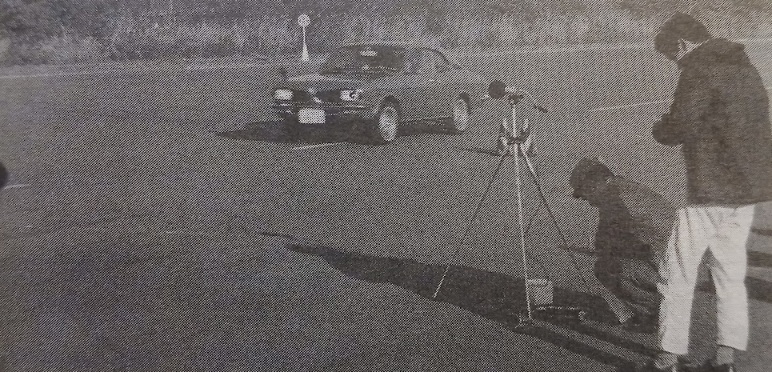
The interior noise levels were very good: 60 phons at 40km/h, 64 phons at 60km/h, 67 phons at 80km/h, 70 phons at 100km/h, and 73 phons at 120km/h. For exterior noise, we recorded 72 phons at a steady 50km/h in second gear, 79 phons under acceleration, and 68 phons at a steady 50km/h in top gear.
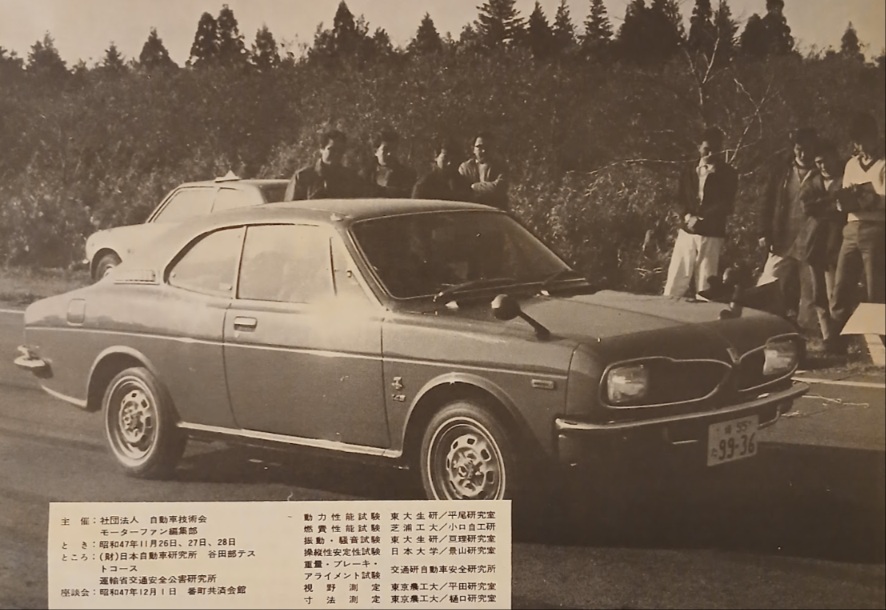
The measurements were taken on the asphalt surface of the Yatabe General Test Course. Compared with the Civic, which was measured on the concrete surface of the Yatabe circuit, the Civic recorded higher interior noise levels, while the 145 produced higher exterior noise levels.
Watari: I think the Yatabe General Test Course probably has the best road surface in Japan right now, so when comparing these figures with other data, we ought to add about 3-4 phons. If we do that, the results aren’t very different from those of the previous air-cooled car, and they’re about what you’d expect in the 1500cc class. There is some gear noise, though. That must be coming from the transmission.
Hirao: Perhaps that’s an unavoidable consequence of a transverse engine.
Watari: Maybe so. Another thing is that although the body’s rigidity has apparently been increased, I suspect the structural members have been stiffened without doing much about the rigidity of the panels themselves. The trunk floor, for example, has a tendency to drum. And now that they’ve gone to the trouble of increasing the suspension spring rates, when the wheels encounter small irregularities in the road and produce a thumping noise, the panels drum in response. That’s the impression I got from the sound.
Magazine: What was the reason for making the springs stiffer?
Takeda: Until now, we’ve tended to aim for a soft ride, but times have changed, and we wanted to give the occupants a greater feeling of security, even if that meant making the ride somewhat firmer. As things stand, though, I don’t think there’s any need to go much further in that direction.
Magazine: So the spring rates have been increased to what would be considered an appropriate level?
Watari: I certainly think it’s become firmer. But that’s not the only thing. There’s also the question of the shock absorbers’ damping characteristics, and I have a feeling their mounting arrangements may have something to do with it as well.
Takeda: Actually, we have made some modifications to the trunk floor, too.
Watari: Where are the rear shock absorbers mounted?
Oda: On the sides of the wheel housings, where the structure is relatively rigid.
Hirao: Have you increased the bump travel? The harshness over bumps seems to have been reduced.
Takeda: We’ve increased it by about 20mm at the front.
Watari: As far as ride comfort and noise are concerned, I think it’s roughly on a par with the 1500cc class. But judging from the way it feels on the road, I also have the impression that a little more improvement would be desirable.
Nakamura: Regarding the gear noise you mentioned earlier, that’s really one of the greatest difficulties with this type of layout. Put simply, if we made the components heavier, we could obtain a comparatively more agreeable sound, but with helical gears, it’s a difficult problem to solve.
Watari: FF certainly gives you plenty of trouble when it comes to noise.
Hirao: And yet I didn’t notice it in the Civic. Maybe it’s because the cars are in different classes. (laughs)
Watari: That’s right. I didn’t notice it at all in the Civic. The fact that it’s almost excessively noticeable in this car may have something to do with the way the sound-insulating materials have been used.
More Subdued Performance
Magazine: Could we have the results of the performance tests?
Furutani: The standing-start acceleration times were 0-50m in 5.1 seconds, 0-100m in 7.8 seconds, 0-200m in 12.0 seconds, and 0-400m in 18.9 seconds. In terms of time to speed, the results were 0-60km/h in 5.6 seconds, 0-80km/h in 9.6 seconds, 0-100km/h in 14.1 seconds, and 0-120km/h in 21.0 seconds.
The acceleration figures aren’t as good as those of the Coupe 9 we tested previously, but from behind the wheel, perhaps because of the improved low- and medium-speed torque, the initial response in overtaking acceleration seemed quite good at lower speeds. Above 4000rpm, however, I had the impression that the engine didn’t pull quite as strongly.
Magazine: As an owner of the air-cooled model, what did you think, Hoshijima?
Hoshijima: I had the impression that both this GL and the fuel-injected FI have much better response at low and medium speeds. At higher speeds, though, the old Coupe 9 seems to pull more strongly. Also, when driving around town at low and medium speeds, I was struck by how much more powerful this car felt. With the air-cooled engine, it was quite difficult to maintain a steady throttle opening at low speeds, so maybe that made the difference seem even greater.
Another thing: when the Honda Z changed from air cooling to water cooling, you changed the wheelbase and even moved the position of the bulkhead, didn’t you? That allowed you to move the wheel housings farther forward and gain more passenger space. Was there no consideration of doing something similar with the 145?
Nakamura: It would be untrue to say we didn’t consider it at all, but there wasn’t the same need for it, or the same benefit to be gained, as there was with the Z.
Hoshijima: Still, I would have thought that even moving the wheel housings slightly forward could bring quite a big improvement in the driving position.
Nakamura: In the case of the Z, we moved them 80mm. But the value of that 80mm is completely different in the Z and the 145, if I may put it rather strongly.
Okazaki: The Honda Coupe has always had a fairly low seating position, and when you press the pedals down, the angle of the clutch pedal in particular doesn’t seem quite right. It feels as though you have to bend your toes awkwardly. When you use the clutch repeatedly, your foot starts to bother you. It’s actually easier if you move the seat forward and press down on the pedal from above. But when you operate it with the seat farther back, the angle is wrong and your foot has to bend. I have a feeling there must be a pedal angle that would let you depress the clutch more naturally in relation to the seating position.
Watari: Besides the vertical relationship, there also seems to be something wrong with the fore-and-aft positioning of the pedals. When you first get into the car, the pedals seem to be offset to the left, making them rather awkward to operate. Once you get used to it, there’s no problem, but I think that’s another consideration. The seats have certainly improved, but in terms of comfort, I still feel they could be a little better. Of course, seats are largely a matter of cost, so it’s difficult to say much more about it…
Hoshijima: The shape of the seats themselves, and the provision for fine adjustment, are quite well thought out.
Hirao: The clutch is a little heavy, though. I couldn’t help feeling that it should be possible to make it a little lighter.
Ishikawa: In terms of the figures, the pedal effort is 16-18kg when fully depressed, and about 8kg at the disengagement point, so the figures aren’t particularly high. The pedal travel is quite long, however. Perhaps that affects the way it feels.
Watari: You don’t notice it so much when engaging and disengaging the clutch, but when you’re holding the pedal down at an intersection or somewhere like that, it seems to take a lot of effort.
Takeda: Even if the peak effort is unchanged, the shape of the characteristic curve can make a difference to the feel of the clutch…
Hirao: Perhaps it’s heavy right from the beginning. It may be the steep initial rise in effort that gives that impression.
Magazine: Could we have the fuel economy results?
Sano: In the constant-speed tests, we recorded 19.0km/l at 30km/h, 19.3km/l at 40km/h, 18.4km/l at 60km/h, 16.2km/l at 80km/h, 13.2km/l at 100km/h, and 9.8km/l at 120km/h. In the simulated everyday driving tests, the figures were 10.5km/l for the 40km/h indicated-speed test and 8.8km/l for the 60km/h test.
Compared with the Civic, the figures are generally about 1km/l lower at slower speeds, but by 100-120km/h they become roughly equal. There was quite a strong wind on the day of the test, and although we naturally averaged the results in both headwind and tailwind conditions, the conditions weren’t particularly favorable. The simulated driving fuel economy figures were also slightly lower than those of the Civic.
Magazine: So it does well at higher speeds.
Sano: I imagine that’s because of the difference in body shape compared with the Civic.
Takeda: Being a coupe, I think it has an advantage at higher speeds.
Magazine: What is the engine oil consumption rate?
Oda: In our internal tests, the figures for continuous high-speed running have been around 4,000–4,500km/l.
Magazine: The oil capacity is smaller than before, isn’t it?
Nakano: The air-cooled engine held 4 liters, while the new one holds 3 liters.
Improved Handling
Magazine: Could we have the results of the handling and stability tests?
Motomiya: The minimum practical turning radius was 5.42m for the outer wheel and 3.15m for the inner wheel. This is on the large side for the 1400cc class, probably because the front-wheel-drive layout limits the maximum steering angle that can be obtained with the steering mechanism.
The overall steering gear ratio was 20.9:1. Up to a steering-wheel angle of about 300°, there was no difference in the actual steering angles of the inner and outer wheels. Since figures of 18-19:1 are common in this class, I would say this ratio is somewhat on the large side. I imagine this was chosen with the heavy front-wheel load and the effort required for stationary steering in mind.
The stationary steering effort was relatively light, partly thanks to the gear ratio, measuring 10-11kg at a steering-wheel angle of about 300°, and rising to 14kg near full lock.
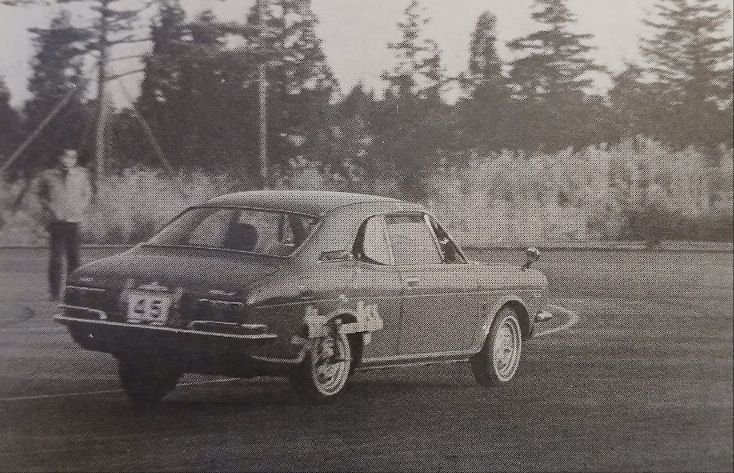
In the understeer/oversteer test, the car showed fairly strong understeer up to a lateral acceleration of about 0.3g, becoming much stronger from around 0.4g. However, since these characteristics were determined by comparing R/R₀ values, the low frictional resistance of the test surface may have had a considerable influence on the results.
The roll rate was determined both from lateral acceleration measurements and from photographic analysis, giving a figure of 4.3-4.4° per g. This is slightly lower than that of the previous Coupe 9, and is also on the low side for this class. I suspect the wider front track, the addition of a stabilizer bar, and changes in tire pressure are responsible.
The steering holding effort was 2.8kg at a lateral acceleration of 0.3g, holding steady above 0.4g at approximately 3.5kg. This can be regarded as an average figure for the class.
As for steering effort during the slalom, it measured 5kg at lateral accelerations of 0.3-0.5g, which is somewhat high for this class.
For the hands-off stability test, we applied a rather large steering input of 0.33g, but the results were good at both high and low speeds. At 100km/h, the oscillations following a 0.3g input converged in about two seconds.
Kageyama: This car is longer overall than other cars in its class, and its maximum actual steering angle is relatively small, which seems to account for the large minimum turning radius.
An overall steering gear ratio of 20.9:1 is the highest in this class. I imagine that was chosen because of the heavy load on the front wheels.
Takeda: Considering the front-to-rear weight distribution, I don’t think the front can really be called heavy. I believe the balance is quite reasonable for a front-wheel-drive car. Besides, the car as a whole is considerably lighter than before.
Hoshijima: I think the handling has improved over the previous model. The steering feels heavy when you’re maneuvering the car around a parking lot or something like that, but otherwise it isn’t particularly heavy. I also think there’s less tuck-in than before. Perhaps the tire pressures and stiffer springs have contributed to that.
What struck me most was how much the hands-off stability has improved, particularly the way the car settles after a disturbance. Could that be because the rear end has become more stable?
Takeda: As for the relationship between steering effort and holding effort, with the 1300, the steering becomes gradually heavier as you turn the wheel. With the 145, effort increases less than with the 1300. But since the initial effort is very nearly the same as the effort to keep turning, even within our company there are people who find the 145 heavier, depending on how they turn the wheel, and others who feel just the opposite. Preferences are divided, too.
Kageyama: Overall, my impression was that the 145 is easier to handle than the previous 1300. Of course, that also says something about just how difficult the 1300 was to handle. (laughs)
Okazaki: When I say the rear end feels more secure, I’m referring to its stability and adhesion in cornering, and the way it behaves when it begins to slide. I didn’t have the impression that the front end had changed very much, but the rear seemed considerably better. So even when cornering hard, I feel I can drive with far more peace of mind than in the 1300, knowing that if something happens, the car will be relatively manageable.
Yamaguchi: As for power-off tuck-in during cornering, it feels much more civilized than in the Civic. (laughs) The Civic tucks in quite abruptly, whereas this car changes its attitude much more gently.
Hoshijima: That’s right. It doesn’t suddenly turn inward. It feels as though it gradually returns to its original line, smoothly easing back from a fairly strong understeering attitude to its previous cornering radius.
Magazine: Is that a result of the weight distribution?
Hoshijima: Rather than the weight distribution itself, I suspect it’s because there’s less weight transfer. That, together with the stiffer springs and the reduced proportion of weight over the front wheels, probably accounts for it.
Kageyama: The specified tire pressures have also changed. On the 1300 they were 1.7kg/cm² at the front and 1.4kg/cm² at the rear, whereas on the 145 they’re now 1.6kg/cm² all round. I think that may have something to do with it as well.
Okazaki: I’m not sure how it compares with the previous model, but what about the tendency for the inside rear wheel to lift when you come off the power in a corner?
Hoshijima: I think it was worse on the 1300. And it tended to happen rather abruptly, too.
Okazaki: I ask because I felt it would be better if that tendency could be even further reduced. I’m not necessarily comparing it with other cars, but I think it would inspire more confidence if there were a little less of it.
Yamaguchi: Are the crossbeam and the setting pivots still different between the sedan and coupe, as they were before?
Takeda: They’re almost the same now.
Yamaguchi: So you’ve gone to a single pivot arrangement. Does that mean the springs are also the same on the coupe and sedan?
Takeda: Yes, they’re common to both. Originally, we developed the 1300 suspension for the sedan, and then introduced an improved version for the coupe. This time we’ve applied that improved arrangement to both models.
A Fundamentally Unchanged Body
Magazine: Could we have the results from the Traffic Safety Research Institute?
Ishikawa: Vehicle weight is 892kg, with a front-to-rear weight distribution of 59:41. With five occupants, this changes to 53:47.
As for wheel alignment, the front wheels have zero toe-in and a slight amount of positive camber. With five occupants, they move into toe-out, although a little positive camber remains. At the rear, there was a fairly pronounced amount of toe-out and a slight negative camber with one occupant. With five aboard, both the toe-out and negative camber increase.
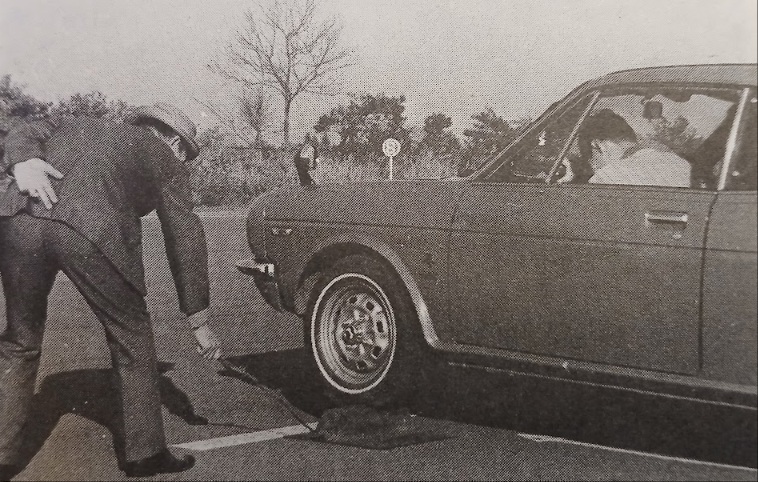
The brakes consist of discs at the front and leading-trailing drums at the rear. The servo assistance acts only on the front brakes, while the rear brakes are fitted with a PCV. The front brakes begin to operate at a pedal effort of 4kg, and the rears at 6kg, but the pedal travel at that point is 30-36mm, which is fairly far down. On the test rig, the pedal effort required for 0.6g deceleration was 19kg, about average for this class. The front-to-rear braking distribution is approximately 80:20.
In the road test, we first checked the brakes at 0.3g before proceeding with the measurements, but they then began to bite rather abruptly, and the pedal effort required for 0.6g came out at just 8kg. There was also some brake squeal at that point, and the feel of the brakes had changed, so perhaps the pads had not yet bedded in properly.
The operating efforts for the various controls were generally quite light. With the clutch, for example, the relationship between pedal travel and effort was linear.
Magazine: What do you make of the toe-out at the rear?
Kageyama: Could that be a consequence of the combination of the crossbeam and leaf springs?
Takeda: The suspension is designed to have toe-out with one occupant, changing toward toe-in as the load increases.
Hirao: So the intention is for it to pass through toe-out and eventually reach toe-in?
Nakamura: That’s how it works out in practice, and toe-in is what we’re aiming for.
Hirao: So that was deliberate. I’ve been wondering for some time why it was necessary to use a crossbeam. It seemed to me that a rigid axle with a Panhard rod ought to be capable of giving the same performance. But in that case, it’s doing something that couldn’t be achieved with a rigid axle.
Watari: In terms of noise and vibration, though, having that extra pivot is a disadvantage.
Magazine: What did you think of the brakes?
Yamaguchi: Is the servo the same as before? I had the impression that the assistance was more noticeable than on the 1300, as though you could feel the servo working more strongly.
Takeda: No, it’s different. The size is almost the same, but the internal construction has been changed. We’ve also tried to make the assistance less noticeable in the feel of the brakes. We’ve shifted the front-to-rear braking distribution slightly toward the rear, too.
Yamaguchi: When I drove it, the braking seemed rather inconsistent…
Ishikawa: How did the brakes respond?
Yamaguchi: There was a delay, and then they suddenly began to bite quite strongly… That gave me the impression of servo assistance coming in.
Ishikawa: Yes, exactly. When you apply the brakes, there’s a sudden change in their response partway through. We found the same thing when taking our measurements, and as I mentioned earlier, I suspect the pads hadn’t yet bedded in properly.
Hoshijima: We drove the same car, but I didn’t experience that when I drove it.
Magazine: Could we have the results of the dimensional measurements?
Onda: Since the changes have been internal rather than external, the basic body dimensions are unchanged from those of the 1300 Coupe. Among the smaller differences, the front track has been widened by 10mm. The tires have also changed from H-rated to S-rated, and the speedometer is now graduated to 180km/h.
On the outside, a decorative tubular bumper guard has been added to the bumper, slightly changing its height. The hood itself is the same size, but it no longer opens quite as far.
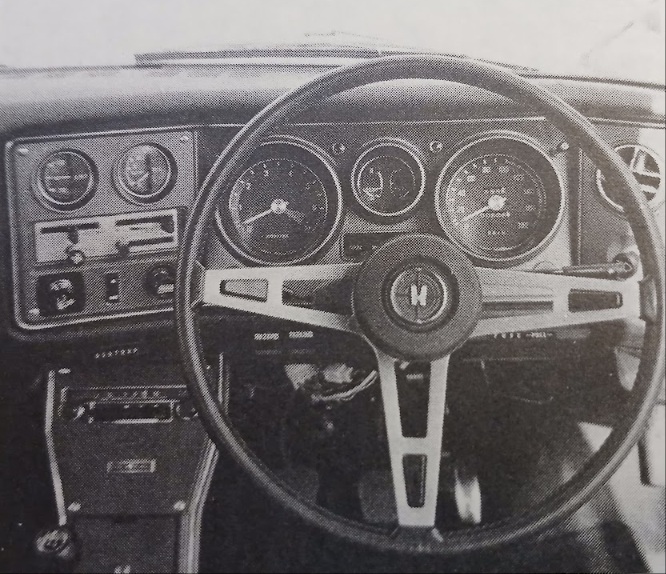
Inside, there was some discussion earlier about the driving position, and our measurements showed a slightly higher seating position than in the 1300 when the seat was in its neutral position. A fine-adjustment knob for the reclining backrest has also been added. The instrument layout still has the familiar “flight cockpit” style, if we should call it that, but with the addition of an overhead console incorporating a clock and other features, I think the interior has taken on an even greater sense of three-dimensional luxury.
Along with the transmission’s internal changes, the shift pattern has also changed to a more conventional layout, with reverse in a different position. The pedals, on the other hand, appear to be unchanged, since the body itself remains the same.
The instruments used to be graduated to remarkably high engine speeds and road speeds, but on this car the tachometer goes only to 7000rpm and the speedometer to 180km/h. I was struck by how these changes, too, reflect a more subdued character.
There’s another point I’ve brought up many times in discussions like this, and that’s the reliability of warning lights. I would like manufacturers to give some thought to the reliability of the warning lights themselves, rather than simply fitting a lamp and assuming that safety has been taken care of. Specifically, I think it can be said that, today, the warning-light system itself, with such problems as burned-out bulbs, is less reliable than the equipment or condition it’s supposed to warn the driver about.
Magazine: Has there been any change in the seat position or the amount of fore-and-aft adjustment?
Onda: Our measurements were taken with the seat in its neutral position, so there’s no change from before. In actual use, of course, people will move the seat forward or backward, so it may feel different. Also, since we’re measuring the height of something soft, the seat measurements are particularly susceptible to error.
Oda: The fine adjustment of the reclining backrest is combined with a memory mechanism for the seat angle, so even if you fold the seat forward to let someone get into or out of the rear, it returns to the position you originally set.
Hirao: So it’s a preset arrangement. That’s very good. One thing about the reach to the controls, though, and perhaps it’s just me: when I try to pull out the fan knob, I end up pulling out the cigarette lighter instead. And when I try to turn the fan off, I push the cigarette lighter back in again.
Hoshijima: Isn’t that just a matter of getting used to it?
Hirao: That’s what I thought, too. Even when I tell myself, “This one’s here, that one’s there,” I still find myself pulling out the lighter. (laughs)
Takeda: We thought that arrangement put the controls in fairly conventional positions, but…
Hirao: That’s just it. Logically, the arrangement makes perfect sense.
Watari: I think it’s because the pedals are offset toward the center of the car, so your body tends to turn in that direction as well. Then, when you reach out your hand, it naturally goes to that position. If you were sitting perfectly straight, the arrangement might be just right. Maybe that’s the reason.
Takeda: It’s true that the seat is angled slightly inward. We’ll certainly look into that.
Magazine: We understand you have plans for an automatic transmission, is that correct?
Nakamura: Yes.
Yamaguchi: The smaller Honda Z now has rear quarter windows that can be rolled down, doesn’t it? Since the 145 is its bigger brother, I think you ought to provide the same feature on this car. After all, the passenger compartment is larger, and there’s enough space to accommodate it mechanically.
Takeda: It presents some difficulties. But it’s certainly something we’d like to try.
Magazine: What about your production plans?
Matsuo: For the 145, we’re initially planning to produce 1,000 cars a month, including both the coupe and sedan. The reason is that we’re building it on the Civic production line, and at present that’s all the capacity we can spare.
Magazine: How many of those will be FI models?
Matsuo: The FI is more or less a built-to-order model, so it’s difficult to give a definite figure.
Magazine: Are you considering exports?
Matsuo: Not right now.
Nakamura: We’ve exported a small number of 1300s to Southeast Asia and a few to Australia, but for now we have no plans to expand those exports.
Magazine: Well then, that’s all for now…
Postscript: Story Photos