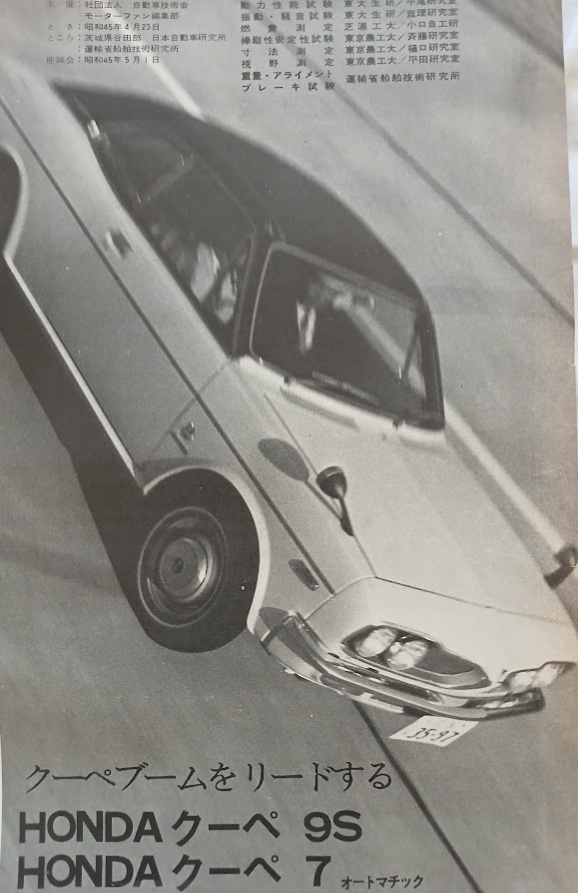
Honda 1300 Coupe 9S and 7 Custom (1970)
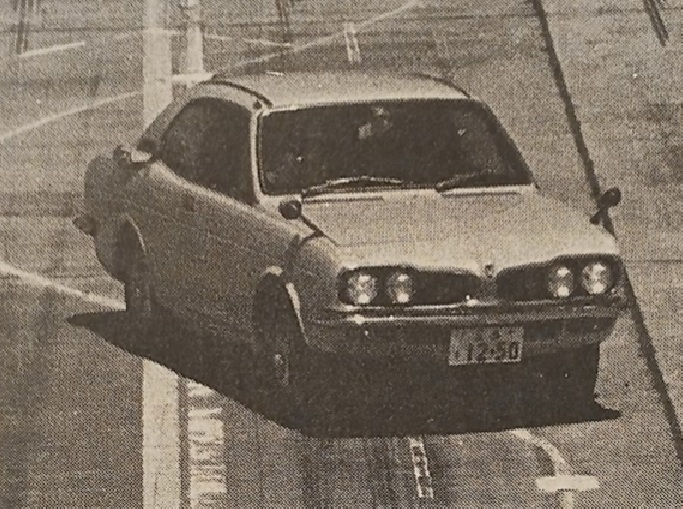
Publication: Motor Fan
Format: Road Test
Date: July 1970
Author: Ryozo Mabuchi, Torao Hattori, Akiro Irikoshi, Osamu Hirao, Kenji Higuchi, Hiroshi Okazaki, Atsushi Watari, Hiroshi Hoshijima, Kunitaka Furutani, Taizo Tateishi, Masahide Sano, Yasuhei Oguchi, Yasushi Saito, Kiyoshi Mori, Kenzaburo Ishikawa, Toshihide Hirata, Minoru Onda, Motor Fan Editorial Staff (uncredited)
Style Aimed at Younger Drivers
Magazine: We recently had the opportunity to test both the Honda 1300 Coupe 9 and the automatic version of the Coupe 7. To begin, Mr. Mabuchi, could you tell us about the aims behind the Honda 1300 Coupe?
Mabuchi: The coupe was introduced about a year after the sedan, but it had been planned as part of the model series from the very beginning.
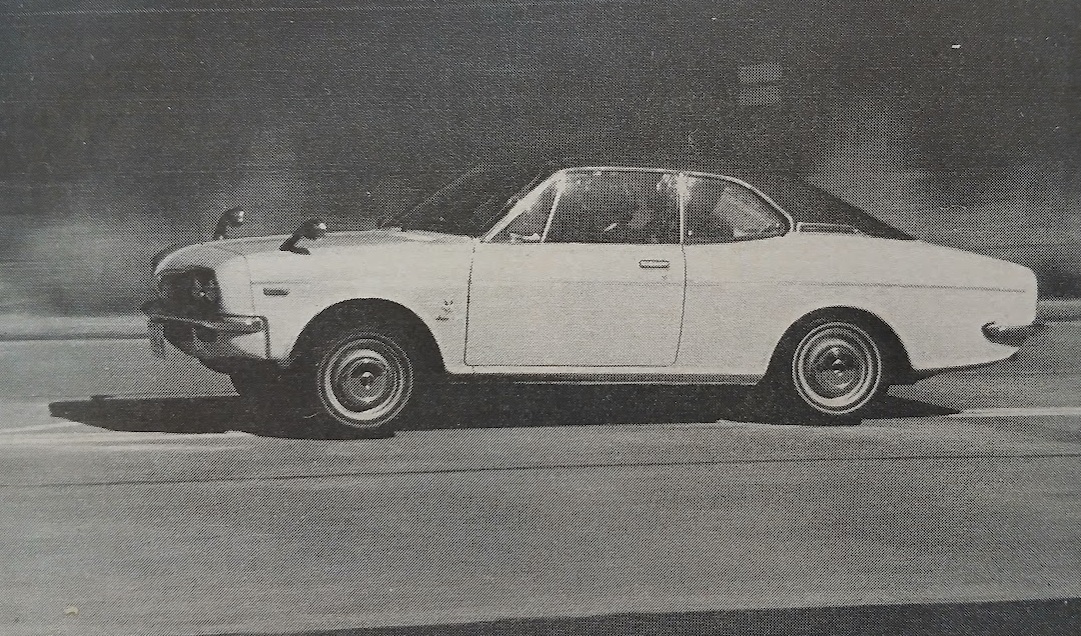
Since we were going to build a coupe, however, we wanted it to make people sit up and take notice–to offer something that would be readily accepted by the public. We gave considerable thought to what those elements should be. As a result, we concluded first that the styling had to appeal to younger buyers. At the same time, we also devoted a great deal of effort to improving the car’s aerodynamics.
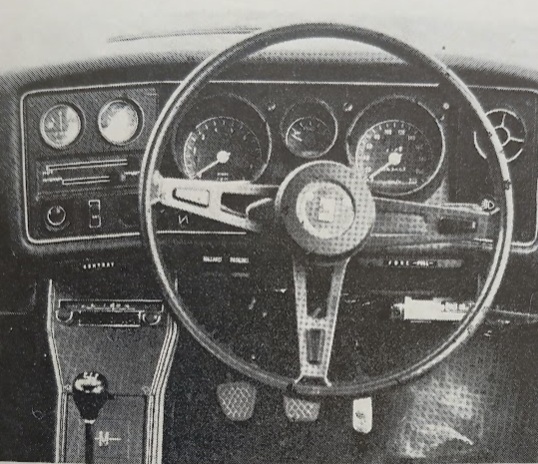
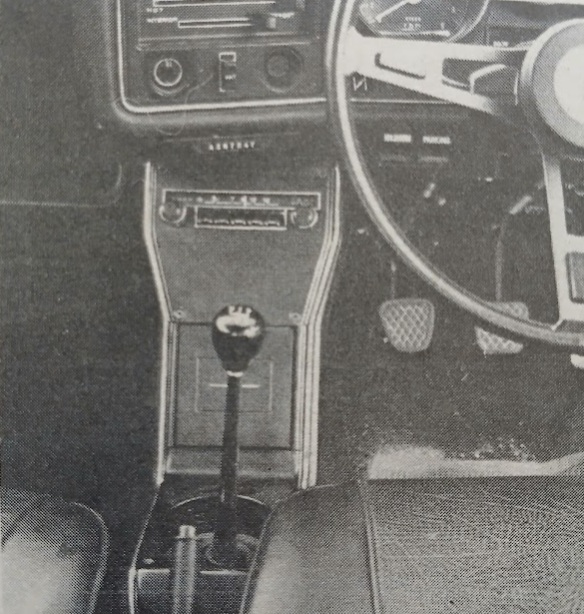
As for the feeling one gets behind the wheel, the interior–what we call the “Flight Cockpit”–is intended to make a strong impression by combining mechanical functionality with sculptural design.
We also wanted to avoid creating a car that emphasized only the traditional sports-car virtues, such as a very stiff ride, high top speed, but poor low-speed acceleration. Instead, we wanted it to offer a character that anyone could enjoy and find easy to drive.
At the same time, we felt it was important to give each model a clearly defined personality. Just as the sedan range is divided into the 77 and 99 series, each with its own character, the Coupe 9 was intended as the high-performance model, with the understanding that a somewhat firmer ride would be acceptable. The Coupe 7, by contrast, is positioned as the softer-riding alternative.
Magazine: And where does the automatic version fit into the lineup?
Mabuchi: The primary aim of the automatic model was to create a car with a distinctly family-oriented character.
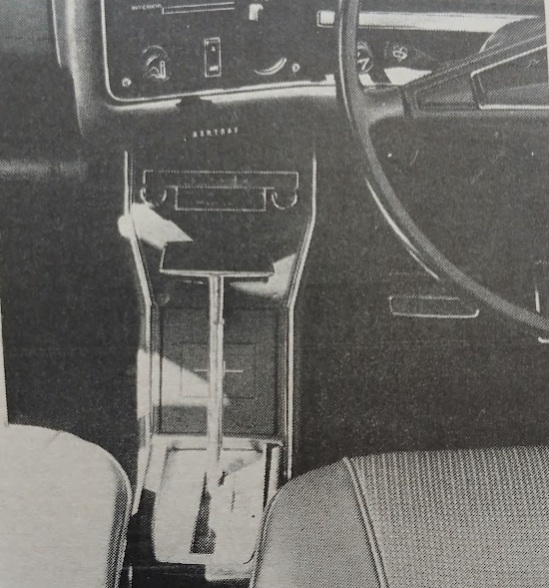
In America, it has already become common to see automatic transmissions offered even in cars such as the Chevy and Mustang, and some racing cars are beginning to use them as well. Japan, however, has not yet reached that stage. We therefore felt that the first step should be a family car. For that reason, the automatic transmission is offered only in the Coupe 7, and at the same time we reduced the engine’s output even further compared with the manual-transmission Coupe 7 in order to place greater emphasis on low-speed performance.
We also developed a set of instruments specifically for the automatic model, giving the instrument panel a more family-oriented character. Rather than treating the automatic as merely an option, we wanted to establish it as a distinct automatic-transmission series in its own right.
Broadly speaking, then, the lineup can be divided as follows: first, the Coupe 7 Automatic; next, the Coupe 7 with manual transmission; and finally, the Coupe 9.
Magazine: From the standpoint of body construction, how are the sedan and coupe related?
Mabuchi: The coupe was developed after the sedan, but aside from the underbody and the front fenders, virtually everything else was redesigned.
As you may have noticed, the roof panel features two character lines running fore and aft. The body structure is designed so that welding is carried out along those sections, thereby increasing body rigidity.
Of course, that construction method was adopted in part to suit mass-production requirements, but even taking that into account, the body shape was changed almost completely.
The Aim of Reducing Horsepower
Magazine: Even so, the coupe still shares a strong family resemblance with the sedan. As for the automatic version, you’ve said it differs substantially from conventional automatic models–to the point of being treated as a series in its own right. Could you tell us a little more about that?
Hattori: Unlike the conventional view of an automatic transmission, where it is little more than an optional accessory, this is an automatic model that has been fully matched to the car itself. We revised the engine’s design to increase low- and mid-range torque, making it a car that is easier to use in everyday driving. As a result, the engine’s characteristics were altered specifically to suit the automatic transmission.
The most significant difference from conventional automatics is its two-shaft design. Most automatic transmissions use planetary gears, but Honda’s automatic uses a two-shaft layout, making it an automatic transmission that is mechanically quite similar to a manual gearbox.
The hydraulic control system also incorporates Honda’s own unique design, and the vehicle itself features a number of automatic-specific specifications, particularly around the instrument panel.
Magazine: With the introduction of the Coupe 9, engine output has been reduced by 5ps across the range. What was the reason for lowering the power?
Irikawa: That wasn’t because the coupe was introduced. The change was made last November across the entire lineup, including the sedan.
The reason was that Honda engines are often said to rev well at the top end but lack low-end performance. In reality, however, the low-speed torque people generally refer to–around 1,500 rpm, for example–is not especially poor.
Even so, there were requests from sedan owners for a little more torque at extremely low engine speeds–just off idle, at the very bottom of the range. We felt there was room to improve drivability in that area, and that’s what prompted the change.
To achieve that, we sacrificed a certain amount of peak horsepower. Most of the change was accomplished simply through alterations to the valve timing.
Hirao: So you’ve lowered the engine speed on the automatic model as well?
Irikawa: That’s right. If low-speed torque is insufficient, then the torque converter’s stall speed has to be raised, which means the engine must operate at higher rpm all the time. And since an automatic transmission inevitably results in some deterioration in fuel economy, we felt it was more important to consider fuel consumption and overall usability than maximum horsepower at the top end.
Hirao: So the reduction was made with fuel economy in mind.
Higuchi: Or were you more concerned about excessive creep at idle?
Mabuchi: That was part of it as well. It’s related to fuel economy, but our primary objective was to create a car with a distinctly family-oriented character. From that standpoint, we felt a top speed of 150km/h would be entirely adequate, and in that context we reduced output to 80ps.
At the end of last year, we reduced the output of the manual-transmission models from 100 to 95ps. However, what one might call practical top-speed performance actually improved. Because low- and mid-range acceleration became stronger–the kind of performance most useful on highways–the engine reaches speeds such as 150-160km/h more quickly despite the loss of 5ps at the top end.
Moreover, because the coupe has lower running resistance, its top speed is still 175km/h in the Coupe 7 and 185km/h in the Coupe 9.
Higuchi: From a marketing standpoint, saying you’ve reduced horsepower may sound a little strange to customers who’ve been hearing “more horsepower, more horsepower” up to now. Perhaps it would be better to say, “We’ve increased maximum torque and usable power.”
After all, that’s the kind of engine that’s easiest for customers to drive.
Mabuchi: When we say we’ve reduced horsepower, people generally complain. Interestingly enough, though, the motoring press seems to have received the change quite favorably. Perhaps that’s because you’ve interpreted it in exactly the way we’ve been discussing.
Hirao: Perhaps the real selling point is being able to say, “We could have given it more power–but we chose not to.” (laughs)
A Cockpit with Excellent Design Sense
Magazine: What were your impressions of the cockpit?
Hirao: I think the instruments are quite well done. The way they’re arranged, wrapping around the driver from both sides, works very nicely.
Higuchi: The first thing I noticed when I got in was how low the eye point was. Then, with all those instruments spread out in front of you, I found myself thinking that if I were flying an airplane, it probably would feel very much like this.
Mabuchi: We devoted a great deal of attention to keeping the overall height low. At the same time, if lowering the car came at the expense of headroom or passenger comfort, that would create serious problems. So we experimented with different seating positions in an effort to make it a car that felt comfortable and natural once you were behind the wheel.
Hirao: That’s certainly true. The moment you settle into the driver’s seat, it has a reassuring, comfortable atmosphere.
Magazine: And what about the car’s family-car qualities?
Higuchi: Though when you say “family-oriented,” I wonder if perhaps you mean the sort of family car that’s really for the father. (laughs)
Mabuchi: Well, our basic objective was simply to create a car that a great many people would want to buy.
Okazaki: It was just suggested that the car feels like something intended for a one-man owner, and I think there’s some truth in that. The driver is very well looked after, but I’ve heard complaints from people riding in the passenger seat. Two people in particular remarked that the passenger seemed to have been treated as something of an afterthought. There is certainly a noticeable disparity.
Higuchi: Even something as simple as the ashtray–the passenger has to say, “Excuse me, could I borrow yours?” (laughs)
Hirao: I think a little more attention could have been paid to the passenger side. It wouldn’t have cost much to do so.
Watari: In that sense, the materials used throughout the interior are rather unbalanced as well. Some are quite expensive, while others seem rather cheap.
Hoshijima: On the Custom model, if a console is fitted in the center, then when air conditioning is installed it ends up directly in front of the passenger seat.
Watari: Exactly. Sitting in the passenger seat, you almost feel more like cargo than a passenger. (laughs)
Hirao: Looking at the overall layout, I wonder if the 1300 might simply be a little too narrow. One could say that it offers the performance of a larger-class engine in a compact package. But isn’t there a risk that people will instead say it has been given a body one size too small for its engine?
Watari: In Europe, they’d certainly say the car is too small for the engine it carries.
Mabuchi: That was actually discussed at length when the sedan was being developed as well. There were arguments that the car should have been made somewhat wider.
Our view, however, was that as automobiles become increasingly common, bigger will not necessarily mean better. Sooner or later, people will begin moving back in the other direction. Furthermore, given Japan’s road conditions and parking problems, we thought it was better to follow the old saying: “a sansho pepper may be small, but it packs a punch.”
Admittedly, whether five adults can ride in comfort is open to debate. Even so, we believe it compares quite favorably with other coupes.
0–400m in 17.1 Seconds
Magazine: Next, let’s have the results of the performance testing conducted by the Hirao Laboratory.
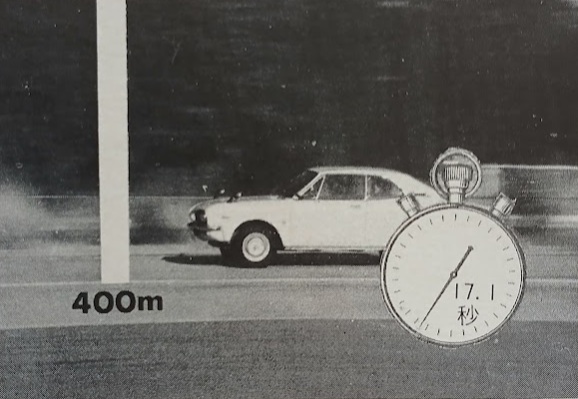
Furutani: For the Coupe 9, standing-start acceleration figures were 0-200m in 10.9 seconds and 0-400m in 17.1 seconds. Expressed in terms of speed versus elapsed time, the car recorded 0-40km/h in 3.3 seconds, 0-60km/h in 5.3 seconds, 0-80km/h in 7.9 seconds, and 0-100km/h in 12.2 seconds.
For third-gear overtaking acceleration from 30km/h, the figures were 1.9 seconds to 40km/h, 5.9 seconds to 60km/h, 9.5 seconds to 80km/h, and 13.6 seconds to 100km/h.
Turning to the automatic Coupe 7, standing-start acceleration figures were 0-200m in 12.6 seconds and 0-400m in 19.7 seconds. In terms of speed versus elapsed time, it recorded 0-40km/h in 4.4 seconds, 0-60km/h in 7.4 seconds, 0-80km/h in 11.7 seconds, and 0-100km/h in 17.8 seconds.
Magazine: The automatic didn’t show much front-wheel spin at launch, did it?
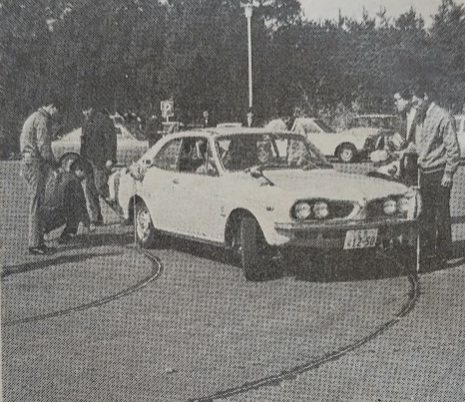
Furutani: No. The Coupe 9 exhibited quite a lot of front wheelspin, but the automatic hardly spun its wheels at all.
Magazine: Even with an ordinary start, the tires break traction. One gets the impression that the front tires will wear out quickly…
Mori: Being a front-wheel-drive car, front-tire wear admittedly tends to be somewhat higher. We recommend regular tire rotation to our customers, however, and on average we don’t believe tire life is poor at all.
Kizawa: We recommend rotating the tires every 5,000km.
In fact, the rear tires wear so little that the opposite problem arises. On cars used on the Tomei Expressway without any tire rotation at all, we’ve seen figures as high as 100,000 kilometers.
Magazine: Next, we’d like to hear the noise-test results.
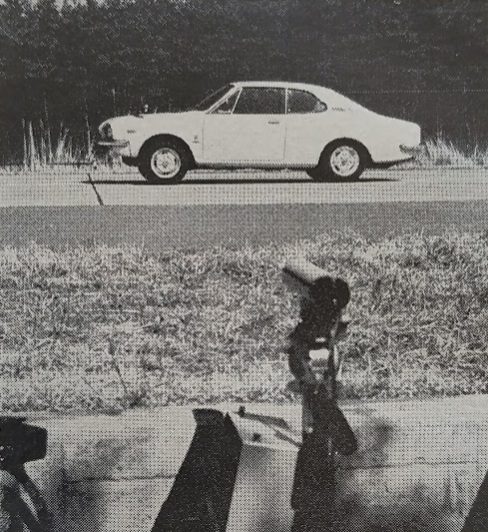
Watari: The noise measurements were conducted on the Tomei Expressway.
In the past, the Third Keihin Expressway had been a satisfactory venue for lower-speed testing, and the results obtained there were not greatly different from those gathered at Murayama. Since the Tomei allows sustained speeds of 100km/h, however, we decided to conduct the tests there this time.
The figures may be slightly higher than those we’ve recorded in the past, but judging from my own experience driving the car in everyday traffic, I don’t think the difference is particularly significant. It would probably be more useful to look at how the noise levels change with speed.
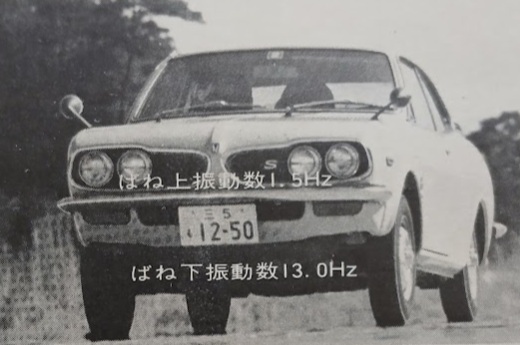
Tateishi: Beginning with vibration data, the suspension’s natural sprung-mass frequency is 1.5Hz front and rear, while the unsprung frequency is 13.0Hz at both ends.
Noise levels for the Coupe 9 were 67 phons at 40km/h, 68 phons at 60km/h, 72 phons at 80km/h, 77 phons at 100km/h, 76 phons at 110km/h, and 79 phons at 120km/h.
For the Coupe 7 Automatic, the figures were 62 phons at 40km/h, 66 phons at 60km/h, 66 phons at 70km/h, 72 phons at 80km/h, 77 phons at 100km/h, 76 phons at 110km/h, and 76 phons at 120km/h.
Watari: I don’t think the figures are especially high. If anything, what stands out is the sharp increase at 90km/h–the question is what’s causing that peak. The low-speed figures are also somewhat elevated.
We’ve seen the same tendency before when comparing coupe and sedan versions of the same model: the coupe usually produces slightly higher readings at lower speeds.
Mabuchi: That 90km/h peak is caused by resonance in the exhaust system. We’d like to improve that aspect. We’re considering various approaches involving the bulkhead.
Watari: While we’re on the subject of noise, I mentioned earlier that the interior felt somewhat unbalanced. There are places where the car produces rather inexpensive-sounding noises, such as the dashboard and steering column. I think it would be worthwhile to continue working on eliminating those kinds of sounds.
As for ride quality, a sprung-mass frequency of 1.5Hz is about standard for a car in this class these days. The question is where you choose to place the emphasis. If this were intended as a true family car, I think the frequency could stand to be a little lower.
On the other hand, driving enthusiasts would probably want it somewhat higher. Lately I’ve begun to feel that cars like this should be offered with a choice of two different spring rates.
Kizawa: The car you measured was the 9S, whose rear dampers are tuned somewhat more firmly. The noise levels, however, are essentially identical to those of the 7.
The automatic model exhibits its peak at 90km/h, while the 9S peaks at a somewhat higher speed. Part of that is due to the gear ratios, and part of it stems from the fact that the automatic uses a manifold-type muffler. The configuration of the exhaust system differs slightly from that of the manual-transmission cars.
Tateishi: The automatic does show that tendency. However, when we previously measured a Honda 1300 99S on Honda’s own test course, the results were virtually identical at lower speeds, aside from the 90km/h peak. At higher speeds, the Coupe’s figures are actually lower.
Higuchi: I think the character of the noise becomes much more noticeable when you’re stopped somewhere like a park, sitting with the engine idling and the windows closed. I think that’s particularly true in a coupe.
Hirao: What is the idle speed?
Irikawa: About 750rpm. The automatic is roughly 700rpm as well.
Better Fuel Economy Than the Sedan
Magazine: Next, let’s have the results of the fuel-economy testing.
Sano: I’ll begin with the Coupe 9S. The results showed a fair amount of variation. At worst, the figures at 40km/h varied by as much as 4-5km/l.
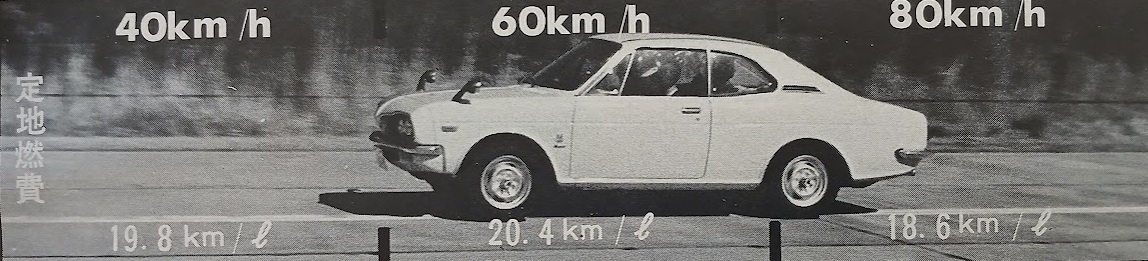
The recorded figures were 19.8km/l at 40km/h, 20.4km/l at 60km/h, 18.6km/l at 80km/h, 16.3km/l at 100km/h, 13.4km/l at 120km/h, and 10.3km/l at 140km/h.
For the model-route fuel-consumption test, the car returned 11.5km/l at a target speed of 40km/h, with an average actual speed of 22.8km/h. When the target speed was 60km/h, the average speed was 25.4km/h and fuel consumption was 9.6km/l.
Turning to the Coupe 7 Automatic, the constant-speed figures were quite consistent and showed little variation: 17.0km/l at 40km/h, 16.8km/l at 60km/h, 14.9km/l at 80km/h, 12.6km/l at 100km/h, 10.0km/l at 120km/h, and 7.0km/l at 140km/h.
Oguchi: At highway speeds, that’s a difference of a little over 20-30%.
As for the model-route test we conducted later, this was carried out in actual city driving. Although the speed limit was 40km/h, the actual average speed worked out to only a little over 20km/h, and even then the car returned 11.5km/l.
In practical use, I doubt the figures would become much worse than that.
Magazine: Looking at these fuel-consumption figures, one gets the impression that the engine’s output belongs more in the 1.5-liter class or above. Doesn’t it consume rather a lot of fuel?
Watari: Those figures do seem a little on the high side to me.
Higuchi: It’s good in terms of horsepower-per-fuel consumption, but not so good in terms of displacement-per-fuel consumption.
Sano: That’s not really true of the Coupe 9.
It managed to reach more than 20km/l. We recently tested the Sedan 99, and in the model-route test the coupe recorded 11.5km/l at the 40km/h setting, compared with 10.7km/l for the sedan, so the coupe was actually better.
The same was true at the 60km/h setting. The coupe returned 9.6km/l, while the sedan managed 9.1km/l. Both are good figures.
Mabuchi: As part of our CO-emissions countermeasures introduced at the end of last year, we revised the carburetor specifications and modified the hot-air intake system. I think that’s why the results are better than when the sedan was tested the previous year.
Oguchi: One factor may be that the exhaust-emissions requirements have allowed the engine to run a slightly leaner mixture. Fuel economy has improved as well, so I imagine that’s one of the changes you’ve made…
There was something else that caught my attention. When we were running laps at Yatabe, we returned after driving flat-out, close to maximum speed, and found that the idle characteristics had changed noticeably.
Another thing was the fuel-consumption testing itself. The figures didn’t change, but at first Mr. Sano had a very difficult time because the data simply wouldn’t settle down. The readings were scattered all over the place. We even began to wonder whether the instruments were malfunctioning. Then we switched to the torque-converter car and everything immediately became consistent, which struck us as rather odd.
Mabuchi: I’m not sure I understand what would cause the measurements to vary so much.
Oguchi: And it’s not something one normally expects to see with idle speed, either.
Mabuchi: Well, for example, there will be differences between an engine that is still quite cold and one that has fully warmed up. The cars are adjusted during final inspection in a fully warmed-up condition, so provided nothing is wrong with the adjustment itself, there should be no reason for temperature-related changes of that sort.
Hoshijima: As it happens, I drove this car about 10,000 kilometers across the United States.
Fuel consumption worked out at almost exactly 25 miles per gallon throughout the trip. Converted to metric units, that’s about 10.2-10.3km/l.
And that was while driving at speeds considerably higher than those normally maintained in typical American traffic.
The worst fuel economy came in Arizona, where I encountered a tremendous sandstorm. Speeds weren’t especially high under those conditions, but even so I was cruising at around 130-140km/h and still managed roughly 8km/l.
The best figure I saw was about 12km/l.
To me, that seemed entirely in line with what American buyers expect from a small car.
Tendency to Wander on a Closed Throttle
Magazine: What do you make of the fact that the coupe seems to return better fuel economy than the sedan?
Hirao: Well, the coupe has a lower drag coefficient than the sedan, so naturally you’d expect it to do better.
Magazine: We didn’t test the manual-transmission Coupe 7 this time, but how much difference is there in fuel economy between the four-carburetor and single-carburetor versions?
Mabuchi: In terms of fuel consumption, they’re about the same.
In fact, I think the four-carburetor version is better at higher speeds.
Hoshijima: On the Tomei, the four-carburetor car is about 1km/l better.
Watari: What’s the fuel-tank capacity of the coupe?
Mabuchi: 45 liters.
Magazine: Next, let’s have the results of the handling and stability tests.
Saito: The catalog lists a practical turning radius of 4.8m. We measured an outside turning radius of 5.25m and an inside radius of 2.92m, which are essentially the same as the sedan’s figures.
Steering effort at a standstill was measured at Yatabe. Turning to the right, effort was 6.5kg at 90°, 8.5kg at 180°, 10.5kg at 270°, and 10.5kg at 360°. Turning to the left, the corresponding figures were 8.0kg, 11.5kg, 10.0kg, and 11.5kg. Since these measurements were conducted at Yatabe, road-surface conditions differed somewhat from those used in our previous tests.
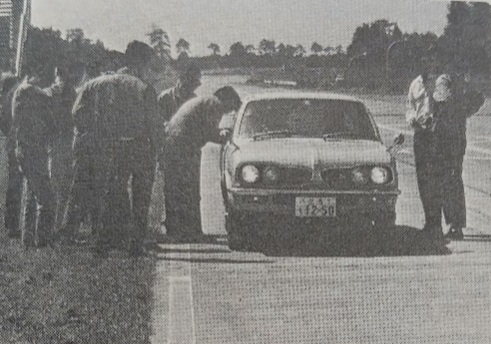
As for hands-off stability, the highest test speed was 120km/h. At 50, 60, and 70km/h, convergence was quite good, but from about 80-120km/h the damping characteristics became somewhat weaker.
Hirao: One thing that caught my attention while driving on the expressway was that when I lifted off the throttle, the car couldn’t seem to settle on a direction. That tendency is definitely there.
At one point, I happened to be on a slight downhill grade. I was driving in the passing lane when another car came up behind me, so I accelerated to about 130km/h, completed the overtake, and then immediately lifted off the accelerator. At that point, the car no longer seemed to have a clear sense of direction.
Up to then I’d completely forgotten about any such tendency, so it made me stop and think. I tried it several more times. With the throttle applied, the car tracked straight and true; lift off, and it became less certain. I came away feeling that this characteristic is definitely present.
Because of that, it seems to me that the test results could vary depending on whether the car was under power during the measurement or whether the throttle happened to be lifted at that moment.
Oguchi: Driving by feel on the Yatabe course, I gradually increased speed, held a slight steering angle and then lifted off the throttle. Up to around 100km/h, I noticed virtually nothing.
Only when speeds reached 120–130km/h did I begin to think, “Ah, maybe that’s it…” and even then only slightly.
Front-Wheel Drive on the Rise Worldwide
Hirao: I suspect it’s the sort of thing you don’t really notice when you’re out on a wide-open course like Yatabe driving by yourself. But when you’re driving with three cars side-by-side, there are moments when you suddenly think, “Huh.”
Because the engine is relatively powerful, the effect shows up more clearly. If the engine were smaller, I imagine it would be subtle enough that you might not notice it at all.
Mori: There’s probably some truth to that.
Higuchi: For someone who drives actively and anticipates what’s happening, it’s very safe. For someone who doesn’t, it could be rather dangerous.
Okazaki: I think the change in steering effort is part of it. When that combines with the car’s response, there are moments when it suddenly makes an unexpected movement at the wrong time, and I find that rather frightening.
Personally, I make a point of completing my braking before turning in. If you try it in a wide-open area, what you’re really dealing with is the onset of a spin-out.
Mabuchi: The whole FF-versus-FR debate tends to be colored by the conventional wisdom that has surrounded automobiles up to now, and that’s why these points become contentious.
Front-wheel drive has its drawbacks, just as it has its advantages.
When people begin weighing one against the other, the discussion inevitably turns to which system is better. Yet if we look at worldwide trends, the number of FF cars continues to increase steadily.
In that sense, whether a car is FF or FR, future progress will depend on how well we can develop the strengths of each layout while eliminating as many of their weaknesses as possible.
We regard that as both our responsibility and the essential nature of technological progress.
Higuchi: The shortcomings of FR are already well known to most people.
Because drivers have become accustomed to them, they tend to regard those shortcomings simply as familiar quirks.
With FF, on the other hand, people are less accustomed to its behavior. As a result, the moment something feels a little unusual, they make a great fuss over it.
Watari: FR is the most ordinary layout of all. It has no particularly outstanding qualities.
FF, on the other hand, has clear strengths, but it also has clear weaknesses. One could argue that, overall, the two average out to much the same thing. Yet the strengths and weaknesses of FF tend to stand out more clearly, making the differences appear larger than they really are.
Overly Effective Air Conditioner
Magazine: Next, let’s look at the weight-related data.
Ishikawa: Including the spare tire and tools, vehicle weight was 921kg. Weight distribution was 62% front and 38% rear, with the left front corner approximately 15kg heavier than the right. The rear was evenly balanced.
With five occupants aboard, weight distribution shifts to 55:45.
As for wheel alignment, with a single occupant the front wheels exhibit a moderate amount of toe-in. With five occupants, that decreases considerably.
Camber is also very slight. With five occupants, the wheels assume a small amount of negative camber and the toe setting shifts toward toe-out.
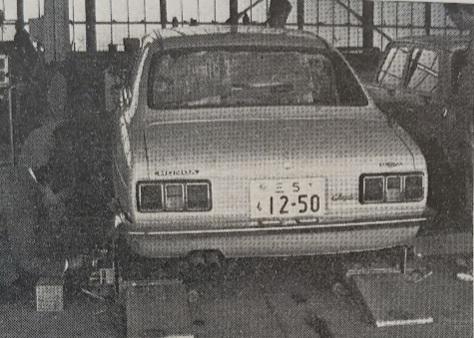
Regarding the brakes, the system uses front discs and rear leading-trailing drums with servo assistance, though in practice the servo effect seems to act primarily on the front brakes.
The front brakes do the majority of the work, giving the impression of extremely front-biased distribution. At approximately 0.6g deceleration, with a pedal effort of 20kg, the front-to-rear distribution is 83:17. It feels as though the car is stopping almost entirely on the front brakes.
The pedal effort required for 0.6g deceleration measured about 25kg in bench testing, but in road testing the figure dropped to just 14kg, making the brakes feel very light in actual use.
Mori: Normal brake pads require a certain bedding-in period before they settle down completely. During that time, pedal effort can be somewhat higher, so I imagine that’s responsible for at least part of the difference.
Hirao: The lighter figure is the way the system is really intended to perform, isn’t it?
Mori: Yes, according to our internal data.
Magazine: Next, we’d like the visibility measurements.
Hirata: We measured only the Coupe 9.
Using a seating reference point 110cm above the ground, with the driver’s eyepoint 54cm from the windshield and 42cm from the center of the rearview mirror, the visible field through the windshield measured 33° to the right and 63° to the left, for a total of 96°.
Vertically, visibility extended 19° upward and 9.5° downward, for a total of 28.5°.
The rear-window visible field measured 13° to the right and 34.5° to the left, for a total of 47.5°. Vertically, it measured 5° upward and 2.5° downward, totaling 7.5°.
The windshield wipers swept 24° to the right and 57° to the left, for a total swept area of 81°.
The total blind area in the horizontal plane was 66.5°, of which 25° lay directly ahead.
Higuchi: How does the eyepoint height compare with that of an ordinary passenger car?
Hirata: It’s not especially low.
Magazine: Next, let’s move on to the dimensional data…
Onda: I think the styling has been improved by retaining the sedan’s wheelbase while increasing the overhangs, creating more space at the rear and giving the front end greater visual depth through the grille and other detailing.
Because the positions of the four wheels remain unchanged, the body itself has grown larger. Yet one of the perennial problems with coupes–interior roominess–seems to have been addressed rather successfully. The rear seat and trunk, in particular, are dramatically different from the sedan’s and offer noticeably more space than similar cars.
As for interior ergonomics, the novelty lies less in the reach to the controls and more in the way they’re arranged. I think drivers will find it very appealing.
At the same time, it’s a little disappointing that despite the advantages of front-wheel drive and its flat floor, the area beside the pedals feels somewhat cramped, as though some of that spacious floor area has been sacrificed.
The instruments, on the other hand, are positively lavish. The large gauges lined up across the panel contribute greatly to the car’s showroom appeal.
Hoshijima: I’m not entirely convinced that placing the air conditioner unit in the dashboard is the best solution. If anything, it works too well. I think it might be better if the unit were located farther toward the rear of the cabin.
Hirao: I don’t mind the outlets being at the front. But I think the vents should be integrated into the dashboard itself.
When you want rapid cooling, you direct the airflow at your face first.
After that, you can deflect it as necessary.
Hoshijima: The problem is that it cools too effectively. The passenger side becomes practically freezing. At least that was my experience about a year ago.
Watari: A front-discharge system requires very careful thought.
Mabuchi: When we were experimenting with air-conditioning systems some time ago, we found that from the standpoint of what might be called healthy air conditioning, the ideal was to lower the cabin temperature by only about five degrees relative to the outside air.
The trouble is that customers find that completely unsatisfactory. Their attitude tends to be, “If it’s too cold, I can always turn it off.”
Hirao: The problem is that the moment you turn it off, it becomes hot again. (laughs)
Then when you switch it back on, it’s immediately too cold. That’s why the argument that “you can always turn it off” doesn’t really hold up.
Magazine: Next, let’s move on to the safety data.
Higuchi: Our evaluation is based largely on how safe a car appears upon visual inspection.
On a scale of 100 points, this car scores 87. Cars in this class used to start at around 70 points, and only since last year have we begun seeing scores in the 80s.
An 87-point score essentially means that just about every expected safety feature has been fitted.
The challenge going forward, I think, is not simply adding safety equipment, but making people actually want to use it–and making it convenient to use.
Take seat belts, for example. Many people have them but never wear them. More often than not, they’re left muddied on the floor. In this car, however, they’ve been arranged so they can be stowed neatly away.
Magazine: Thank you all very much for your time today.
Postscript: Story Photos