Honda 1300 Coupe 9S and 7 Custom (1970)
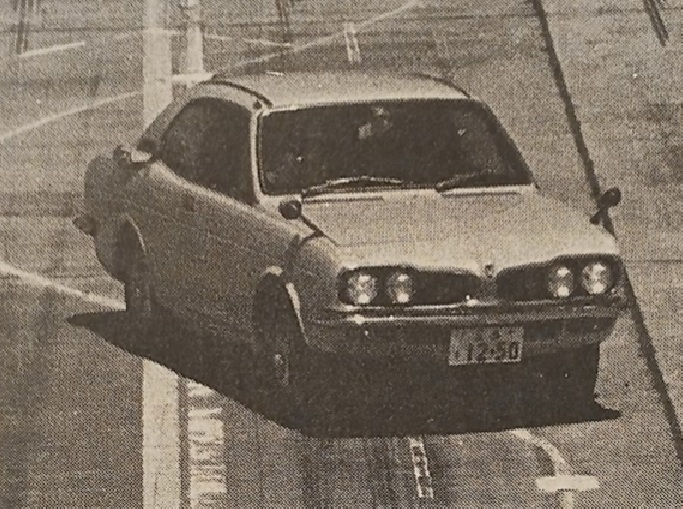
Publication: Motor Fan
Format: Road Test
Date: July 1970
Author: Ryozo Mabuchi, Torao Hattori, Akiro Irikoshi, Osamu Hirao, Kenji Higuchi, Hiroshi Okazaki, Atsushi Watari, Hiroshi Hoshijima, Kunitaka Furutani, Taizo Tateishi, Masahide Sano, Yasuhei Oguchi, Yasushi Saito, Kiyoshi Mori, Kenzaburo Ishikawa, Toshihide Hirata, Minoru Onda, Motor Fan Editorial Staff (uncredited)
Style For Young People
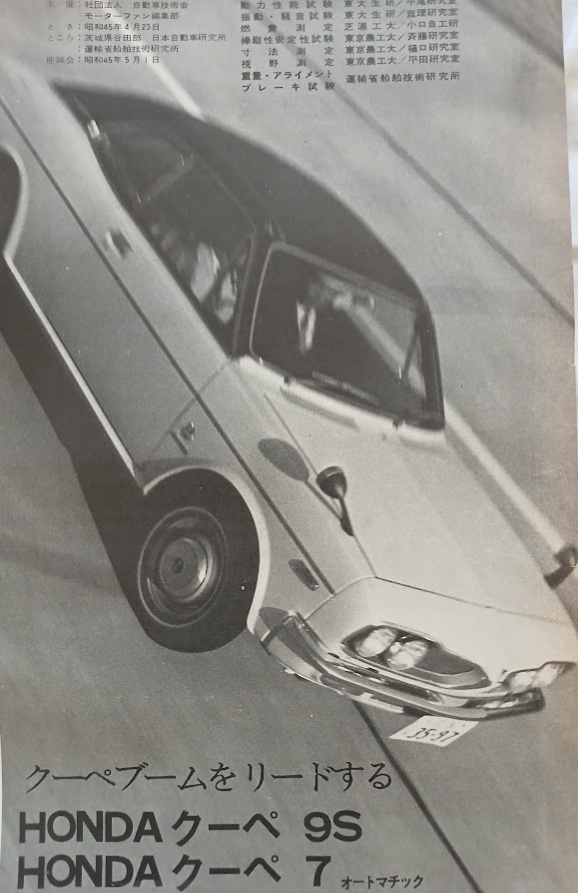
Magazine:This time, we will present our road test of the Honda 1300 Coupe 9 and 7 automatic models. First, we would like to ask Mr. Mabuchi about the aim of the Honda 1300 Coupe.
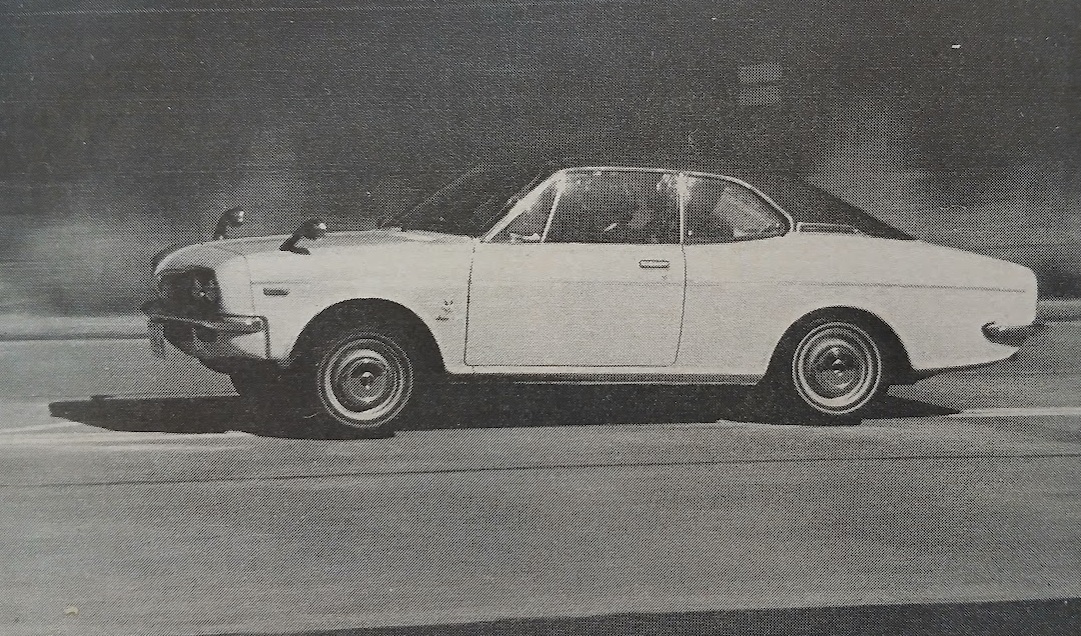
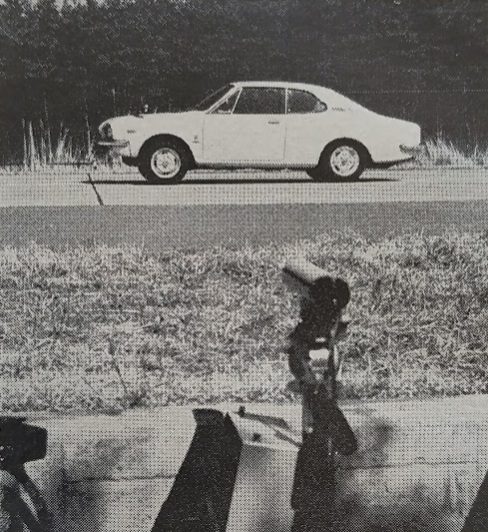
Mabuchi: We announced the coupe about a year after releasing the sedan, and we always planned for the series to include both models. However, once the decision was made to develop a coupe, we thought a lot about what elements would make it a car that would surprise the public and make it well-received. In the end, we decided that it had to have styling that would be welcomed by young people, and at the same time, we also researched ways to improve on the sedan aerodynamically.
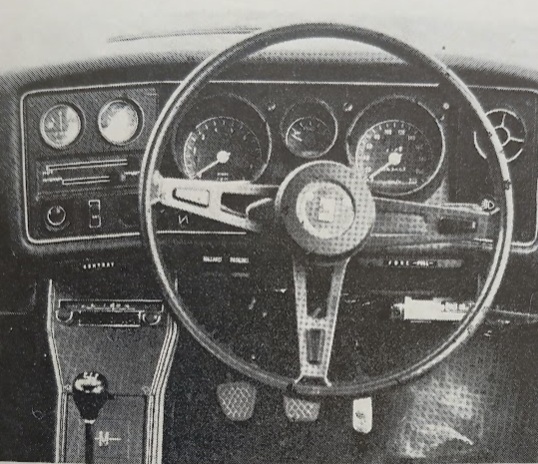
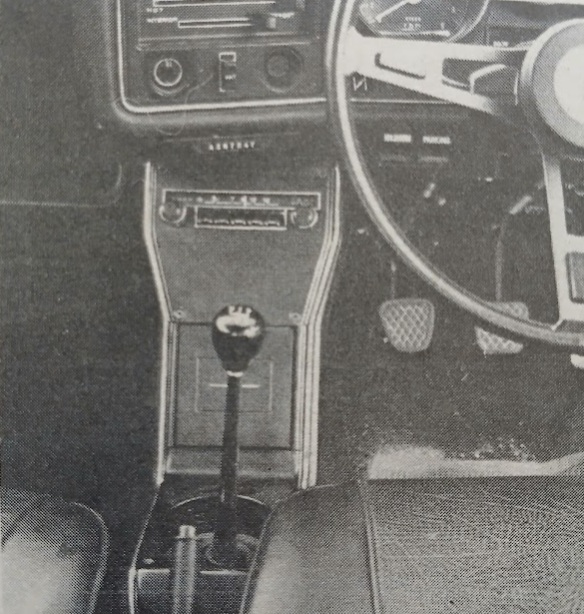
Along the same lines, we refer to the interior as the “flight cockpit,” which is the feeling you get when you sit in the car, and we aimed for a very strong appeal by matching functional and sculptural elements.
Our goal was to create a car that is easy to drive and can be enjoyed by anyone, rather than just pursuing the sports car-like aspects that are common with this type of car, such as a very stiff ride or being able to reach high speeds but not accelerating well at low speeds.
To achieve this, we decided to clearly define the characteristics of each model. Just as the sedans are divided into the 77 series and the 99 series and have their respective characteristics, the Coupe 9 is characterized by high performance, and if its ride is a little too stiff for some, the 7 offers a softer ride for those users.
Magazine: How does this principle apply to the automatic car?
Mabuchi: The first aim of the automatic is that it’s a very family-friendly car. In America, we’ve already entered an era where Corvettes and Mustangs are equipped with automatic transmissions, and even some racing cars are equipped with automatics, but Japan hasn’t reached that stage yet, so the first step was to create an automatic car that is family-focused. We offer the automatic only in the 7, and at the same time, we reduced the power even further than the manual transmission 7 series to emphasize low speed response.
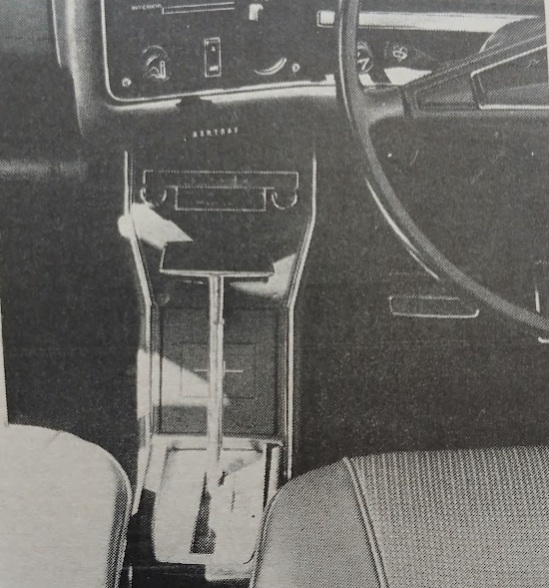
We also developed a special instrument panel layout specifically for automatic vehicles to create a family car-like feel. Rather than just adding an automatic transmission as an accessory, we wanted to create something completely different with the automatic series.
The above can be broadly characterized as follows, in a spectrum from family- to sports-focused: First there is the 7 series automatic, then the 7 manual, and then the 9 Coupe.
Magazine: How are the sedans and coupes distinguished in terms of bodywork?
Mabuchi: The Coupe was designed after the sedan, and the entire shape was changed except for the undercarriage and one side of the front fender. As you may have noticed, there are two lines running from front to back on the roof. The body structure is welded beneath those to increase the body rigidity. Of course, this is done as part of the unibody structure for mass production, but even this has changed the shape of the car.
The Aim of Reducing Horsepower
Magazine: In terms of image, it has something in common with the sedan in that the automatic has been made into a series of its own. Could you tell us more about that?
Hattori: Unlike conventional automatic cars where the automatic is something of an afterthought, this is a car where the automatic and the overall design are integrated. The engine design was changed, increasing torque at low and medium speeds, making the car easier to use for general use. Therefore, the engine performance itself was changed, and the automatic transmission was made to match it.
The biggest difference from conventional automatics is that it is a two-shaft system. While ordinary automatics use planetary gearsets, the Hondamatic is mechanically similar to a normal manual transmission, and uses a hydraulic control mechanism unique to Honda. The body and instrument panel designs are also model-specific for the automatic cars.
Magazine: At the same time the Coupe 9 was released, the power was reduced by 5 horsepower. Why was the horsepower reduced?
Irikoshi: The power drop coincided with the release of the Coupe, but was not related to it. We made this change at the end November last year, including for the sedan. The reason we lowered it is that we heard people saying that Honda engines rev well at high speeds but not at low speeds, and that the torque range we consider to be low-speed, for example, around 1500rpm, is actually not that low.
We received feedback from users saying they wanted more torque at extremely low speeds, such as when the engine is just off idle, so we made some changes to improve the feel in that area. To achieve this, we sacrificed a certain amount of horsepower, but the majority of the change was just in the valve timing…
Hirao: So the rotation speed of the automatic car has also been reduced?
Irikoshi: That’s right. If the low-speed torque is insufficient, the stall speed of the torque converter must be increased to keep the rotations high at all times, and of course, fuel economy will be worse to some extent with any automatic, so the upper limit was lowered to take fuel economy and other factors into consideration rather than increasing the horsepower at the upper end.
Hirao: So you lowered it out of consideration of fuel efficiency.
Higuchi: In reality, were you also afraid of strong idle creep if it kept its high-rpm characteristics?
Mabuchi: Yes, that too. It’s also related to fuel efficiency. However, the aim from the beginning was to make it very family-friendly, so we settled on a horsepower reduction to 80, as a top speed of 150km/h would be sufficient for this model.
At the end of last year, the horsepower of the manual transmission vehicle was reduced from 100 horsepower to 95 horsepower. This improves what is generally referred to as the practical maximum speed, because while the peak power is reduced, the time it takes to reach 150km/h or 160km/h is actually shorter due to the increased acceleration force at low to medium speeds on the highway.
Moreover, the coupe has less rolling resistance, so its top speed is 175km/h for the 7, and 185km/h for the 9.
Higuchi: If the horsepower is reduced when it is put on sale, it will seem a bit strange to the fans who have been crying “horsepower, horsepower” up until now, so instead, it would be better to say “we’ve increased the usable torque and horsepower.” From the user’s perspective, that is the easiest type of engine to drive.
Mabuchi: Generally, people will complain if we say horsepower has dropped, but by contrast, the change seemed to have been well-received by journalists. Perhaps that’s because they interpreted it the same way we did.
Hirao: I think the killer line is, “we could have released it, but we held it back.” (laughs)
A Cockpit With Excellent Taste
Magazine: What were your thoughts on the cockpit?
Hirao: The gauges look pretty good, don’t they?
Higuchi: The first thing I felt when I got in was that my eyepoint was low. And there were all these amazing things in front of me, so yes, I thought it was exactly what it would be like to fly an airplane.
Mabuchi: We put a lot of effort into lowering the car height. However, lowering the car without changing the seating would result in sacrificing head room and comfort, which would be a serious problem, so we thought about various ways to change the driving position and make the car easier to drive.
Hirao: Indeed, when I first sat in the driver’s seat I felt that it had a very relaxing atmosphere.
Magazine: What did you think about the family car elements?
Higuchi: Even though we say it’s family car-like, I thought it was suited to more of a one-man, old man kind of family. (laughs)
Mabuchi: To put it another way, we wanted to make it a car that many people will buy…
Okazaki: It’s true that it’s a one-man owner kind of car. It takes care of the driver very well, but the person in the passenger seat sometimes complains, and I heard two people say that the passenger’s side seems to be neglected in terms of design, and there is certainly a big disparity.
Higuchi: For example, when it comes to ashtrays, I have to ask the driver to lend me theirs. (laughs)
Hirao: I think it would be good to provide a little more hospitality to the passenger seat area as well. It doesn’t feel like as much money was spent there, either.
Watari: In that sense, the interior materials are quite unbalanced, with both expensive and cheap ones used.
Hoshijima: In the case of the Custom, since the console is in the middle, if you want to install an air conditioner, it will go right in front of the passenger seat.
Watari: When I sat in the passenger’s seat, I felt like I was riding on a baggage carousel. (laughs)
Hirao: Considering the overall layout, isn’t the 1300 a bit narrow? With such high performance, it’s fine to say that it’s a small car with an engine from a higher class, but wouldn’t you say that it has a body that is a step below the engine?
Watari: In Europe, people would say that the car is small compared to its engine.
Mabuchi: Actually, this was also the case with the sedan. There were many discussions. There was a question of whether we should make it a little wider, but we felt that as cars become more popular, bigger is not necessarily better. We thought that there would come a time when we would return to the original dimensions. Also, in Japan, with road conditions and parking issues, we thought it would be fine for the car to have a character that is something like, “a small pepper with a spicy kick.” As you say, there is some debate about whether it is comfortable enough for five people, but among coupes, we think it is among the better ones.
0-400m in 17.1 Seconds
Magazine: We would like to see the results of the performance measurements taken by the Hirao Laboratory.
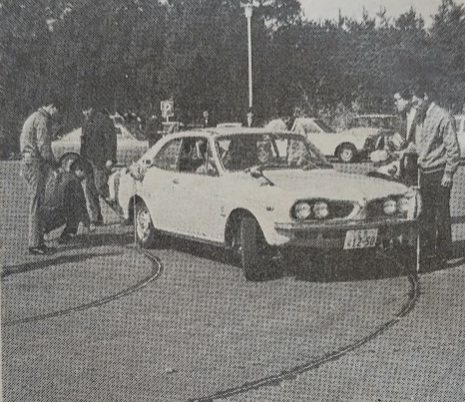
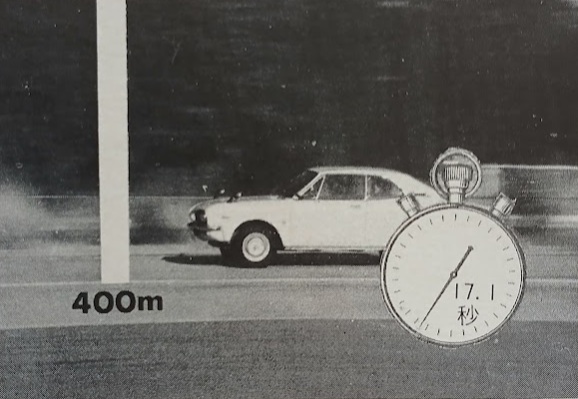
Furutani: Standing-start acceleration times for the Coupe 9 are 10.9 seconds for 0-200m and 17.1 seconds for 0-400m. In terms of time to speed, it takes 3.5 seconds to reach 40km/h, 5.5 seconds to reach 60km/h, and 12.2 seconds to reach 100km/h. Overtaking from 30km/h takes 1.9 seconds to 40km/h, 5.9 seconds to 60km/h, 9.5 seconds to 80km/h, and 13.6 seconds to 100km/h.
Next, the automatic Coupe 7 accelerates from 0-200m in 12.5 seconds and 0-400m 19.7 seconds. In terms of time to speed, it takes 4.4 seconds for 40km/h, 7.4 seconds for 60km/h, and 17.6 seconds for 100km/h.
Magazine: The automatic model did not have as much front wheelspin when starting off.
Furutani: Yes, the front wheels of the Coupe 9 were spinning quite a bit, but the automatic didn’t slip as much.
Magazine: Even when starting under normal driving conditions, you can get front wheelspin, so I feel like the tires will wear out quickly…
Mabuchi: The FF design makes it inevitable that front tire wear will occur a little earlier. We ask our users to rotate the tires more frequently. In this case, I don’t think the average tread life is bad at all.
Hattori: We advise that the rotation period is every 5,000km. By contrast, the rear tires do not wear down very much at all. If you’re driving only on the Tomei Expressway, the figure without rotation is 100,000km.
Magazine: Next, we would like to ask for the data on noise levels.
Watari: Speaking of driving on the Tomei Expressway, in the past, the surface of the Third Keihin Expressway was relatively better in terms of noise at low speeds, and the data for the Third Keihin Expressway and the Murayama course were not that different, so that’s where I took measurements. But since the Tomei Expressway can be driven at 100km/h, I tried taking measurements there this time. I think the readings are a little higher than the data we’ve had up to now, but from my experience driving in the city, I don’t think it will have too much of an impact on the comparative data, so I think it will be a good idea to continue with this change in the test routine and see how it goes.
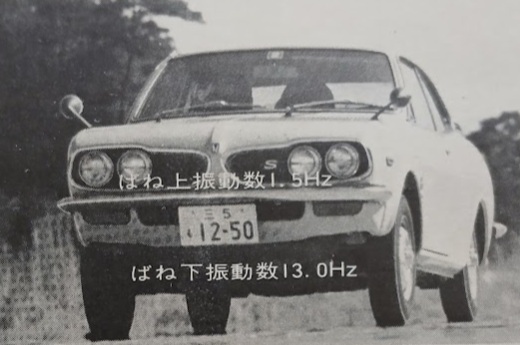
Tateishi: In terms of vibration frequency, the sprung vibration frequency is 1.5Hz for both front and rear, and 13.0Hz for unsprung vibration front and rear. The noise level is 67 phons at 40km/h, 68 phons at 60km/h, 72 phons at 80km/h, 77 phons at 100km/h, 76 phons at 110km/h, and 79 phons at 120km/h.
The 7 automatic is 62 phons at 40km/h, 66 phons at 60km/h, 72 phons at 80km/h, 77 phons at 100km/h, 76 phons at 110km/h, and 76 phons at 120km/h.
Watari: I don’t think it’s very high. If I had to say, the only thing that stands out is the increase at 90km/h. I wonder what that peak is, and the low-speed numbers are also generally high. Even with the data we’ve had up until now, when comparing coupes and sedans of the same class, the low-speed data is higher.
Mabuchi: The peak at 90km/h is due to the resonance of the exhaust sound. We would like to fix that somehow. We’re thinking about changing the bulkhead.
Watari: In relation to sound, another aspect of the imbalance I mentioned earlier is that some parts of the interior can produce cheap noises. I think it would be good to eliminate these noises in places like the dashboard and steering column.
In terms of ride comfort and up-and-down vibration, the sprung frequency of 1.5Hz is about standard for this class of car, but what the user thinks will depend on their priorities. If it were really being used as a family car, I think it would be better to lower the spring rates a little more. On the other hand, I think street racers will want to raise them even higher than this. I’ve been thinking lately that cars like this should offer two different spring constants for the suspension.
The car we took measurements on was the 9S, which has slightly stronger rear dampers. The sound is exactly the same as the 7, but the automatic model’s noise level peaks at 90km/h, while the 9S peaks at a slightly higher speed. This is partly due to the gear ratios, and partly because the automatic model has a different muffler, and the exhaust shape is slightly different than that of the manual transmission model.
Tateishi: The automatic transmission model is showing similar results, but I previously measured the 1300 99S sedan on Honda’s test course, and the results were almost the same at low speeds, except for the peak at 90km/h. At high speeds, the values are lower.
Higuchi: I think the noise would be a problem if you were in a park or somewhere quiet like that, or idling with all the windows closed, but I think that’s especially true of the coupe.
Hirao: How fast does the engine idle?
Irikoshi: It’s 750rpm. The automatic version is around 700rpm.
Better Fuel Economy Than the Sedan
Magazine: Next, we’d like to ask for the results of the fuel economy tests.
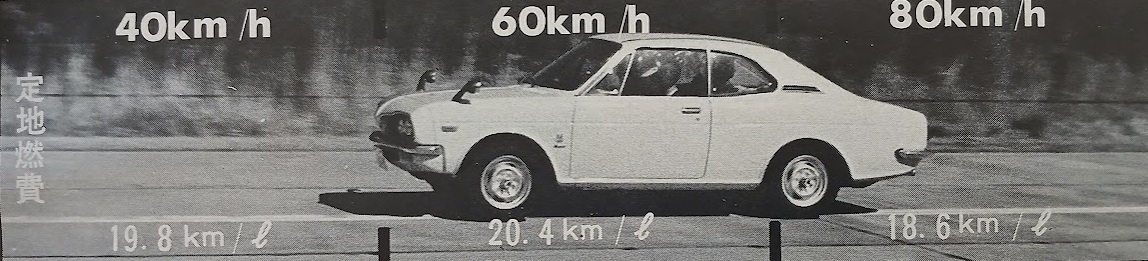
Sano: I’ll start with the Coupe 9S. The fuel economy varied quite a bit. At its worst, it varied by 4-5km/l over a 40km/h range of speeds. The steady-speed data is 19.8km/l at 40km/h, 20.4km/l at 60km/h, 18.6km/l at 80km/h, 16.3km/l at 100km/h, 13.4km/l at 120km/h, and 10.3km/l at 140km/h.
The model operating fuel consumption is 11.5km/l at an average speed of 22.8km/h in a simulated 40km/h speed zone, and 9.6km/l at an average speed of 25.4km/h when the speed zone is 60km/h.
Next, the 7 automatic’s fuel economy figures are quite consistent: 17.0km/l at 40km/h, 16.8km/l at 60km/h, 14.9km/l at 80km/h, 12.8km/l at 100km/h, 10.0km/l at 120km/h, and 7.0km/l at 140km/h.
On minor expressways, it’s about 20-30% better. The fuel economy I recorded later was 11.5km/l, based on a model run in a real city, with a speed limit of 40km/h and an average speed of 20km/h. This figure suggests that it won’t get any worse in real-world driving.
Magazine: According to this fuel economy data, while the car is more powerful than some cars in the 1.5-liter class, the fuel consumption figures are a little high.
Higuchi: In terms of fuel efficiency, it’s good for its horsepower, but bad for its cc displacement.
Sano: This is less true with the 9. It managed to reach over 20km/l. When I did a practical fuel economy run with the 99 sedan, it got 10.7km/l, while the coupe got 11.5km/l, which is good. In a simulated 60km/h speed zone the coupe achieved 9.6km/l, while the sedan achieved 9.1km/l, both of which are good figures.
Mabuchi: As part of the CO countermeasures implemented at the end of last year, we made small changes to the carburetor and the hot-air intake control system, so I think it’s better than when we measured the sedan last year.
Oguchi: If this is related to exhaust gas control, wouldn’t it be okay to just make the mixture a little leaner? Fuel efficiency has also improved, so it’s one of the many changes that have been made…
Then something that bothered me was that when I was driving around Yatabe, I had the accelerator down hard and drove at close to top speed, and when I came back to the pits, the idling speed had completely changed.
Another thing is that while the average fuel economy hasn’t changed, at first, Mr. Sano was having a very hard time with individual measurements, the data was all over the place, which was unsettling. We gave up, thinking that the test equipment was broken, but when we moved on to the 7 automatic it was working fine, so we thought something must be wrong.
Mabuchi: You mention the measured data was inconsistent, but I don’t understand what that means.
Higuchi: I didn’t expect the idling would change that often.
Mabuchi: Maybe this was because, for example, the engine was very cold. The values will change depending on whether the engine is cold or warm. We adjust the engine before shipping when it is in a fairly warm state, so unless the adjustment is poor, it is unlikely that a warm engine should be affected.
Hoshijima: I happened to drive about 10,000km in the US with this car, and the fuel economy was almost perfectly consistent, at 25 miles per gallon. In terms of liters, that is 10.2 to 10.3km/l. We were traveling at a much faster speed than the average American traffic. The worst was in Arizona, where we were hit by a massive sandstorm and couldn’t go very fast. But, at 130-140km/h, I got about 8km/l. At its best, I got about 12km/l. I thought that this was probably about what people in America expect from a small car.
Confused Direction With Power Off
Magazine: Why do you think the coupe’s fuel economy is better than the sedan’s?
Hirao: In short, the drag coefficient is lower than that of the sedan, so it’s only natural that it is better in this regard.
Magazine: We didn’t measure the 7 model with the manual transmission this time, but what is the difference between the four-carb and the single-carb car? Is it a big difference?
Mabuchi: In terms of fuel economy, it’s roughly the same. In fact, I think the four-carb model is better for highway fuel economy.
Hoshijima: On the Tomei Expressway, the four-carb is about 1km/l better.
Watari: What is the tank capacity of the coupe?
Mabuchi: 45 liters.
Magazine: Next, please provide us with the results of the maneuverability and stability tests.
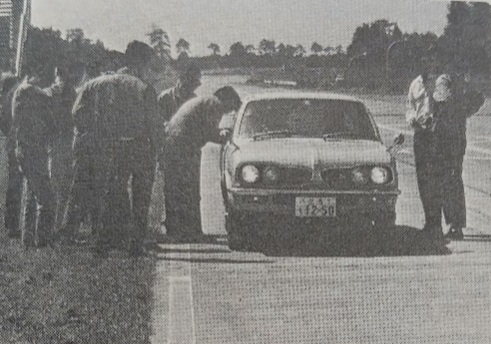
Saito: The practical turning radius is listed as 4.8m, and the measured outer turning radius was 5.25m and the inner turning radius was 2.92m, which is roughly the same as that of the sedan. The steering force for turning the wheel when stationary is 6.5kg for 90° to the right, 8.5kg for 180°, 10.5 for 270°, and 10.5 for 360°. To the left, 90° is 8.0kg, 180° is 11.5kg, 270° is 10.1kg, and 360° is 11.5kg.
The highest speed reached in the free-release stability test was 120km/h. At the initial lower speeds of 50km/h, 60km/h, and 70km/h the car converged well, but the damping ability decreases slightly from about 80km/h to 120km/h.
Hirao: One thing that bothered me when I was driving on the expressway was that when I backed off the power, it felt like the car couldn’t decide which direction to go. This is a definitely a characteristic of the car. To give one example, this was on a slight downhill slope, but I was driving in the express lane and someone was chasing me, so I increased my speed to about 130km/h to get some distance from them, and then immediately took my foot off the accelerator. However, the car would not steer in the right direction. Up until then I had been driving without paying attention to such things, so I thought it was strange and repeated the inputs, trying various things, and whenever I stepped on the accelerator the car would steer in the right direction, but when I took my foot off the accelerator it would not steer in the right direction. I felt this is definitely something that happens.
So in terms of the free-release stability testing, I think the data will be slightly different depending on whether power was being applied during the test or whether the power was immediately released.
Oguchi: I drove at the Yatabe course to get a feel for this, gradually increasing the speed, adjusting the steering, and then taking my foot off the accelerator, and as I increased the speed up through about 100km/h, I hardly felt anything. But when I got to 120-130km/h, I thought, “Oh, there it is.”
FF is Increasing Worldwide
Hirao: I don’t think you’ll feel it much when you’re driving alone on a relatively wide course like Yatabe. However, when you’re driving in traffic on a three-lane road, it’s a bit unnerving.
The engine is large, so it has a big effect. I think if the engine was smaller, you wouldn’t even notice it…
Mori: Yes, there is some truth to that.
Higuchi: It’s perfectly safe for people who think proactively about driving safely, but dangerous for people with a passive attitude towards safe driving.
Okazaki: There is definitely a change in steering force. The chassis reaction coincides with that, and it feels unsettling. Sometimes this happens suddenly, which can be scary.
In actual driving, I just slowed all the way down before entering corners, but when I tried harder on the wide area of the test course, I ended up spinning out.
Mabuchi: Regarding the FF discussion, there is a kind of common sense that has applied to automobiles up until now, so there are various issues in that regard, and FF has its advantages and disadvantages. I think there will be debate as to which is better, but looking at the global trend, FF is currently on the rise.
In that sense, in order to further develop in the future, whether it is FF or FR, we need to maximize the strengths and eliminate the weaknesses as much as possible. That is our duty, and I believe that this is the advancement of technology.
Higuchi: The disadvantages of FR are already common knowledge and are well-understood by many people, so I think people have become accustomed to it and think of its flaws as simple quirks.
When it comes to FF, perhaps because people are not as used to it as they are to FR, they may make a big fuss if they notice something is a little off.
Watari: FR is the most conventional and has no outstanding features. FF has its good points but also its bad points, and on average they balance out, but the more familiar one seems better.
Overly Effective Cooler
Magazine: Next, let’s take a look at some weight-related data.
Ishikawa: The weight is 921kg with spare tire and tools, with a weight distribution of 62% at the front and 38% at the rear. The measured weight at the left front wheel is about 15kg heavier than the front right, while the rear is the same on both sides. With five people on board, the weight distribution if 55:45. The wheel alignment is such that there is a medium amount of toe-in when one person is on board; with five people on board, the toe-in decreases.
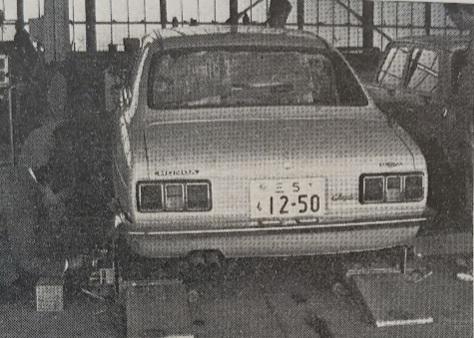
There’s also a slight amount of camber. With five people on board, the camber reverses into negative camber. The brakes are discs in the front and leading-trailing type drums in the rear, but the servo only seems to work on the front discs.
The front brakes are working hard, and the front-to-rear brake distribution is extremely front-heavy, giving a ratio of 83:17 when deceleration is around 0.6g, with a pedal force of about 20kg. It felt like most of the braking was coming from the front.
The pedal force at 0.6g deceleration is approximately 25kg in bench tests, but the road test results show that it is a very light 14kg.
Mori: With normal pads, it takes a little while for the pedal to settle, and during that time there are times when the pedal pressure is a little higher, so I think it varies.
Hirao: But the nature of it is basically light.
Mori: Yes, that’s the case according to our internal data.
Magazine: We would also like to ask for the visual field data.
Hirata: I only took measurements on the 9, and I measured the distance from the ground to the height of my viewpoint at 110cm, the distance from my viewpoint to the windshield at 54cm, and the distance to the center of the rearview mirror at 42cm. The visible range through the windshield was 33° to the right and 63° to the left, for a total of 96°. The front and rear directions were 19° up and 9.5° down, for a total of 26.5°. The visible range through the rear window was 13° to the right and 34.5° to the left, for a total of 47.5°, 5° up and 2.5° down through the rearview mirror, for a total of 7.5°, and the wiper wiping range was 24° to the right and 57° left, for a total of 81°. The invisible range in the horizontal plane at the time is 66.5°, of which 25° is in the forward direction.
Higuchi: How much ground clearance is there compared to a normal car?
Hirata: It’s actually not that low.
Magazine: Please share the data on dimensions.
Onda: The wheelbase is the same as the sedan. In terms of dimensions, I think the styling has been improved by making the overhangs larger, increasing the space at the back, and making the grille and other parts more deeply curved at the front.
The position of the four wheels remains the same, so the body is larger, but the interior space, which is always an issue for a coupe, seems to have been greatly improved. The rear seats and trunk space in particular have changed dramatically from the sedan, and are more spacious than similar cars. The interior space is more about the new layout than the dimensions, and it seems to be very popular with drivers.
Also, while FF cars have a flat floor, the space next to the pedals is cramped, and it feels like a large amount of floor space has been sacrificed. The gauges are luxurious and generously sized, so I think they are a good feature in terms of perceived product value.
Hoshijima: I think it’s a bad idea to have the air conditioner on the dashboard. It’s too conspicuous, so I think it would be better to have it installed at the rear of the cabin.
Hirao: I think it’s fine for the air to exit in the front, but even if it’s in front, I think the grille that comes out should come out from somewhere on the dash panel. And that way, if you want to feel the cool air immediately, you can point it at your face first. Then you can move it away as needed.
Hoshijima: It was so sensitive that I practically froze in the passenger’s seat. That was about a year ago.
Watari: Next time we’ll have to be more careful to test it before the summer holidays.
Mabuchi: When we tried out various air conditioners last year, in terms of healthy cooling, it was actually best to keep the temperature about 5 degrees cooler than the outside temperature, but from the customer’s point of view, this was not enough. If it was too cold, they thought, “well, then I’ll just turn it off.”
Hirao: But if I turn it off, it gets too hot right away. (laughs) And if I turn it on, it gets too cold right away. So the argument, “just turn it off” doesn’t hold water.
Magazine: Now let’s take a look at some safety-related data.
Higuchi: It certainly appears to be safe. Using our methods, out of a total 100 points, this car gets 87 points. Cars like this started out at around 70 points, but since last year they’ve been in the 80s. I think the 87 point rating is basically because it has all the features you could want, and the question going forward will be whether the safety features are easy to use, and make you want to use them or not.
For example, many people have seat belts but don’t use them, so they end up covered in mud on the floor of the car, but this one has a neat design that makes them easy to store them away.
Magazine: Thank you all for your continued support.
Postscript: Story Photos