Honda 1300 77 Custom and 99S (1969)
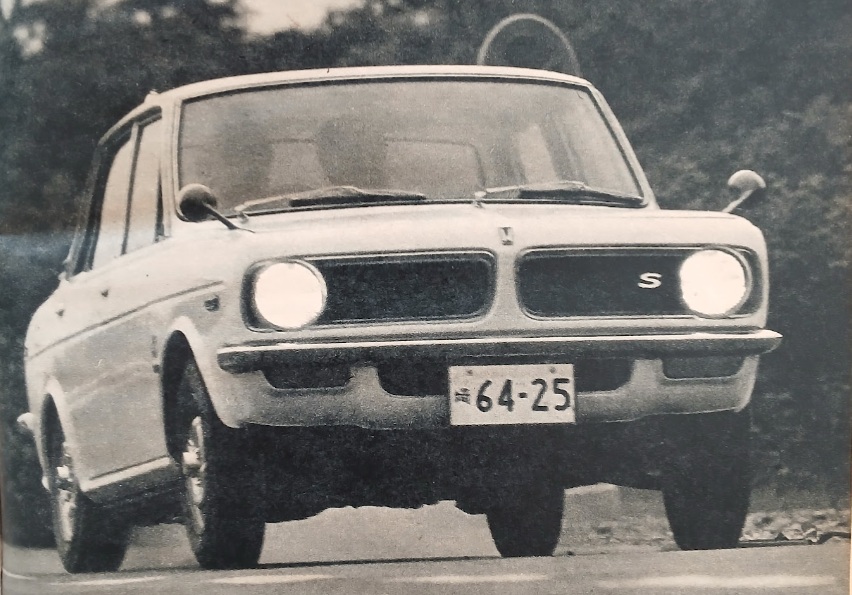
Publication: Motor Fan
Format: Road Test
Date: July 1969
Authors (Roundtable): Ryozo Mabuchi, Hisashi Tamai, Hiroshi Hayano, Akio Miyamoto, Mineo Yamamoto, Toshiji Baba, Osamu Hirao, Kenji Higuchi, Atsushi Watari, Hiroshi Hoshijima, Minoru Onda, Yashei Oguchi, Nagao Yoshida, Kunitaka Furutani, Kenzaburo Ishikawa, Taizo Tateishi, Kazuo Kumabe, Yasushi Saito, Toshihide Hirata, Hiroshi Sase, Motor Fan Editorial Staff (uncredited)
Aiming for High Performance, Safety, and Ease of Use
Magazine: The Honda 1300 has earned a reputation as a car packed with a great many new mechanisms. To get started, could you tell us about the basic thinking behind the design of this new model?
Mabuchi: Our aim was to develop a car whose substance could stand up anywhere without embarrassment, and to that end we established three main pillars that guided development.
The first was an absolute commitment to an air-cooled engine. In terms of combustion efficiency and maintenance, air cooling offers nothing but advantages over water cooling, but in conventional designs there remained one major drawback: noise. We directed our research toward solving this problem, and were able to achieve results that are, for the time being, quite satisfactory.
The second pillar was an emphasis on what we call primary safety. Generally speaking, when people talk about safety measures, they are referring to occupant protection after a collision. We classify that as secondary safety, and distinguish it from primary safety.
With this car, we sought safety in the sense of avoiding accidents in the first place by raising the level of performance itself. That meant improving top speed and acceleration, and ensuring that the car responds faithfully to the driver’s intentions. For this reason, we adopted a front-wheel-drive layout. In addition, the suspension and body shape were developed with resistance to crosswinds as a key theme.
From the standpoint of stopping safely, all models are equipped with front disc brakes, and the Deluxe grade and above are fitted with servo assistance incorporating a PCV (pressure control valve). What applies across the board is our concern for safety in the sense that the car should do exactly what the driver intends.
The third pillar was to give the car a dual character. In other words, while offering high performance, we also wanted it to be easy to use at low speeds, with a supple ride. We adhered to this way of thinking throughout the design. As a result, the steering is light enough at low speeds that parking can be done smoothly with one hand, and even at just 20km/h in top gear, the engine runs smoothly without knocking.
Magazine: Could you tell us about the development process of the air-cooled engine, and its key mechanical features?
Tamai: To achieve high output, you want to improve combustion efficiency, and in that respect air cooling is clearly advantageous–that much probably goes without saying. The real issues in designing this engine were how to implement the cooling system and how far to take the noise reduction. If you make the cooling fins longer, you gain an advantage in cooling, but the fins begin to vibrate more.
So we devised a double-air-cooling system called the DDAC method, which integrates the cylinder head and block into a single unit. We fitted relatively short cooling fins internally, and then forced high-speed air through them for cooling. With a double-wall structure, you also get the advantage of additional cooling by natural airflow. Also, because the exhaust air is routed to warm the intake duct, efficient fuel atomization can be expected even at start-up.
Another point is our adoption of a dry-sump system. Of course it brings the usual benefits such as oil cooling of the engine, but the major advantage is that the engine can be installed lower due to the absence of an oil pan, which lowers the center of gravity and improves handling and stability. Drawing on our Formula 1 racing experience, we designed a dual-suction oil system so that lubrication remains sufficient even during cornering. We also use what we call a G-type gallery, which quickly returns oil that enters the crankcase back to the tank as fast as possible.
Innovations in the Intake and Exhaust System
Magazine: Could you tell us about the front-wheel-drive layout?
Hayano: We approached engine mounting with a slightly different philosophy than other manufacturers. Placing the engine transversely is inherently disadvantageous in terms of controlling powertrain movement and vibration, so most manufacturers resort to very rigid mounting. In this car, however, we used a long-span, T-shaped extension engine mount, positioning it as far rearward on the body as possible. The mounting structure itself is designed to be relatively flexible rather than rigid, allowing for controlled compliance, and thick rubber is used at the mount points to suppress the system’s natural vibration frequencies.
Magazine: High-performance engines are something of a Honda specialty. Could you share one secret behind how this engine’s character comes alive?
Tamai: This may sound a bit textbook, but to produce high output you are essentially limited to two options: first, increasing engine speed, and second, taking in as much fresh air as possible. In this engine, we especially focused on the latter. We designed the port shape carefully and adopted a combustion chamber design that generates swirl and improves mixture uniformity. As a result, we believe we’ve achieved relatively high output even at comparatively low engine speeds.
Miyamoto: Looking at the bore and stroke, it’s unusual for a modern engine to have a longer stroke than bore (74 × 75.5mm). Was there a specific reason for that?
Tamai: When you go with front-wheel drive, space constraints become an issue, especially in the front-to-rear direction of the engine compartment. The length from the clutch to the fan is limited, so it’s difficult to increase the bore size. We decided that increasing the stroke a bit instead wouldn’t really cause any problems in practice.
Strong Against Crosswinds, Easy to Control
Magazine: We’ve heard that since the car was displayed at last year’s Motor Show, the design has been revised in various ways. What sort of changes were made?
Mabuchi: The major changes were an increase in weight and a larger trunk. In particular, the weight and its distribution were adjusted to reduce the effects of crosswinds as much as possible. We took the car abroad for repeated testing, and as a result the weight increased significantly from the original design, but we believe that this produced very good characteristics.
Yamamoto: Even so, it’s still a light car. How are its structural strength and torsional rigidity?
Baba: We used subframes only where extra strength was required, and the rest is an integrated unit body.
Hayano: Torsional rigidity is kept on the order of 8 × 10³kgm/deg. Ideally, we’d like to reach the 10⁵ order, but for a passenger car, we felt that level wasn’t really necessary.
Yamamoto: When I drove it, the vibration felt well controlled. Is that due to the suspension?
Hayano: We really worked hard on the suspension mounting and the suspension itself to achieve a soft, comfortable ride, so I think that effort is paying off.
Hirao: The rear suspension springs do seem fairly soft. The longitudinal stiffness is especially low, so I think it has a strong positive effect on ride comfort when driving over things like railroad tracks. It must have been difficult to achieve that without sacrificing high-speed stability.
Yamamoto: When a car is capable of high speeds, it must have been especially challenging.
Mabuchi: Once you enter the era of highway travel, disturbances caused by wind increasingly become a safety issue, so we paid a great deal of attention to this point.
Yamamoto: When the car is hit by a crosswind, is the center of pressure located toward the front?
Mabuchi: We positioned it slightly forward of the center. When we tested the car in America, there was even a surprising result: it was less affected by wind than the Chrysler we were driving alongside it.
Yamamoto: That must have been a tough target to achieve, especially at those speeds.
Mabuchi: On highways, wind-induced disturbances often compromise safety, so we were extremely sensitive to this issue.
Higuchi: In an FF car, when you’re pushed off course by a crosswind, is the steering and throttle response the same as in a conventional FR car? Or is there any special technique required?
Mabuchi: We designed it so that even when hit by wind, the change in behavior is very small, so I don’t think there’s anything special about it being an FF. Also, we focused on minimizing the difference between power-on and power-off conditions, so we believe ordinary corrective inputs are sufficient.
Higuchi: So you’re saying that even if a crosswind disturbs the car, you don’t need to pay special attention to your driving inputs to stay safe.
Mabuchi: That’s exactly why I think FF makes the car respond more as the driver intends.
Hirao: I think there are two elements to consider when a car is hit by a crosswind. One is the lateral force pushing the car downwind, and the other is the moment that rotates the car’s orientation. The first lateral force cannot be eliminated regardless of shape, but the second moment can be reduced by things like front-to-rear weight distribution, side-profile area distribution, and trunk size, which is what you were saying. By doing this, you can neutralize the moment.
But does that mean the first lateral force is completely unavoidable? I believe it can be improved by making effective use of side-force steer–not roll steer, but the car’s natural tendency to self-correct against side forces. If that is done well, would it be possible to reduce wind effects even more than on a large car like a Chrysler? Normally, larger cars are stronger against crosswinds, but I don’t fully understand the logic behind this.
Plenty of Comfort for Rear Passengers
Magazine: We’ve heard that the Honda 1300’s body is small on the outside but spacious inside. Could you explain what distinguishes its body design?
Mabuchi: Until now, there’s been a strong impression that a large body equals a high-level car. But I think we’ve entered an era where people decide a car’s size based on their actual needs and usage. In that case, when we considered driving in crowded city streets, parking, and maneuverability, we thought that this size is probably the best for Europe and Japan. As a five-seater, it should be large enough not to cause fatigue even over long periods, and a width of about this size (1415mm) should make it easy to handle…
Watari: One hallmark of FF cars is their roomy interior, but in this case, the front legroom feels a bit tight.
Hirao: In an FF layout, you need to place a certain amount of weight on the front wheels, so the driver’s seat inevitably has to be pushed forward as much as possible, right?
Mabuchi: We did want to secure sufficient length front to back. In the past, there was a tendency to sacrifice rear-seat space, so we made efforts to ensure that, even when the front seat is slid all the way back, the person in the rear doesn’t feel stuck in a cramped position. The front seat is also angled slightly inward by about 2 degrees, so it should be adequate.
Watari: Since the trunk is more spacious now, wouldn’t it be possible to shorten it slightly and give the driver a bit more room?
Higuchi: I felt that if you set the seat so the pedals are easy to reach, the seatback ends up leaning away from the driver’s back. In other words, the relationship between pedals, seat, and steering wheel feels a bit off.
Watari: It also seems like the right foot tends to bump against the wheelhouse. I haven’t driven it for long, but I suspect that would get tiring.
Hoshijima: I drove it for quite a distance and didn’t feel fatigued. What did concern me, though, was the angle of the seatback in its most upright setting. If it were made less reclined, closer to vertical, I think the seat would suit a wider range of driving positions.
Magazine: We’ve talked a lot about dimensions. Could you share the measurement data from the Higuchi laboratory?
Onda: One thing that stood out was the ground clearance. Measured at the exhaust pipe, it’s only 145-150mm, which is quite different from the catalog figure of 175mm. Also, the hood opening seems a bit small.
As for the interior, although the discussion suggested it might be cramped, the numbers actually show good values. The seatback angle ranges from 26° to 70°, and the fully upright position does feel a little unusual compared to most cars.
Because it’s an FF, the rear floor is flat, and items like the spare tire and fuel tank are housed beneath the trunk floor. The instrument layout is strikingly clear, and the warning lamps for doors, seat belts, and brakes are very well thought out. The seat belt pocket is also an impressively clever idea.
Remaining Issues with Pedal Layout
Magazine: How did you find the pedal layout?
Onda: The layout is very similar to the N360. It’s certainly good that the seat is angled inward, but the wheelhouse still gets in the way to some extent.
Higuchi: Doesn’t the wheelhouse get cold and make your foot feel chilly? Adding some kind of insulation there would improve the perceived quality. Also, there’s no rubber pad on the accelerator pedal. It might be better to add some finishing there too.
Watari: Sometimes the side of the shoe contacts the wheelhouse, and as you keep pressing the accelerator, your foot can gradually slide sideways on the pedal. So it might be good to add some non-slip material to the wheelhouse lining.
Higuchi: A minor point is the metal trim around the radiator grille. Honda is very good at plastic molding–even large parts like dashboards are molded as a single piece, right? The large areas around the lights appear to be die-cast, but I wonder if using plastic or a wire mesh might be more economical.
Hayano: What we’re using now is an aluminum die-cast frame on the outside, but we’ve kept the castings thin to reduce weight. Wire mesh is used on the 99 series, but that has a strong sporty look from a design standpoint. The 77 series was designed with family-car elements in mind, which is why it looks the way it does.
Magazine: Why did you decide to release only a four-door model in this series? Cost must have been a factor, too…
Mabuchi: This is also a basic development policy for us: we decided to target the widest possible market with a single model, which is why we launched with a four-door. We also aimed for a soft, comfortable ride, and the idea was that women could also handle it easily; those concepts are all connected.
Oguchi: It’s not for me to judge whether the styling is good or bad, but doesn’t it look smaller from the front than its actual dimensions would suggest? In this class, there tends to be a strong desire to make the car look larger, so I wonder if there was any intention behind that.
Mabuchi: I don’t think it looks particularly small.
Hoshijima: Comparing the 77 and the 99, the 99 looks noticeably wider. I think it has something to do with the headlights. Square ones tend to look smaller.
Mabuchi: If you compare it to 1.5-liter-class cars, that might be the case. But if you look at other cars with similar overall dimensions, I don’t think you’d hear that kind of comment.
Higuchi: The Honda 1300’s front design is very distinctive, so much so that from the first glance, you immediately think, “Here comes a Honda.” But the rear styling feels fairly conventional, like a design you’ve seen somewhere before, and I think it could use a bit more character.
Mabuchi: We did significantly change the tail design from the original announcement model to the production version…
Hirao: This is my personal view, but I think the rear view should be given more importance than the front. The way a car looks from behind is really important, isn’t it?
Yoshida: Adding character to the rear is, in a way, quite difficult…
Oguchi: Also, the body seams were noticeable from the outside.
Higuchi: I’m not familiar with the manufacturing side, but what struck me was how visually segmented the body panels are. Especially around the rear fenders, it gives the impression that there are a lot of seams.
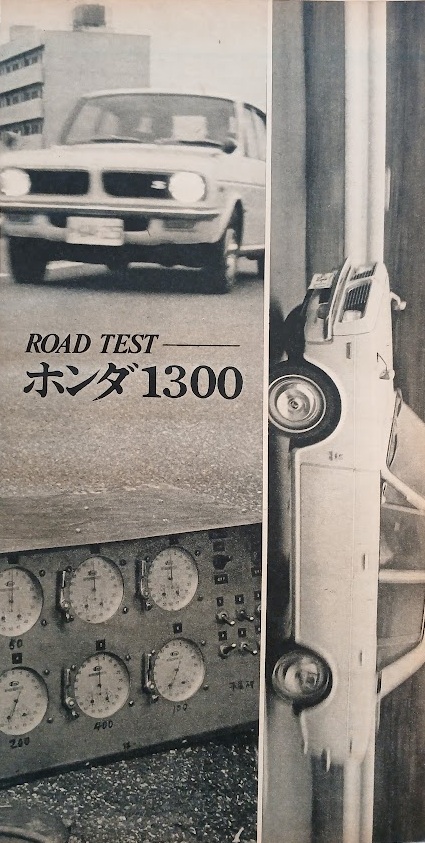
Magazine: Let’s have the Hirao Laboratory present the measured power-performance test results.
0–400m Acceleration: 16.8 Seconds (99S)
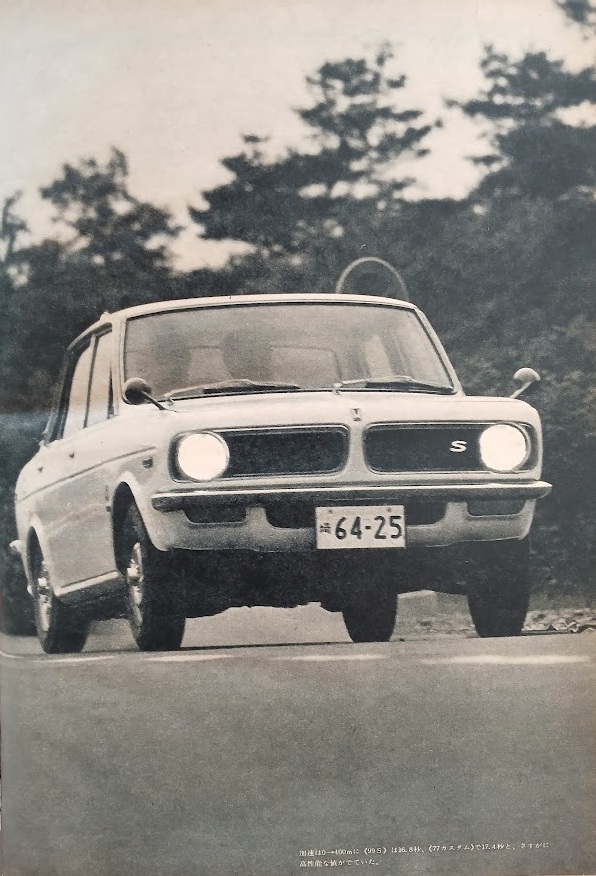
Furutani: The cars we tested were the 99S and the 77 Custom. The 99S has a catalog weight of 895kg, and the three occupants and instruments on board for testing added 205kg, for a total test weight of 1100kg.
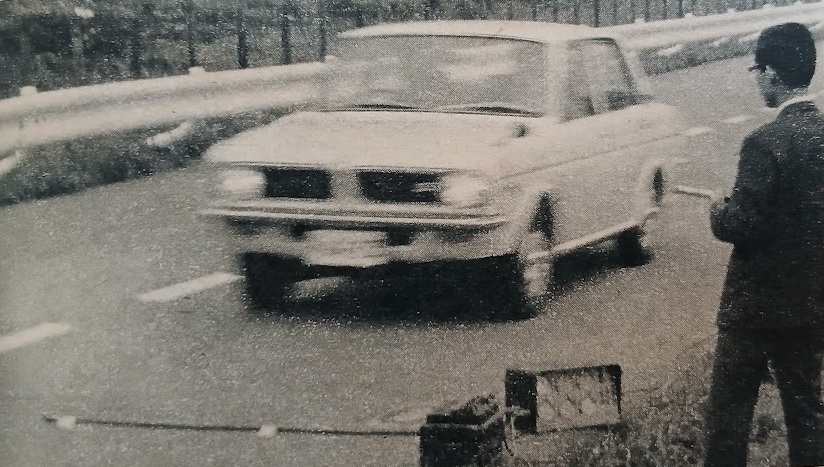
Starting with the 0–400m acceleration, the 99S took 4.5 seconds to reach 50m, 7.0 seconds to reach 100m, 10.8 seconds to reach 200m, and 16.8 seconds to reach 400m.
In terms of time to speed, it reached 40km/h in 2.9 seconds, 60km/h in 4.8 seconds, 80km/h in 7.2 seconds, and 100km/h in 11.1 seconds.
Next was overtaking acceleration. Starting from 30km/h in third gear, it reached 40km/h in 3.4 seconds, 60km/h in 8.4 seconds, 80km/h in 12.4 seconds, and 100km/h in 17.4 seconds.
For the 77 Custom, the curb weight is also 895kg, so with the same load of 205kg, its test weight was the same 1100kg. Its standing acceleration times were 4.6 seconds to 50m, 7.1 seconds to 100m, 11.1 seconds to 200m, and 17.6 seconds to 400m.
In terms of time to speed, it reached 40km/h in 3.4 seconds, 60km/h in 5.6 seconds, 80km/h in 8.4 seconds, and 100km/h in 12.8 seconds.
For overtaking acceleration, starting from 30km/h in third gear, it reached 40km/h in 3.0 seconds, 60km/h in 8.3 seconds, 80km/h in 13.2 seconds, and 100km/h in 18.0 seconds.
Oguchi: Are the gear ratios the same for both models?
Mabuchi: Exactly the same.
Watari: What are the catalog acceleration figures for 0-50m and 0-400m?
Baba: For the 99, 0-50m is 5.1 seconds, and for the 77 it is 5.3 seconds. The 0-400m times are 16.9 seconds for the 99 and 17.5 seconds for the 77.
Magazine: How was the acceleration in terms of feeling when you drove it?
Oguchi: In these kinds of acceleration tests, when a rear-wheel-drive car starts off, it usually experiences wheelspin and the car veers off line. But this car stays almost perfectly straight, with wheelspin for about the first 20 meters.
Magazine: That must be because it’s an FF car. That’s a very good point.
Higuchi: The overall mood it creates is good, but the sense of acceleration felt somewhat weak.
A European-Car Feel
Watari: The feel from 0–50m is slow. Considering the sound, that’s surprising (laughs).
Magazine: How are the gear ratios? Does it feel European in that sense?
Watari: Yes, it did feel like that.
Tamai: The gear ratios are definitely on the tall side.
Oguchi: I did feel that. Even the pedal layout, the seating, and the way the interior space is arranged all feel very European.
Higuchi: Because of that, city drivers will probably have the opposite reaction from what they expected. People will say, “It’s slow off the line!”
Baba: If you launch it too aggressively, that’s exactly what happens.
If you try to get a good time by revving it up and abruptly releasing the clutch, it doesn’t work. If you launch it calmly, matching the revs and slipping the clutch smoothly, it’s fast.
Hayano: In an FF car, they say to give it a 30cm roll before accelerating fully at intersections.
Baba: First gear may feel sluggish, but once you shift into second, it pulls strongly.
Hoshijima: The feel off the line is best if you approach it expecting the response of an ordinary car. You’ll get the sensation of speed during overtaking acceleration. When you floor it from third gear, the way it pulls is truly impressive. However, we didn’t reach the catalog top speed when we ran it at Suzuka. The straights are short there, but we only managed about 170km/h. Still, it did feel quite strong against crosswinds.
Watari: The steering feel is different. And I don’t mean this negatively; while the N360 and N600 felt unstable, this one feels firmly planted.
Hoshijima: I had the sense that the usual odd FF quirks, like changes in behavior between power-on and power-off, aren’t really present.
Watari: I thought the steering was excellent. But what about the steering wheel diameter? I found it a bit large–and also heavy. How much effort does it take to steer?
Unexpectedly “Wet” Steering
Hirao: When I drove it, the steering feel reminded me of that in a Mercedes. Would that be considered a compliment?
Oguchi: I think the steering is on the heavy side. The wheel itself has a thick rim, and the feel is not “dry” or crisp. It’s more “wet," if you will, with a smooth, heavily-damped feel.
Higuchi: For a luxury car, that kind of steering is fine. (laughs) When you’re cornering with measured inputs, it has that deliberately weighty, controlled feel.
Ishikawa: When making a U-turn, it’s extremely light, yet it still feels very natural in everyday driving.
Baba: Since it’s front-wheel drive, the steering weight changes depending on speed and how much drive force you’re applying. If you turn slowly without putting much power down, it feels light.
Watari: I wonder if it could be made a bit lighter when cranking the wheel hand-over-hand in city driving. That might be an unreasonable request, though.
Magazine: The Watari Laboratory has also measured vibration and noise data, so please tell us about those results.
Watari: Given the engine size, this car should be compared with others in the 1300cc class, and within the upper and lower limits of our usual noise evaluation zone, I’d say it’s about average. If I had to point out a weakness, it would be the presence of peaks around 50km/h and 100km/h. However, that may not be because it’s air-cooled and therefore noisy, but rather due to the front-wheel-drive layout.
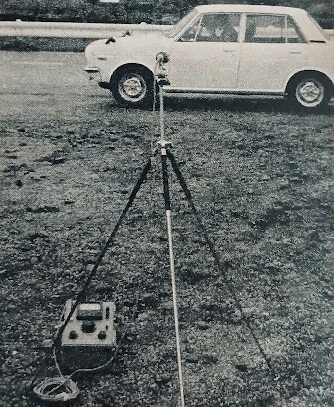
Tateishi: We measured noise levels at Honda’s Arakawa test course, and the environment and road surface there are different from the course at the Mechanical Engineering Laboratory. These were the measured results, beginning with interior noise: with four occupants, and the microphone placed at ear height in the center of the cabin, the A-weighted values for the 99S were 63 phons at 40km/h, 66.5 phons at 60km/h, 73 phons at 80km/h, 77 phons at 100km/h, and 80 phons at 120km/h. Exterior noise was measured with the car in second gear, and the values were 74 phons during steady running at 50km/h, and 79 phons during full-throttle acceleration from 50km/h. The same measurements were taken for the 77 Custom, and the values were slightly lower than those of the 99S.
Hayano: As you pointed out, the noise is coming not so much from the engine itself, but more from the suspension and running gear.
Watari: I’d seen the advertisements for the car emphasizing “quiet, quiet,” but based on our tests, I still feel there are unresolved issues when it comes to noise.
Hirao: As long as you have to qualify “it’s quiet” with “even though it’s air-cooled,” I don’t think it can really be called fully mature yet. I’d like to see it become the kind of car where people say, “I don’t know whether it’s air-cooled or water-cooled, I just know it’s quiet.” That’s the goal, isn’t it?
Baba: As for the suspension layout, the front uses a MacPherson-strut independent suspension, while the rear is a cross-beam type with leaf springs. However, the beam and the leaf springs are connected via floating joints.
Watari: What kind of vibration frequencies did you record?
Tateishi: The sprung-mass bouncing frequency is 1.4cps at the front and 1.5cps at the rear. The unsprung-mass frequency is 21.5 cps at both the front and rear.
Watari: The tires are a low-profile type, aren’t they? That seems to have improved ride comfort quite a bit. The dampers are De Carbon-type gas-charged units, but while they may be good at low speeds, don’t they become less effective at higher speeds?
Hayano: A lot of research has gone into this recently, and things have improved considerably. In particular, the issue of high-speed effectiveness has been addressed by raising the sealed gas pressure to around 30 atmospheres.
Magazine: Professor Kumabe, how did it feel to you?
Kumabe: I thought it was very good. Compared with the earlier N360, even though it’s also front-wheel drive, this one feels like a properly finished car. I was genuinely impressed.
Watari: Still, if we focus only on noise, it doesn’t quite reach the level of being outstanding… I’d say it sits around the average.
Hirao: For Professor Watari to say “around average” is actually quite a compliment. Japanese regulations are very strict when it comes to noise, so I think cars have come a long way in this regard.
Kumabe: The N360 wasn’t very good in that respect, though.
Watari: Well, that was a different class of car altogether…
Fuel Economy Improves at Higher Speeds
Magazine: Next, we’d like to ask about the fuel-consumption test results.
Oguchi: For this test, measurements were taken using the 99S. Starting with steady-speed fuel consumption, the results were 19.8km/l at 40km/h, 18.0km/l at 60km/h, 15.6km/l at 80km/h, and 12.8km/l at 100km/h.
We also conducted our standard model driving-cycle fuel-consumption test, which simulates city driving with acceleration, deceleration, and stops for traffic signals. A target indicated speed is set, and average fuel economy is then calculated. Using this method, with an indicated speed of 40km/h and an average speed of 22.4km/h, the model fuel economy was 10.7km/l. When the indicated speed was raised to 60km/h, the fuel economy dropped to 9.1km/l with an average speed of 25.4km/h. We expect these figures to be slightly better for the 77.
Hayano: As you can see from the steady-speed fuel-consumption figures, we were consciously aiming to achieve good fuel economy at higher speeds.
Oguchi: The most economical speed appears to be around 40-50km/h, but even when you continue accelerating up to 100km/h, fuel consumption doesn’t suddenly worsen. For the fuel economy to remain this good at high speeds is really quite remarkable.
Mabuchi: The steady-speed fuel-consumption figures are very close to our internal data.
Watari: If you take about 60% of those figures, that gives you something close to real-world fuel economy under normal driving conditions.
Oguchi: That’s right. For most cars, average fuel economy in city driving tends to be roughly 60% of steady-speed fuel consumption.
Magazine: What are your in-house steady-speed fuel-consumption figures, and how about oil consumption?
Hayano: For the 77, the figures are 20.7km/l at 40km/h, 21.5km/l at 50km/h, 20.2km/l at 60km/h, 18.8km/l at 70km/h, and 17.6km/l at 80km/h. Compared with those, there is a slight discrepancy with the figures from this particular test, but they generally agree.
As for oil consumption, it’s about 3,000-4,000km/l. The 3,000km/l figure applies when the car is driven continuously at relatively high speeds.
Magazine: For the handling and stability tests, this time we’ve asked Professor Saito of Tokyo University of Agriculture and Technology to take over from Professor Kondo. Could we have the results?
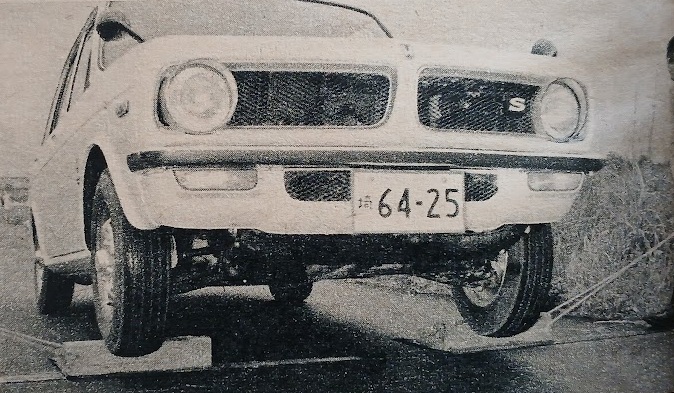
Saito: In the future, we intend to reexamine the testing methods themselves, but for the time being we conducted the Honda 1300 tests using the same procedures employed by Professor Kondo in the past. The practical minimum turning radius measured 5.34m on the inside, which is somewhat larger than other cars in the same class.
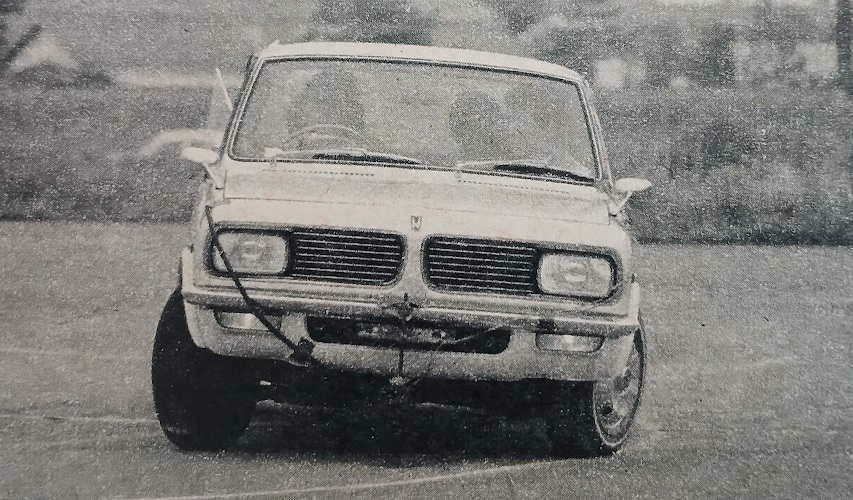
The understeer/oversteer (US/OS) tests were conducted by accelerating in a circle with a 15m radius, and the results indicate a fairly strong understeer characteristic. The maximum steering force to hold the wheel steady was 5kg at 0.59g, which I would say is on the heavy side.
The roll angle is about 4.0°. Maximum steering effort with the car at a standstill was 12.5kg to the left and 11.0kg to the right, both measured at approximately 270° of steering angle. Compared with previous data, these values are slightly lighter than average.
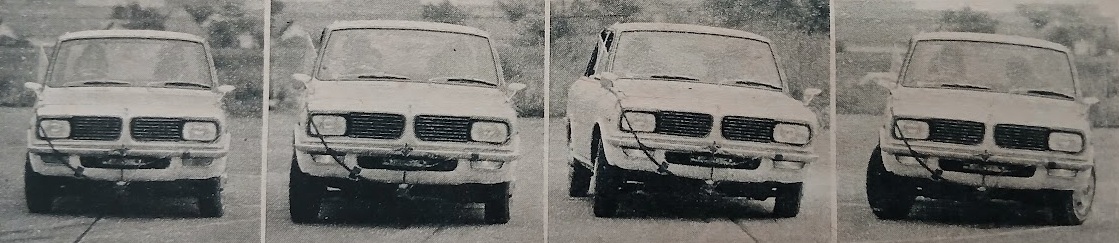
During slalom testing at 80km/h, with a lateral acceleration of 0.25g, steering effort measured 2.0–2.2kg, and the force required increases linearly with lateral acceleration.
We also conducted free-release directional stability tests up to 110km/h, and the results show that the car converges back to a straight path extremely well.
Magazine: Earlier, there were comments about the steering having a good “feel.” Could we ask the engineer responsible to explain the design intent behind this?
Hayano: As for the steering feeling somewhat heavy, we consider that to be primarily related to rotational inertia. The relationships between roll rate and understeer/oversteer are almost exactly what we had intended. We’re pleased to hear the comment about good convergence, because we deliberately incorporated a steering damper to improve high-speed stability. This, however, also contributes to the heavier feel when the wheel returns to center.
The inertia was intentionally made heavier. This is very much part of the car’s character, and we deliberately aimed for a “wet” steering feel, as it was described earlier.
Watari: Steering feel is a difficult thing to define, but put simply, I’d say it has a kind of shibui quality–a muted, grown-up feel.
Magazine: This uses a rack-and-pinion steering system, correct?
A Brake Feel That Doesn’t Seem Like Discs
Hayano: Yes. The steering wheel diameter has been made on the smaller side, and the rim itself is thicker. It’s a matter of taste, but some people dislike thin-rimmed steering wheels.
Oguchi: I personally like a “wet” steering feel, but I had the impression that it’s a bit different from the usual character of Honda cars…
Watari: Steering feel can be perceived very differently depending on the car you were driving just before, or even on one’s driving style.
Ishikawa: In the early days of the N360, the steering returned so quickly that if you let go of the wheel mid-turn, you had no idea where the car was going. This car is nothing like that.
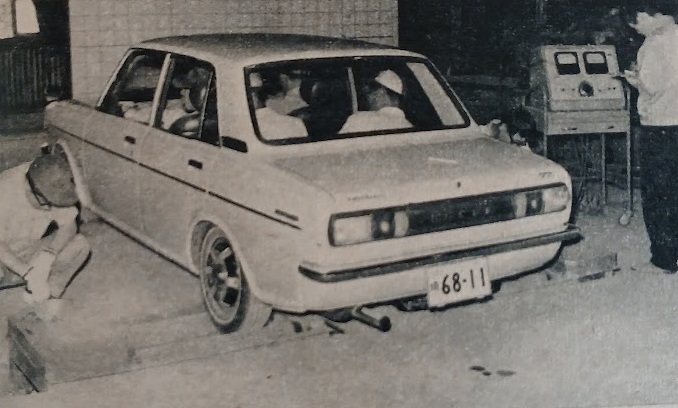
Magazine: Please present the results of the weight measurements and brake tests conducted at the Ship Research Institute.
Ishikawa: We took measurements on the 77 Custom, and the catalog vehicle weight is 895kg, but with the spare tire and tools, it came to 935kg. Weight distribution was 269kg for the front right, 301kg for the front left, and 179kg for the rear right, 186kg for the rear left. As expected for an FF car, the front–to-rear distribution is heavily front-biased at 61:39. Even with five occupants aboard, it remains front-heavy at 55:45.
As for wheel alignment, with one occupant the toe-in is relatively large. At the rear, toe-in is also large, with a small amount of camber. With five occupants aboard, however, toe-in is reduced and negative camber begins to appear.
The brakes are discs at the front and leading-trailing drums at the rear, with servo assistance acting only on the front. The rear is equipped with a pressure-limiting valve to control hydraulic pressure. Because the servo effect starts at relatively low pedal efforts, the brakes bite strongly even with a light touch. However, to achieve 0.6g of deceleration, a relatively large pedal force of 30kg is required, which gives the system a somewhat peculiar feel.
That said, in the road test, the pedal force required for 0.6g was 18kg, quite different from the bench test results. The servo remains effective up to about 0.35g deceleration, so only about 10kg of pedal force is needed up to that point, but once the servo cutoff point is reached, pedal effort increases sharply–that tendency was clearly felt.
Magazine: How about the distribution of braking force?
Ishikawa: The front contributes 85-90%, which seems extremely high, almost as if only the front brakes are working…
Hayano: At 0.6g, that pedal force is about what we expect. The reason for allocating such a large share of braking force to the front is purely safety-related. The downside is increased wear of the front brakes, but we’ve addressed that by increasing the pad area and other measures.
Hirao: Another downside is that wear on the front tires is also increased.
Ishikawa: As for other operating efforts, the clutch uses a cable linkage and requires only 7.5kg to disengage, which is extremely light. I think that makes it much less fatiguing to use.
Higuchi: In terms of feel, the brakes don’t really seem like disc brakes at all, and in that sense I think they’ll be easy to adapt to even for people who aren’t accustomed to discs.
Watari: They aren’t bad brakes by any means.
Hayano: If the system makes you think it’s a twin-leading drum setup at the front, then it’s exactly in line with what we were aiming for.
Thorough Attention to Safety
Watari: Won’t the front tires have a shorter service life?
Mabuchi: That’s certainly true, but with regular tire rotation we expect a total of about 30,000km from the front and rear combined.
Magazine: Next, let’s hear the results of the visibility tests conducted by the Hirata Laboratory.
Hirata: We conducted measurements with the seat adjusted to three positions: fully forward, in the center of the sliding range, and fully rearward. I’ll present the figures for the center position. In that configuration, eye height was 116cm above the ground, and the distance from the front edge of the lens cap to the windshield was 60cm. The forward field of view through the windshield was 96.5° horizontally and 23° vertically. The visible range through the rear window was 52°. The wiper sweep covered 32° on the right and 52° on the left, which is quite generous. The dead angle on the horizontal plane passing through the eye point was about 45°.
Yamamoto: I think the blind spots are relatively small, but the headrests installed for safety do tend to get in the way.
Hirata: That’s why, in recent cars, the eye point has been getting progressively higher.
Oguchi: This may be jumping around a bit, but I was concerned about the position of reverse in the shift pattern. It’s located to the left and forward, next to first gear, and since they aren’t separated much in the horizontal plane, it seems possible that when trying to engage low gear, one might accidentally select reverse instead. Was there a particular intention behind this shift layout?
Mabuchi: Our thinking was that during garage parking or repeated back-and-forth maneuvers, having low and reverse close together would make things easier. If reverse were placed next to second gear, we felt it could actually be more dangerous during downshifts.
Watari: Yes, having it close to second would definitely be more hazardous.
Magazine: Now, speaking of safety, we’d like Professor Higuchi to go into this area in more detail.
Higuchi: Regarding safety, we used American safety standards as a reference and evaluated each area using a five-point scale, adding a Japanese perspective to the criteria. Considering the size of the car, the result is extremely–well, “impressive” is the word for it. It includes features that until now have only been found on higher-class cars, such as a warning lamp that remains lit unless the seat belt is fastened. From the standpoint of engine displacement, the car scores at least one class above what would normally be expected.
Out of a possible 100 points, it scored 86 points, so I think it’s fair to say that the manufacturer’s emphasis on safety is clearly reflected in the results.
That said, I do have some requests. For example, I’d like a bit more thought given to bumper thickness and how the bumper engages with the body structure. And if I may add one more luxury item, it would be nice to have a rear-window defogger.
Mabuchi: That last item is available as an option.
Magazine: How is the maintenance?
Higuchi: With oil changes every 5,000 km and grease service every few tens of thousands of kilometers, it’s essentially maintenance-free, so there’s no real problem there. However, since this is a dry-sump engine, for users who aren’t familiar with that system, I’d like to see the owner’s manual clearly explain how it should be used–for example, what oil level means what, and what action should be taken when.
Mabuchi: On the oil-tank dipstick, the upper mark corresponds to 4 liters and the lower to 3 liters. The dipstick itself extends further, though, and as long as oil is showing at the tip there’s still about 1.3 liters remaining, so up to that point it’s basically safe.
Magazine: Since you’re introducing a completely new small passenger car, what will the service network look like?
Yoshida: Sales will follow the same approach as with the existing N Series, but we’re building a nationwide Service Factory network so that no matter where the car is purchased, it can receive service at the same technical level as at the factory. The warranty period will be one year, with as few exclusions as possible, and for the first vehicle inspection we plan to use Service Factory equipment and keep the cost to 15,000 yen. By the end of this year we’ll have 300 Service Factory locations, and by the time of the second inspection, two years later, we plan to have 500 locations, of which 300 will be equipped to carry out inspections in-house.
Magazine: Finally, what about production plans and exports?
Sase: Sales will begin at the end of May, and by around November we’ll have facilities in place at the Suzuka plant to produce 10,000 units per month. But we’re not a company that’s satisfied with just meeting planned production, so by next spring we’re looking to reach 12,000 units per month.
As for exports, this year we’ll be fully occupied with domestic demand, so realistically it won’t happen yet. That said, we believe that unless about 30% of production goes overseas, a car can’t truly be called a global product, so I think you can look forward to that.
Magazine: Thank you all very much for your time today.
Postscript: Story Photos