Honda 1300 99 Custom (1970)
Publication: Motor Fan
Format: Special Test Drive Report
Date: March 1970
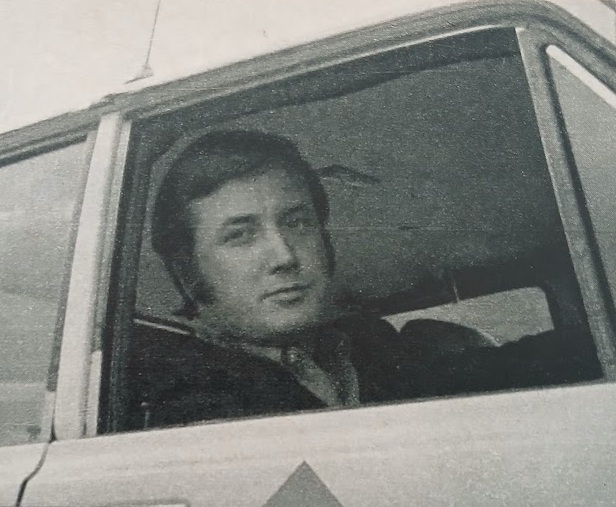
Author: Mauri J. Salo, Motor Fan Editorial Staff (uncredited)
With Love From Finland
A high-speed run from Tokyo to Fuji Speedway! In this special test drive report, we present impressions of the Honda 1300 from a Finnish motoring journalist.
Finland as a Test Market
Until I attended last year’s Tokyo Motor Show, I had certain preconceived notions about Japanese cars. Namely, that they were durable, but uninteresting. Well made, yet lacking creativity in their mechanical design… Even now, that view still applies to most of what the Japanese automotive industry produces, or perhaps more accurately, to the cars it exports.
However, the Honda 1300 that I was fortunate enough to drive, specifically the 99 Custom, is something entirely different from the Japanese cars I have known up to now. Should I call it a welcome surprise?
As you may know, since imports of the 3-speed Datsun Bluebird began in 1962, Finland has served as a test market for Japanese automakers, a foothold for Japanese cars entering Europe. Following Nissan, other manufacturers began to appear in Finland: Toyota, Isuzu, Toyo Kogyo, and finally Honda, known for its small cars, all entered the market in that order.
None of these cars were especially remarkable in any particular technical respect, but from the outset they performed well and were warmly welcomed. Their reputation grew accordingly, and even now that favorable standing continues. Finnish users regard Japanese automobiles as “good buys.” To their owners, Japanese cars are known as long-lasting vehicles with few troubles.
Unexciting Japanese Cars, But…
In my magazine (Tekniikan Maailma, “World of Technology”), we have been road-testing each of the Japanese cars that have been brought into Finland. Almost without exception, one senses that, relative to their price, they are extremely well made, yet there is always a lingering feeling of dissatisfaction, a sense that something exciting is missing. Their steering, in general, does not seem particularly sharp (in part due to tires that are not especially good). Their brakes tend to be over-assisted, and as a result, from the driver’s point of view, they feel as though the wheels lock too easily.
On the other hand, the engines are consistently excellent, and the gearboxes are of outstanding quality. The heaters, an indispensable requirement in a country with severe winter cold, perform better than expected.
However, as mentioned earlier, I had not encountered a truly exciting car up to now, although most of them are “good” as family transportation. The Isuzu Bellett comes closest, and has many enthusiastic fans even as a rally car. My point, though, is that they lack the kind of individuality found in an Alfa or BMW, Jaguar, or Renault Gordini. Perhaps this is not the best way to put it. To name the closest comparison, they lack the technical innovation, the “banzai!” feeling, found in Japanese cameras and electronic products.
A “Good” Sign for the Honda 1300
Japanese motorcycles also show this spirit, as seen in the various races contested in Europe, where they have led their classes almost without exception. So motorcyclists have had a taste of this excitement. But cars? No. And yet…
The Honda 1300 is a car that, in its own way, allows a grown man to behave like a small boy. It is a car that makes you forget that it is “just a car.” Instead of gritting your teeth and suppressing, on ordinary roads, the temptation to unleash its full potential, you feel compelled to take it to the racetrack in order to experience it the way it is meant to be enjoyed. In other words, it creates a sense of anticipation for an experience to be savored, and for an automotive journalist, this is the most reliable sign of a good car.
We Would Like More Helpful PR
Before beginning the story of the Honda 1300, I should first relate my experiences when visiting Japanese automakers’ factories. European automobile plants, perhaps because they have been exposed to such an overwhelming number of visitors, seem to spoil us with their hospitality. As you probably know, press materials are well prepared, and even the most exciting machines are made available in abundance for us to try.
In Japan, however, it seems nearly impossible to obtain any kind of information. Even when meeting the staff responsible for explaining things to factory visitors, one is not given the opportunity to take the wheel of any car. If one does ride in a car, it is only in a company taxi. Before visiting the Tokyo Motor Show, we came expecting to drive many cars, having thoroughly crammed ourselves with knowledge about each manufacturer. We also hoped to speak with designers and discuss Finnish road conditions, as we often do, so that I could return home equipped with first-hand experience and information for readers eager to learn about these cars, which would soon be appearing on the scene.
If it were not for the help of Motor Fan, I would have returned with only two or three photographs from the show. As for everything else, I would have gone home empty-handed. That is, of course, apart from my impressions of Japan’s natural beauty and its delicious food…
But my friends arranged for me to drive the Honda. For this, I would like to express my deepest gratitude.
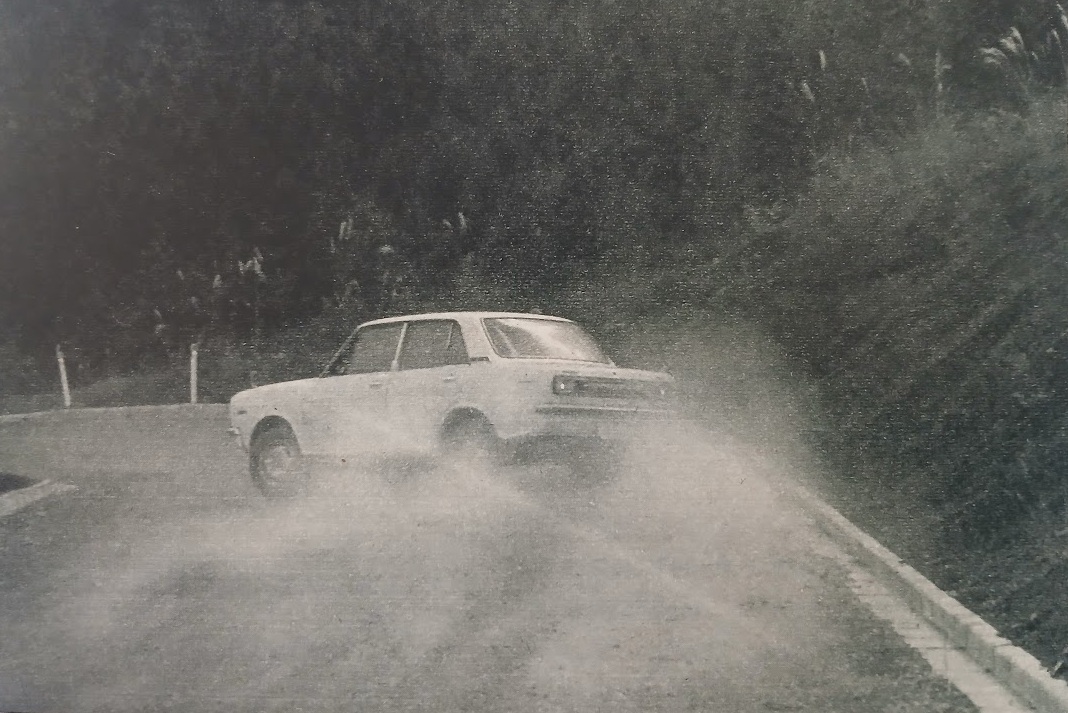
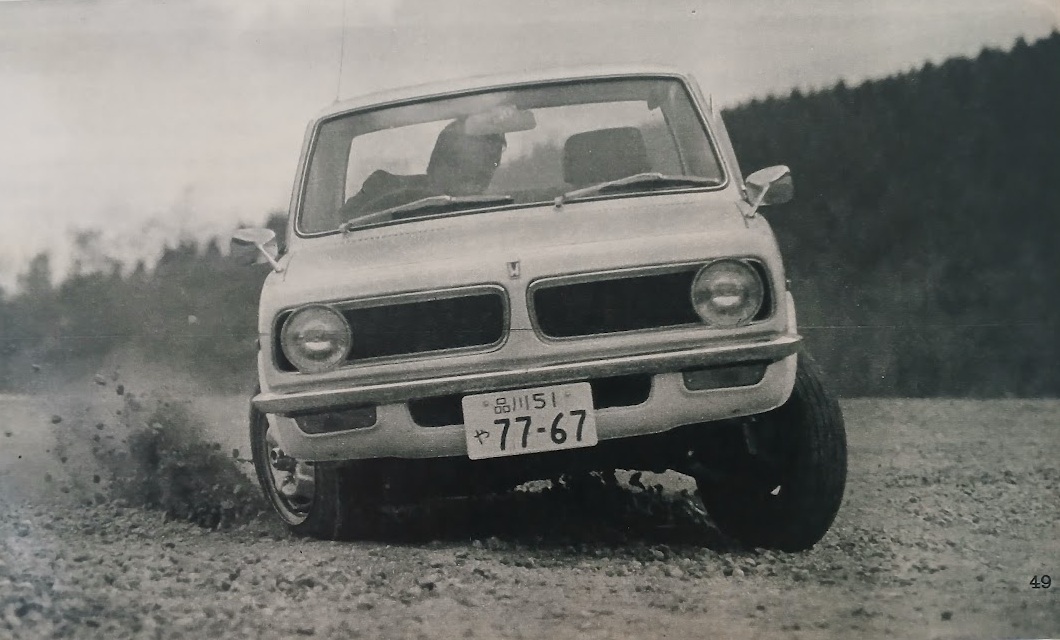
Now, let me return to the Honda 1300. Like myself, or perhaps even more so, there are probably many readers who have already been following the development of this car, so I would like to skip over the technical details. Instead, I will talk about what I felt, and my own impressions, as I drove the 1300 on the expressway to Fuji Speedway, along country roads, and over well-maintained gravel roads.
This route was, in fact, very similar to a Finnish rally course.
A friend of mine in Belgium, who had visited Japan two or three times before I did, had previously shared his impressions of the Honda 1300 77 Series with me. He said that while the 77 Series was a “fantastic” car, its suspension was soft, which significantly compromised cornering ability. He also felt that the brakes would not withstand the demands imposed by its power performance.
For comparison, he described it as being in the vein of European cars such as the MG 1300, Lancia Fulvia GTE, Alfa Romeo 1300 TI, Fiat 128, and Escort GT, with performance approaching that of the “hot Italian cars” that were then at the forefront. He also pointed out that it was tighter inside than its European rivals.
I am 184cm tall, and I found ample room in the driver’s seat. In the rear, however, it is somewhat cramped. To compete with European cars as a family sedan, it should be a little wider. But as a sporting car, it seems entirely sufficient.
Unexpected Performance
The performance was not quite what I had expected, nor fully in line with Honda’s own claims. This became apparent on the expressway, even without attempting to reach the 185km/h catalog top speed, which would have involved risking a speeding violation anyway. In terms of acceleration, I did not have the opportunity to record any times, but the engine did not seem to be delivering the full punch of 115ps. Pushed hard, it ran out of breath just before 7000rpm. This limitation seems to lie with the carburetors. Perhaps they were slightly out of tune. Replacing the four Keihin carburetors with twin-choke dual Weber units would undoubtedly improve performance. I would suggest that export models would benefit from this modification.
However, I did not find the suspension to be problematic, contrary to what my Belgian friend had noted. It is likely that firmer springs and shock absorbers are fitted for the sporty 99 Series. Although understeer is still pronounced, it never felt unpleasant on the road. Thanks to the straight-line acceleration, one can afford to take corners at a leisurely pace. I also felt that the chassis was exceptionally solid on rough surfaces, transmitting no uncomfortable vibrations. This gives the driver what might be called an undefinable feeling of strength.
Tuning for Victory in Rallies
At this point, I began to wonder about the subject of competition. How might the Honda fare as a rally car? I have entered rallies myself with the Renault 8 Gordini. It was an older model, with 1150cc and an output of 105ps, but the new 1300cc model is equipped with a tuned OHV engine delivering 120ps (DIN) and is over 100kg lighter than the Honda 1300.
In its class, the Gordini only just manages to be competitive, so for the Honda 1300 to be competitive as well, it would need to be tuned up to around 130ps. Naturally, the two-door version, being lighter, would make a better base for such tuning.
In any case, any talk of rally participation seems, at least for now, a matter of the future. I know several young people in Finland who are watching closely, eager to see how the Honda 1300 might be tuned.
And of course, it seems there is plenty of potential to increase the car’s driver appeal. Fitting wider tires on wider rims would clearly improve cornering, and brighter body colors would make the car even more attractive to younger buyers, just as the “special” models of Japan’s 360cc cars do.
The seats themselves need to be made larger, and the cushions should be extended to support the thighs, particularly for taller Europeans. Above all, to earn real acclaim, the engine should deliver more power and reliably match its promised output. In other words, the performance should match the specifications in the catalog. After all, in Europe, it will be entirely possible to verify the stated top speed of 185km/h.
The interior is neat and functional, and despite being air-cooled, the engine is genuinely quiet, though it does not remain so when revved hard. Overall, it feels perfectly natural to drive, and build quality is above average.
Objectively speaking, the handling is somewhat below average, though not alarmingly so. For example, the Lancia is better balanced, and even the Saab 96 corners more quickly. Nevertheless, the combination of performance and handling in this car is very well matched. I am convinced that the 1300 will quickly be developed into a very good car.
The Honda 1300: Expected to Be Well Received
Let us hope that Honda produces an updated version of this car in a special sports specification. A gleaming red two-door model, reduced by 100kg and perhaps fitted with a 1600cc engine, would be easily “homologated” in the class of sporty coupes available in Europe. One can likewise imagine seeing a Japanese car running in the lead in Europe’s major rallies. For a racing journalist, and especially for me, there would be no greater delight than to see a pair of Finnish drivers flashing the victory sign from the winning Honda. Whether it arrives as a sports model or not, there is no doubt that the Honda 1300 will be warmly welcomed in Europe and Finland.
Postscript: Story Photos