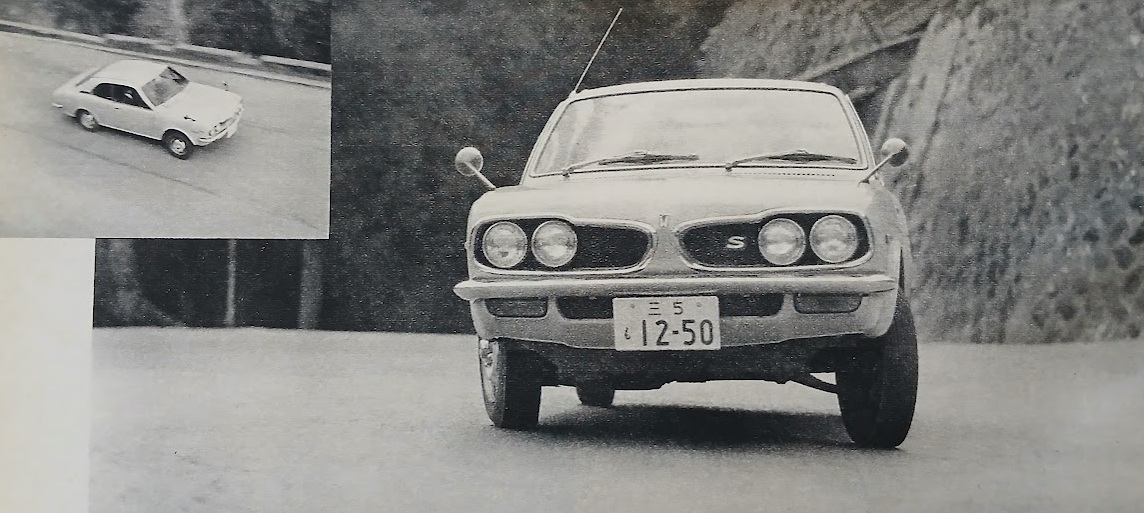
Honda 1300 Coupe 9S (1970)
Publication: Motor Fan
Format: Dynamic Test Drive
Date: May 1970
Author: Shigeki Asaoka, Noriko Asaoka, Motor Fan Editorial Staff (uncredited)
Honda 1300 Coupe 9: Full of Frontier Spirit
The “Dynamic Test Drive” series has been well-received by readers, and is now in its fifth installment. The car that was decided to be the subject this time was Honda’s 1300 Coupe 9, and on the day before the test, just as everyone was getting excited, our protagonist, Shintaro Taki, ruptured his Achilles tendon. Our editorial team scrambled to find a replacement, and we were finally able to approach one of the racing world’s most prominent theoreticians, Shigeki Asaoka. We hope to see Taki return once he’s recovered, but this time we asked Shigeki Asaoka and his wife to conduct the test drive of the Honda Coupe 9.
(Asaoka:) My senior colleague, Taki-san, has torn his Achilles tendon, so I’ve been asked to take on the role of pinch hitter. When I think seriously about filling in for my lofty senior and writing the test drive report in his place, it’s a heavy burden and a daunting task. It makes me a bit depressed.
However, I have also dedicated my entire life to racing. Hoping to contribute to the development of automobiles, I have devoted all of my energy, however insignificant, to challenging the possibilities in this field. In this spirit, I accepted the offer, determined to give it my all, just as I have done in racing up until now, even though I am not certain that I can write something that will move readers in the same way as Taki-san.
Since I have accepted the position, I will not make any long-winded excuses for myself. People will read it, and I will do my best to earn their forgiveness.
I see, it’s a Honda car!
On the day of the test drive, I was already at Fuji Speedway for some business when Motor Fan arrived with the Honda Coupe 9. I had often seen this car in catalogs and magazines, but it was my first time seeing one in person. It was in the driver’s salon at Fuji Speedway that I first encountered it. At that moment, a familiar, nostalgic feeling struck me: “Ah, this is definitely a Honda car!”
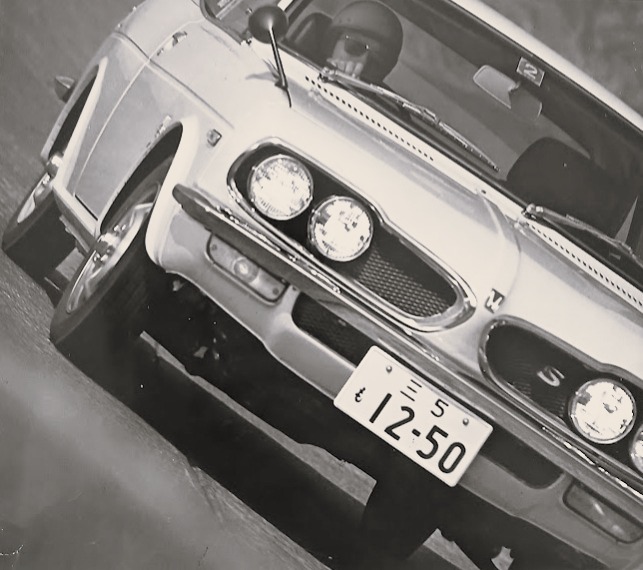
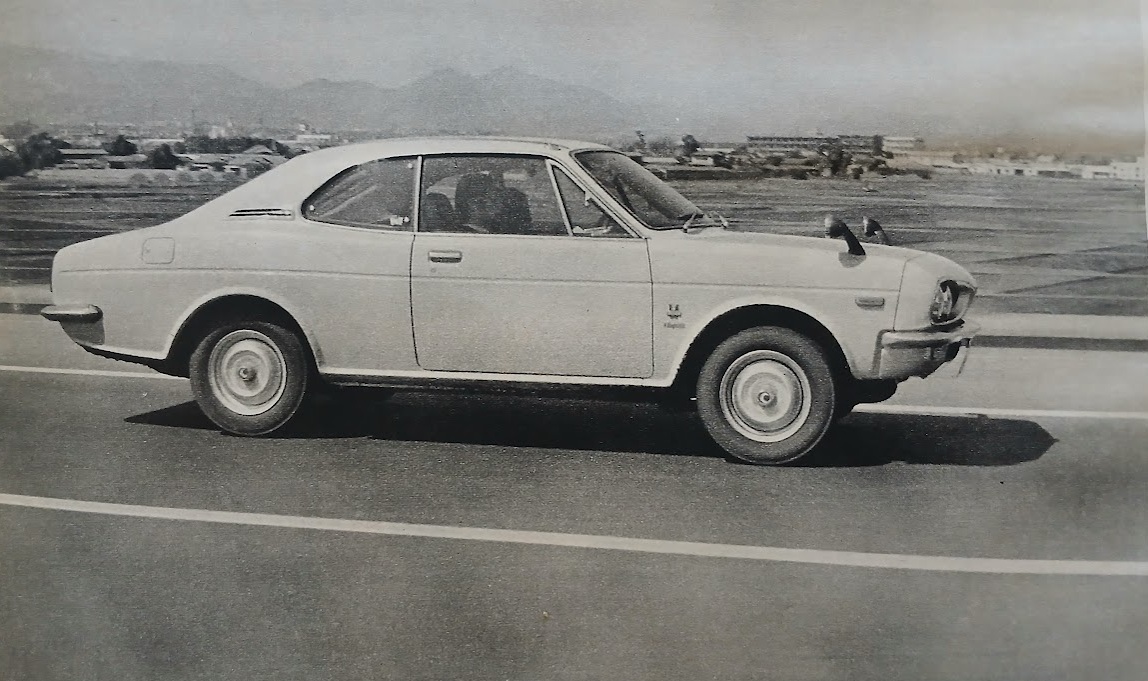
The front view is bold, split into two halves with a central apex. It has an unmistakable challenger spirit. When you think of Honda as a company, it is immediately associated with challenging convention. That image began with their motorcycles, and has stayed with them to this day. Not only the front view, but also the cantilever roof, the 20.5 degree rear window angle, etc., all say “Honda” from the first glance.
Still, why does it look slightly smaller than its 1300 sedan counterpart? Perhaps the curvature of the overall R angle has the effect of making the car next to it look larger, though this was surely not the intention during the design phase.
I opened the driver’s door. Once again, I thought, “Ah, just as I expected,” and settled into the seat. The steering wheel felt great in my hands. The size was just right. I focused my eyes on the dashboard. “So this is what they call a ‘flight cockpit’…” I looked ahead, straightened my arms, and assumed a driving position. The gauges were very easy to read. It was the kind of thoughtful design that you would expect from Honda, a leader in the racing world.
When I was around 20 years old, when I wore the look of a grown-up on my face and was confident that I knew everything about cars, I probably would have jumped at the chance to own this car the moment it was released.
Honda is also likely targeting a younger demographic with this car.
Viewpoint: Mrs. Noriko Asaoka
When I started racing as a woman, I was driving a Honda S600. Taking part in this test drive, I was able to drive a Honda car for the first time in a long time, and it brought back such a feeling of nostalgia that it made me shiver. My first impression when I sat in the seat was that it was not at all different than the Honda I had when I was racing three or four years ago. My “20-year-old younger brother” here has been singing the praises of this Honda Coupe 9, and seeing it in person, I can understand his sentiment very well. The exterior and interior styling seem to incorporate all the latest trends–major manufacturers like Toyota and Nissan would never be able to go to these extremes. I felt strongly that Honda’s design philosophy remains alive and well.
Outstanding seats and excellent visibility
There was no point sitting and admiring the interior forever. So I prepared to set off from Fuji Speedway. I turned the key and started the engine. “Hmm… is this definitely air-cooled?” I checked with the editor just to be sure, and he said it was. Considering that, it’s very quiet. I wouldn’t go as far as saying it’s quieter than a normal water-cooled engine, but it’s quiet enough that it’s hard to believe it’s air-cooled. They must have put a lot of effort into it. The editor added that it’s an OHC system, and I thought, “Of course it is.” It’s a mechanism that is unique in the world.
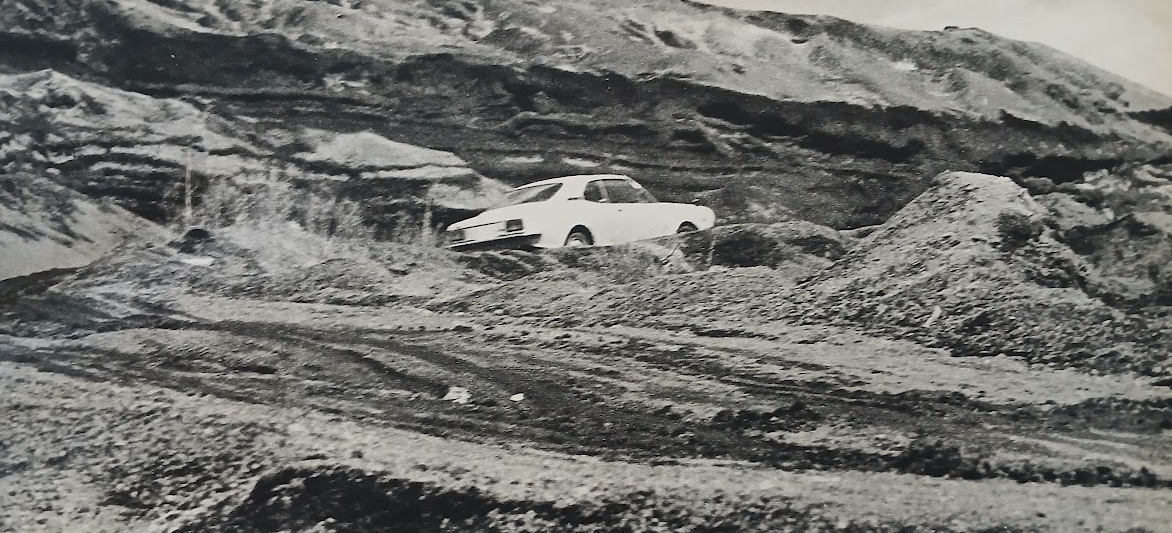
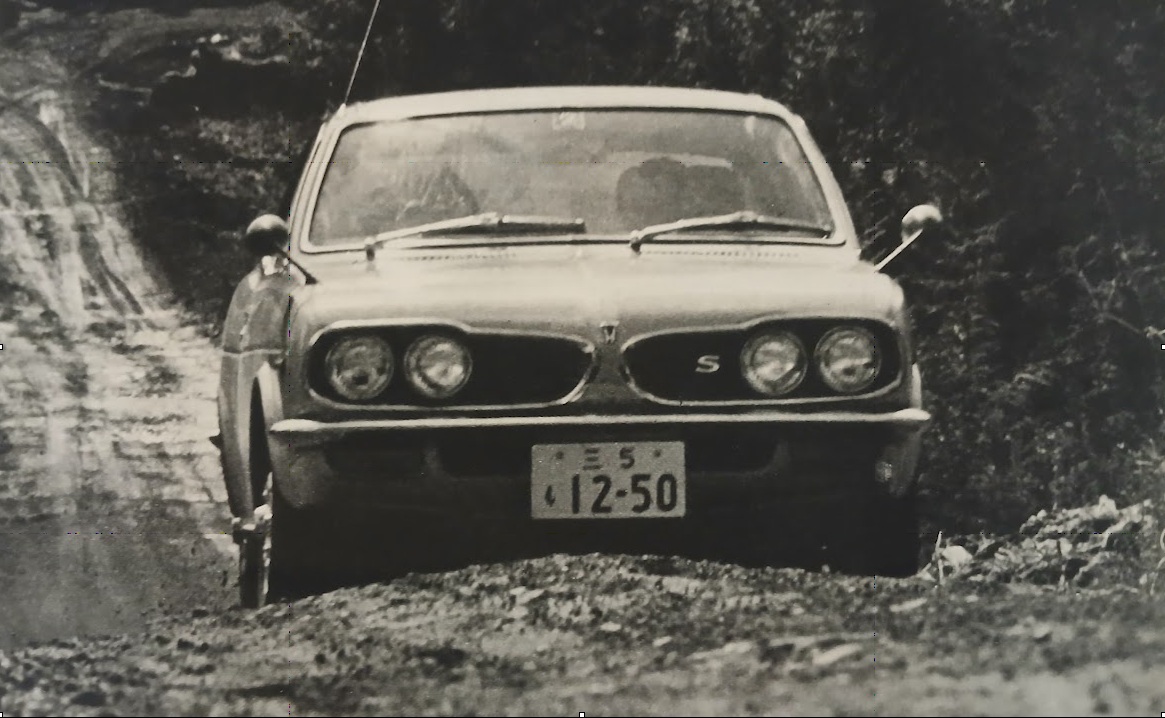
Leaving Fuji behind, I turned onto a local dirt road. I didn’t push the speed too much, and started off at a normal driving pace. Under these conditions, the seat felt great, just as it had when the car was stationary. The cushion fit my lower body perfectly, and it was very supportive, so even as I was moved up and down or swayed side-to-side, I didn’t slide around. The padding wasn’t particularly soft, but it wasn’t particularly hard either. The seatback was quite narrow, but the area under my shoulders was nicely contoured, giving me the feeling that it was cradling my entire back.
In addition, visibility was excellent, again in the same way it had appeared when the car was parked. With long-nosed, sporty cars, it’s common to have to shift your body around while driving to compensate for poor visibility. However, with the Coupe 9, just by glancing up and down, you can see the road ahead and the gauges. The speedometer and tachometer are large, with the fuel gauge in the middle and the smaller amp and oil gauges on the left. It’s a very simple and legible layout.
Even without driving hard or quickly, you can appreciate the light shifting effort and the crisp, satisfying feel of engaging and disengaging each gear. It’s the complete opposite of the squishy feel of Porsche-type gearboxes, and while some people like this feeling and others dislike it, it perfectly matches my tastes. The “click-click” feeling inspires confidence. Here again, I strongly sensed that the design was influenced by “young people’s preferences.”
Viewpoint: Mrs. Noriko Asaoka
The position of the shifter is very good, and it was easy to drive with the seat slid forward to improve visibility. Most cars position the shifter too far back, so that even if I want to pull the seat farther forward, I can’t, and end up having to slide it backward for driving. The Coupe 9 is unusual in that I can still operate the shifter even with the seat all the way forward. Also, it’s common in this type of car for the seat to be too low, with the steering wheel in your line of sight, but I could see out of this car surprisingly easily. I wonder if it was designed with women drivers in mind…
The high-speed engine has been heavily modified
Apparently, the release of the 1300 Coupe coincided with revisions to the 1300’s engine, with a reduced overlap time and revised distributor to improve flexibility and fuel economy. While driving it, I could definitely feel the changes. In hard acceleration through first, second, and third gears, the engine speed doesn’t climb as quickly as in previous Hondas. The redline starts at 7500rpm, but even using full throttle, it will only just reach that speed. Without even checking the catalog, just judging from the driving feel, I suspected that maximum torque arrived somewhere around 4500-4700rpm. Later, I looked it up, and it is rated at 11.5kgm at 5000rpm, which is admittedly somewhat higher than other cars of the same class. However, compared to the 3.2kgm/7000rpm of Honda’s NIII, I felt that the traditional high-speed character had been significantly reduced. (Note: maximum output is still a high 110ps at 7300rpm.)
Even so, the engine revs well. The power and acceleration are as expected of a Honda. I couldn’t help thinking that it’s perhaps rather dangerous for someone who isn’t a particularly skilled driver. Humans have a troublesome instinct to want to go faster. In that respect, Hondas have always given me satisfaction, though I don’t know whether that’s a good thing or a bad thing…
Next, I opened the engine compartment. Oh dear. Air-cooled engines are supposed to be compact, but this 1300 engine is huge, looking more like a 1800cc or 2000cc engine. Checking the details, it is apparently a single-body, dual-air-cooled design, and it’s clear that a great deal of attention has been paid to “silencing” the engine. A thick cover encases the entire unit, and this is what prevents it from being more compact.
The transmission, which is responsible for bringing out an engine’s performance, can be said to be a perfect match for this engine’s high-speed characteristics. The ratios are 3.446, 2.014, 1.367, and 1.000 for first, second, third, and fourth gear, slightly higher than other cars in the same class. This matches well with the performance and brings out its full potential.
Viewpoint: Mrs. Noriko Asaoka
The engine runs very smoothly. I couldn’t help but wonder, with my feminine instincts showing, how durable it will be if it runs so smoothly…
Too bad! The handling makes you shake your head
After the dirt-road driving, to complete the test drive assignment, I drove the Coupe 9 to my heart’s content over the course of two days, taking a route over Otome Pass, on to Sengokuhara, and returning on the Tomei Expressway. For me, it was more distance than I needed (about 400km).
Now, let’s move on to the main topic and get into my opinions.
In terms of my personal preferences, I honestly don’t care much about interior comfort or exterior styling. That’s probably why I am involved in racing, because what I’m really interested in is power and handling. If you asked me to describe the true joy of racing, I would say it is the constant pursuit of the limits, always challenging the machinery. I apologize for sounding like I think I know what I’m talking about, but I truly believe the point I want to make next. It’s a big mistake to think that cars simply go where they are pointed naturally. It is because of the efforts of all manufacturers, not just in Japan but all around the world, and who go to great lengths, that cars can be made to follow the driver’s intended line.
The current situation is that we are somehow able to create cars that do so by accumulating experiments day after day to determine what is wrong with a car dynamically, and then improve it. The power of the racer, or rather the driver, plays a major role. What the driver feels during each test is essential to creating a safer car. In some ways, it is not an exaggeration to say that a single driver’s feeling determines everything.
When it came to high-speed driving, the first thing I noticed in the Coupe 9 was that it was a very difficult car to get a grasp of. Of course, I am aware of the characteristics of the trendy FF mechanism. Even so, when I was winding through the curves of Otome Pass and around Gora, steering to the right and left, I felt that the way the steering wheel turned and returned to its original position was oddly inconsistent.
To be more specific, when you turn the wheel and then release it, and anticipate it returning naturally to the straight-ahead position, it instead remains in the turned position, if only for a fraction of a second. If the pattern was fixed and it always behaved consistently, then you could just adjust your driving accordingly. However, under similar repeated conditions, there just didn’t seem to be one right way to steer the car to get the intended result.
It took two days of intensive driving before I finally figured out the quirks of the car’s handling. I acknowledge that the FF mechanism itself is quite complicated, but even so, this made me feel uneasy.
Of course, it may not be something that has much of an impact in normal driving to the average driver. Perhaps my unease is due to being overly nervous about the tough races at 200km/h and 300km/h?
However, this judgment led me to the following speculation: Perhaps this instability was the result of insufficient testing. Despite all the painstaking effort, perhaps there were still some unresolved issues that could not be ironed out before the car was released for sale. I’m not trying to make excuses, nor am I in any way suggesting it’s a defective car. No car is built perfectly.
The difficulty is the same in any organization. There’s always a fierce battle between engineers and salespeople. The struggle to find a balance between providing cars to users as quickly as possible, and collecting as much data as possible to create an even more perfect car, is what leads to the creation of the product on the market. There must be an element of high-level judgment at play that a simple person like myself can’t understand.
However, I can’t help but feel that with minor modifications to improve the handling, as opposed to fundamental changes, much better stability could have been achieved. I have a friend who is an engineer at Honda. He is a very talented guy. Honda has many young engineers with great potential. I have heard him express similar opinions, and perhaps this is why I am greedy, wanting still more from the car.
Of course, even if fixing this is just a matter of a “small” correction, it’s not the kind of problem you can glance at and tell in an instant what that solution is. When it comes to handling, even a 1mm change in the way the wheels are mounted can make a big difference. That’s how difficult carmaking is. Even if the answer is simple, it can sometimes take a long time, perhaps a year or two, to figure out the problem.
In this way, the manufacturer’s so-called corporate social conscience determines the limits of safety, compromises are made, and the product is commercialized. It’s true that I can’t claim to understand everything after driving the car for a day or two. But since I agreed to write a test drive report for Motor Fan, it’s my responsibility to at least express everything that comes to mind.
If I may add more, I also felt that the relationship between the steering and the suspension was a little lacking. In other words, its tracking didn’t feel right. This is a slightly different nuance from the sharpness of the steering. Rather, I got the feeling that the way the steering wheel was turned and the way the car changed direction were somehow inconsistent. It wasn’t that there was play in the steering, exactly, it was just…
The rationality of the FF mechanism is unclear
Up to this point, I have given a rough outline of the car’s appearance and driving feel, but after writing down all my thoughts and asking myself where they lead, the conclusion I keep returning to is that I still don’t understand why this car had to be FF.
It is generally accepted that FR has an advantage in terms of handling from a mechanical standpoint. The reasons for choosing FF can be summarized into two main points. 1) To keep the cabin the same size while reducing the exterior dimensions, and 2) To simplify the mechanical layout, making the design more rational.
There are probably other ways of looking at it, but I think these points can at least be considered two of FF’s key strengths.
And yet, the interior of the Honda 1300 Coupe 9 did not feel particularly spacious, nor could I detect any rationality gained from mechanical simplification during my time driving it.
Moreover, alongside its advantages, FF also has disadvantages. Namely, it combines two extreme handling characteristics–understeer and oversteer–in a single car. This is the reason front-wheel drive is often said to be difficult for inexperienced drivers. Normally, efforts are made to secure stability through weight distribution. But even just looking at one element, the suspension, as an example, this will behave differently when driving at a steady speed, accelerating, braking, turning, turning while accelerating, and turning while braking–all of these conditions will lead to different situations. Therefore, it is necessary to make the suspension’s characteristics suit all of these conditions. This is an extremely difficult task.
I said earlier that even small things can take a considerable amount of time and effort, and this is exactly why.
Although it’s not directly related to the issue of rationality, this is something that can perhaps be said more broadly about this coupe. That is, it has been equipped with the latest and most fashionable mechanisms, but somehow they didn’t all fit together perfectly. Whether you look at the FF mechanism, the air-cooling, the coupe style, or the OHC mechanism, there is nothing that would not stimulate the enthusiasm of young people.
However, even if you assign the best technology to each area of the design, it doesn’t necessarily mean that you will be able to create the best overall product, and in this case, that is what they were unable to do.
I apologize for jumping around a little, but consider, as another example, the brakes. Their initial pedal feel and pressure is very good. It creates a sense of confidence that is rarely found in other cars. However, when it really matters, they are too strong at the front, locking up early, so although the brakes are effective, it takes a long time to stop. I think this is due in some subtle way to the geometry of the MacPherson-type front suspension. As another example, perhaps because the front suspension is slightly too soft, when one wheel runs into gravel or loose stones, stability deteriorates dramatically.
Of course, this is not a problem that can be reduced to any single component, such as the suspension alone.
I have no intention of saying something nonsensical, such as suggesting they should change this car from FF to FR. But because Honda is committed to taking such forward-thinking measures that mass-market manufacturers like Toyota and Nissan would never be able to attempt, I want to applaud their stance of trying to go their own way. And for that very reason, I can’t help but think that if they were willing to go this far, they could just as well have made it a four-seat mid-engined car.
If you ask me which current car most fully embodies the rationality of FF, I would answer: BLMC’s MG 1100.
Postscript: Story Photos