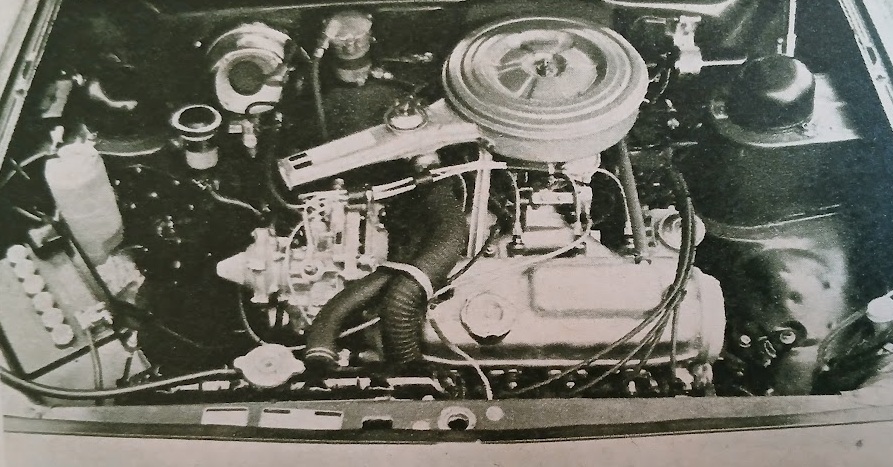
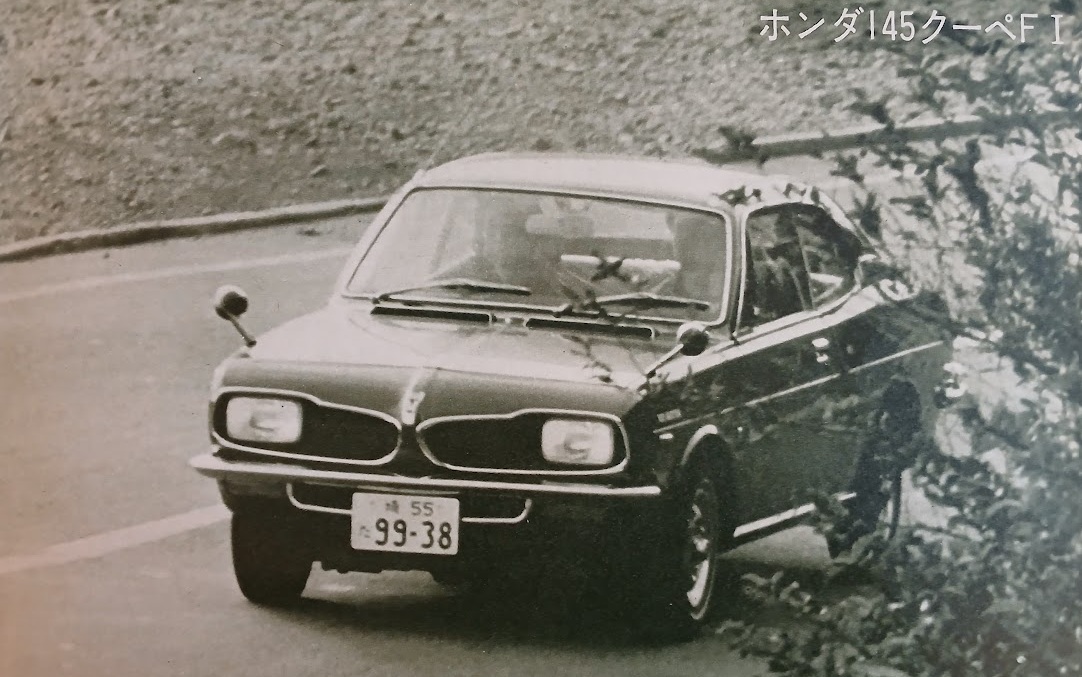
Honda 145 Coupe FI (1973)
Publication: Motor Fan
Format: “Bubble Index” Road Test
Date: January 1973
Authors: Osamu Mochizuki, Katsuzo Kageyama, Shigeki Asaoka, Yasuhei Oguchi, Reiko Ikuuchi, Kensuke Ishizu, Masahide Sano, Motor Fan Editorial Staff (uncredited)
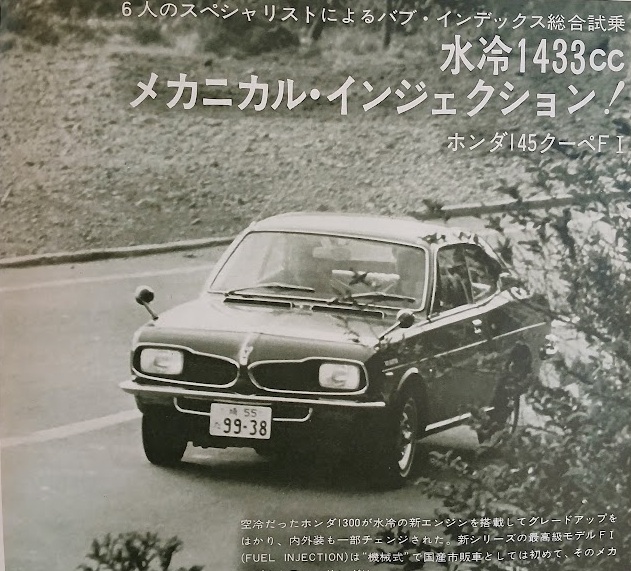
Water-Cooled 1433cc Engine, Mechanical Fuel Injection!
The air-cooled Honda 1300 has been upgraded with a new water-cooled engine, along with some changes to the interior and exterior. The top model in the new series, the FI (Fuel Injection), is the first Japanese production car to use mechanical fuel injection. But what are its mechanism and driving characteristics like?
Unleaded Gasoline Can Also Be Used
“To produce superior products at reasonable prices, meeting the needs of customers from a worldwide perspective.” This is the corporate motto of Honda Motor Co. (quoted verbatim).
Today, Honda appears to regard safety and pollution control as its highest priorities in meeting the needs of its customers. The successive introductions of the Life, Civic, and CVCC (Compound Vortex Controlled Combustion) engine clearly demonstrate the company’s determination to fulfill its corporate responsibility by pursuing greater safety and freedom from pollution.
The Honda 145 Sedan and Coupe, announced on October 20, just before the opening of the Tokyo Motor Show, also adhere to this policy. Developed around the principles of “being capable of meeting pollution-control requirements” and “providing ample performance and safety under all driving conditions,” the new models went on sale simultaneously throughout Japan on November 15.
The range consists of seven models: the Standard, Deluxe, and Custom sedans, and the SL, GT, GL, and FI coupes. Equipped with a new water-cooled 1433cc engine that can run on unleaded gasoline, the Honda 145 series can essentially be regarded as a facelifted and upgraded version of the former air-cooled 1300 series. The name “145,” apparently, is neither an internal model designation nor anything else of particular significance.
“We simply wanted to emphasize a new image, since the car has a different character from the 1300 series,” explained a representative of Honda’s Public Relations Department.
But just how has that character changed? For this month’s comprehensive Bubble Index road test, we have chosen the top-of-the-range Honda 145 Coupe FI.
FI, of course, stands for “Fuel Injection,” indicating that this coupe is equipped with such a system.
Among Japanese cars fitted with fuel injection, the Isuzu 117 Coupe ECGI was the first, followed by the Bluebird U 1800 Hardtop SSS-E and the Mark II 2000 Hardtop GSL with EFI. Three manufacturers have already introduced such models, but all of these systems are electronic, as indicated by the “E” in their designations.
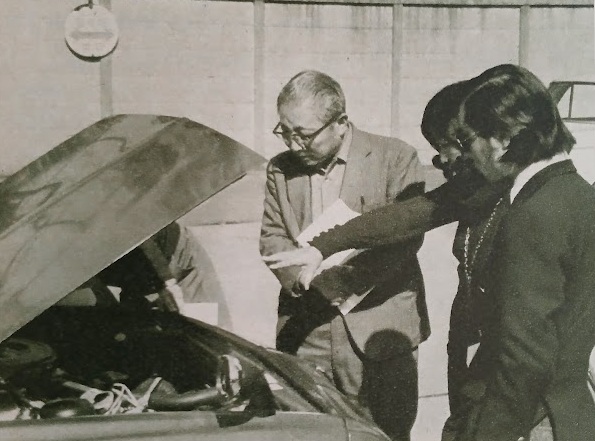
The Honda 145 Coupe FI, however, uses a mechanical fuel-injection system that meters the fuel under pressure and distributes it evenly among the cylinders. To describe the mechanism briefly, four plungers, each serving one cylinder, are arranged radially around a single metering cam. As the cam rotates, the plungers reciprocate, injecting fuel into the intake passages near the valves in accordance with engine speed and firing order.
Research and development of the system began several years ago, and some readers may remember seeing it exhibited separately as the “Honda Fuel Injection System” at the Tokyo Motor Show in the autumn of 1970. This is, of course, the first application of mechanical fuel injection to a Japanese production passenger car, and Honda’s technical achievement deserves broad recognition.
As usual, our test followed a course of approximately 250km around the Hakone area, using the Fantasy Drive-In, near the Tokyo Interchange of the Tomei Expressway, as our base. Various measurements were taken with instruments along the section of the expressway between the Tokyo Interchange and Nakai Service Area, with test driver Osamu Mochizuki at the wheel in his capacity as the specialist responsible for Performance.
No sooner had he taken the wheel than he remarked admiringly: “There’s no mistaking that it has fuel injection.” He had immediately noticed the excellent throttle response.
Professor Katsuzo Kageyama, responsible for Handling & Stability, observed: “Compared with the 1300 Coupe, its more pronounced handling peculiarities have been corrected.” He could clearly feel that the car had acquired a different character.
Racing driver Shigeki Asaoka, assessing Comfort & Accommodation, commented: “The suspension has improved, too, and the car behaves much more naturally.”
Associate Professor Yasuhei Oguchi, who takes a particularly rigorous approach to Safety, remarked: “The seating position is low, making it difficult to judge exactly where the front of the car is.” Nevertheless, he emphasized that the car was fully equipped with safety measures.
Reiko Ikuuchi, the sole woman among the specialists, considered the car from the standpoint of Economy: “If something goes wrong, maybe the consequences won’t be as serious as with an electronic system. But 811,000 yen, well…” She went on to make a comparison with other cars available at that price.
Finally, Kensuke Ishizu, responsible for Product Appeal, offered this assessment: “It’s a significant product, born of a manufacturer’s outlook and commercial spirit that says, ‘Demand isn’t something that simply exists; it’s something you create.’”
All six specialists thus gave the car quite favorable initial assessments. But these comments are only fragments, and only part of our attempt to get at the truth. We hope readers will take their time and draw their own conclusions from the reports that follow.
For reference, cumulative production of the Honda 1300 and 1300 Coupe stood at 106,460 units as of September 1972. The sedan was announced in May 1969, followed by the coupe in February 1970.
Following its corporate motto, Honda sets out five points under the heading “Our Company’s Management Policies.” The second reads, “Respect theory, ideas, and time.”
Honda’s business approach, characterized by unconventional ideas, extraordinary plans, and an emphasis on speed, has also changed with the times, finally bringing mechanical fuel injection into practical production. And now the company is devoting itself to testing the CVCC engine. Even among our six specialists, there was quite a lot of talk about when this low-pollution engine would enter production and which models would receive it.
Performance: Enjoyable Driving with Power in Reserve (Osamu Mochizuki)
The 145 Coupe is essentially a car with the same body and chassis as the former 1300 Coupe, but fitted with a newly designed 1433cc water-cooled engine. There have also been numerous chassis improvements, including a wider track and changes to the suspension springs and dampers. What stands out most, however, is Honda’s bold approach to the engine change.
Engine displacement has increased by 135cc from the previous Coupe’s 1298cc, but output has reduced considerably. Where the earlier GTL developed 110ps/7300rpm and the Custom 95ps/7000rpm, the new engine produces 80ps/5000rpm, or 90ps/6000rpm in the fuel-injected FI.
Conversely, maximum torque has increased. The former figures of 11.5kgm/5000rpm and 10.5kgm/4000rpm have risen to 12.0kgm/3500rpm and 12.5kgm/4000rpm. With the torque peaks also occurring at lower engine speeds, smoothness in the low- and medium-speed ranges has improved.
FI, of course, stands for Fuel Injection. The injection pump is a production development of Honda’s own system, first shown at the 1970 Tokyo Motor Show. Fuel delivery is controlled with exceptional precision by a plunger pump.
Because the test car was completely new, fuel economy was surprisingly disappointing, but the throttle response had a distinctive quality that only fuel injection can provide, and the results were very satisfying. The strength of the acceleration the instant the throttle is pressed is quite unlike that of a carbureted engine. Combined with the torque characteristics, it makes for relaxed, effortless driving in town and on mountain roads.
With output being relatively modest, however, the rate at which the car gains speed at the upper end begins to fall off rather early. Even so, it would not be unreasonable to place the FI in the high-performance category for the 1.4-liter class, and it does not take an unduly long time to reach around 150km/h.
Looking at the valve timing of the 145 FI, the intake valves open 5° before top dead center and close 30° after bottom dead center. The exhaust valves open 40° before bottom dead center and close 5° before top dead center.
This gives valve-opening durations of 205° on the intake side and 215° on the exhaust side. These are about 20° shorter than the current average for Japanese passenger cars, and nearly 30° shorter than those of sporting sedans.
This decisive approach to valve timing must contribute a great deal to stronger torque at low engine speeds and to the prevention of incomplete combustion. As an interim measure in preparation for an era of increasingly stringent pollution regulations, it deserves high praise.
The reduction in mechanical noise resulting from the change to water cooling is remarkable. Measures such as the use of a rubber timing belt are also effective, making the new engine exceptionally quiet. Vibration is slight throughout the entire engine-speed range, and the engine runs smoothly.
The one disappointment is a somewhat pronounced booming noise, apparently caused mainly by the exhaust. Without this, the 145 Coupe would undoubtedly be among the quietest cars in the 1.4-liter class.
The brakes are powerful, with a good relationship between pedal effort and braking effect.
It seems fair to conclude that the 145 Coupe has succeeded in combining a reasonable degree of sportiness with ease of everyday use.
Kageyama: “With the increase in power, the car feels as though it runs effortlessly.”
Oguchi: “The smooth way the engine gains revs gives a stronger feeling of acceleration than the figures suggest. It runs extremely well.”
Handling & Stability: Marked Improvement with Previous Peculiarities Corrected (Katsuzo Kageyama)
The upper edge of the dashboard is high, as are the door window sills, while the seats are low. As a result, sitting in the car gives the impression of being sunk deep into it. To make matters worse, the windshield wipers park in a high position, further restricting forward visibility, particularly close to the car. The coupe body style also limits visibility diagonally to the rear, and I frequently found this inconvenient during the test.
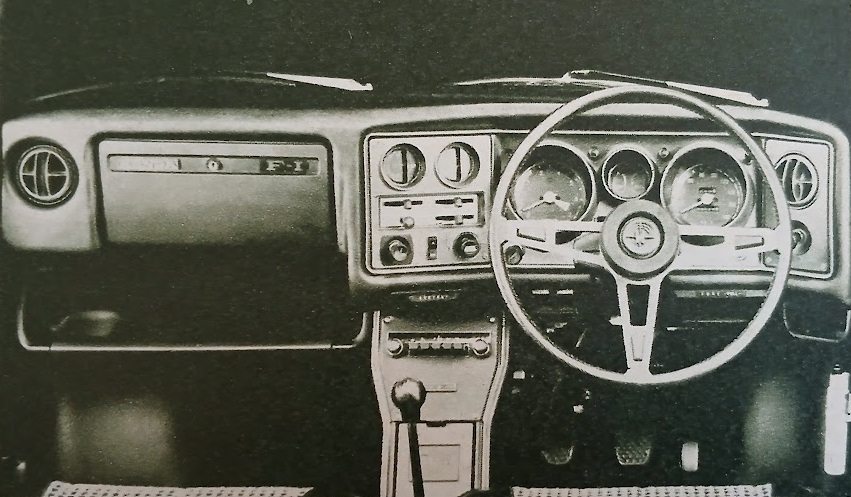
The arrangement of the gauges, switches and controls makes them easy to operate, and once again I was impressed by this manufacturer’s skill in interior design.
There is one drawback, however. To clear the wheel housing, all three pedals have been pushed toward the left, and the spacing between them is narrow. For someone with wide feet like myself, this makes them difficult to operate, and I occasionally caught my shoe on an adjacent pedal. In connection with this, it is also worth pointing out that the presence of a center console, despite the car being FF, further restricts foot room and aggravates the already awkward pedal arrangement.
My first impression on setting off was that the steering was quite heavy around the straight-ahead position. On the expressway, the small, constant steering corrections needed to maintain a straight course required unusually high effort. But the steering was not particularly heavy when turning the wheel through a larger angle, nor did the effort needed to hold the wheel during high-speed cornering seem excessive.
The steering also returned poorly toward the straight-ahead position. This made it difficult to maintain a steady course, and I had to pay close attention to steering corrections, applying deliberate force to make each one. I suspect this is caused by friction in the steering mechanism around the center position, although it should be a problem that can be corrected by adjustment during assembly.
The suspension is on the firm side, and the shock absorbers provide effective damping. Consequently, the car shows very little pitching on roads with pronounced undulations, making it easy to drive.
The Honda is well known for its elaborate crossbeam rear suspension. As the catalog points out, this arrangement minimizes camber change. But I believe its aims go further than that. As an independent suspension system, it reduces unsprung weight to improve road holding, while also limiting lateral movement of the tire contact patches and increasing lateral rigidity to prevent the rear end from wandering. It also seems well suited to rough-road driving.
That said, there were few stretches of genuinely rough road on our test route, so we had little opportunity to discover the full capabilities of the suspension.
Naturally, the car displays characteristic FF behavior, particularly the influence of opening and closing the throttle on the steering during high-speed cornering. Still, compared with the previous 1300 Coupe, its more pronounced handling peculiarities have been greatly reduced, and there is a marked improvement in handling and stability.
Mochizuki: “Compared with the old 1300 Coupe, the handling and stability have improved enormously.”
Comfort & Accommodation: Improved Overall, But… (Shigeki Asaoka)
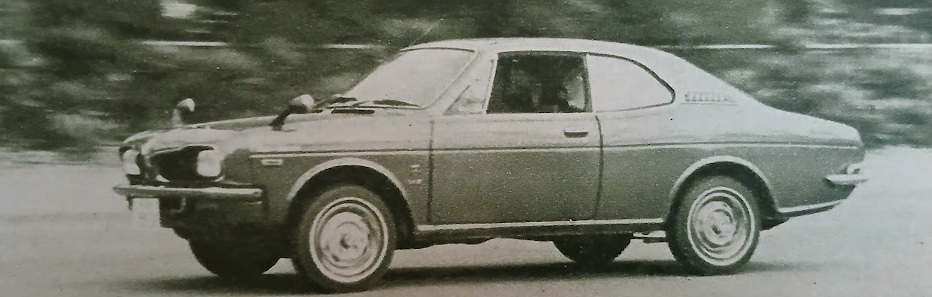
The 1300 Coupe has now been replaced by the 145 Coupe. The body is basically the same as before, with only minor changes to the lights, bumpers and other details, so unless you look carefully, you might not even realize that it is a new model.
The engine, however, is completely different. Although its displacement is larger than that of the previous unit, the new water-cooled OHC engine is much more compact. The old engine was remarkably heavy despite having a die-cast block, and its air-cooled design required an enormous amount of space for the DDAC (Duo Dyna Air Cooling) noise-suppression system. For all the fuss the manufacturer made about it, there was very little to recommend it.
The Honda 145 uses an engine block shared with the Civic, resulting in a compact, well-integrated unit that is powerful and easy to use. The fuel-injection system is also very effective, providing smooth acceleration.
The interior remains as overdecorated as ever. The black-and-white checked cloth seats make the cabin feel visually cramped, and the whole effect is far too self-conscious and in rather bad taste. The instrument panel is almost unchanged from the previous model, with enormous tachometer and speedometer dials directly ahead of the driver, set deep within cylindrical housings. At night, when the lights are switched on, their “fancy” green illumination glows like neon.
The center console, one of the most absurd features imaginable in an FF car, is still there. To blatantly take up valuable space just to provide a place for the radio and a few cassette tapes seems extraordinary. Perhaps there is some reason why even Honda, which has become markedly more mature lately, cannot bring itself to abandon this idea.
The rear seat looks so small that I hesitated for some time before trying it. Once I did, however, I was surprised to find that it compares well with other coupes in this respect. Even so, I would ask to be spared the experience of sitting three across back there.
Engine and tire noise, barely noticeable in the front seats, become quite intrusive in the rear. This apparently results from the air outlets in the rear quarter panels, which are positioned almost level with the rear passengers’ ears and allow outside noise directly into the cabin.
The suspension has also improved enormously, and the car now behaves itself on the road. Honda may object to my putting it that way, but the previous 1300 Coupe could not be described as a car whose suspension mechanism had been properly thought out and developed. It is only with the new 145 that Honda has finally got things right.
That does not mean it is perfect, of course. Front-wheel-drive cars inevitably present certain difficult problems, and there is little that can be done about that. After all, engineers everywhere are struggling with them to a greater or lesser degree…
Oguchi: “The engine has become quieter, but the gear noise seems to have remained.”
Mochizuki: “The rear seat offers plenty of room and feels spacious. However, quite a lot of impact noise is transmitted through the suspension.”
Ishizu: “I’d like them to reconsider just how much more convenient the car would be without that console, which negates one of the advantages of FF.”
Safety: Improvements Beneath the Surface (Yasuhei Oguchi)
Although the revised Honda 145 Coupe has little that is strikingly new about its appearance, it gives the impression that the finishing touches have been put on the performance of the series. The fuel-injected 145 Coupe FI tested here clearly showed the improvements brought about by the model change. Particularly noticeable was the smooth way the engine picked up revs, overcoming the somewhat lackluster standing-start performance often associated with front-wheel-drive cars.
The handling, too, has much less of the frictional resistance felt in the early Honda 1300 Coupe, and the car has taken on a generally lighter, more responsive character. It now seems to have driving characteristics well suited to a coupe. Whereas the 1300 Coupe had a powerful, almost forceful character that encouraged the driver to push it hard, the 145 Coupe FI feels much more refined.
If I were to relate this to safety, someone would probably ask how the connection could be demonstrated quantitatively, so I won’t go quite that far. At the very least, however, there is no doubt that the car has been improved overall, allowing one to enjoy driving it more freely and with a comfortable margin of reserve performance.
As for safety equipment, the main features include several that are already familiar: an impact-absorbing steering system with an offset steering shaft and cross joint; a tandem master cylinder with separate front and rear brake circuits; front disc brakes with a proportioning valve to help prevent skidding under heavy braking; and a monocoque body with increased rigidity. In short, the car is fully equipped.
One point that bothered me while driving was the difficulty of judging exactly where the front of the car ended, partly because of the low seating position. The windshield wipers were also parked in a rather obstructive position.
Recently, the emphasis of society’s demands on the automobile has shifted markedly, from safety toward cleaner engines. Honda’s recently announced CVCC engine has attracted considerable attention both in Japan and abroad. By using a lean air-fuel mixture and controlling combustion within the engine itself, without the use of a catalytic converter, it is said to be capable of comfortably meeting emissions standards that had previously been considered difficult to achieve.
The concept and engineering have been widely praised as typical of Honda.
As part of its efforts toward pollution control, the company has adopted fuel injection for the 145 Coupe FI, aiming to reduce emissions without sacrificing the car’s sporting character. Special-alloy valve seats have also been fitted to permit the use of unleaded gasoline. To control fuel evaporation, Honda has adopted the familiar canister system already used on the Civic and other models.
As with safety, and particularly in the case of pollution control, these are not matters that can be properly judged from a brief road test. Even so, from what I saw and learned of the test car, Honda appears to be pursuing these objectives with great determination.
Kageyama: “I’d like to see a grab handle on the passenger side as well.”
Asaoka: “The instrument lighting is attractive and rather ‘fancy.’ But isn’t it a little too bright…?”
Ikuuchi: “If they’re going to spend money on things like the overhead console, I’d rather see it go toward safety measures.”
Economy: Fuel Economy Should Be Good in Practice, But… (Reiko Ikuuchi)
Let’s begin with a comparison with the previous Honda 1300 series. The 145 Coupe replaces the former Coupe Dynamic series, and prices remain unchanged.
Engine displacement has increased from 1298cc to 1433cc.
Admittedly, output has been reduced from the former GTL’s 110ps to 80ps, but this is less a reduction in performance than a change in engine characteristics to meet the demands of the times. With greater ease of use and a more settled feel, it should be regarded as an improvement rather than a step backward. During the test, I certainly felt no lack of power resulting from the 20ps reduction in output in the FI, which produces 90ps.
Prices of the sedan models, however, have each risen by 5,000 yen. The manufacturer explained that prices for the previous sedans were established earlier than those of the coupes, and that the increase reflects the rise in costs during the intervening period.
The Coupe FI tested here costs 811,000 yen. This is a newly introduced model, replacing the former top-of-the-range GTL, which had four carburetors and cost 773,000 yen. At 811,000 yen, the FI is the most expensive model in the series and, indeed, the most expensive car in Honda’s entire range.
The FI is essentially a GL fitted with fuel injection, although there are several other differences. These include wire-type windshield wiper blades suited to high-speed driving, three-point seat belts, alloy trim along the lower portions of the doors, and wheel trims.
So, the 100,000-yen price difference between the FI and GL cannot be attributed entirely to the fuel-injection system. Still, anyone wanting fuel injection must, in any event, purchase the model costing 100,000 yen more.
By comparison, fuel injection adds 41,000 yen to the price of the Corona Hardtop 2000SL EFI, and 50,000 yen in the case of the Bluebird U1600 SSS-E. On the other hand, the fuel-injected Isuzu 117 Coupe ECGI costs 200,000 yen more.
All these other systems are electronic, whereas the Honda uses its own mechanical arrangement, known as the Honda Fuel Injection System. The manufacturer claims several advantages over electronic injection, including a lower likelihood of failure. In any case, since the systems are fundamentally different, it goes without saying that it would be unreasonable to compare them on price alone.
Other cars available at around the FI’s price include, among the sportier models, the Sprinter Trueno and Corolla Levin at 813,000 yen, and the Bluebird 1800 SSS at 814,000 yen. In the 2000cc class, there is also the Laurel Custom at 800,000 yen and the Mark II 2000 Hardtop GL at 817,000 yen.
According to the catalog, both the FI and GL return the same fuel economy of 20km/l. However, the FI is equipped with a fuel cut-off system during deceleration, additional fuel delivery during acceleration and starting, a fuel cut-off system when the engine stops—which is useful in case of a stall—and a system that adjusts fuel delivery according to engine temperature. These features should give it good fuel economy in actual use. Unfortunately, we were unable to make a direct fuel-consumption comparison with the GL during this test.
As for maintenance, the scheduled inspection and servicing charges are the same for cars equipped with fuel injection as for the other models.
The new-car warranty provides one year of full coverage and two years for specified mechanical parts. Ordinarily, such warranties are limited to one year or 20,000km, and two years or 50,000km, respectively. Honda, however, imposes no mileage limits.
It is too bad that the popular shaken inspection guarantee, under which the required vehicle inspection and servicing could be carried out for 15,000 yen, was discontinued in the spring of 1972.
Kageyama: “The unusual fuel-injection system is interesting, but for an extra 100,000 yen…”
Oguchi: “The true price of a car is its purchase price minus its trade-in value. I wonder how the FI would fare on that basis?”
Product Appeal: A Masterpiece of Producer-Oriented Thinking (Kensuke Ishizu)
There is an expression, “to create trends.”
If any company fits that expression, it is Honda Motor Co. Driven by the commercial conviction that “demand is not something that exists, but something to be created,” President Soichiro Honda, that great man of ideas, has always made the most of his particular talents.
Partly because the circumstances surrounding the automobile have become increasingly demanding, Honda has grappled with problems of safety and pollution more than most manufacturers. From an early stage, the company pursued research and development under the principle that “as a manufacturer’s responsibility, we should strive to make the world’s air cleaner.” These efforts culminated in the announcement of the CVCC low-pollution engine in October 1972. And now Honda has also succeeded in bringing the 145 Coupe FI, equipped with a new engine capable of using unleaded gasoline, into production.
Looking at the course of Honda’s business practices and products over the years, it is clear that the company is more producer-oriented than it is consumer-oriented.
“We have made this kind of car. If you like it, please buy it.” Isn’t that essentially the message Honda sends out?
In this sense, the Honda 145 Coupe FI is a truly unusual car. I find it particularly appealing as a product that seems to bring together the company’s philosophy and technical capabilities.
Today, the world of fashion is becoming increasingly diverse, yet at the same time increasingly lacking in individuality.
People often ask, “Who creates fashion?”
The answer that is frequently given is, “In the past, manufacturers created it, but today consumers do.”
I think of this as sophistry. To say that manufacturers dictated fashion in the past, whereas consumers do so today, is merely to change the way we look at and describe the situation. The phenomenon remains basically the same.
What has changed is that people today have developed a more discerning eye. Their horizons have broadened to encompass the world, and they are able to judge what is good or bad from an international perspective.
After all, it’s their own money they are spending, and they have a better understanding of themselves. And because these decisions concern them personally, they take the trouble to study things carefully. They are well informed, and they have a sharp eye for choosing what suits them. The same applies to car buyers.
In such a world, if manufacturers merely chase after things they think consumers might like—this might sell, that might sell—they will produce nothing but characterless, anonymous products designed to appeal to the broadest common denominator.
In this respect, Honda seems to have successfully combined (1) product planning, (2) market research, (3) sales expansion, and (4) the numerical controls required to run the business.
In conclusion, the Honda 145 Coupe FI may not appeal to 10,000 people, but it will surely find 1,000 buyers who say, “Nothing else will do.”
A product designed for high-volume sales at a small profit margin is not necessarily the best kind of product. In that sense, the 145 Coupe FI, bringing together Honda’s corporate philosophy and technical expertise, deserves a high assessment for its product appeal.
Oguchi: “Perhaps the time has come for a full model change, for both coupe and sedan.”
How to Read the Bubble Index
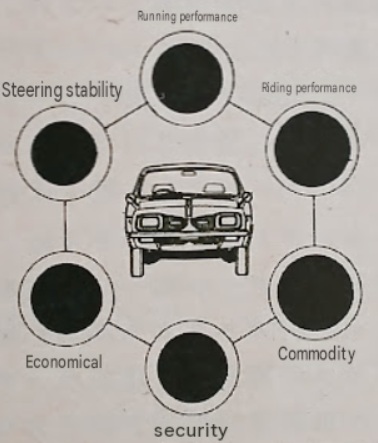
The aim of this comprehensive test drive series is to judge a car’s overall character by evaluating it across six key pillars: running performance, handling and stability, ride quality, safety, economy, and product appeal. For the evaluation, we use a format called the “Bubble Session”–a method from systems engineering in which six specialists from different fields gather around a hexagonal table (the “bubble,” or honeycomb) to exchange opinions.
Each black area within the six circles represents a specific evaluation. The more evenly sized the black areas are, the more balanced the car is across all aspects; if the sizes vary, it signals a vehicle with more pronounced personality in certain areas.
Postscript: Story Photos