Honda 1300 Coupe 9S (1970)
Publication: Auto Sport
Format: Road Impression
Date: March 1970
Author: Yoshimasa Sugawara, Auto Sport Editorial Staff (uncredited)
The Honda 1300 Coupe 9 has just been released, with an aerodynamic body born from wind tunnel testing and a high-power, high-speed 110 horsepower engine. Yoshimasa Sugawara, an expert on front-wheel drive cars, took it for a test drive.
High-Powered FF Car
(Sugawara): I am a man fascinated by FF cars. That said, I didn’t start off racing in them. I raced a Honda S500 until I switched to a Mini Cooper in 1967, and was completely satisfied with the S500. In the All Japan Racing Drivers’ Championship T-1 class, I raced against 1300cc Contessa Coupes and other cars in the 800-1200cc class, and was able to get quite close to my opponents despite the difference in displacement.
What made me switch to a Mini Cooper was that even if I could get pretty far in a 500cc car, I still couldn’t hope to win the T-1 class.
I couldn’t go on that way and expect to advance. I really wanted to drive a 1300cc car. At the time, I had heard about the Mini Cooper’s successes in races abroad, and I decided to give it a go.
Although I thought I could be competitive in a Mini Cooper, I didn’t give much thought to competing using a front-wheel-drive car. Why? Because although I knew that the Mini Cooper was front-wheel-drive, I had never driven one and I assumed that there would be no significant difference in handling between rear-wheel-drive and front-wheel-drive cars. That turned out to be a complete lack of understanding.
During practice with the Mini Cooper before participating in races, I even thought, “That’s it, I’m giving up on FF cars.” The car just wouldn’t go in the direction I wanted it to, and if I continued driving with the same technique, the car would be jumping here and there, and I wouldn’t even be able to finish a race, let alone win one. At first, it was very embarrassing. But if I gave up on the Mini Cooper at that point, my racing career would be over.
That’s how much I was worrying about it at the time. I told myself, “Mini Coopers have been doing well in overseas races, so there’s no reason why I can’t do it.” And I wanted to beat the manufacturer’s team. To achieve their track record, they absolutely needed a high-performance car. The difference was that they had tamed the rodeo horse.
So I went into my first race with a Mini Cooper without any confidence, but I ended up in 5th place in my class. It was an unsatisfactory result for me. It was only much later that I finally got the confidence to feel competitive in the car.
Flexible OHC Engine
The Honda 1300 Coupe, which was announced at last year’s Tokyo Auto Show, is finally going on sale. I got the chance to drive it with the Auto Sport editorial team before its release.
The course started in front of the Honda Technical Center in Yaesu, Tokyo, then entered the Tomei Expressway, exiting at Gotemba. Then we crossed Otome Pass and headed to Lake Yamanaka, where the previous Honda 1300 test was conducted, and on the way back to Tokyo we took the Chuo Expressway.
We chose a course that was approximately 300km long, allowing us to thoroughly test cornering at high, medium, and low speeds.
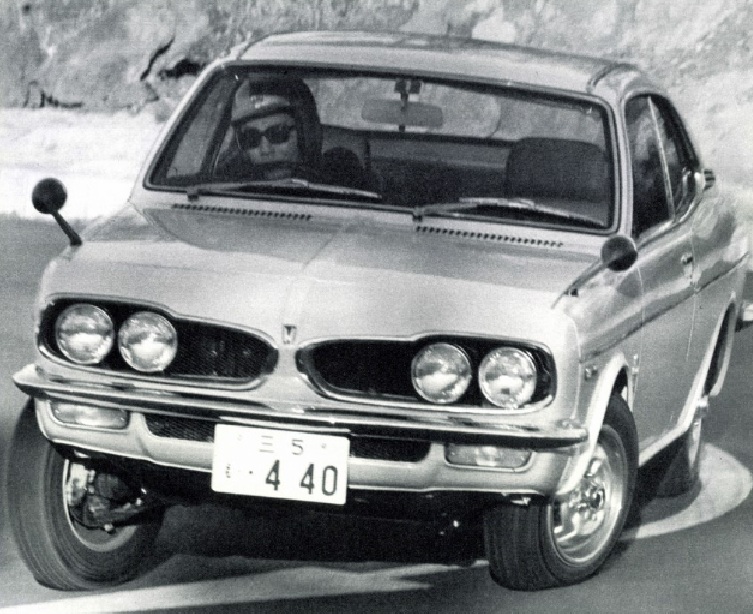
First of all, before leaving, we took a long look at the Coupe’s body. It appears lower and longer than the previous 77 and 99 series, probably because its body was thoroughly honed in wind-tunnel testing in anticipation of the high-speed era.
Honda’s distinctive longer and thinner nose also helps to reduce the frontal area. The windshield is also more raked than Nissan or Toyota models, for example, making it look faster. But what is most appealing to me is that, while many European front-wheel-drive cars have a long wheelbase and wheels that run the full length of the car, the 1300 Coupe has such an elegant style, with longer overhangs, that it could be mistaken for an FR car.
After getting out of the city, we finally entered the Tomei Expressway. When I stepped on the accelerator, the OHC engine revved up as smoothly as a rotary engine. And yet, the engine noise was hardly noticeable at all. When I drove the 99S (at 140km/h or more) I was bothered by the wind noise, but in the Coupe, I could hardly hear it, and could talk to the person in the passenger’s seat without shouting.
We immediately began acceleration tests with the help of the editorial department. In top gear, the speed increased from 80 to 120km/h in 11 seconds, while the same acceleration in third gear took only 8.1 seconds, showing that this is an extremely flexible engine.
During the test, the engine revved up so smoothly that I constantly had to keep an eye on the tachometer to avoid over-revving.
When driving straight, you don’t feel any effect from crosswinds, which are inevitable on the highway, so you can drive with peace of mind.
The next thing that impressed me while driving was the dashboard area, which has been designed with great attention to detail. The placement of the tachometer, speedometer, and other gauges, the angle of the ashtray and lighter, and other parts are all perfectly aligned, and it’s rare to see a car designed around the driver to this extent. This will surely ease the driver’s level of frustration during rush hour.
FF Driving Techniques Learned From Experience
After taking a short break at the Ebina service area, the front tires started to make a thumping noise as soon as I started driving again. I was driving on a particularly well-surfaced stretch of road, so I thought it was odd and investigated. The cause was flat-spotting of the tires. After the car is parked, the warm tires deform on the road surface as they cool, resulting in an uneven shape and a thumping vibration when starting off. However, after driving for a while the tires warm up and return to normal. This phenomenon seems to be particular to the new nylon tires.
After passing the Oi-Matsuda interchange, I tried driving at high speed through the uphill corners. At first the car’s response was neutral, but as I picked up speed and took my foot off the gas while cornering, the characteristics of front-wheel-drive began to come out. That is, when the power was off, there was slight oversteer, and when the power was on, there was a tendency for it to understeer.
The brakes, which are servo-assisted discs at the front and include a PCV system, are appropriate for a high-speed car and work well. One thing that bothers me is that the ride picks up joints in the pavement quite clearly, which seems to be due to the shock absorbers as well as the stiffness of the suspension.
Next, I headed onto Otome Pass where the middle-speed test could be conducted. Here, too, the sound and feel of the car picking up the joints in the road was noticeable, but the car felt very precise, and the high-performance engine’s power was fully utilized as the car climbed higher.
This is where the experience gained from racing FF cars comes into play. If you enter a corner too quickly or turn in sharply, the front wheels will not enter the corner, but will push to the outside. If you release the accelerator at this time, the car will oversteer, and at the moment the car points towards the inside of the corner, you need to turn the steering wheel in the opposite direction and step on the accelerator, reset your stance, and accelerate. By continuing this driving technique, you can corner safely even when you increase your speed considerably. Select a gear where the engine torque is strong, press the left foot firmly on the floor, and hold the steering wheel firmly but not tightly, with both hands, steering into turns early as if you are pointing toward the inside of the approaching corner.
This brought back memories of the Paul Frere racing school I once attended. Frere explained to me over and over again, “When racing, whether the car is FF, FR, or MR, you should not rely solely on the steering, but make full use of the accelerator.” In the case of the racing Mini Cooper, both the front and the rear wheels have powerful grip, and the front wheels are also equipped with a differential lock, but when entering a corner at high speed, the rear wheels start to slide outward first. To prevent this, close the throttle and turn the front wheels outward, then when the car’s posture has stabilized, get back on the throttle and turn the front wheels inward to exit toward the outside of the corner. During a race, the throttle is often fully closed and the driver countersteers all the way to the opposite lock.
Easy-to-Maintain Power Unit
In a controlled test conducted near Lake Yamanaka, the Honda 1300 Coupe exhibited fairly strong g-forces when driven at high speed around a tight corner. With the throttle open, the tires were squealing and the car understeered considerably, but when the accelerator was released, it suddenly oversteered, demonstrating strong front-wheel-drive characteristics. What you need to be careful of in these conditions is that, at the limit, the car will understeer no matter how much you turn the steering wheel (in fact, even if the steering wheel is at full lock), but if you let go of the accelerator here, there is a risk of the car spinning off the road.
Instead, what you must do if you have gone too far in the corner is turn the steering wheel back to the center at the same time that you back off the throttle. Don’t countersteer too far in the opposite direction, or the car may spin in the other direction. Also, don’t forget that during high-speed cornering, the inside rear wheel often leaves the ground and you will be driving on three wheels. The degree of body roll in the Honda 1300 Coupe seems to be larger than that of the Mini Cooper.
Finally, we joined the Chuo Expressway and headed back into slow-paced Tokyo traffic, until we arrived in front of the headquarters of the Honda Engineering Research Institute.
The fuel consumption over our drive was about 7km/l. It’s a little excessive for a 1300cc, but its power performance is closer to that of a 2-liter engine, so it has the driver appeal to make up for the shortcomings in fuel consumption.
One last thing that impressed me was how well the engine’s serviceability has been considered. In the case of the Mini Cooper, cylinder head-related repairs can be done without removing the engine, but all other repairs must be done by removing the engine along with the subframe. With the Honda 1300 Coupe, not only the head but also the cylinder block can be removed as is, and the design of the underside makes it easy to inspect the transmission. This is an absolute advantage in racing.
Another difference between the 1300 Coupe and the Mini Cooper is that the latter uses engine oil to lubricate the engine, transmission, and differential parts, so small metal chips from the transmission can also get into the engine, which is naturally bad for it. Also, there is a crevice in the oil pan which causes the oil to be splashed around, resulting in premature engine wear.
By contrast, the Honda 1300 series is equipped with a full dry sump system similar to that in a racing car, the engine uses only synthetic oil, and the transmission uses a forced oil supply system, which are quite elaborate mechanisms for a street car.
Overall, I was impressed by the potential of the Honda 1300 Coupe, and felt a strong desire to use it in my own racing activities.