Honda 1300 77 Deluxe (1969)
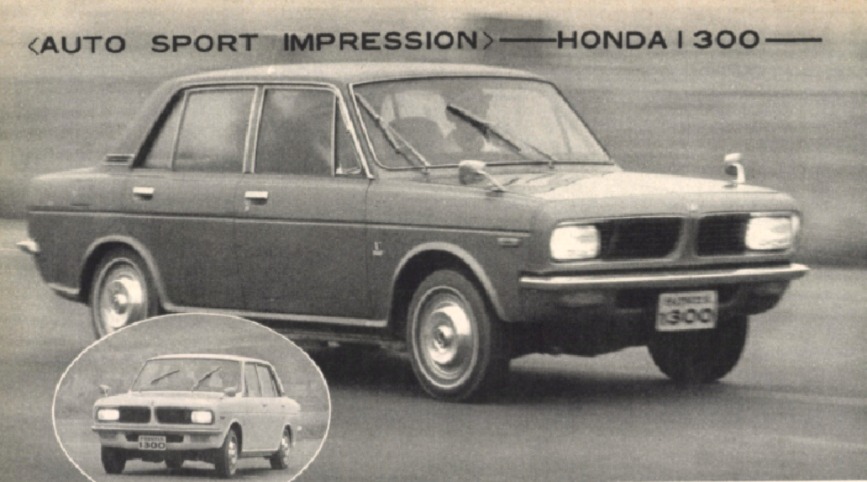
Publication: Auto Sport
Format: Auto Sport Impression
Date: April 1969
Author: Juichi Inoue
The F-1 Mechanism Hidden In A Sedan
A quiet but powerful air-cooled engine and a hard clutch. Outstanding acceleration and high-speed stability. Even when the Honda 1300’s redline was exceeded in each gear, the engine was unperturbed, and the car responded like a rabbit…
“We will create a passenger car that will astound the world,” Honda Motor Co. President Soichiro Honda declared even before the announcement of the Honda 1300. And when the Honda 1300, equipped with a groundbreaking “integral double-structure” air-cooled engine, was announced at the 15th Tokyo Motor Show last fall, it certainly attracted a great deal of attention, both at home and abroad.
However, there were many who were puzzled by the “overall balance” of the car, packed as it was with so many different ideas, and the viability of each of them. In light of this, the price announcement, which was scheduled for March 1st, was postponed to April 15th, and it was revealed that the release date would not be until late May.
It was no wonder that people began asking, “What happened?” So, perhaps because of this, a test drive of the Honda 1300 for journalists was held on the afternoon of February 24th at Honda Motor’s Arakawa test course. The weather was cloudy, with light rain. The temperature was around 2°C.
Quiet, High-Power Air-Cooled Engine
Of course, we didn’t get to hear it at last year’s Motor Show, but the sound of the Honda 1300 at idle, which I first heard while waiting for my test drive, is very quiet. It’s about the same as a water-cooled engine, and doesn’t give the audible impression of being “air-cooled” as in the past. This feeling didn’t change even when I revved the engine to about 7000rpm during my drive. This is probably due to the remarkable effect of the integrated double air-cooling structure called the “DuoDyna Air Cooling System” and the short fins that prevent resonance sounds.
The aluminum alloy engine is assembled from eight blocks, and the combustion chamber is a hemispherical type similar to that of the air-cooled Honda F-1. The fins in the air passage are set at an aerodynamic angle to improve the efficiency of the cooling air. The blower fan, which also serves as the flywheel, is attached to the tip of the crankshaft, so overheating the engine due to a broken fan belt would be impossible even if you tried. In fact, Honda Motor has so much confidence in this cooling system, and the results of its rigorous in-house testing, that the car doesn’t even have an engine temperature gauge or an overheat warning lamp.
Regarding the interior, the test vehicle was a Deluxe model, so the instrument panel used woodgrain trim, and the steering wheel and shift lever knob also had a wood grain pattern.
The seats have reclining backrests, but they are a little firm, so comfort while driving is adequate rather than excellent. With a 160mm sliding range, anyone can find their preferred driving position. Also, the pocket on the underside of the seat back to store the safety belt buckle is a good idea. The back seat has a flat floor space, which is good for passengers’ feet, but it is still cramped for three adults. The back seat can be folded down to be integrated with the trunk, and the small storage compartment under the ignition key shows the respect for practicality that has been a feature of Honda cars since the N360.
The maximum power output of 96ps/7200rpm from a 1300cc engine is astonishing. It accelerates powerfully even with only a light touch on the accelerator. The speedometer has markings indicating the speed range of each gear: first gear, up to 45km/h; second gear, 80km/h; third gear, 120km/h. However, even when I reached an indicated 130km/h in third gear, there was no abnormal engine noise or valve imbalance. Although I was unable to try to reach the catalog top speed of 175km/h, I was able to feel the hidden high performance of this car.
Hard Feelings
The suspension is MacPherson type in the front and a novel cross beam type in the rear, and the combination of nitrogen-filled shock absorbers and 6.2S12-4PR low profile tires made for a comfortable ride. However, although the car had good stability in a straight line and good traction in corners, the roll angles were high, and it was difficult to hold my body in place when I cornered at 60km/h.
Also, because it is a front-wheel drive car, understeer is inevitable, but how about the weight of the steering? To put it politely, it’s like that of a racing car, but to put it less kindly, it’s like that of a truck. The steering mechanism is a rack and pinion type, with a gear ratio of 17.6:1. However, while it resists wavering in a straight line, it requires considerable strength in corners. The effort doesn’t get softer even at gentle speeds. This calibration is questionable for a car that is aimed not only at enthusiasts, but also at general private-owner demand.
Safety was given a great deal of consideration in the development of the 1300. When the Honda 1300 was announced, the “themes for safety” were described as:
- Performance with plenty of power to spare.
- The car can be controlled as desired.
- Safe stopping.
- Mechanisms to proactively prevent trouble.
- Comfortable living environment for both body and mind.
Certainly, careful consideration has been given to the position of the emergency flashers and the inside door handles, for example, but I would like to take issue with the third item, “stopping safely.” Specifically, the front disc brakes do not have a servo mechanism. At high speeds they work smoothly, but at low speeds they are not so effective and deceleration lags behind the driver’s inputs. Without a servo mechanism fitted as standard for driving in urban areas, it cannot be said to “stop safely.” Also, the large body roll and heavy steering effort make it difficult to “maneuver as desired” as mentioned in item two.
Like the steering, the clutch in the car I test-drove was heavy. It is a diaphragm type that is directly operated by a cable, and the more you press it, the harder it gets. This may be because the clutch has been strengthened to accommodate the high power… but if you don’t press it all the way down during gearchanges, the gears will clash and rattle.
It was cold on the day of my test drive, so the inside of the windshield fogged up, as it would in any car. So I tried to turn on the defroster, but to my surprise, there was no fan switch to adjust the amount of airflow. This was because, since the engine isn’t water-cooled, there is no heater fan, and all the air comes from the cooling blower fan. However, even though I turned the lever to “hot defrost,” not a trace of warm air came out. This left even the manufacturer representative scratching his head. Perhaps something was stuck in the ventilation duct, or it wasn’t opening and closing properly.
Looking at the instrument panel, the combination gauge and the speedometer in front of the driver are of course the same diameter, but this means the fuel gauge is unusually large, while the speedometer is relatively small and difficult to read. Also, perhaps because there were many people who confused the light and wiper switches on the N360, the 1300’s wiper switch is a lever attached to the left side of the steering column, which may seem strange to those who are driving it for the first time.
Conclusion
As mentioned before, this car will be targeted at a wide range of general users and young sports-loving users who have grown up with the N360. In this case, there are several unbalanced aspects of the car. For example: heavy steering and clutch. Suspension that is firm but has high roll angles. Back seats that are too narrow and uncomfortable for three people. Disc brakes that require a lot of pressure when driving in city streets.
Looking closely, these things show that the manufacturer is struggling to combine sportiness and high speeds with general city driving. Honda Motor still has a short history in four-wheeled vehicle production, so naturally the question must have been, what should the character of this car be? Many problems remain to be solved. However, what can be said for sure about the Honda 1300 is that it is a small, high-performance car that squeezes out performance equivalent to a 2000cc engine from a remarkably small displacement. This is a victory for Honda’s innovative engineering, and would be unthinkable without the experience of F1 racing.