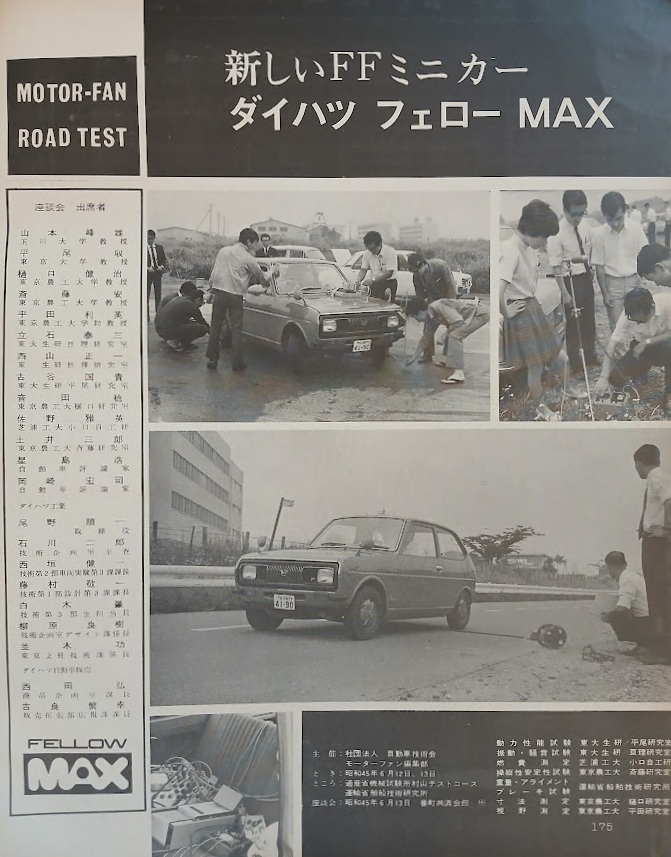
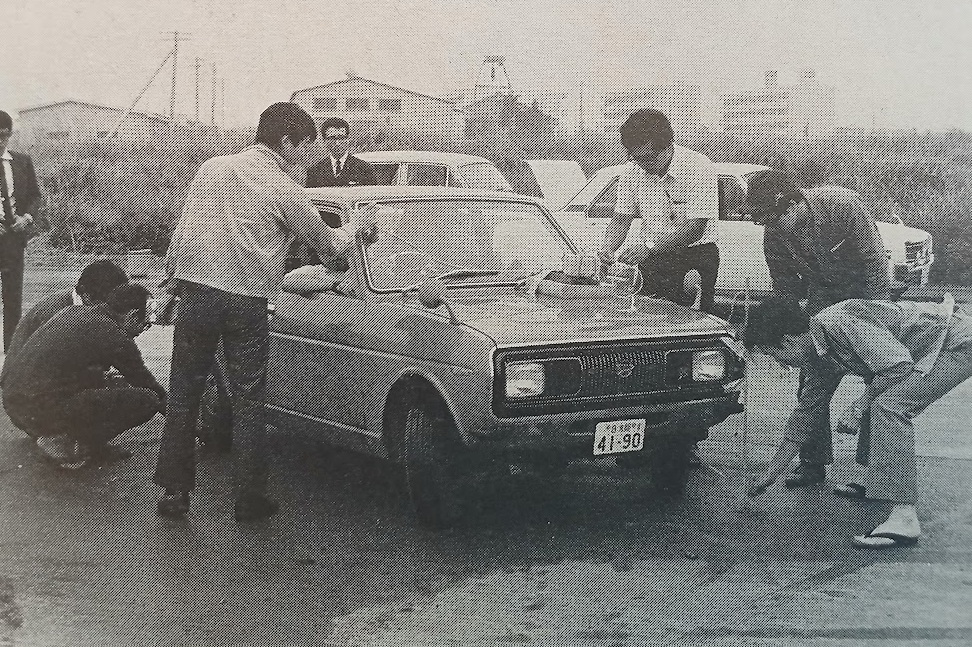
Daihatsu Fellow MAX (1970)
Publication: Motor Fan
Format: Road Test
Date: August 1970
Authors (roundtable): Junichi Ono, Jiro Ishikawa, Hiroshi Okazaki, Takashi Shiraki, Osamu Hirao, Mineo Yamamoto, Kenichi Nishigaki, Hiroshi Hoshijima, Yasu Saito, Kenji Higuchi, Yoshiki Yanagihara, Keiichi Fujimura, Kunitaka Furutani, Masahide Sano, Shoichi Nishiyama, Taizo Tateishi, Hiroshi Nishida, Toshihide Hirata, Minoru Onda, Motor Fan Editorial Staff (uncredited)
Aimed at Younger Drivers
Magazine: We’d like to begin by asking about the aims of development for the Max.
Ono: Demand for kei cars began to pick up again around the autumn of last year. I think one major reason is not simply that they offer various advantages under the regulations and in other respects, but that the cars themselves have become much, much better.
The previous Fellow went on sale in November 1966, so it isn’t really that old yet, but by today’s standards there are nevertheless quite a few areas in which it falls short.
One of the objectives in developing the Max, then, was to push toward the limits of what could be achieved in the kei-car class in areas such as performance, safety, passenger accommodation, and noise.
The second point was that our market research showed a very large proportion of kei-car users to be young people. We therefore developed the Max with the focus on this younger generation, which will form the core of Japan’s motorization in the years ahead. So I think you can regard the Max not as a model change, but as an entirely new model.
For example, although the engine is based on the ZM type we have been using up to now, internally everything has been changed—the crankshaft, pistons, connecting rods, and crankcase. As for the drive layout, we built prototypes with both front- and rear-wheel drive and compared them in every respect. One major reason we ultimately chose front-wheel drive was, of course, its advantages in handling and stability. But there were a number of other considerations as well: it provides better passenger accommodation, for example, and allows a longer wheelbase, which in turn improves the ride. Taking all of these factors into account, we decided to go with front-wheel drive.
Magazine: Perhaps you could tell us how those objectives were translated into the actual car…
Ishikawa: We wanted the styling to appeal particularly to younger buyers, so we gave it a long nose and a cut-off tail. Overall height is 1305mm, which I believe makes it the lowest of the kei cars, while the 2090mm wheelbase is the longest.
The water-cooled two-stroke engine is mounted transversely at the very front, on the right-hand side, with the transmission to its left. In other words, the engine, clutch, and transmission are arranged in line. The differential is located where the transmission countershaft would normally be, and drive shafts fitted with Birfield-type ball joints extend from either side of the differential to the wheels. That is the basic front-wheel-drive layout.
The front suspension is of the strut type, while at the rear we use semi-trailing arms with a 15° sweepback angle, giving independent suspension on all four wheels.
Inside, depending on the model, the rear seat back is divided into two sections, which can be folded down to connect the passenger compartment with the luggage compartment. The rear parcel shelf can also be lifted upward, allowing luggage to be taken out through the passenger compartment.
The engine is based on the ZM type, but the intake and exhaust systems, pistons, crankshaft, and other components have all been redesigned. Rated output is 33ps, and we guarantee 29ps even on a net basis. We have also fitted a particularly large radiator, so that cooling is accomplished almost entirely by natural airflow. When the coolant temperature rises above 90°C, an electric motor automatically switches on the fan.
We also make use of this cooling circuit for the heater. There is a secondary heater core inside the passenger compartment, and the electric fan is also used to boost the heater output.
Okazaki: About the “Kamm tail”—the oil coming from the exhaust pipe gets all over the trunk lid. Couldn’t you prevent that by changing the position of the tailpipe or something like that?
Shiraki: That is certainly determined by the position and length of the exhaust tailpipe. And the higher the vehicle speed, the more readily the oil tends to be deposited there. But we have to work within the dimensional limits of the kei-car regulations, and we settled on that arrangement only after doing a considerable amount of testing. I don’t think there’s any problem with, for example, oil getting onto the rear window.
Hirao: The real problem is that oil comes out of the tailpipe in the first place. That’s one of the drawbacks of a two-stroke, after all—the way the end of the tailpipe is always wet.
Styling Determined in the Wind Tunnel
Yamamoto: Of course, if you mean a Kamm tail in the strict sense, that’s something rather different… (laughs)
Nishigaki: If we’re talking about the ideal, there are various other considerations, but we carried out quite a lot of model testing in a wind tunnel using smoke trails, and determined not only the cut-off shape at the rear but the overall shape of the car that way. We gave full consideration to the problem of oil being deposited on the rear when we arrived at that shape, but with a two-stroke there are certain unavoidable drawbacks inherent in the principle itself. What we have done is make every effort to reduce them as much as possible.
Hoshijima: Why not fit some cool-looking “mud flaps”? (laughs)
Nishigaki: Mud flaps are effective when mud is being thrown up and relatively large particles are sticking directly to the body. But it doesn’t help when the airflow separates at the rear and creates a recirculating flow that draws them back onto the car. In that case, the shape of the body itself becomes the decisive factor. From a technical standpoint, I certainly wouldn’t claim that our solution is perfect, but it is a considerable improvement over what we had before…
Saito: What’s the coefficient of aerodynamic drag?
Ishikawa: The lambda value is about 22/10,000.
That’s a figure measured on the scale model. I believe the previous car was around 25/10,000.
Nishigaki: That shape is also extremely good in crosswinds. It’s quite resistant to sudden gusts as well.
Higuchi: That’s the combined effect of the body shape and front-wheel drive, then.
Yanagihara: From a styling standpoint, the Kamm tail is one technique for making the car look larger. The higher the point that defines the car’s full length, the larger the car appears, so we raised that point and at the same time gave the rear window a pronounced slope, emphasizing the effect.
I think it also offers some aerodynamic advantage.
Magazine: Was removing the front bumper also done for styling reasons?
Yanagihara: We discussed that quite extensively. We were still uneasy about simply doing away with it altogether, so we gave the pressed section below the grille the function of a bumper and got the “OK” for that arrangement. I think it had a considerable effect on the styling. Since we adopted that sort of shape, however, we also carried out extensive collision testing. In fact, dangerous projections on the exterior of the car are more of a concern, so we gave considerable thought to that as well.
Hirao: From a safety standpoint, I’d like to see bumpers given adequate energy-absorbing capacity. I wonder whether, for example, bumper dimensions might be excluded from the dimensional regulations. It seems to me that something along those lines might be worth considering.
Considerable Work on Engine Mounting
Magazine: Was the extra power obtained mainly through changes to the intake and exhaust systems?
Shiraki: With practical road speeds increasing, and with the additional objective of improving passing acceleration, we aimed for better high-speed performance.
The main means of achieving that was to change the exhaust timing and, in conjunction with it, fit a diffuser-type muffler—an expansion chamber—at the front, matching the exhaust system to make use of the pressure-wave effects. That was the biggest factor, although we also raised the compression ratio. And with the adoption of an electric fan, there is no mechanical loss from a cooling fan. At the 6500rpm speed of maximum output, that alone gains us about 1.5ps.
Yamamoto: With the previous car, when you revved the engine you would get blue smoke from the exhaust, but there seems to be less of that with this one.
Shiraki: Since the exhaust pipe runs forward first, its total length ends up extending over almost the full 3m length of the car. That makes it easier for the exhaust temperature to fall, which actually puts us at a disadvantage when it comes to suppressing smoke. So we worked on the construction of the muffler to get the exhaust gases outside while their temperature is still as high as possible.
Yamamoto: I also had the impression that there was surprisingly little “car knock.”
Shiraki: I think that’s one of the major advantages of front-wheel drive. With rear-wheel drive, the differential is driven through a propeller shaft, so you have backlash in the differential, play in the universal joints, and so forth. When you use engine braking, the engine is being back-driven from the rear wheels, and since the throttle is almost completely closed, the misfire rate is high. Those resulting jerks can resonate through the driveline and produce the phenomenon we call “car knock.” With front-wheel drive there is no propeller shaft, so the amount of inertia involved is considerably different, which gives it a great advantage in this respect.
Magazine: What effect does mounting the engine transversely have in terms of vibration?
Fujimura: This was our first transverse powertrain layout, so we had considerable difficulty matching the engine mounts properly. Structurally, there is a subframe at the front, and the power unit is mounted to that. In particular, the direction in which the engine rolls is different from that of a longitudinal installation: here the movement is fore and aft. We therefore have mounts for the engine and transmission, as well as a differential mount supporting the differential. We had quite a lot of difficulty determining such things as the angle of the rubber mounts and the spring rates of the rubber.
Ishikawa: In relation to the body itself, the mounting is effectively in two stages. And to control the direction in which the engine rolls when starting off, there is also a radius rod running forward from the cylinder head, so in that sense the power unit is restrained in three ways.
Magazine: The mounting is fairly stiff, isn’t it?
Ishikawa: In terms of vibration alone, the ideal would be to allow freedom of movement both fore and aft and vertically. But because this is front-wheel drive, we wanted to make it as rigid as possible in the fore-and-aft direction, and that’s how we arrived at this arrangement.
A Free-Revving Engine
Magazine: The maximum torque comes at a rather high 5500rpm. What does it feel like in actual driving?
Hoshijima: The torque peak may be at high revs, but the engine picks up speed extremely quickly. If you’re not careful, it’ll over-rev almost immediately in first gear.
Higuchi: If anything, what concerns me is that it revs too freely. You find yourself wondering whether the engine can really take it.
Hirao: I felt much the same way. When starting off, you tend to rev the engine too much before the clutch takes up. Will the clutch stand up to that?
I wonder whether it might be better to make the flywheel a little heavier? Or maybe use higher gearing. Then again, maybe it’s simply something you get used to, but I did still stall it occasionally.
Magazine: We imagine it’s fine when you’re driving enthusiastically, but what is it like crawling along in Tokyo traffic?
Okazaki: When I first drove it, I had the impression that it was a little weak at low speeds. But after spending more time with it, I began to wonder whether that hadn’t been something of an illusion. The pickup from around 4000rpm is so tremendously strong that I think it makes the difference compared with the lower range seem greater than it really is. The lower end is actually quite usable too.
Magazine: Have the transmission gear ratios been changed as well?
Ishikawa: Yes, they’ve all been changed.
Intrusive Center Tunnel
Yamamoto: Does the body use a backbone structure?
Ishikawa: Although it’s front-wheel drive, there is a tunnel rather like a backbone running down the center. That’s there to accommodate the muffler while maintaining an appropriate amount of ground clearance; we don’t rely on it all that much for structural strength.
Hoshijima: In connection with that, I do have some reservations about the tunnel. Because of it, there’s simply nowhere to put your left foot.
When you look at the car again from that standpoint, you begin to wonder whether the overall layout might not really be a body designed specifically for front-wheel drive. The overall height is only about 1300mm, which makes it low and good-looking, but because it’s so low, the driver inevitably has to sit in a somewhat reclined position.
That being the case, I wonder whether the driving position couldn’t have been moved farther forward. There are various ways of doing it: the existing bulkhead could be moved forward, or the area around the driver’s feet could be extended slightly forward, perhaps with a recess in the floor. That would allow the driver’s seat to move farther forward. And if the windshield were raked back more, the car would look even better, and wouldn’t that also give you more room in the rear seat?
Ishikawa: There were various problems involved in the relationship between the pedals and the seat, but in the end we settled on the arrangement you see now. As for the console box interfering with the driver’s leg, that’s something we’d like to improve.
Hirao: Perhaps it’s because I’m fairly small—160cm tall and 52kg—but the position of the tunnel and console didn’t bother me at all. I found the car quite comfortable to drive as it is. I certainly never felt that there was nowhere to put my left foot.
Magazine: Is the console fitted only to the Personal model?
Ishikawa: Yes.
0–400m in 22.0 Seconds
Magazine: Let’s please have the performance-test results.
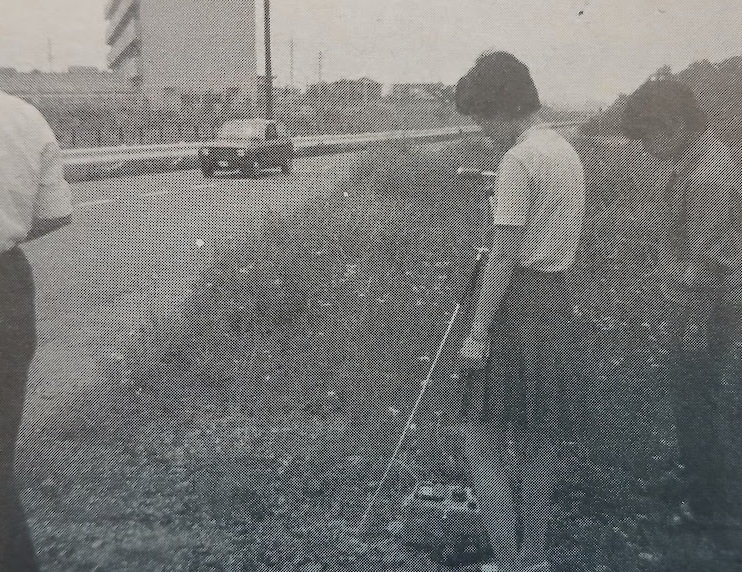
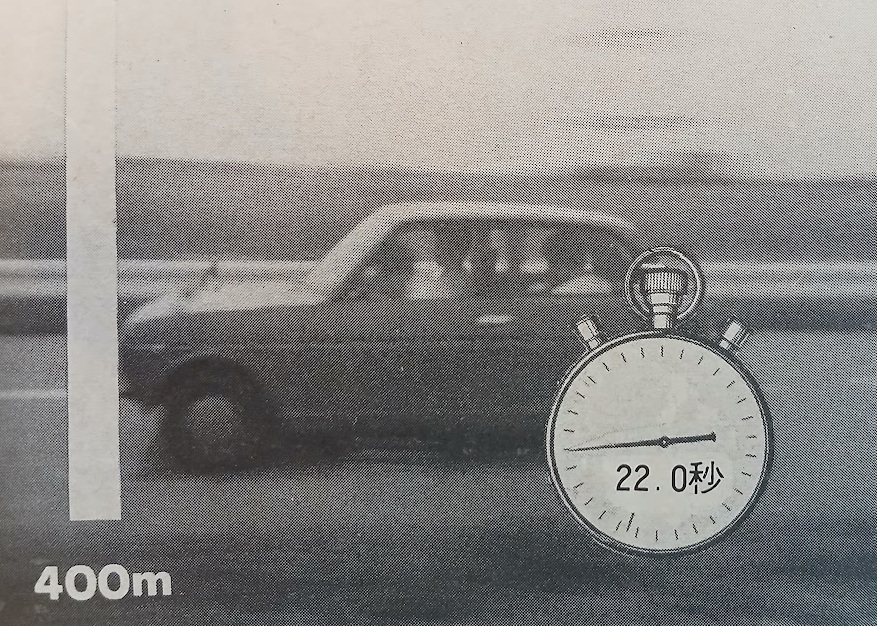
Furutani: First, in standing-start acceleration, the results were 0-50m in 5.6 seconds, 0-100m in 8.7 seconds, 0-200m in 13.7 seconds, and 0-400m in 22.0 seconds.
The 22.0-second time for 0-400m is the fastest figure we’ve recorded among the kei cars tested so far. As we were saying earlier, the engine revs very freely and the response is exceptionally good. Overall, though, the gearing feels rather low, and I thought it would be better if each gear carried the car a little farther.
Hoshijima: I agree on that point. First gear seems so low that you almost wonder whether they were too conscious of the fact that it’s front-wheel drive.
Okazaki: I drove it quite a lot on gravel roads, and I felt that having first geared that low was unavoidable to some extent. But I’d like to see second and third made a little taller.
Higuchi: When you’re driving out in the suburbs, you find yourself wanting a little more at the top end of third for overtaking. You finally get past someone, only to have them pass you again almost immediately. (laughs)
Magazine: Perhaps kei cars, of all things, ought to have 5-speed transmissions. (laughs)
Furutani: Another thing that bothered me was the long throw of the gear lever.
Ishikawa: We’d like to give some more thought to the length of the lever and other details…
Fuel Economy Holds Up at High Speeds
Magazine: How was the fuel economy?
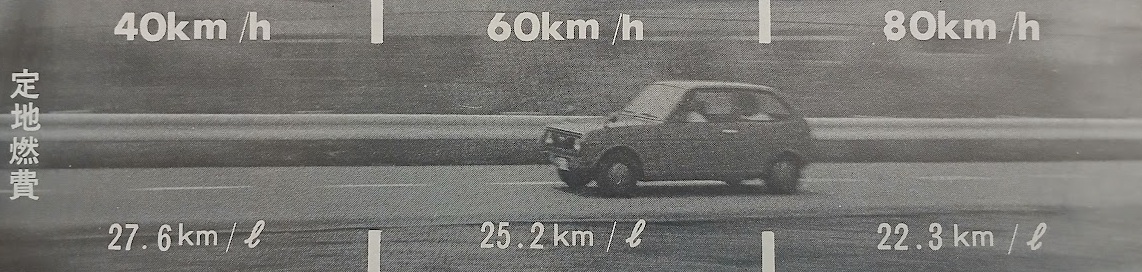
Sano: In the model driving-cycle test, with a target speed of 40km/h, the average speed was 22.3km/h and fuel consumption was 13.5km/l. With a 60km/h target, the average speed was 25.4km/h and fuel consumption was 11.5km/l.
The distinctive feature of the constant-speed figures is that, as you get into the higher-speed range, the fuel economy falls off less than it does with other kei cars.
Magazine: Why is the fuel economy so good at high speeds?
Shiraki: Since we’ve increased the power in the medium- and high-speed ranges, less throttle opening is required.
Magazine: Is the 11.5km/l figure in the 60km/h model driving cycle about average for a kei car?
Sano: It’s the best figure among the cars we’ve tested so far.
Magazine: It may be good for a kei car, but it’s about the same figure you’d get from a 1-liter car.
Sano: That’s true. But because of the test conditions, kei cars tend to produce rather poor figures.
Ishikawa: It’s a severe test cycle for a car without much power.
Magazine: Still, driving in Tokyo, they all have to keep up with the same traffic…
Hoshijima: I can’t help feeling that being a two-stroke makes it use more fuel, though.
Higuchi: But among the younger buyers you’re aiming at, I wonder how many are really concerned about fuel economy.
Magazine: A two-stroke may use more fuel, but at least it can get by on regular gasoline. (laughs)
Ride Comfort Varies Greatly with Tire Pressure
Magazine: Next, let’s have the suspension vibration and noise data.
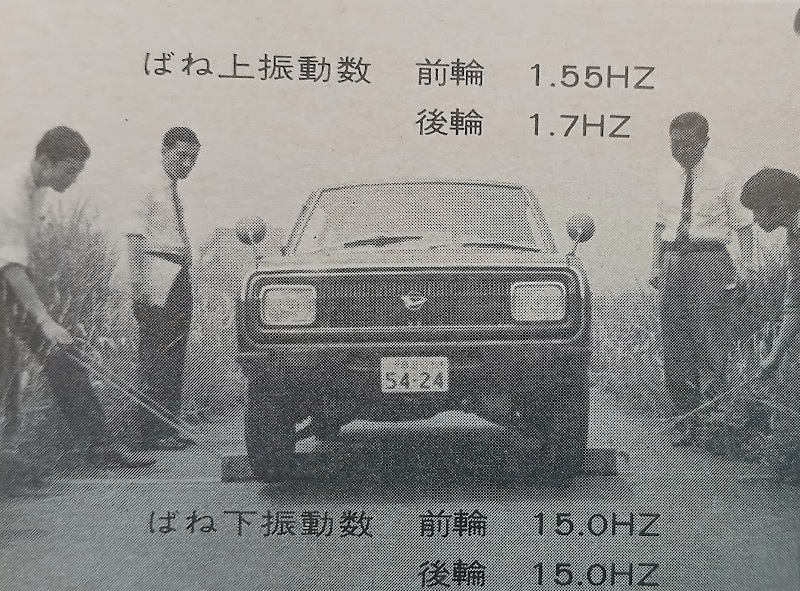
Nishiyama: The suspension vibration tests were carried out with the car fully loaded. At the front, the sprung-mass frequency was 1.5Hz and the unsprung-mass frequency 13–15Hz. At the rear, the sprung-mass frequency was 1.7Hz and the unsprung-mass frequency 15Hz.
As for noise levels, interior noise measured 71 phons at 40km/h, 77 phons at 60km/h, 79 phons at 80km/h, and 84 phons at 100km/h. Compared with the previous Fellow, the noise level is almost the same up to around 60-70km/h, but at higher speeds it is about 3 phons lower.
Ishikawa: We put a great deal of effort into making the car quieter, and in our own tests we’ve obtained a figure of about 81 phons at 100km/h.
Tateishi: The surface of the Murayama test course produces readings about 5 phons higher than an ordinary road at low speeds, and about 2-3 phons higher at high speeds. We take that into account in establishing a noise-level zone, but this car is just slightly above the upper limit of that zone. It is considerably quieter than the previous Fellow, though.
As for vibration and ride comfort, the front unsprung-mass frequency is about normal for this class, but the rear sprung-mass frequency seems a little high. On the other hand, the long wheelbase helps with pitching and so forth, and I think the ride is good overall.
Fujimura: As far as the vibration frequencies are concerned, we made the suspension somewhat firmer with our younger target buyers in mind, and also from the standpoint of handling and stability. But I don’t think the car is particularly firm overall.
Hoshijima: Perhaps saying this means I’m no longer young, but on roads where the old streetcar tracks are still in place, you certainly feel it.
Higuchi: I noticed it at railroad crossings.
Hoshijima: I’m beginning to think the manufacturers may have reached the point where they should reconsider this idea of making cars “for young people.” (laughs)
That is, I wonder whether it’s really young people who are buying them. Of course, young people naturally tend to be opinion leaders, but even with kei cars, I imagine there are quite a lot of owners in their thirties and forties.
Hirao: No matter how young the driver may be, it’s obviously better if the ride isn’t harsh. Is the point that something important would have to be sacrificed in order to achieve that?
Nishida: In our market research, 60% of those surveyed were in their twenties. With the previous Fellow, only about 30% of the buyers were in their twenties, whereas even with the present Fellow Max, roughly half of the owners are in that age group.
Hoshijima: In that case, I’ll withdraw what I said about their age. But even among these younger people, I have the feeling that more of them use the car for family purposes than drive it particularly hard.
Nishida: In Daihatsu’s case, our cars had previously been aimed too much at middle-aged buyers, which left us out of step with the overall pattern of demand and prevented us from achieving large sales volumes. That’s why we decided to focus primarily on younger buyers.
Ono: When we introduced this car, we were concerned about how the traditional “Daihatsu faithful” would react. It has been on sale for less than two months, but so far it seems to have been received surprisingly well by family buyers too.
Ishikawa: I fully understand Mr. Hoshijima’s point. But the suspension is only about 4% stiffer. In terms of frequency, I think the difference is only about 0.15Hz. So it really comes down to where we strike the balance between ride comfort, handling, and stability….
Hoshijima: The feel changes quite a lot depending on the tire pressures. I drove it with 1.8kg/cm² in front and 1.4kg/cm² at the rear, but the rear still felt rather harsh over bumps, so I lowered the pressure further. I didn’t find the front too firm.
Ishikawa: The specified pressures are 1.5kg/cm² at the front and 1.2kg/cm² at the rear.
Okazaki: When I drove the car at the press preview, the rear was bouncing so much that I checked the pressures. They were 2.1kg/cm² in front and 1.9kg/cm² at the rear. Once I set them to the specified pressures, there was no problem at all. So if you’re thinking particularly of younger owners, one thing you might do is explain tire-pressure adjustment to them in more detail as a simple means of tuning the car. It makes quite a big difference to the ride.
Higuchi: By feel alone, it’s quite difficult to distinguish between what is coming from the sprung and unsprung masses.
So even when the tire pressure is simply too high, there’s a danger of attributing the harshness to the spring rate instead.
Handling That Suppresses the Usual Front-Wheel-Drive Character
Magazine: Let’s move on to handling and stability.
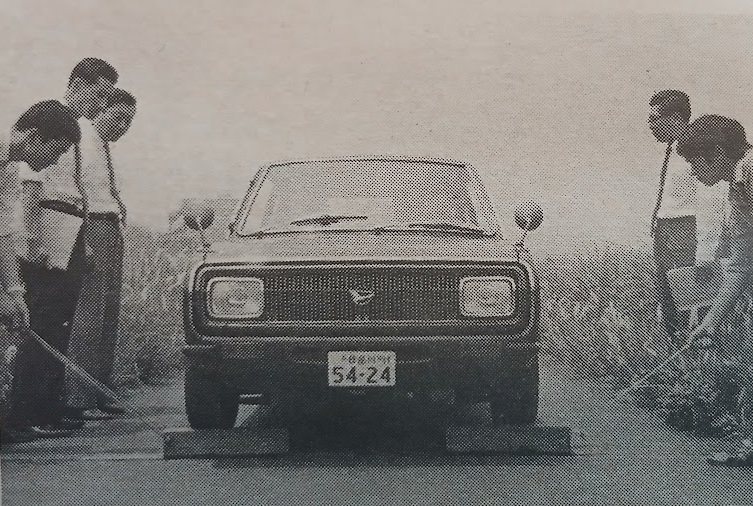
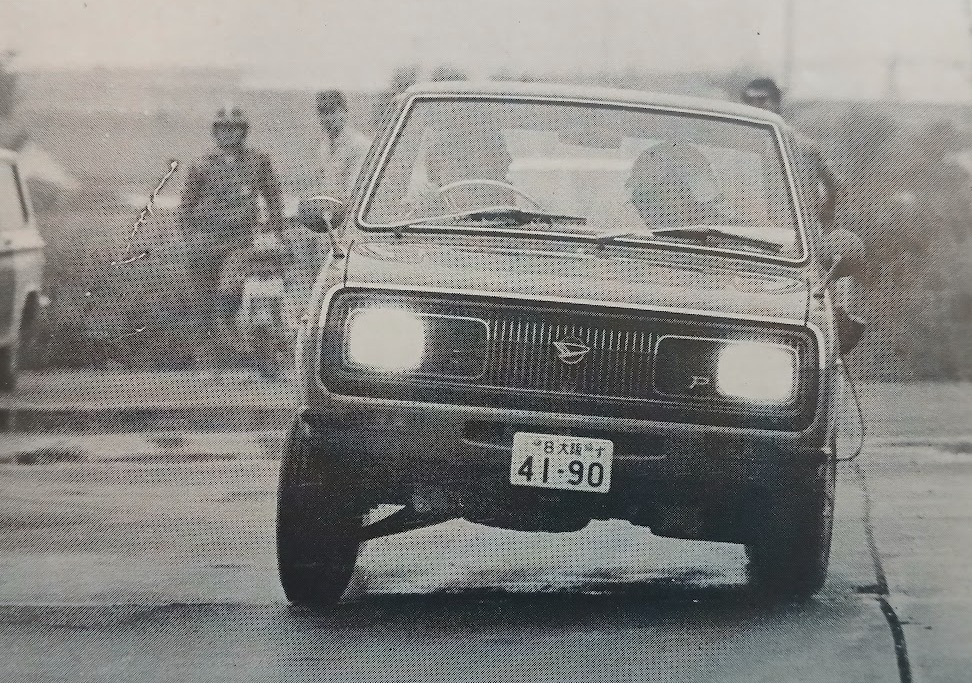
Saito: Since the degree of oversteer or understeer varies with the load distribution, we brought the wheel loads close to the design values for the tests. The loads were 178kg on the left front wheel, 197kg on the right front, 160kg on the left rear, and 152kg on the right rear, for a total of 687kg. Tire pressures were 2.0kg/cm² at the front and 1.6kg/cm² at the rear.
The measured minimum turning radius was 4.265m on the outside and 2.200m on the inside, only a very small difference from the catalog figure of 4.2m.
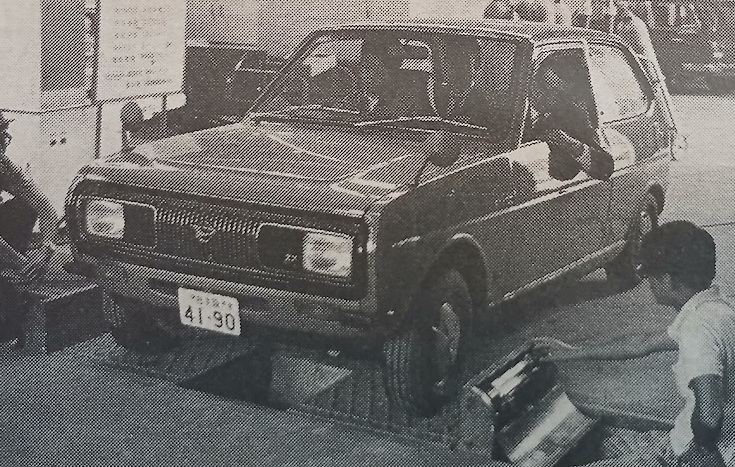
When we measured stationary steering effort, the road surface was wet. Turning to the right, the figures were 8kg at 90° and 10.5kg at 180°, levelling off at 10.5kg at both 270° and 360°. To the left, they were 7.5kg at 90°, 10kg at 180°, 12kg at 270°, and 13.5kg at 360°. Compared with the Subaru R-2, the figures are somewhat on the heavier side.
The basic oversteer/understeer characteristic is understeer. At V² = 100, R/R₀ is 1.26.
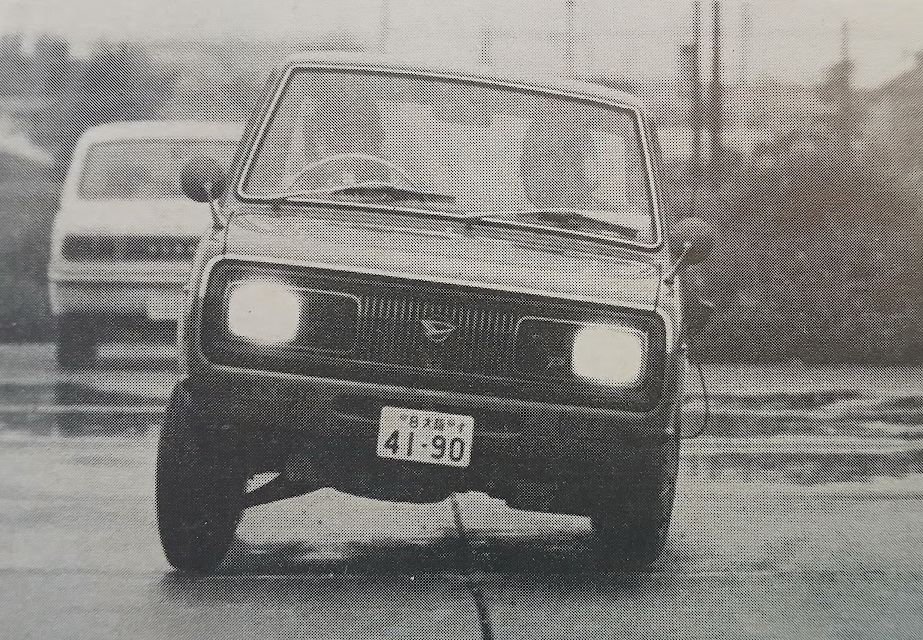
We measured the roll rate during steady-state circular cornering, both by calculation and from photographs. The calculated figure was 4.5°, while the photographic measurement gave 4.7°, so there is a slight discrepancy between the two. Subjectively, the roll stiffness feels high, which gives the impression that the roll rate is fairly low.
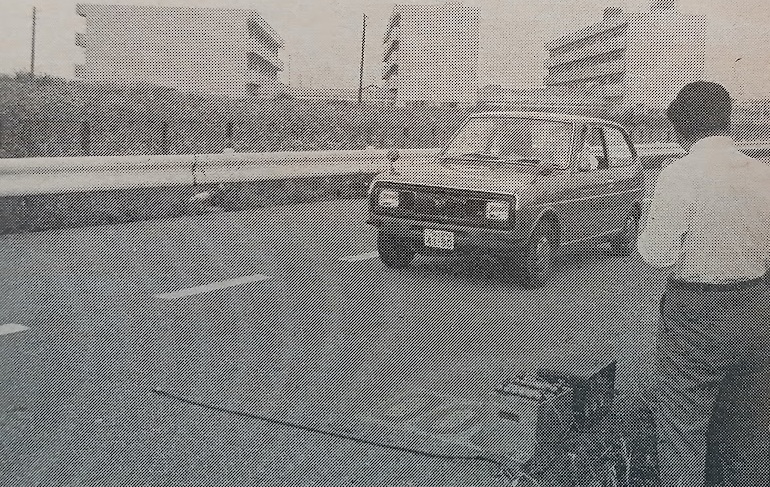
We tested hands-off stability up to a maximum of 110km/h, and the car is exceptionally stable. At 110km/h, the oscillation converges cleanly in about 3 to 3.5 cycles. Subjectively as well, I felt the stability was very good.
Nishigaki: Our own data gives a somewhat lower roll rate. As for the degree of understeer, compared with cars having a conventional drive layout and suspension, I think the change in R/R₀ is very progressive and stable. For reference, at a lateral acceleration of 0.3g, R/R₀ is around 1.33. The behavior up to that point is quite linear. A figure of about 1.33 represents slightly strong understeer.
Higuchi: You can’t compare the strength of understeer simply from R/R₀ alone. There’s also the relationship with the power available…
Nishigaki: That’s true. And it’s also frightening if the degree of understeer suddenly changes beyond a certain point.
Ishikawa: We took particular care to make the behavior through that transition as linear as possible, and I think we’ve succeeded reasonably well.
Hoshijima: For a front-wheel-drive car, it’s extremely “natural,” and it feels very good through corners.
In fact, if you approach it expecting it to behave like a front-wheel-drive car, you could almost say that because it lacks the frightening characteristics one associates with front-wheel drive, it also lacks some of the “fun.” (laughs)
For example, if you suddenly lift off the accelerator, it doesn’t tuck in toward the inside of the corner. We were discussing what might account for that, and someone even suggested that maybe the engine braking just isn’t very strong… (laughs)
Ishikawa: We built prototypes with both rear- and front-wheel drive, and ultimately decided to go with front-wheel drive. At that stage, one of the most important questions was what to do about the difference in behavior between power-on and power-off conditions while cornering. Our goal in that respect was to make the car behave as little like a front-wheel-drive car as possible.
Rather than it being a matter of the two-stroke engine, the key is the rate of change in toe-in. That’s the area we worked hardest on.
Hirao: I think the results of that effort are certainly there. If someone hadn’t been told, I don’t think they could tell that the car was front-wheel drive simply from the feel through the steering wheel.
Nishigaki: There are also subtle effects from such things as the way the subframe is mounted.
Okazaki: In the sense that it’s entertaining enough to drive without giving you any feeling of insecurity, I think you’ve done remarkably well with this wheelbase and track. Lowering the center of gravity—or, maybe, keeping changes in the center of gravity to a minimum—also seems to contribute considerably to the stability. There are some compromises, such as slightly limited ground clearance and a rather firm ride, but personally I’m pleased that priority has been given to stability on the road.
Nishigaki: Giving the car characteristics that would allow it to be driven dynamically and hard was certainly one of our objectives. But that also has to be considered in relation to noise and ride comfort, so finding the right balance among those factors was what concerned us most.
Okazaki: And because the rear suspension is semi-trailing-arm, there isn’t much rear-end lift even if you charge fairly forcefully into a corner. In that respect, it gives you a reassuring feeling when the car is driven roughly.
A Layout That Gives Priority to the Driver
Magazine: We suppose the semi-trailing-arm rear suspension represents a balance between cost and its advantages, but one can’t entirely escape the impression that it’s a sort of “mechanism accessory”…
Ishikawa: It wasn’t a matter of trying to pander to younger buyers by giving them every mechanical feature we could think of.
Fundamentally, we wanted to lower the center of gravity, and we also had considerable difficulty finding a place for the fuel tank. With the semi-trailing-arm layout, we were able to fit the 26-liter tank neatly between the arms and gain about 60mm in floor height.
As for the question of cost, it isn’t particularly expensive either. The mounting points do require considerable accuracy, though, so those areas are made very rigidly.
Ono: It’s a little extravagant, perhaps, but I think it’s a good thing from the user’s standpoint.
Hirao: I seem to remember being given almost exactly the same explanation for the thinking behind the Bluebird’s rear suspension. I suppose that really must be the reason, then.
Magazine: What were the results of the visibility measurements?
Hirata: With the seat in its central position, the visible area through the windshield was 88°, and the vertical field of view was 32°. Through the rear window, the visible area was 46.5° and the vertical field 13.5°. The windshield-wiper coverage was 63%, although there is a fairly large unwiped area in the center.
My impression from taking the measurements was that the interior rearview mirror is a little small. I’d like it to be somewhat wider. As for the wipers, I think it might be better simply to make the right-hand wiper blade a little longer.
Magazine: There doesn’t seem to be any precedent for using different-length wiper blades on the left and right, but dimensionally it would be possible, wouldn’t it?
Ishikawa: It would. We’d have to give some thought to the torque of the wiper motor, though.
Yamamoto: Overall, those are fairly reasonable figures. And for a kei car, I think the distance from the windshield to the driver’s eyes is quite good. If one wanted to be particular, a little more would be better still.
Magazine: Next, let’s have the dimensional measurements.
Onda: The most distinctive dimension is the overall height, which we measured at 1315mm—the lowest among comparable cars. At the same time, the 2090mm wheelbase is the longest. One consequence of making the car so low, however, shows up underneath: the ground clearance is limited. In particular, I think it’s a little tight around the front muffler.
As for the interior dimensions, the recent tendency has been to mount the seats lower in order to gain headroom. Since this car itself is low, the seats have been lowered even further. Perhaps as a result, the knee room in the rear is 155mm, which is a little cramped.
There is much more room for the driver, and the steering-wheel angle can also be adjusted to some extent, so there is a fair amount of freedom in choosing a driving position. The seat back, however—and this may partly be a matter of my own preference—felt a little too reclined, by nearly 5°. If possible, I’d like to see some simple means of making a fine adjustment.
The trunk was clearly an area that required a great deal of ingenuity, perhaps partly because it was one of the car’s selling points. Whether the trunk lid itself is particularly easy to use, though, is something open to discussion.
One thing that bothered me inside the car was that underneath the dashboard there are components hanging down, such as the turn-signal unit, that have nothing directly to do with the user. The fuse box is farther in behind them, so I found it rather strange that things like that should be hanging in front of it.
The wiring in the engine compartment is very neatly arranged, so that part of the interior struck me as being inconsistent by comparison.
And then there’s the glove-box lid. Is there any possibility of that coming off? It uses a very unusual kind of hinge.
Nishida: It’s polypropylene, and rather than using a separate hinge, we simply put a crease in the material itself. We’ve tested it for durability through about 100,000 opening and closing cycles.
A Difficult Trunk Lid
Hoshijima: The trunk is a little awkward to use.
Onda: If the whole rear panel lifted up along with the rear window, I suppose it would give the car the image of a light van.
Ishikawa: We had a great deal of discussion about that within the company as well. If we had used a van-type arrangement, we would have had to provide weather sealing around the opening. We considered points such as the effect that would have on rearward visibility and on head clearance in the fore-and-aft direction, the problem of waterproofing as the car grew older, and the rattling that might develop when it was locked shut. After considering all those factors, we settled for the time being on the arrangement you see here. Technically, there’s no particular difficulty in making the other type.
The final question that remained was whether the trunk lid itself should be hinged at the top or at the bottom. Each arrangement has its advantages and disadvantages, and ultimately we arrived at the current design.
Hoshijima: I think it would be all right if that lid simply opened farther upward. And maybe it doesn’t even need to be a choice only between opening upward and downward—couldn’t you consider having it open sideways, or even diagonally?
Onda: As for the driving position, the seat and steering column are set at the same angle, while the seat itself is angled inward by 4°. The intrusion of the wheelhouse isn’t bothersome. The tunnel does make the footwell feel somewhat narrow, but the dimensions are sufficient for a kei car.
Shiraki: Regarding the ground clearance beneath the front muffler, we’ve carried out extensive testing on rough roads, and we believe there should be no problem.
Ono: Perhaps it’s because of the wheelbase, but it doesn’t seem to strike the ground as often as you might expect.
Higuchi: As for safety, our assessment is based on those aspects of safety that can be checked visually. And since many safety devices are essentially accessory items, the result tends to be that more expensive cars, with more safety equipment, receive higher scores. Recently, most cars have been scoring in the seventies, and this one received 79 points. That’s a relatively high figure for a kei car.
Magazine: We haven’t talked about the brakes. What did you think of them?
Okazaki: In ordinary use, the brakes are very stable, helped by the performance of the tires. Even at high speeds, there’s almost no cause for concern.
If I had to point to one thing, you need to be a little careful about braking suddenly when climbing hills at high speed. With the car’s weight shifted toward the rear, the front wheels tend to lock rather easily. Generally speaking, though, the brakes are stable and easy to use.
Higuchi: You mean something like braking suddenly on a gravel road over a mountain pass?
Okazaki: No, I’m talking about higher speeds than that. In practical use, I don’t think it’s any problem at all. It would be something like braking while charging uphill at full throttle. (laughs)
Hoshijima: What’s the front-to-rear brake distribution?
Ishikawa: About 7:3.
Okazaki: The fact that there isn’t much weight transfer is an advantage under braking as well.
Hoshijima: Still, considering that it’s front-wheel drive, I have the feeling the front brakes could perhaps do a little more of the work.
Ishikawa: We thought we’d already increased the front proportion quite a lot.
Magazine: How is production going?
Nishida: We wanted to appeal not only to younger buyers but also to traditional Daihatsu customers, so rather than simply building up the equipment level in the conventional way, we created the Personal as a model with a character of its own. The Personal comes with the console as standard, and the installation rate for car stereos is also high—about 25% of the cars sold in April had them fitted.
The Personal has been selling so well that it’s given us the welcome problem of trying to keep up with demand. Right now, we’re still short of cars. Our production target is 15,000 units a month, but in May, because we couldn’t supply enough cars, sales were limited to 11,300. I think there’s still a great deal more to come.
Magazine: And as further variations, you have plans for an “SS” and a van, correct?
Nishida: Yes. We plan to introduce the SS shortly.
Magazine: That’s all for now…
Postscript: Story Photos