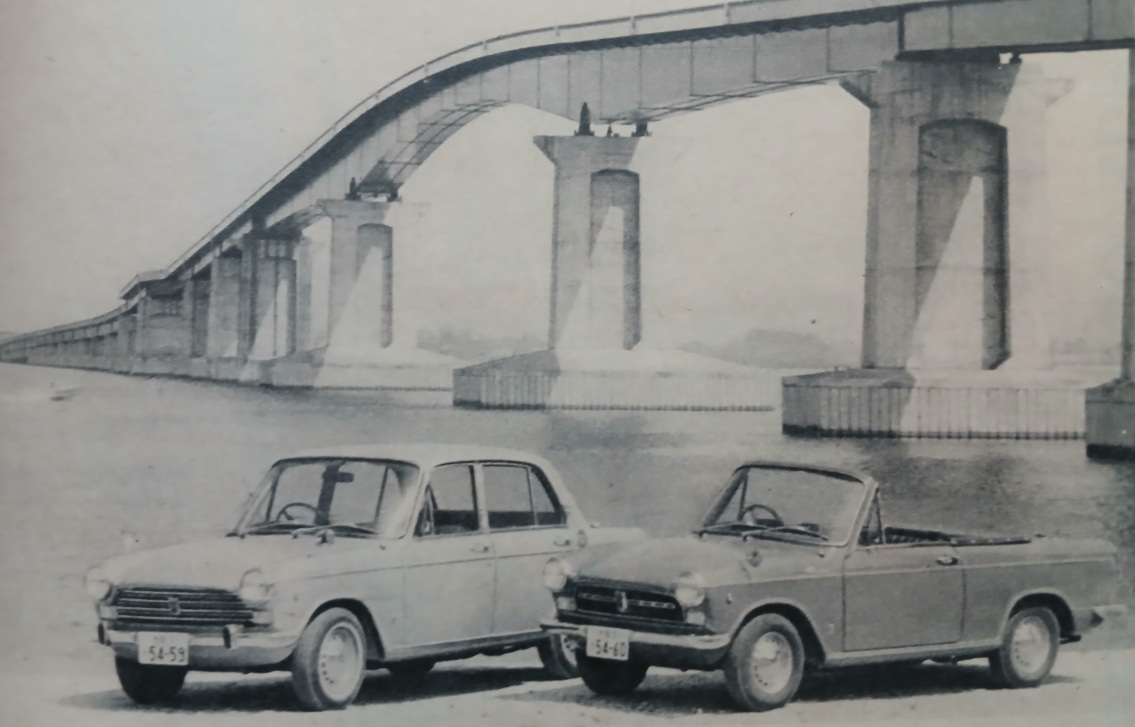
Daihatsu Compagno Spider (1967)
Publication: Motor Fan
Format: Test Drive Report
Date: October 1967
Author: Jun Todoroki
A Distinctive Convertible
There are surprisingly few convertibles in Japan.
This tendency may be due to such factors as the amount of rain and the slow progress in improving the roads, but there are times when one feels the urge to enjoy an open, carefree drive beneath a blue sky.
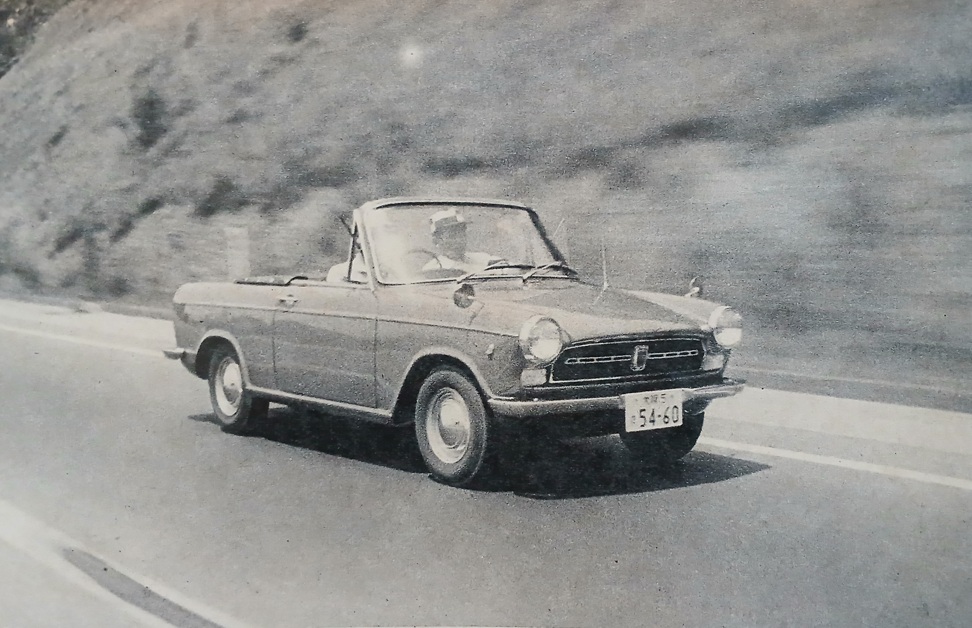
As one of these few convertibles, the Compagno Spider is ideally suited to exactly this purpose.
The fact that it seats four is also an advantage as a sporty car for a household that can own only one car.
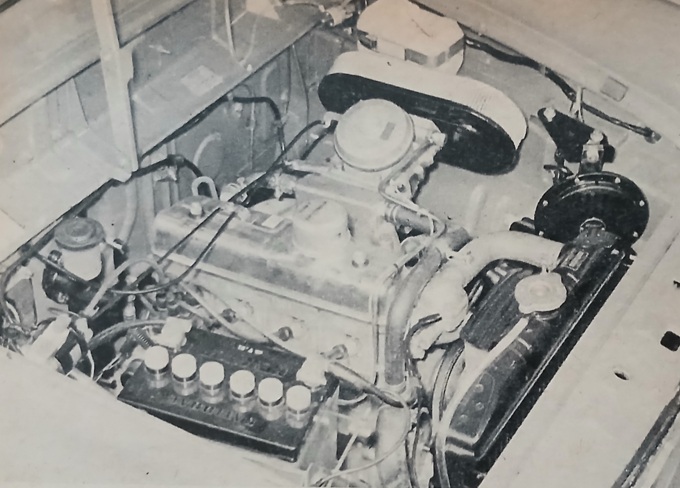
The engine is a 958cc, water-cooled OHV four-cylinder, with a compression ratio of 9.5 and an output of 65ps/6500rpm. Its specific output of 67.9ps/l is very high for this type of engine, and it could be said to be well matched to the 775kg body.
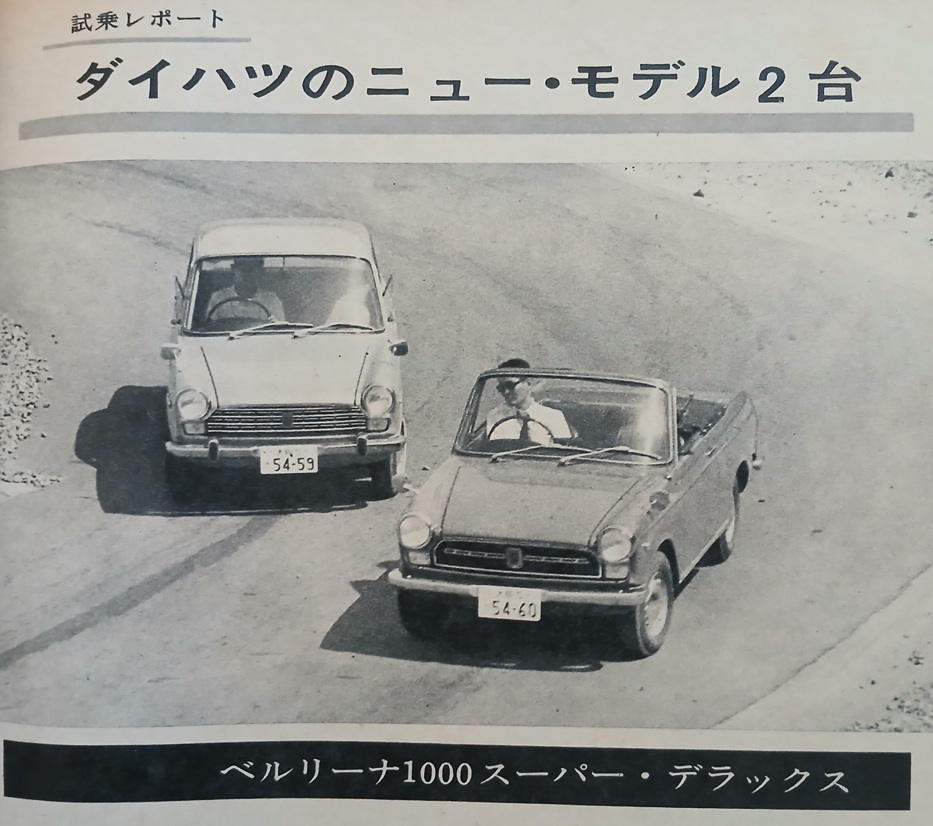
With this latest facelift, the grille has been widened and changed to a fine black mesh. At the center is a large emblem incorporating Daihatsu’s “D,” flanked by a straight-line bar design that gives the front a purposeful appearance. Changes have also been made to the interior and instruments, all apparently with improved safety as their underlying theme.
Newly Added Oil-Temperature Gauge
At 10:00am on July 28, a Compagno Spider in especially vivid Oriental Red appeared before the main entrance of Daihatsu’s modern headquarters in Ikeda, Osaka. The weather forecast reported a typhoon approaching the Korea Strait, but there was not the slightest sign of its effects. With clear skies and no wind, it was ideal weather for a drive.
I settled into the cockpit and looked over the instrument panel.
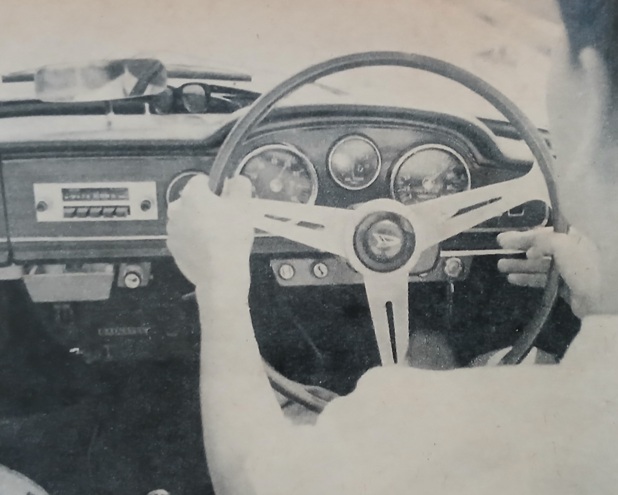
On the right is a large-diameter speedometer, and on the left, a tachometer scaled to 8000rpm, with a yellow zone beginning at 6500rpm and a red zone at 7000rpm. The speedometer is marked to 180km/h and incorporates the odometer, trip recorder, high-beam indicator, turn-signal indicator and charge warning lamp. Between these two large instruments, above the steering column, is a combination gauge incorporating an oil-pressure gauge.
Cars equipped with an oil-temperature gauge as standard are extremely rare in Japan. Previously, the Spider did not have one either; it has been newly added with the recent model change. Daihatsu explains the reason: “When we offered an oil-temperature gauge as an option, it proved quite popular and many owners had one fitted, so we decided to incorporate it as standard when the model was changed.” Since it allows constant monitoring of the oil temperature, whether in sporting driving or when crawling through city traffic, it is extremely useful for keeping track of the engine’s condition.
Controls That Quickly Become Familiar
To the left of the tachometer, nearest the passenger seat, is a combination gauge for fuel level and water temperature.
The panel is finished in a fairly dark wood-grain pattern, while all the gauges are round, with white markings on black faces and red needles. The fact that everything is unified in a sporting style is, of course, very pleasing to the driver. I should also mention that all the gauges use non-reflective glass.
The light switches are located at the far right of the panel, while the two-stage, pull-out type choke is mounted on the small auxiliary panel below. In some cars it is all too easy to switch on the wipers when intending to operate the lights, but the layout in this car is very good, and there seems little chance of making such a mistake.
The steering wheel is a Nardi type with metal spokes, although the rim is plastic rather than wood. Its position is somewhat lower than on earlier models, but it still seems to retain the slightly high-set feel characteristic of the Berlina series.
The gear lever is, of course, floor-mounted, with a conventional 4-speed pattern. A spring constantly pushes the lever toward the neutral position. The spring seems somewhat stiff, but the shift throws are consistent and the lever operates smoothly.
The various controls all have a feel that is extremely easy to get used to, with nothing offering any particular resistance. After only two or three minutes behind the wheel, one feels almost completely at home in the car.
Emphasis on Ease of Use
Leaving Daihatsu headquarters, I drove through Ikeda and on to the Toyonaka interchange through fairly heavy traffic.
The car provided to us had covered about 600km and was still virtually new, yet the engine revved up so smoothly that this was hardly a concern.
After ascending the beautifully laid-out clothoid ramp at the Toyonaka interchange, the Meishin Expressway stretched out ahead.
Pressing the accelerator hard, the car seems to leap forward in first and second gears, but from around 90km/h in third the acceleration begins to taper off. Judging from the time it takes for the revs to reach the red zone, the gap between second and third may be a little too wide.
The catalog gives the gear ratios as 3.678 in first, 2.334 in second, 1.481 in third and 1.000 in top, confirming that this impression was not only subjective.
Compared with a GT of 1500cc or more, the acceleration certainly does not feel tremendously strong, but this is unavoidable given the absolute difference in engine power. Keeping in mind that this is a 1000cc car, its performance can by no means be called inadequate.
From the standpoint of ease of use, it offers a sporting atmosphere while still being enjoyable for those without any particular driving skill, and in this sense it might be described as extremely flexible.
This is not the flexibility that comes with abundant power, but rather flexibility in the sense that anyone from a beginner to an experienced driver can easily enjoy sporting driving.
Even above 100km/h, there is no marked change in vibration or noise. With the top down, the airflow is also very well controlled, and there is no tendency to dishevel one’s hair.
The exhaust note certainly lives up to the pride that Mr. Kobayakawa, Daihatsu’s head of research, takes in it: light, resonant and with a splendid sporting tone. The driver, however, does not get to hear very much of it, so it seems almost more calculated to make an impression outside the car.
When shifting down from top at 100km/h, third gear slips into place easily thanks to the powerful synchromesh and smooth rise in revs, requiring only light double-declutching.
There is nothing particularly noteworthy about the shift feel, except that the overall pattern is somewhat large and the stroke correspondingly long. Each gear is selected smoothly, and clutch engagement is gentle.
Stable Cornering
I left the Meishin Expressway at the Kyoto-Minami interchange and drove into Kyoto. The heat, barely noticeable while traveling at speed, suddenly became intense on entering the city. In an open car, exposed directly to the blazing sun, summer driving can be quite unforgiving.
Heading north along Higashiyama-dori, I turned right at Hyakumanben and climbed a narrow but well-paved road, pleasantly shaded by trees. Before long, the gate to the Hieizan Driveway appeared on the left.
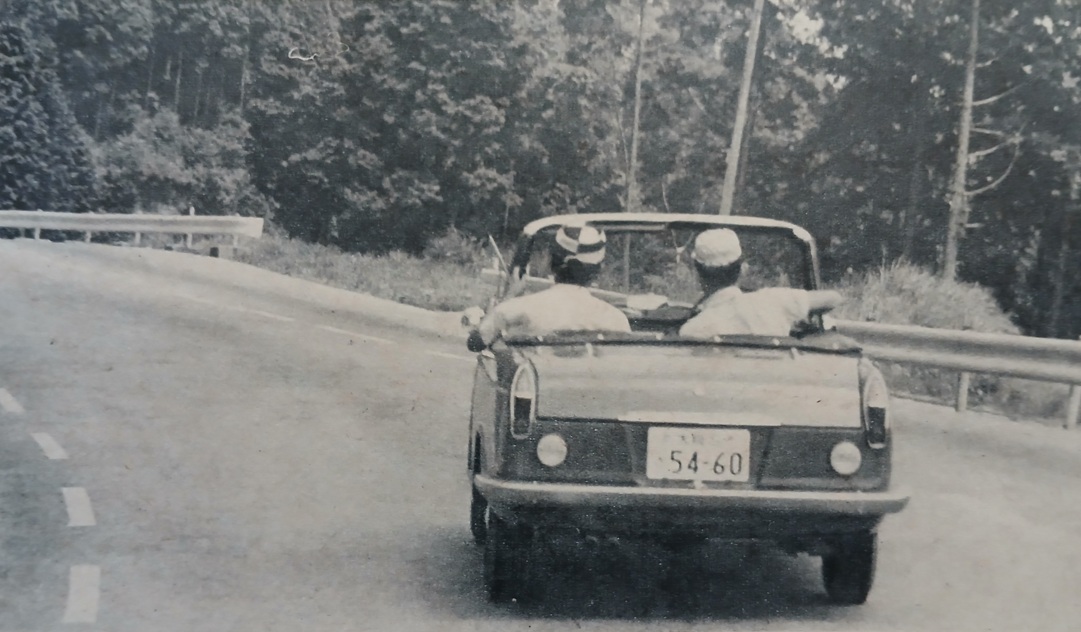
Perhaps because it was a weekday, there were hardly any other cars entering. It is an ordinary two-lane road, with one lane in each direction, but extremely well maintained and very pleasant to drive. The Spider had behaved smoothly enough in town, but on a mountain driveway it somehow comes alive like a fish in water.
Its handling is characterized by understeer, and there is little sense of roll even in tight corners. In curves where the Berlina Super Deluxe accompanying us showed pronounced body lean, the Spider held firm and cornered with ease. At times I tried charging into hairpins of around 40-50R at more than 60km/h, but the tires remained securely planted, with no lifting or skidding of the rear wheels.
Perhaps because of the highly rigid chassis, its cornering has a very “relaxed” feel to it. For someone used to the performance of 1500cc-class cars, however, it is somewhat unsatisfying, and one cannot expect the same sense of power while cornering. Particularly on an uphill stretch where the gradient becomes steeper partway through, speed falls off quickly, so delicate use of the accelerator and early downshifts are necessary; maintaining a constant speed requires a little knack.
From Ikeda to the parking area at Shimeigatake on the summit of Mount Hiei, I had driven about 90km without even a short break, yet felt no fatigue at all from the drive.
I’d Like to Heel-and-Toe, But…
The reclining seats, upholstered in black vinyl, hold the body very well, at least as far as the driver and front passenger are concerned. The backrests do not wrap around far enough to be called bucket seats, but because the car is so stable in cornering, there is no tendency for the body to be thrown side-to-side.
There is also plenty of legroom for a car in the 1000cc class, and the layout is such that no particular part of the legs becomes locally fatigued. The clutch pedal face is very close to the center tunnel, but its arm bends sharply to the right, leaving plenty of room in which to rest the left foot.
The accelerator pedal is elongated vertically, but not long enough to be called an organ-type pedal, which makes heel-and-toe rather difficult. The accelerator and brake pedals are close together, so I think that if the accelerator were extended downward another 3cm or so and hinged to the floor, it would be easy to brake while operating the accelerator with the heel of the right foot.
When entering a corner, braking and downshifting before going through under power, a car of this character makes one want to double-declutch smartly. With the present pedal arrangement, however, I found it somewhat difficult to blip the throttle to match the revs.
From the summit of Mount Hiei, the toll road continues on to Sakamoto on the western shore of Lake Biwa. This Oku-Hiei Driveway has even less traffic than the Kyoto side and is a splendid road, with occasional views through the greenery of Lake Biwa and the well-tended fields surrounding it.
Turning left at Sakamoto, I followed National Route 161 for about 10km to Katata, where a right turn leads to the toll bridge across Lake Biwa. The Biwako Ohashi is 2.6km long and spans the narrowest part of the lake; once across it, the Ritto interchange of the Meishin Expressway is only a short distance away.
Although I had already been driving hard for more than 100km, the fuel-gauge needle seemed to have hardly moved. This is true of any car, but the fuel gauge seemed to give very approximate readings—perhaps it is only intended as a rough guide.
The oil-temperature gauge, too, always indicated around 90°C, with no change at all whether climbing, crawling through city traffic or running at high speed. Of course, there was the proper amount of oil in the engine and I had not been driving particularly hard, so there was no reason why the reading should have changed. But if the oil-temperature reading is not particularly necessary in ordinary driving, perhaps the relatively responsive water-temperature gauge should occupy the most easily-seen central position, instead of putting the oil-temperature gauge there together with the oil-pressure gauge.
If I may make just one more complaint about the gauges, despite the trouble taken to use non-reflecting glass, I cannot help feeling that the bright chrome-plated metal gauge rings upset the balance of the whole arrangement. If these were also finished in matte black, the driver could drive without being bothered at all by reflections from the gauges….
It Can Be Made “Harder” with Optional Equipment
From Ritto back to Toyonaka, I tried driving at a faster pace again.
The ride feels little different from that of a normal sedan, making the car very comfortable over long distances. On the other hand, the youthful, sporting character one might expect to experience in a sports car is somewhat lacking. Still, if the car’s performance is considered in terms of the mood the manufacturer was aiming for, the intention is certainly well expressed. That intention can also be clearly seen in the styling, which is restrained and makes no attempt to be unconventional.
The engine is basically the same as that of the Berlina 1000, but for sporting use it is fitted with a Mikuni-made Solex carburetor, giving quick response. The exhaust manifold is also a dual type, pairing cylinders 1 and 4 and cylinders 2 and 3, with two separate pipes continuing toward the rear. For those who want an even more sporting car, optional equipment includes suspension modifications, Weber-type twin carburetors, an intake manifold for improved breathing, and disc brakes, so plenty is provided for those who find the standard car insufficiently sporting.
Because of the fine weather, I had no opportunity to use the top during the drive, and tried it only after returning to Daihatsu headquarters in Ikeda. Raising or lowering it is extremely easy: releasing the fasteners on the cover takes about 30 seconds, and setting up the top another 30 seconds or so. It can easily be handled by one person without requiring any particular knack.
Even with the top down, however, the rear seat is too narrow for two people to sit comfortably, while legroom is also decidedly cramped unless the driver’s seat is moved well forward. As a result, it is very much an occasional seat. With the top raised, there is an even greater sense of confinement from overhead, reinforcing this impression.
But this is not a car intended to carry four people over long distances. Rather, it should be understood as a 2+2: suitable for touring by a husband and wife with their children, or otherwise as a car that can seat four in a pinch without exceeding its legal capacity.
The Advantage of Seating Four
Surely, the fact that Daihatsu has made it possible to seat four people in a car with this amount of space and performance represents thoughtful consideration on the manufacturer’s part. Sporting cars have appeared one after another recently, yet most are two-seaters without even an occasional auxiliary seat, and there are strong calls for manufacturers to “at least make them 2+2s.” By comparison, Daihatsu’s approach is well suited to conditions in Japan, and one is inclined to think that the Spider deserves to sell better than it does….
One thing that struck me during this test was that, more than two years after the Compagno first appeared, detail improvements have clearly been made throughout, even in areas that are not easily visible. Perhaps this reflects the recent rapid growth in the number of people attracted to this kind of sporting character, and the manufacturer’s efforts to make the car easier to use and more considerate of their needs.
In any event, my impression from this test of the new Compagno Spider is that it is an affordable sporting car that is easy to handle and enjoyable to drive.
Postscript: Story Photos